
Why orphan care ministries ask for donor information is not a peripheral administrative question. It sits at the intersection of lawful stewardship, child-centered ethics, and the credibility of Christian witness in a field where emotion can easily outrun accountability.
Christian donors often feel the tension: the biblical mandate is clear, yet the modern orphan care movement has had to reckon with real abuses of trust. When a ministry requests a mailing address, employer name, spouse name, or a copy of a passport for an international trip, it can feel intrusive. The harder question is whether the request is ordered toward faithful care and sound governance, or whether it signals a ministry that has not learned the discipline of transparency.
Legal and accounting reasons are not optional
Tax receipting requires identifying information
In the United States, a ministry that receives charitable contributions has specific obligations if it wants to issue proper acknowledgments. For many gifts, the donor’s name and address are part of standard documentation, and the ministry must provide a written acknowledgment for any single contribution of $250 or more for the donor to claim a charitable deduction. The requirement is detailed in IRS Publication 1771 and related guidance on substantiation and disclosure rules (IRS).
Orphan care ministries often receive a high volume of year-end gifts, church collections, and recurring donations. Without consistent donor records, even well-intentioned organizations can fail at basic compliance, creating hardship for donors and exposing the ministry to avoidable reputational damage.
Restricted giving and designated giving create additional documentation needs
Orphan care donors frequently want to give to a specific program: family reunification, kinship support, trauma counseling, domestic adoption grants, or transition-to-independence services. Some ministries accept gifts to restricted funds; others cannot ethically or legally accept donor-controlled designations in the way donors assume. Either way, the more a gift is tied to a stated purpose, the more the ministry needs clear records that connect the donor’s intent to the organization’s accounting treatment.
This is one reason ministries ask for donor information even when a donor would prefer anonymity. Accounting standards, audit trails, and internal controls depend on knowing the origin, purpose, and acknowledgment status of funds. Mature ministries treat this as part of honoring the donor’s intent, not as bureaucracy for its own sake.

Protection of children and vulnerable families can require traceability
Child safeguarding pushes ministries beyond minimal compliance
Orphan care is not merely program delivery; it is work among vulnerable children and often vulnerable parents. Because exploitation can follow money, credible ministries build systems that make it difficult for bad actors to gain access, influence, or proximity. In practice, that can mean vetting visitors, tracking who funds what, and ensuring that no donor uses a gift to obtain special access to children.
Across our verification work at Most Trusted, the ministries that meet The Most Trusted Standard tend to treat traceability as a form of protection. When donor identity is unknown, it becomes harder to detect coercive patterns, inappropriate communications, or attempts to “purchase” relational access through giving. The request for donor information can be a sign that a ministry is unwilling to trade safeguarding for convenience.
International work adds legal complexity
Many orphan care ministries operate across borders or support partners who do. International transfers can trigger anti-money-laundering expectations, banking compliance questions, and partner due diligence. Donors sometimes experience this as an organization “asking too much,” but it is frequently the cost of operating lawfully and keeping partner organizations from being cut off by financial institutions.
When a ministry is handling mission trips, adoption-related travel, or overseas volunteer placements, it may request identification details for insurance, security protocols, and emergency response planning. These are not merely administrative preferences. They are part of the moral obligation to protect people placed under a ministry’s care.
Stewardship requires clarity about how ministries will and will not use donor data
Personal data can be used responsibly or exploited
Christian donors are right to ask why an organization needs information beyond what is necessary for receipting and safeguarding. Donor data can be used to serve donors well: accurate receipts, clear communication about impact, and the ability to correct errors quickly. It can also be used to pressure donors, sell lists, or create manipulative fundraising systems that turn generosity into a revenue strategy.
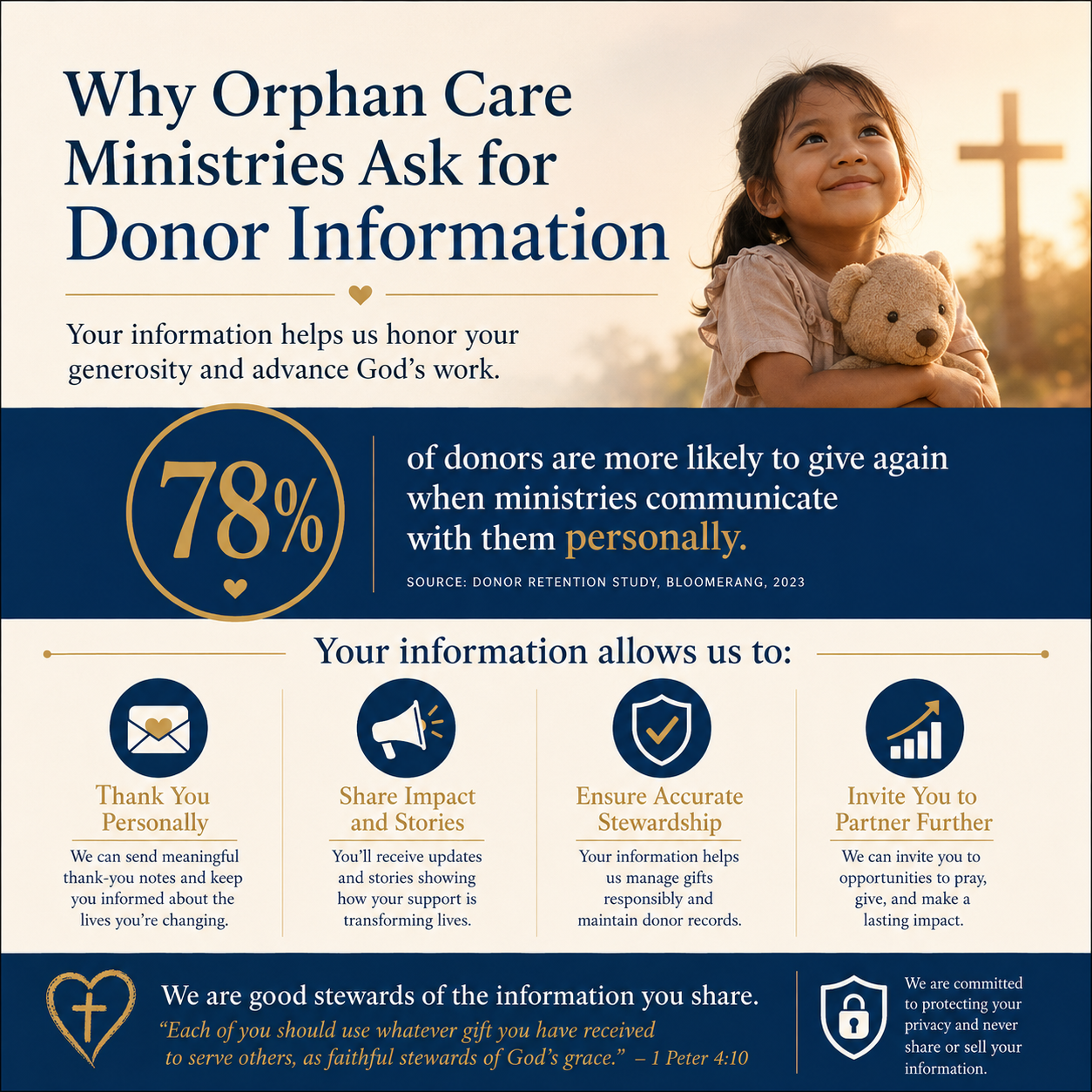
The field of philanthropy has long recognized that major gifts, planned giving, and donor-advised philanthropy require relational cultivation. The ethical question is not whether ministries communicate with donors, but whether their practices are truthful, proportionate, and respectful of conscience.
What we recommend donors ask before sharing more than basic details
When an orphan care ministry asks for donor information beyond a name and address, we recommend asking for a clear explanation tied to a policy. Mature organizations can answer without evasiveness.
- Which information is required for receipting, and which is optional?
- Will the ministry ever sell, rent, or trade donor lists, and where is that stated?
- Who inside the organization can access donor records, and how is access controlled?
- How long is donor data retained, and what is the process for deletion when appropriate?
- Can donors opt out of non-essential communications without penalty or relational pressure?
These questions are not suspicious; they are a normal exercise of stewardship. Jesus’s teaching about money consistently assumes moral seriousness rather than sentimentality. A ministry that handles donor information carelessly is rarely careful elsewhere.
Orphan care is uniquely susceptible to emotional fundraising
The field has had to reckon with incentives that can distort truth
Christians genuinely disagree about the best models of care in complex contexts, but there is broad agreement that children should never be used as fundraising instruments. Orphan care has historically attracted powerful storytelling, and sometimes the story has been allowed to outrun reality. This is one reason donor information becomes part of the conversation: the same systems that track donor records also shape how ministries report outcomes, attribute impact, and resist exaggeration.
It is also why credible ministries avoid practices that bind a donor emotionally to a specific child through financial sponsorship while blurring what the money actually funds. Some sponsorship models can be honest and protective; others create a marketing relationship that places a child’s privacy at risk. Ministries that ask for donor information should be equally prepared to explain how they protect the child’s identity and dignity.
Good data practices signal a larger commitment to truthfulness
Most donors are not asking for perfection. They are asking for candor: what the ministry can verify, what it cannot, and how it knows what it claims. The same discipline that produces accurate donor receipts should also produce accurate program reporting. The credibility of Christian witness is not served by inflated numbers, curated anecdotes that hide failure, or vague claims that cannot be traced to evidence.
For donors who want to think more broadly about the responsibilities that come with giving to ministries serving vulnerable children, we maintain editorial and evaluation resources connected to Orphan Care Ministries. Christian generosity is strengthened when it is joined to careful discernment.
How Most Trusted evaluates donor data and stewardship practices
What strong ministries tend to document
Most Trusted exists to help Christian donors give with confidence by evaluating ministries against The Most Trusted Standard, a 15-criteria framework across Faith Foundation, Financial Integrity, Governance and Leadership, and Transparency and Effectiveness. Donor data practices touch several of these criteria because they reveal whether an organization can be trusted with what does not belong to it.
In our review work, stronger ministries tend to have clear, accessible policies that address privacy, data security, and donor intent. They do not hide the ball. They can explain why they collect certain data, how it is protected, and how a donor can limit communications without losing access to receipts or required disclosures.
Practical warning signs donors should take seriously
Some patterns consistently correlate with weak governance. A ministry may not be disqualified by one concern, but multiple signals should prompt caution and further inquiry.
Warning signs include unwillingness to share a privacy policy, vague statements about “partners” who handle donor data, pressure to provide unnecessary personal details, or fundraising appeals that imply a gift purchases access to a child. Another concern is a ministry that cannot explain how restricted gifts are tracked and reported. These issues sit within the same stewardship ecosystem as accurate tax receipting and honest reporting.
Donors who are focused on the practical mechanics of receipts, acknowledgments, and stewardship expectations in this space often benefit from reviewing the broader landscape of Tax Receipts and Stewardship for Orphan Care Donors. The goal is not to become suspicious, but to become clear-eyed.
FAQs for Why orphan care ministries ask for donor information
Is it normal for a ministry to require my address for an online gift?
Yes. A mailing address is commonly used for accurate receipting, donor record integrity, and required written acknowledgments for certain gifts. If you want to minimize sharing, ask whether the address is required for receipting or simply requested for marketing preferences, and confirm how you can opt out of non-essential communications.
Should we give a ministry our employer name or additional personal details?
Sometimes it is reasonable, but it should be explained. Employer information may be relevant for matching gifts, corporate giving documentation, or internal controls tied to major gifts, but it should not be treated as mandatory for ordinary donations. If the ministry cannot clearly explain why it needs the information, how it will be used, and how it will be protected, it is prudent to decline and reassess the organization’s governance maturity.
A faithful ministry treats donor information as entrusted property
When orphan care ministries ask for donor information, the best reason is stewardship: to comply with law, protect children, and tell the truth about how funds are received and used. Christian donors should not be shamed for asking careful questions, and ministries should not be defensive about answering them. The church’s care for the fatherless is too important to be sustained by sentiment alone; it requires the quiet disciplines of integrity that make trust durable.



