
How to give stock to orphan care ministries is, first, a question of stewardship before it is a question of mechanics. Appreciated securities can become a disciplined way to fund durable, family-centered care without triggering unnecessary tax friction, especially when a donor’s portfolio has grown faster than cash flow.
Christian donors also carry a distinctive moral responsibility in orphan care. Scripture is unambiguous about God’s concern for the fatherless (Psalm 68:5), but the modern orphan care movement has had to reckon with hard realities: institutionalization can harm children, incentives can drift, and well-meaning generosity can finance the wrong model. A stock gift is not spiritually neutral simply because it is tax-efficient; it must be directed toward work that protects children and strengthens families.
Why stock gifts often fit serious Christian stewardship
Giving appreciated assets can increase mission impact without increasing household strain
For many mature donors, the question is not whether to give, but how to give without diminishing long-term capacity. Donating appreciated stock held more than one year generally allows a donor to give the fair market value and avoid capital gains tax, while the ministry receives the full value when it liquidates. That structure can effectively turn unrealized gains into immediate care: family reunification services, domestic adoption support, trauma-informed foster care, or job training that stabilizes vulnerable households.
Because tax law changes and personal situations vary, we treat this as a planning conversation rather than a slogan. Most donors will want to confirm the expected deduction rules and limitations with a CPA or tax attorney, and to coordinate with their brokerage so the transfer is executed correctly and acknowledged properly.
Orphan care funding decisions are never only financial
Christian donors genuinely disagree about the best delivery model for orphan care in complex contexts. Some countries restrict international adoption. Some regions lack competent foster systems. Some children have no safe kin network. The harder question is not whether the need is real, but whether a given ministry is measurably moving children toward safe, permanent family care whenever possible.
Across our verification work at Most Trusted, the ministries that meet The Most Trusted Standard tend to show clarity on outcomes, sober risk management, and an unwillingness to keep children in institutions simply because donor dollars flow more easily that way.

Confirm the ministry can receive stock and handle it with integrity
What to ask before you initiate a transfer
Not every ministry is equipped to receive securities directly. Some rely on a brokerage account in the ministry’s name. Others use a third-party service that accepts securities and sells them. Either approach can work, but the questions are similar: Will the ministry provide written transfer instructions? Who is the point of contact? How quickly are shares liquidated after receipt? What controls prevent an individual staff member from handling transactions without oversight?
Governance matters here. A stock gift is a financial instrument, and ministries should treat it with the same seriousness they bring to restricted gifts, child protection standards, and field operations. If a ministry cannot clearly explain its process, that is not necessarily malice, but it is a signal to slow down.
Use a simple due diligence checklist
The goal is not to interrogate faithful leaders. The goal is to honor donors’ responsibility to give wisely and to protect the children the ministry serves. Before transferring shares, we recommend verifying:
- The ministry is a recognized 501(c)(3) in good standing and can issue a compliant acknowledgment
- Stock transfer instructions are written, current, and include DTC number, account number, and registered account name
- A designated staff member can confirm receipt promptly, and a second leader provides oversight
- The ministry has a clear policy for liquidating securities and recording gift value
- Program model aligns with family-based care and child safeguarding best practices
If your giving is specifically focused on orphan care, it is often helpful to keep the larger mission context in view. Many effective ministries sit at the intersection of child welfare, poverty alleviation, and church-based family strengthening. The best ones can articulate that integration without drifting into vague claims.
Execute the stock transfer carefully and document it well
How the mechanics typically work
In most cases, you will initiate the transfer through your brokerage using the ministry’s DTC instructions. You are transferring shares, not cash. A common error is selling the stock first and then donating the cash proceeds, which can trigger capital gains tax that a direct share transfer would likely avoid.
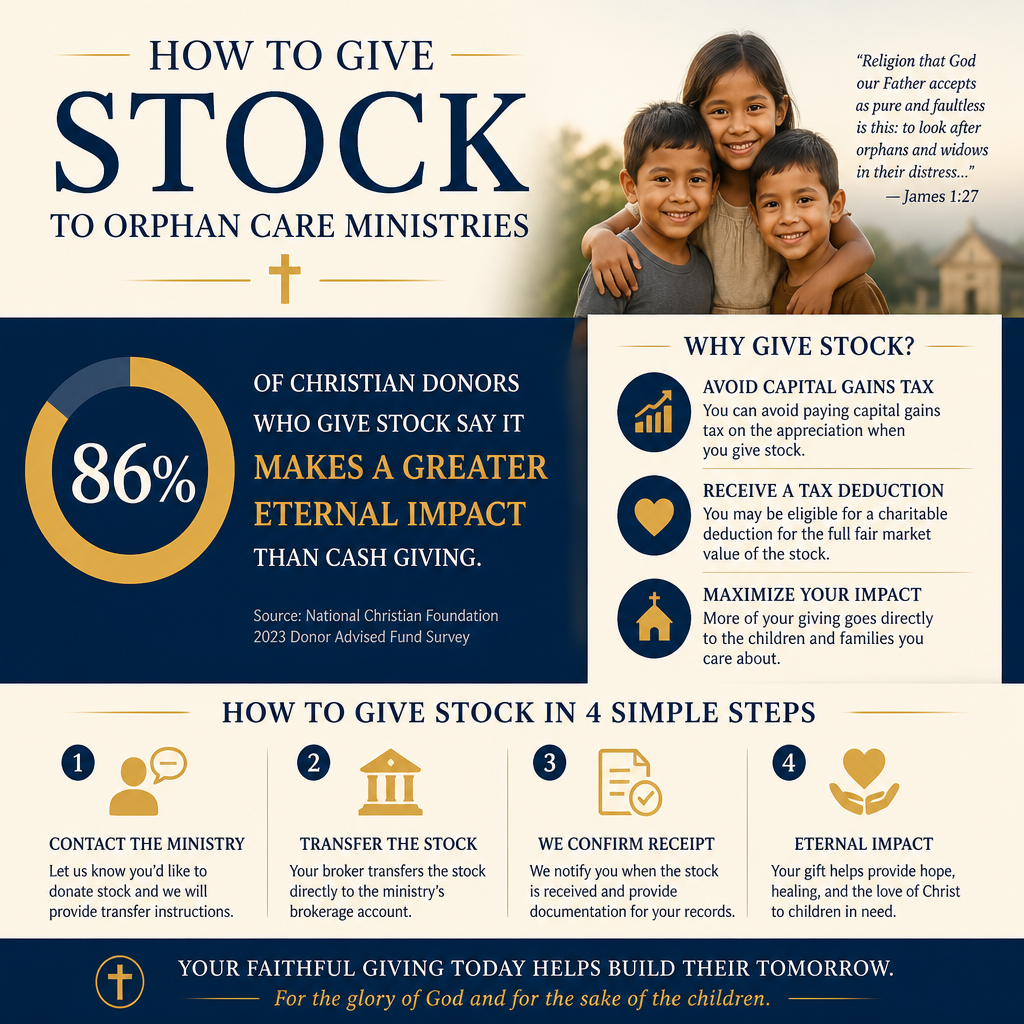
Because brokerages and timelines differ, donors often coordinate three parties: their brokerage, the receiving brokerage or service, and the ministry’s finance contact. The ministry’s role is usually limited to providing accurate instructions and confirming receipt. Your role is to initiate the transfer and keep records that match what your broker shows.
How gift receipts work for stock
For noncash charitable contributions, the ministry’s acknowledgment should state the date of receipt, describe the donated property (for example, “200 shares of XYZ Corp”), and confirm whether any goods or services were provided in exchange. The ministry generally does not state the dollar value on the receipt for publicly traded securities; donors determine fair market value based on IRS rules and brokerage documentation.
For larger noncash gifts, additional IRS documentation can apply, including Form 8283. Donors should consult their tax advisor for thresholds and substantiation requirements. The aim is not paperwork for its own sake, but faithful compliance and clarity.
Many donors who give stock also plan their giving calendar with intention. If you are managing year-end giving or multiple designated gifts, placing stock giving within a broader stewardship approach can reduce errors. For donors working through documentation and compliance questions, the category on Tax Receipts and Stewardship for Orphan Care Donors addresses common patterns we see and how to prevent avoidable friction.
Direct the gift toward orphan care that is demonstrably responsible
Prefer family-based care and measured outcomes over compelling images
Orphan care is unusually vulnerable to emotional fundraising. Images of children can move donors quickly, and ministries sometimes feel pressure to show visible “rescue” stories rather than the slower work of reunification, foster placement, adoption support, or economic strengthening for families at risk. Donors can respond by asking for the kinds of outcomes that indicate real child well-being: permanency, stability, school continuity, and safeguarding practices.
The field’s evidence base increasingly recognizes that children generally do best in families rather than institutions when safe family care is available. The United Nations has stated that poverty should never be the sole justification for removing a child from parental care, reflecting a global shift toward supporting families rather than filling beds in residential facilities United Nations.
Watch for incentive problems that donors unintentionally create
The most difficult stewardship problems are rarely about one dishonest leader. They are about incentives. A ministry can become financially dependent on residential care, and then subtly resist reunification because reunification reduces donor-visible need. Another ministry may underinvest in safeguarding because it assumes spiritual sincerity is a substitute for professional practice.
The When Helping Hurts framework, articulated by Steve Corbett and Brian Fikkert, has helped many Christian donors see how good intentions can create dependency or displace local responsibility if we do not design help with humility and accountability Moody Publishers. Orphan care giving benefits from the same discipline. We do not fund institutions simply because they exist; we fund what measurably protects children and strengthens families.
Donors looking to evaluate ministries with this kind of seriousness often benefit from an independent lens. Most Trusted exists to help donors give with confidence by evaluating Christian nonprofits against The Most Trusted Standard—criteria that include faith foundation, financial integrity, governance and leadership, and transparency and effectiveness. For the larger landscape of this work, see Orphan Care Ministries.
Decide whether stock giving belongs in your long-term generosity plan
When stock gifts are especially fitting
Stock giving tends to be especially appropriate when a donor holds highly appreciated shares, wants to maintain cash reserves for family obligations, and desires to increase giving without reducing long-term capacity. Some donors also pair stock gifts with disciplined recurring cash giving, keeping the household budget steady while using appreciated assets for larger strategic gifts.
Donors with significant stock holdings may also consider donor-advised funds or charitable trusts as part of an integrated plan. Those instruments can be useful, but they add administrative layers and should be chosen for genuine planning reasons rather than for appearances. A straightforward stock transfer to a vetted ministry is often sufficient.
How to align tax wisdom with spiritual formation
Jesus’ warnings about money are not limited to those who are overtly greedy. Wealth can form our instincts quietly, shaping our sense of security and control. A stock gift can be one concrete practice of loosening our grip, turning growth we did not “need” into mercy we can offer. But the discipline does not end when the transfer is complete; it continues in how carefully we ensure the gift serves the good of children and honors the gospel.
FAQs for How to give stock to orphan care ministries
Should we sell the stock and donate the cash, or donate the shares directly?
In most cases, donating the shares directly is cleaner because it may avoid capital gains tax and allows the ministry to receive the full value after liquidation. Selling first can create a taxable gain before the gift is made. Because individual circumstances vary, we recommend confirming the best approach with a qualified tax advisor before executing the transaction.
Can we restrict a stock gift to a specific orphan care program?
You can request a designation, but it should be done carefully and in writing, and only when the ministry can responsibly track and honor the restriction. Overly narrow restrictions can unintentionally hinder a ministry’s ability to respond to child placement needs, safeguarding requirements, or changing conditions in-country. A strong practice is to designate to a program area (for example, family reunification services or foster care support) while allowing reasonable flexibility for child welfare and compliance.
Giving stock with confidence in orphan care
A stock gift can be an act of clear-eyed generosity: tax-wise, administratively sound, and directed toward work that protects children rather than perpetuating systems that harm them. The responsibility is twofold—execute the transfer carefully, and choose ministries whose model, governance, and outcomes reflect the moral weight of caring for the fatherless. When those elements align, appreciated shares become something better than a financial asset: they become an instrument of mercy ordered by truth.



