
What Scripture says about caring for orphans is neither obscure nor optional. Across the canon, God binds care for fatherless children to his own character, and he treats neglect of the vulnerable as a spiritual crisis before it is a social one. For Christian donors, the question is rarely whether orphan care matters; it is how to give in ways that are both biblically faithful and demonstrably safe for children.
That tension is real. The modern orphan care movement has had to reckon with hard evidence that some well-intentioned interventions can fracture families, incentivize unnecessary separation, or reinforce institutions that do not serve children well. Christian giving is not only about compassion; it is about stewardship, truth-telling, and the patient work of doing good without doing harm.
God identifies himself with the fatherless
Care for orphans is grounded in the nature of God
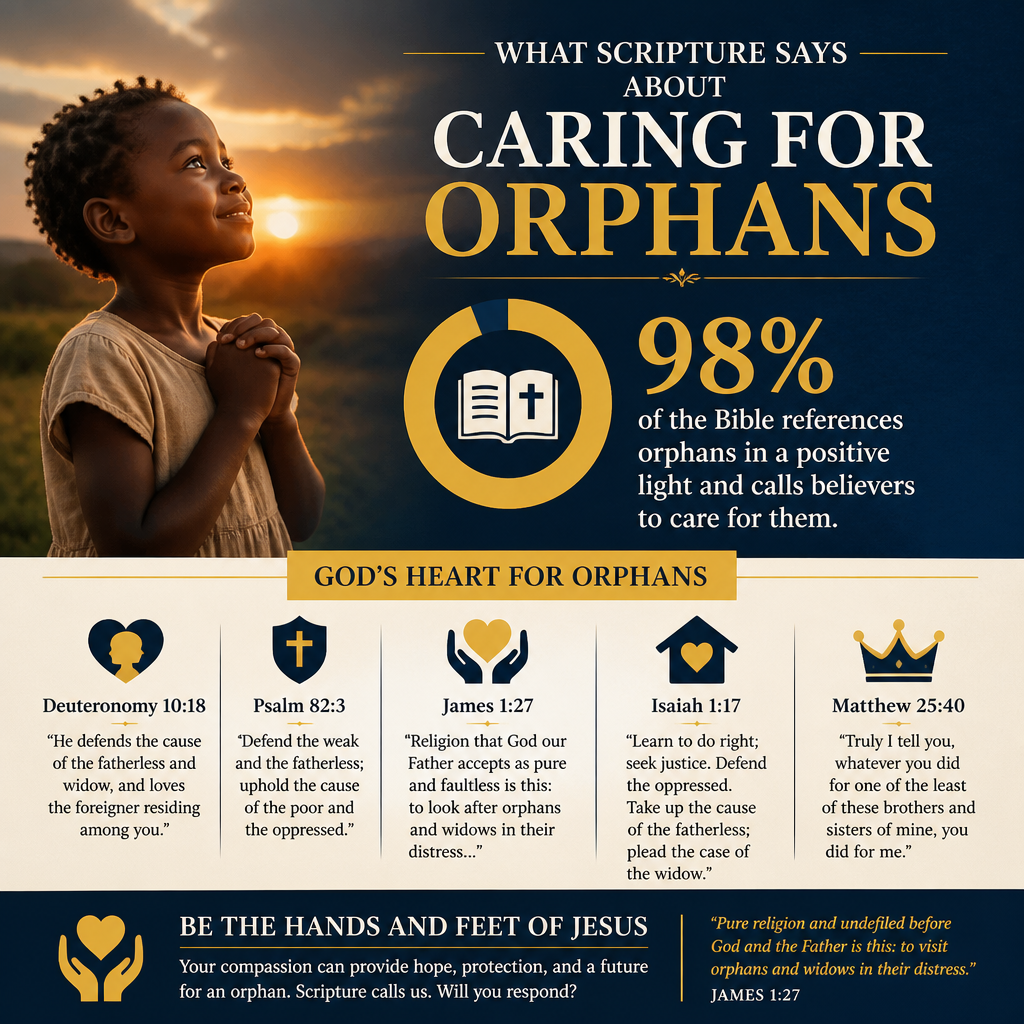
Scripture does not introduce orphans as a peripheral concern. God names himself as “Father of the fatherless” (Psalm 68:5), placing his protective authority where human protection is absent. The law’s repeated concern for “the sojourner, the fatherless, and the widow” is not sentimental; it is covenantal. Israel’s faithfulness was tested by whether the community’s economic life and courts were safe for those with the least power.
That is why the prophets treat oppression of the fatherless as a litmus test of spiritual integrity. Isaiah’s call to “seek justice, correct oppression; bring justice to the fatherless” (Isaiah 1:17) sits beside denunciations of hollow worship. When the fatherless are exploited, the problem is not merely inadequate charity; it is disordered religion.
Scripture binds worship to mercy
James states the connection with disarming clarity: “Religion that is pure and undefiled before God… is this: to visit orphans and widows in their affliction” (James 1:27). James does not reduce the Christian life to social action; he insists that devotion to God takes visible shape in costly mercy. “Visit” is not a drop-in gesture. It is a word of presence, responsibility, and ongoing regard.
For donors, this matters because “orphan care” can become a brand category detached from the moral texture Scripture requires. The biblical call is not to fund whatever is moving. It is to align resources with God’s protective concern, especially where a child’s welfare is at stake.

Scripture also warns against harm done in the name of good
The biblical ethic includes prudence, not only compassion
Christian donors are rightly moved by suffering, but Scripture’s moral vision includes discernment. Proverbs commends knowledge and wise counsel; Jesus warns that zeal without truth can be destructive. In orphan care, prudence is not a concession to secular professionalism. It is a form of love that refuses to gamble with children’s futures.
The modern field has learned that not every program labeled “orphan care” actually serves orphans, and not every institutional solution protects children. The research consensus is particularly strong that young children raised in institutional settings face serious developmental risks, which is why many child welfare agencies emphasize family-based care over long-term residential care. Donors do not need to become specialists, but we do need to recognize that the biblical mandate does not sanctify any particular model by default.
When incentives distort compassion
A difficult reality is that money can create perverse incentives. When donor dollars flow primarily to beds filled in institutions, organizations may be tempted to prioritize occupancy over reunification, kinship placement, or family strengthening. Scripture’s repeated warnings about unjust gain are not theoretical. They apply wherever vulnerable people become a means to a financial end.
For that reason, we recommend donors ask questions that are both theological and operational: Does this ministry pursue what is best for the child, even when that path reduces fundraising narratives? Does it honor the child’s family when reunification is possible? Does it have the humility to submit to child protection standards that constrain “ministry creativity” for the sake of safety?
The New Testament expands the category beyond institutions
Adoption theology shapes Christian practice
Paul uses adoption to describe salvation itself: believers “received the Spirit of adoption” (Romans 8:15). That doctrine does not romanticize adoption; it dignifies belonging. God does not merely rescue; he places, names, and inherits. For Christian donors, adoption theology presses us to care about durable family attachment, not only short-term relief.
This is where many donors feel the weight of competing goods. International adoption has transformed lives and reflects profound Christian conviction. It has also faced serious scrutiny where weak oversight enabled coercion or fraudulent paperwork. Christians genuinely disagree about how to weigh these realities across countries and eras. What Scripture requires is not naïveté; it is fidelity expressed in truthfulness and costly protection of the vulnerable.
Hospitality and kinship are spiritual disciplines
The New Testament’s vision of community involves tangible, household-level mercy: hospitality, generosity, and shared life. Many children who are functionally orphaned are not legally orphaned; they may have extended family, a surviving parent under strain, or kin who can care for them with support. A biblical approach does not default to separation when preservation is possible.
In practice, this means donors should not equate “orphan care” with “orphanages.” Strong ministries often prioritize family strengthening, kinship care support, foster care recruitment, trauma-informed services, and reunification. These approaches can be less emotionally straightforward for fundraising, but they are often closer to the New Testament’s emphasis on embodied, relational care.
What responsible orphan care giving requires from donors
Stewardship applies to child welfare outcomes
Because Scripture binds mercy to integrity, donors should care about evidence, governance, and safeguards. This is not distrust; it is the appropriate seriousness of giving on behalf of children. A mature donor posture asks whether a ministry can demonstrate that its interventions reduce harm and increase stability over time.
Across our verification work at Most Trusted, we observe that the ministries that meet The Most Trusted Standard tend to treat child protection as a governing responsibility, not a program detail. They invest in policies, training, reporting channels, and independent oversight even when those measures are costly and slow. They also communicate plainly about what they can and cannot prove, rather than leaning on emotionally compelling stories alone.
Concrete questions that separate worthy work from risky work
The following questions help donors translate biblical concern into wise action:
- Does the ministry prioritize family preservation and reunification when safe, or does it default to long-term residential placement?
- Are there written child safeguarding policies, background checks, and clear reporting pathways for abuse allegations?
- Does the organization avoid “voluntourism” patterns that create repeated attachment and loss for children?
- Is there financial transparency that shows how funds are used, especially for overseas programs?
- Does leadership invite external accountability, including local child welfare authorities where applicable?
These questions are not secular add-ons to a spiritual mandate. They are expressions of the biblical insistence that the vulnerable must not be further harmed by the powerful, even unintentionally.
Scripture’s mandate meets modern complexity in the local church
Giving should strengthen the body, not outsource obedience
Orphan care often exposes a subtle donor temptation: outsourcing the church’s calling to distant institutions. Yet Scripture consistently situates care for the vulnerable within covenant community. Donors can and should fund specialized ministries, but healthy giving also strengthens local ecosystems—foster families, respite care, counseling, legal advocacy, and material support that keeps families intact when poverty is the primary threat.
What this means in practice is that donors may need to hold two commitments together: supporting excellent direct-service organizations and resourcing the church’s capacity to welcome children and families over the long haul. The most credible ministries are often those that work in partnership with local churches while maintaining professional child welfare standards.
Choosing ministries with verifiable integrity
Because “orphan care” can include everything from adoption grants to family preservation to residential care, donors need a framework that accounts for theology and for operational trustworthiness. The Most Trusted Standard evaluates ministries across Faith Foundation, Financial Integrity, Governance and Leadership, and Transparency and Effectiveness. This kind of due diligence is not a replacement for prayerful discernment; it is one way we honor Scripture’s call to faithful stewardship.
Donors exploring specific approaches will benefit from reviewing the wider landscape of Orphan Care Ministries, especially as the field continues to shift toward family-based care and stronger safeguarding expectations. Many donors also ask how biblical texts should shape giving priorities; that conversation belongs within Biblical Foundations for Orphan Care Giving, where Scripture’s moral logic is taken seriously rather than used as a slogan.
FAQs for What Scripture says about caring for orphans
Does the Bible command Christians to support orphanages?
Scripture commands care for the fatherless, but it does not prescribe one institutional form. The biblical burden is protection, justice, and belonging for children without adequate family care. In today’s context, that may mean supporting foster care, kinship care, reunification services, adoption when appropriate, and child safeguarding systems. Donors should evaluate whether a particular orphanage or residential program is truly necessary, time-limited, and demonstrably safe, rather than assuming the label guarantees faithfulness.
How can donors honor Scripture and still insist on strong oversight?
Insisting on oversight is a way of honoring Scripture. The Bible repeatedly condemns exploitation of the vulnerable and calls God’s people to truthful weights, honest leadership, and justice in the gates. Strong governance, financial transparency, and child protection safeguards are modern expressions of those ancient moral requirements. Donors should not feel pressured to choose between compassion and accountability, especially when children bear the risk of failures.
A biblically faithful approach is both tender and exacting
What Scripture says about caring for orphans is clear: God’s people must protect the fatherless, pursue justice, and embody a community where the vulnerable are not used. The harder work is refusing simplistic solutions and funding ministries whose compassion is matched by safeguarding, truthfulness, and measurable commitment to children’s long-term flourishing. Christian donors are not called to fund sentiment. We are called to participate in God’s protecting love with integrity.



