
How to give wisely to orphan care ministries is not mainly a question of sincerity. For Christian donors, it is a question of stewardship under a clear biblical command, pursued with the sobriety that comes from knowing that good intentions can still produce harm.
Scripture is unambiguous about God’s concern for children without protection. God identifies himself as “Father of the fatherless” (Psalm 68:5). James describes care for “orphans and widows in their affliction” as “pure and undefiled religion” (James 1:27). Yet the modern orphan care field has had to reckon with difficult realities: institutional care can damage children, family separation can be incentivized by funding, and outsiders can mistake visibility for effectiveness. Wise giving does not retreat from the mandate; it insists on truthfulness about what actually serves a child’s long-term good.
Start with a biblical definition of the good you seek
Christian donors often begin with compassion for a child’s immediate need: safety, food, education, protection from exploitation. Those needs are real, and responding is an act of mercy. The harder question is what kind of intervention most often restores what Scripture assumes children ought to have: stable, faithful, long-term care within a household, and the social belonging that makes formation possible.
Across the orphan care movement, research has consistently highlighted the risks of large-scale institutionalization. A major analysis of the Bucharest Early Intervention Project found significant developmental harms associated with institutional care and documented improvements when children were placed in family-based settings; it remains one of the most cited bodies of evidence in the field (Bucharest Early Intervention Project).
Prefer family preservation and kinship care when safely possible
When family preservation is possible without exposing a child to abuse or severe neglect, it is often the most humane and culturally coherent form of care. This does not romanticize broken systems or minimize situations where removal is necessary. It recognizes that poverty is not the same as abandonment, and material crisis is not the same as parental unfitness. Ministries that invest in emergency support, case management, counseling, and community-based protection can prevent unnecessary separation and serve children with less disruption.
Be clear about when residential care is justified
Some children cannot safely remain with their families, and some communities lack functional foster care systems. Residential care can be a temporary refuge when it is trauma-informed, protective, and oriented toward reunification or long-term family placement. The moral issue is not whether a building exists; it is whether the ministry’s model keeps children in institutions because it is financially convenient, or moves them toward stable family life as quickly as responsible practice allows.
Ask whether evangelism is integrated with protection
Christian donors rightly care about gospel proclamation. Wise giving, however, refuses a false choice between spiritual and physical wellbeing. A ministry can be doctrinally orthodox and operationally harmful. We should expect that a biblically faithful orphan care ministry will speak truthfully about its limits, collaborate with child protection professionals, and submit its practices to moral scrutiny rather than defensive rhetoric.

Evaluate the ministry model before you evaluate the story
Orphan care communication often centers the child’s image and the donor’s emotional response. That is understandable; children’s vulnerability is not theoretical. But giving wisely requires moving from the story that moved us to the model that will shape a child’s life.
One of the most persistent confusions in the sector is the assumption that “orphanage” equals “orphan.” UNICEF has long emphasized that many children living in residential care have at least one living parent, and that poverty and family crisis are frequent drivers of placement (UNICEF). That reality does not make residential care illegitimate in every case. It does mean donors should treat “we serve orphans” as a claim that needs definition: legal orphan status, functional abandonment, or temporary family separation.
Clarify what the ministry is funding
Some donors intend to fund adoption, foster care development, kinship support, family reunification, or independent-living preparation. Others intend to fund a residential home. Those are different strategies with different risk profiles. Wise giving begins by asking the ministry to describe its theory of change in plain language: what problem it is solving, for whom, by what means, and what outcome would count as success in five to ten years.
Scrutinize practices that can unintentionally incentivize separation
Per-child sponsorship models can be an effective funding mechanism, and many ministries manage them honorably. The risk is structural: when donations are tied to bed count or a child’s continued placement, the ministry may face pressure—often unspoken—to keep children in care longer than necessary. A credible organization mitigates that pressure with clear reunification goals, independent oversight, and financial structures that reward permanency rather than institutional occupancy.
Reject ministries that treat visiting teams as a core program
Short-term visits are not inherently wrong. They can serve legitimate purposes: training, professional consultation, construction oversight, or church-to-church relationship. But when frequent volunteer teams are central to the ministry’s identity, children can become relationally exposed to repeated attachment and loss. Wise donors ask how a ministry protects children from “voluntourism” dynamics, what safeguarding rules exist, and whether visitors are limited to roles that do not create repeated emotional bonding with children.
Demand verifiable transparency, not reassurance
In orphan care, transparency is not a marketing preference; it is an ethical requirement. Children cannot advocate for themselves, and donors are not on the ground to observe what daily life actually looks like. The ministries most worthy of support treat documentation as part of their moral duty, not as a concession to skepticism.
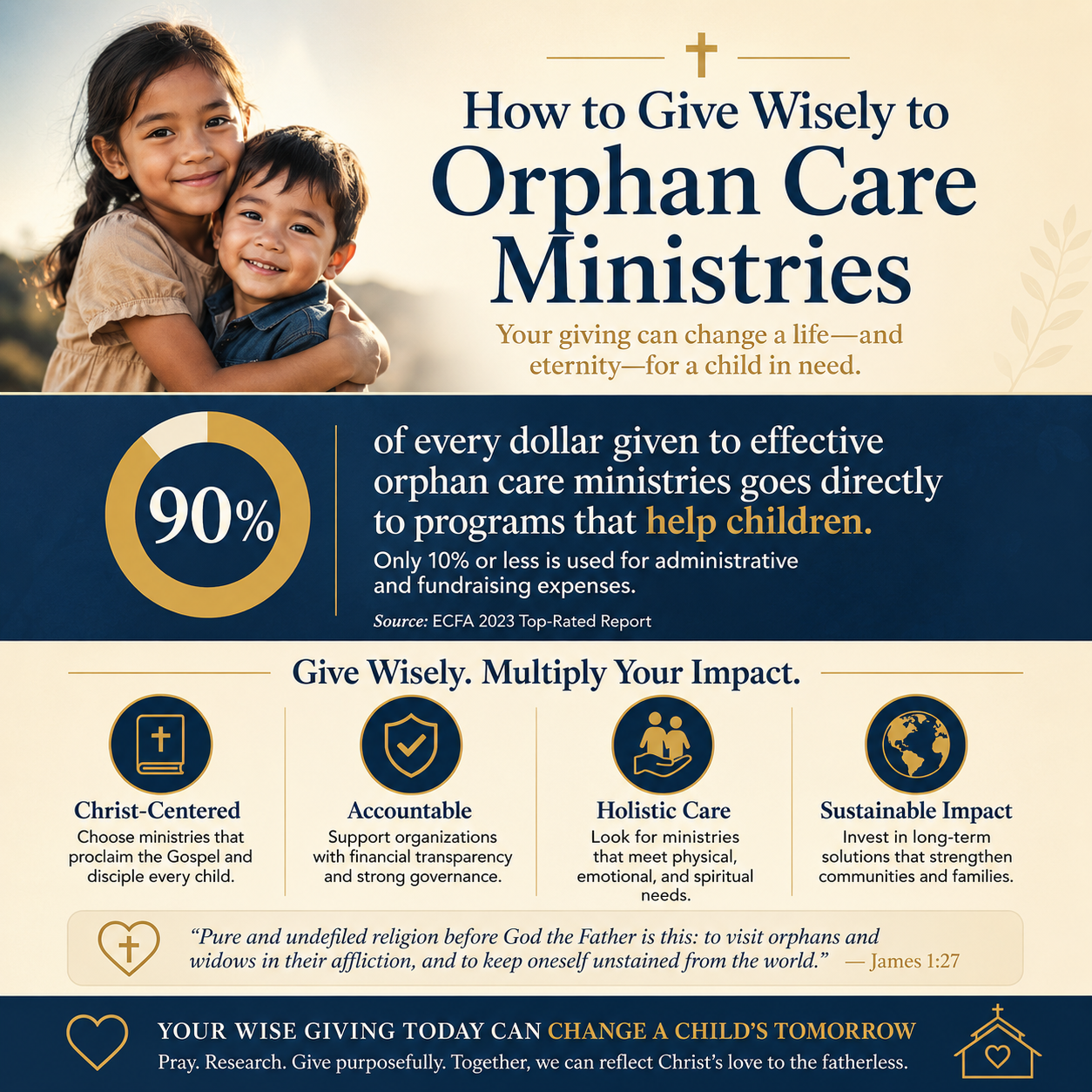
Across our verification work at Most Trusted, we find that donors are often shown powerful narratives while being given very little operational evidence. Wise giving insists on a different standard: documents, policies, audits, and measurable outcomes that can be checked by an outside party. This is the logic behind The Most Trusted Standard, which evaluates ministries across faith commitments, financial integrity, governance, and demonstrated transparency and effectiveness.
What documents a mature ministry should readily provide
Donors should expect, at minimum, current financial statements and governance disclosures, along with written child-safeguarding policies. Depending on the context, that may include background check protocols, visitor policies, incident reporting procedures, and training requirements for staff and volunteers. A ministry may not be able to share identifying details about children, and it should not. But it should be able to share policies, oversight structures, and aggregated outcomes without defensiveness.
Financial transparency should include an independently prepared audit when the organization’s size and complexity warrant it. The Evangelical Council for Financial Accountability has articulated widely respected expectations for transparency and board accountability among evangelical nonprofits (ECFA). Not every faithful ministry is an ECFA member, but the standards provide a useful benchmark for what seriousness looks like.
How to read impact claims without cynicism or naivete
Orphan care outcomes are difficult to measure because the desired goods are long-term: attachment, educational attainment, reduced vulnerability to exploitation, healthy adult relationships, and sustained faith formation. The research is mixed on which metrics best predict long-term flourishing across cultures, and ministries operate in environments where data systems may be limited.
What this means in practice is that donors should look for coherence rather than perfection. Are the ministry’s claimed outcomes plausible given its staffing and budget? Do reported results include denominators and time horizons, not just success stories? Does the organization acknowledge setbacks—failed reunifications, disruptions in foster placements, staff turnover—alongside successes? Mature accountability sounds like truth, not triumph.
Give in ways that strengthen governance and reduce risk
Wise giving is not only about selecting the right mission; it is about funding the conditions that make good care sustainable. In orphan care, the greatest risks often emerge from weak governance: concentrated authority, inadequate oversight, undertrained staff, and a culture that treats questions as disloyalty.
Christians genuinely disagree about how much administrative capacity a ministry should build, and donors often fear funding “overhead.” Yet major philanthropic evaluators have warned against simplistic overhead ratios as a measure of worth; the widely circulated “Overhead Myth” letter argued that outcomes and transparency matter more than a single cost percentage (Candid GuideStar). For child-serving ministries, this is especially relevant: safeguarding, supervision, training, and independent review all require real investment.
Prefer organizations with credible, accountable leadership
Healthy governance is not a bureaucratic accessory. It is one of the primary ways power is limited for the sake of the vulnerable. Donors should ask whether the board is independent of the founder, whether conflicts of interest are disclosed, and whether financial controls separate authorization, custody, and recordkeeping. Where possible, donors should look for evidence of local accountability in the country of operation, not only Western oversight from afar.
Fund the unglamorous essentials
Wise donors sometimes do more good by funding staff training, case management systems, social worker salaries, trauma-informed care coaching, or legal services for permanency planning than by funding visible projects. Buildings and gifts photograph well. Stable adult care, consistent supervision, and careful documentation protect children. Ministries that resist funding for these essentials often do so because they assume donors will not pay for what they cannot easily see.
Use restricted giving carefully
Restricted gifts can protect donor intent, but they can also distort priorities and create cash-flow instability. If a ministry has earned trust, unrestricted or lightly restricted support often strengthens the organization’s ability to respond responsibly to child protection needs as they arise. When donors do restrict a gift, it should align with the ministry’s actual strategy: funding reunification, foster family development, or safeguarding systems, rather than inadvertently underwriting longer institutional stays.
For donors seeking a wider view of the field, including how we assess ministries against The Most Trusted Standard, we encourage engagement with Orphan Care Ministries as a category where these questions of theology, evidence, and accountability converge.
Wise giving is protective love under truth
Orphan care ministries invite some of the most tender forms of Christian compassion, and also some of the most complex moral trade-offs. Giving wisely requires more than goodwill; it requires insisting on models that strengthen families where possible, protect children where necessary, and submit leadership and finances to verifiable accountability. The ministries most worthy of sustained support tend to welcome these questions, because they understand that protecting children requires light, not sentiment.



