
How orphan care ministries use donations is not a peripheral question for Christian donors. It sits at the intersection of biblical obligation, modern child welfare realities, and the moral weight of stewardship before God. Scripture is unambiguous about God’s concern for the fatherless (Psalm 68:5), and James does not treat care for vulnerable children as optional charity but as evidence of living faith (James 1:27).
What is less simple is determining whether a particular ministry’s spending actually strengthens children and families—or unintentionally reinforces the very systems that separate children from them. The orphan care movement has had to reckon with hard data about institutionalization, the incentives created by sponsorship funding, and the difference between compelling stories and verifiable outcomes. Donors deserve a clear account of where dollars go and what those dollars are accomplishing.
Orphan care funding is morally urgent and operationally complex
Most donors ask first about a percentage: “How much goes to the children?” The question is understandable, but it can flatten a complex reality. In orphan care, the right spending pattern depends on the ministry model—family preservation, foster care support, kinship care strengthening, domestic or international adoption services, residential care, or a combination. A healthy ministry can have different cost structures in different countries, and even within one country, depending on whether it operates programs directly or through vetted local partners.
Christian donors also carry a particular burden of conscience. Jesus’ warnings about wealth and hypocrisy make us wary of sentimental giving that substitutes emotion for discernment. Yet Scripture’s call to mercy also resists cynicism. The question is not whether administration exists; it is whether governance and controls prevent drift, protect children, and keep spending aligned with mission.
Across our verification work at Most Trusted, we see that ministries worthy of confidence typically do three things consistently: they define the child protection and care model they are funding, they document how funds flow through that model, and they report outcomes that can be evaluated by outsiders. What this means in practice is that a donor’s best questions move from “How much overhead?” to “What care model is being funded, and what safeguards and results accompany it?”
Institutional care has measurable risks
The modern field has largely moved away from treating large-scale institutions as a default solution, even when donors prefer the clarity of “beds and meals.” A widely cited meta-analysis in Child Abuse & Neglect concluded that children in institutional care face substantially higher risks across multiple domains compared with family-based care; the review synthesizes evidence on developmental delays and mental health harms tied to institutional settings (ScienceDirect journal page).
This does not mean every residential program is automatically illegitimate. Some children require short-term stabilization, safe housing, or specialized therapeutic care. But donors should understand that “orphanage support” is not a neutral category. The moral question is whether the spending pattern reduces separation and accelerates safe family placement—or whether it financially sustains an institution that becomes dependent on keeping children inside it.
Many “orphans” have living parents
One of the most consequential facts for donors is that “orphan” is often used broadly in international contexts, sometimes referring to children with one living parent, or children separated from family due to poverty, disability stigma, or crisis. UNICEF has long documented that the majority of children living in residential care are not double orphans, and that poverty and family stress are frequent drivers of separation (UNICEF). That reality changes what responsible spending should prioritize: prevention, reunification, and family strengthening often accomplish more than building facilities.
Donor expectations can unintentionally shape incentives
Christian donors often want designated giving, especially child sponsorship. Designation can be appropriate, but it can also pressure ministries to present simple lines of causality that do not exist: “your $X paid for this child’s food.” In many settings, funds are pooled for fairness, compliance, and child protection; the more a ministry insists on one-to-one allocation, the more it may be tempted to reduce financial integrity to marketing.
Christians genuinely disagree about whether sponsorship programs are best framed as relational discipleship, poverty alleviation, or donor engagement. The more important question is whether the ministry’s internal accounting, child protection practices, and communications tell the truth about how funds are used.

What donations typically fund in mature orphan care models
When donors picture orphan care spending, they often imagine the visible parts: facilities, food, uniforms, and school fees. In the more mature models we see today, donations more often fund the less visible work required to keep children safely within families or move them into permanent family care. This work is slower, harder to photograph, and more dependent on competent local leadership.
For donors exploring Orphan Care Ministries, it helps to map gifts to the actual components of care. Responsible organizations can explain this without defensiveness and without pretending every dollar produces an immediate, measurable change.
Family preservation and reunification
In many contexts, the most life-giving use of donor dollars is to prevent unnecessary separation. Spending here often includes case management, social worker training, emergency family supports, parenting education, and partnerships with local churches and community leaders who can identify at-risk families early.
This category can also include reunification work: tracing family members, mediating safe returns, and providing time-limited stabilization supports. The outcome is not dramatic in donor communications, but it is often the most aligned with the field’s consensus that children belong in families whenever it is safe.
Kinship care and foster care support
Where foster systems exist—or where kinship care is the culturally normal response—donations frequently fund caregiver training, background checks where lawful, material supports, respite, and trauma-informed counseling. In well-run programs, a meaningful portion of spending goes toward supervision: home visits, ongoing assessments, and documented child protection protocols. These are sometimes categorized by donors as “administration,” but they are in fact core to safe care.
In the United States, for example, children are disproportionately removed for neglect associated with poverty-related factors. The U.S. Department of Health and Human Services reports that neglect is the most common type of substantiated maltreatment in Child Protective Services cases (HHS Administration for Children and Families). That reality reinforces the logic of funding preventive supports, not only downstream placements.
Adoption services and post-placement care
When ministries support adoption, donations may fund home studies, counseling, legal compliance support, ethical oversight, and post-adoption services. Post-placement support is particularly important for Christian donors to understand. Adoption is not a single transaction; it is a lifelong vocation that often requires trauma-informed care, attachment support, and family counseling. Ministries that spend meaningfully here tend to have a more realistic theology of suffering and sanctification—one that does not romanticize the cost borne by adoptive families or adopted children.
Residential care when it is truly necessary
Some ministries still operate residential programs, sometimes for good reasons: crisis care, therapeutic care, or transitional housing for older teens. Responsible spending in residential care looks different from the “orphanage model” many donors imagine. It prioritizes high staff-to-child ratios, safeguarding, professional training, independent oversight, and intentional plans for reunification or permanent placement. It also treats education, healthcare, and emotional development as core, not optional add-ons.
What donors should examine beyond overhead ratios
Donors frequently ask for a single number that will settle the matter: the percentage spent on programs. Program ratios can be informative, but they are not sufficient, and they can be manipulated. A ministry can classify almost anything as “program” if definitions are loose. A ministry can also underinvest in compliance, financial controls, and safeguarding to keep overhead low—creating exactly the conditions in which misuse and harm become more likely.
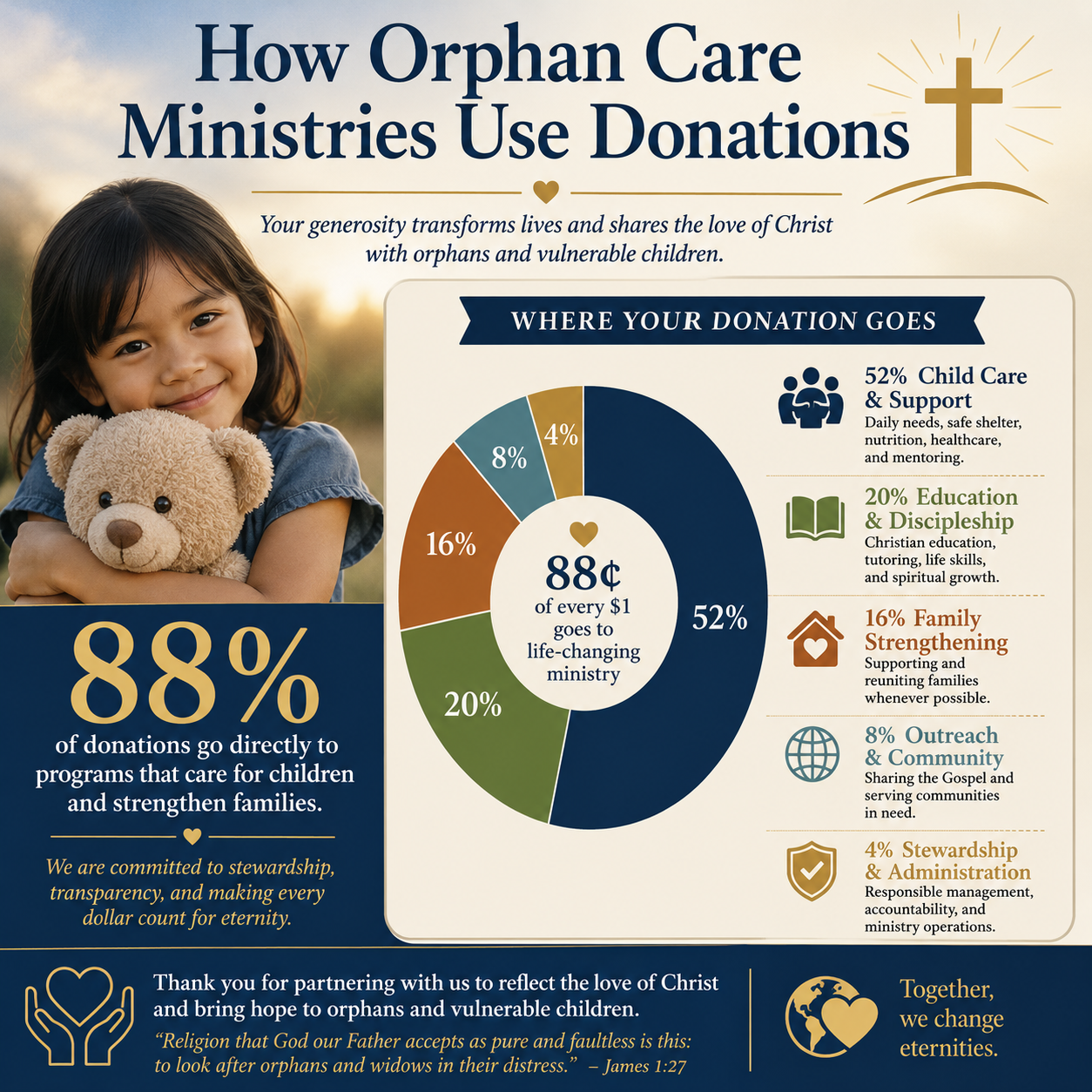
Wise donors are not impressed by austerity. They are persuaded by evidence of integrity and competence. The question is whether spending aligns with mission, whether controls are strong enough to prevent misuse, and whether the ministry can show that its chosen model benefits children without creating perverse incentives.
Financial integrity and clear allocation rules
Mature ministries can explain how restricted gifts are handled, what happens when restricted funds exceed immediate needs, and how they prevent cross-subsidization that violates donor intent. They can also show that local partners are vetted, monitored, and audited in a way proportionate to risk.
Donors should expect to see audited financial statements where feasible, a clear narrative of revenue streams (including sponsorship), and a credible description of internal controls. When a ministry dismisses questions about allocation as “lack of faith,” that is not spiritual maturity; it is a warning sign.
Governance that can say no to money
Orphan care attracts strong emotions and generous donors. That combination can tempt organizations to build programs around what is fundable rather than what is best. The ministries that sustain integrity over decades tend to have boards that exercise real oversight, evaluate executive leadership, and protect the mission from donor capture. Governance is not glamorous, but it is one of the few mechanisms that can prevent a ministry from drifting into child-separation incentives or ethically compromised partnerships.
Transparency that includes outcomes and trade-offs
Transparency is not a collection of inspiring stories. It is a pattern of disclosure that allows outsiders to evaluate whether claims are supported by evidence. Donors should look for ministries that publish measurable indicators aligned with their model: reunifications completed with follow-up, foster placements supported, caregiver training completed, educational continuity, and safeguarding incidents tracked and addressed.
The harder question is whether the ministry acknowledges trade-offs. For example, family preservation work can look “inefficient” compared with paying for school fees, because it requires skilled labor and long timelines. Yet it may prevent institutionalization and reduce long-term harm. Sophisticated donors should reward ministries that tell the truth about these tensions rather than hiding them behind simplistic metrics.
How Most Trusted evaluates orphan care use of donations
Most Trusted exists because Christian donors should not have to choose between naïveté and suspicion. We evaluate ministries against The Most Trusted Standard, a 15-criteria framework covering Faith Foundation, Financial Integrity, Governance and Leadership, and Transparency and Effectiveness. The aim is not to impose one orphan care strategy on every ministry, but to test whether the chosen strategy is carried out with integrity, competence, and child-centered safeguards.
In orphan care, the most significant verification questions often sit beneath the financial statements. A ministry may have clean audits and still operate a model that unintentionally sustains family separation. Conversely, a ministry may have modest revenue and still demonstrate exemplary safeguarding and disciplined reporting. Our work focuses on whether the ministry’s public claims are supported by verifiable documentation and whether the organization’s incentives are aligned with children’s best interests.
Key questions we press for donor confidence
- What is the ministry’s care model, stated plainly? If the model is institutional care, what is the exit strategy toward family-based care, and how is it funded?
- How are gifts accounted for? What are the rules for restricted funds, sponsorship revenue, and pooled program budgets?
- What safeguarding framework is in place? Are there documented child protection policies, reporting mechanisms, training, and independent oversight?
- What outcomes are reported? Are outcomes tied to the model, tracked consistently, and presented without exaggeration?
Patterns we see in healthier funding practices
The ministries that meet The Most Trusted Standard tend to invest in the “unseen” infrastructure donors sometimes resist: competent finance functions, documented partner oversight, trained case management, and safeguarding systems. They also tend to resist simplistic one-to-one sponsorship claims, not because they are less committed to children, but because they are more committed to truthfulness and equity.
They are also more likely to collaborate with local churches and child welfare systems rather than building parallel structures. That collaboration can be slower and less controllable, but it often results in more durable outcomes and less dependence on foreign funding cycles.
Giving that honors both compassion and truth
Christian donors give to orphan care because Scripture forms our conscience: God defends the vulnerable, and he expects his people to do the same. Yet the modern realities of child welfare mean that compassion must be disciplined by evidence, safeguards, and a willingness to fund what is effective rather than what is most emotionally legible.
The most responsible orphan care ministries can explain how donations are used in language that is both pastoral and precise. They can show how funds move from donor to program, how children are protected, and how outcomes are measured. This is the kind of clarity that allows generosity to become a steady practice of stewardship rather than a reaction to the story of the moment.



