
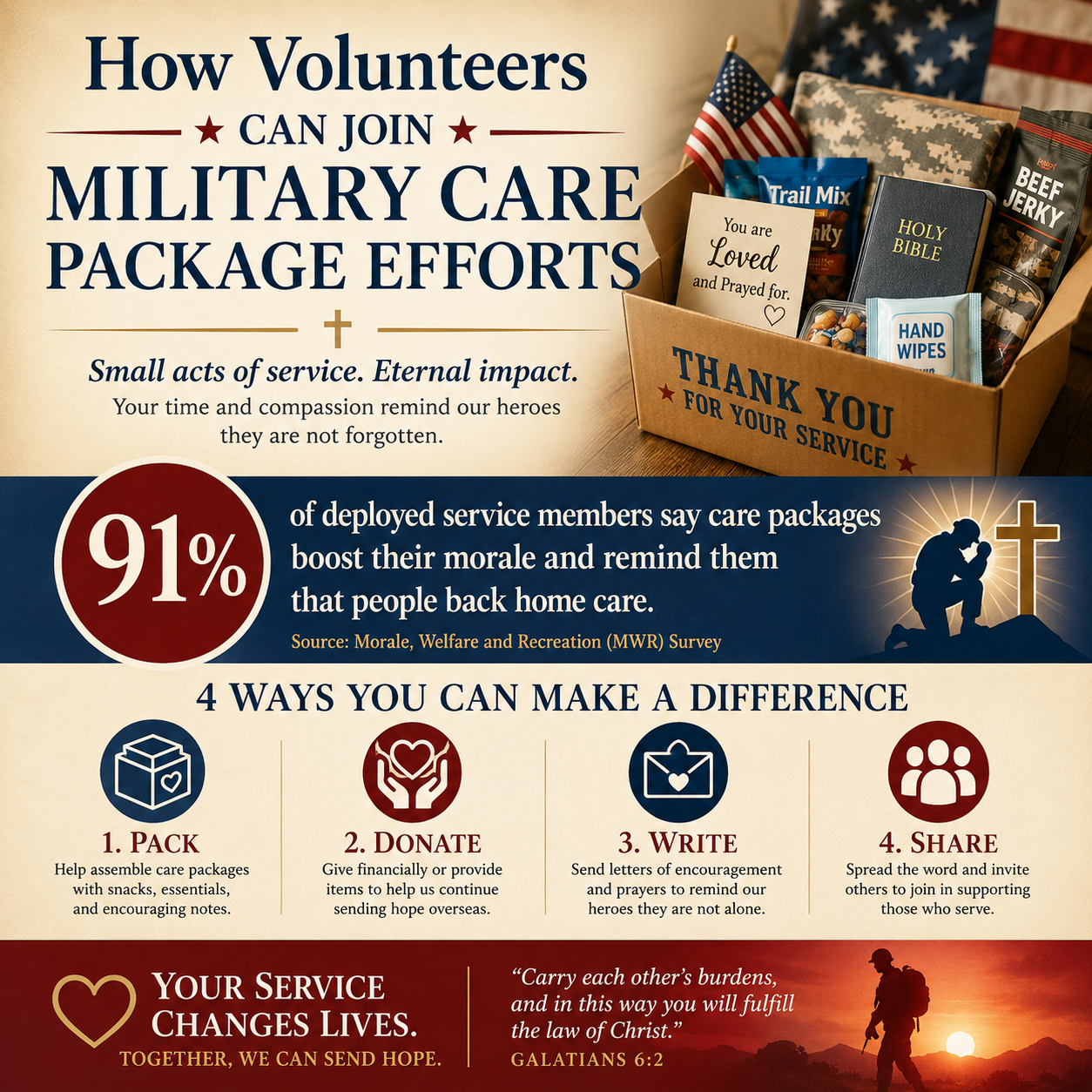
How volunteers can join military care package efforts is not primarily a question of logistics. It is a question of Christian stewardship: how we strengthen courage without romanticizing war, how we honor those who serve without turning service members into symbols, and how we give in ways that are accountable to truth. For donors who fund military outreach, volunteer-driven care packages can be a disciplined work of mercy when they are governed well and aligned with the real needs of units and chaplains.
Care packages sit at the intersection of morale, pastoral care, and public trust. They can also drift into waste, duplication, or even inadvertent risk when organizations ship items that are prohibited, culturally unwise, or operationally burdensome for deployed units to manage. The mature question is not whether care packages “feel encouraging,” but whether they are actually serving service members in ways that are prudent, verifiable, and spiritually responsible.
Start with purpose and accountability, not packaging
Care packages are pastoral gestures, not consumer shipments
In Scripture, encouragement is never mere sentiment. Paul repeatedly links encouragement to endurance, faithfulness, and the steady work of love (for example, encouragement that “builds up” the church). That framework matters in a military context where stress, isolation, and moral injury are real. A care package is most faithful when it supports the service member’s endurance and moral clarity rather than offering a vague message of national pride.
What this means in practice is that volunteers should join efforts that understand care packages as part of a broader ministry posture: chaplain partnership, prayer, follow-up, and respect for military realities. Many mature donors already recognize the danger of “project-first” compassion; the When Helping Hurts framework, articulated by Steve Corbett and Brian Fikkert, has helped the church see how good intentions can unintentionally undermine dignity and effectiveness.
Donors should ask for the same clarity we expect in any ministry
Across our verification work at Most Trusted, we observe that the ministries that meet The Most Trusted Standard tend to articulate a tight chain between inputs and outcomes: what goes into a program, what the program does, and what results can reasonably be expected. Care package efforts should be no different. A ministry that cannot clearly explain how recipients are identified, how shipping is coordinated, and how funds are safeguarded is asking volunteers to substitute enthusiasm for evidence.
Volunteer recruitment should therefore begin with simple, auditable information: a written item list, shipping guidance, financial controls for donated funds, and a process for reporting back to supporters. Public trust is not a cosmetic issue. It is a moral issue, because Christian giving is meant to be “honorable… not only in the Lord’s sight but also in the sight of man” (2 Corinthians 8:21).
Choose the right channel: chaplain-supported, unit-requested, or family-connected
Chaplains reduce risk and increase relevance
The most consistently effective care package pathways are those that are requested or validated by someone with proximity to the unit’s actual needs. Military chaplains are uniquely positioned for this. They operate with command access, confidentiality expectations, and an everyday view of stress points in the formation. When a ministry ships through chaplain channels, it is more likely to send items that are welcomed, permitted, and suited to the environment.
There are also legal and operational constraints that volunteers should respect. Shipping rules for APO and FPO addresses can change, and certain items are restricted for safety or local policy reasons. The U.S. Postal Service maintains guidance for military mail and APO and FPO shipping requirements at usps.com. Mature ministries incorporate these constraints into training rather than treating them as red tape.
Unit-requested support avoids duplication and “warehouse relief”
Some care package efforts function like public drives with broad appeals and generalized item lists. Others begin with a specific request from a unit, chaplain, or command point of contact. The second model generally produces higher impact and less waste. Service members can be overwhelmed with items that are hard to store, hard to distribute, or simply not needed.
Christian donors funding volunteer involvement can ask a practical question: does the ministry begin with a request, or does it begin with inventory? When inventory drives the work, packages tend to reflect donor preferences. When requests drive the work, packages tend to reflect recipient reality.
Volunteer roles that genuinely strengthen military care package work
Hands-on assembly is valuable when it is standardized
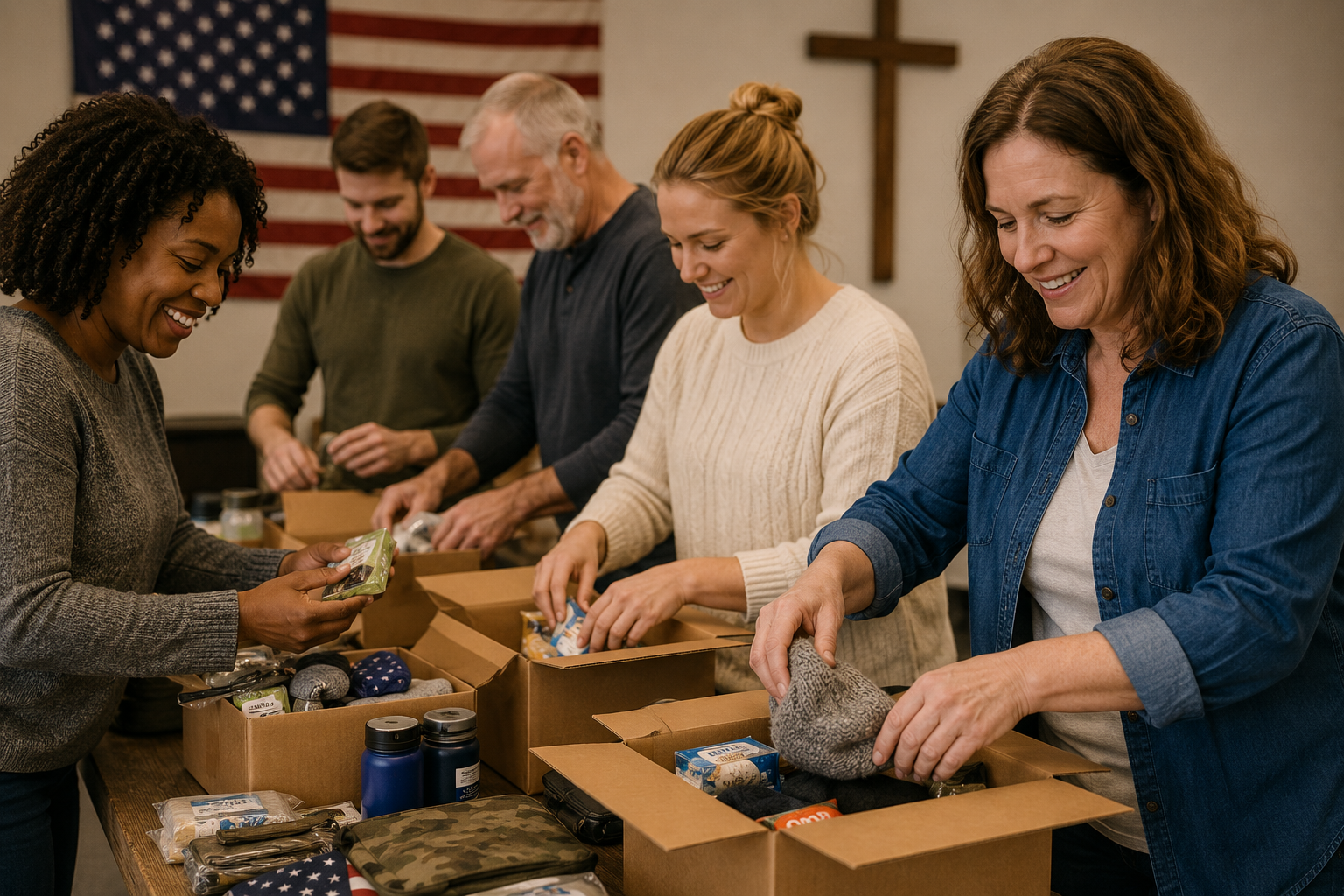
Care package assembly is a natural volunteer on-ramp because it is concrete and measurable. It also becomes chaotic quickly if the ministry lacks standard packing lists, quality checks, and shipping discipline. Volunteers should look for projects with clear roles: item sorting, expiration-date checks, pack-line leadership, box labeling, customs form preparation when relevant, and final inspection before shipment.
When these processes are executed well, the ministry honors donors by respecting cost per package and honors recipients by reducing the burden of dealing with unusable items. Standardization is not unspiritual. It is a form of neighbor-love expressed through competence.
Non-assembly roles are often where integrity is protected
Many ministries treat “volunteering” as synonymous with packing boxes. In reality, the highest-trust volunteer roles can be administrative: inventory tracking, donor acknowledgment, budget reconciliation, shipping documentation, and post-shipment reporting. These functions protect against misallocation and reputational risk. For mature donors, it is encouraging when a ministry invites volunteers into these less visible roles, because it signals that leaders understand accountability as part of ministry.
For donors seeking context on how these efforts fit within the broader landscape of ministry to service members, we maintain coverage of Military Outreach Ministries, including how different program models handle governance, partnership, and reporting.
Guardrails: what wise care package ministries refuse to do
They avoid manipulative messaging and partisan signaling
Christians genuinely disagree about aspects of military policy, the ethics of particular conflicts, and the relationship between church and state. A care package ministry does not need to settle those debates to serve service members well. It does need to avoid recruiting volunteers and donors through partisan rhetoric that treats deployed troops as props in domestic political argument.
Service members are neighbors before they are symbols. A ministry’s communications should reflect that: gratitude, prayer, and pastoral seriousness rather than outrage and spectacle. In our assessment work, we treat this as part of a ministry’s faith foundation and public witness: whether it speaks truthfully, avoids manipulation, and keeps its focus on discipleship and mercy.
They refuse “anything goes” donation policies
Care package drives can become a convenient outlet for household clutter. That is not generosity; it is disposal. Mature ministries set boundaries that feel restrictive to casual donors but protective to recipients. They publish clear item lists, refuse expired goods, and decline items that are likely to be discarded or that create storage and hygiene problems downrange.
A disciplined approach also protects volunteers. When a ministry lacks policies, volunteers often become the final filter, forced to decide what is safe or appropriate without guidance. That is avoidable with leadership that plans and communicates.
- Written packing lists tied to recipient requests or chaplain guidance
- Quality controls for expiration dates, damaged packaging, and hygiene standards
- Shipping compliance with USPS and unit-specific constraints
- Data discipline for addresses, quantities, and delivery confirmation when possible
- Feedback loops so supporters learn what was received and what was useful
Due diligence for donors funding volunteer-driven care packages
Ask the questions that protect the cause and the people it serves
Care package ministry often attracts high trust quickly because it feels tangible and patriotic. That is precisely why donors should apply sober due diligence. Trust should not rest on sentiment; it should rest on evidence that a ministry is financially sound, governed responsibly, and transparent about outcomes and limitations.
When donors evaluate any charitable organization, a baseline step is reviewing the IRS Form 990 (for U.S. nonprofits) and comparing stated programs to reported spending and governance. The IRS provides guidance and access points for nonprofit filings at irs.gov. Those documents do not tell the whole story, but they often reveal whether an organization is structured for integrity or improvisation.
Favor ministries that report outcomes, not just volume
Many care package efforts report success primarily by counting boxes shipped. Volume is not meaningless, but it is also not equivalent to effectiveness. Better reporting includes the proportion of packages tied to specific unit requests, the percentage delivered on time, recipient feedback when feasible, and operational lessons learned. It also includes candor about what cannot be measured.
For donors who want to support volunteering as part of military outreach, the relevant question is not only “How many people packed boxes?” but “Did the ministry demonstrate faithful stewardship of money, truth, and trust?” Our work at Most Trusted is designed for that kind of clarity. The Most Trusted Standard evaluates ministries across faith commitments, financial integrity, governance, and transparency, because donors deserve more than inspiring stories; they deserve verifiable accountability.
For donors and volunteer leaders specifically focused on this program area, our broader research on Volunteering with Military Outreach Ministries addresses how ministries structure volunteer engagement without compromising security, dignity, or theological seriousness.
FAQs for How volunteers can join military care package efforts
What should a volunteer ask before joining a care package drive?
Volunteers should ask who requested the packages, how item lists are determined, and what shipping rules govern the effort. They should also ask how donated funds are handled, whether the ministry provides receipts and acknowledgments, and whether there is any reporting after shipment. A serious ministry will welcome these questions because they reflect stewardship rather than suspicion.
Are care packages always the best way to support deployed service members?
Not always. Sometimes the most constructive support is funding chaplain-led care, emergency assistance for military families, or counseling and reintegration support after deployment. Care packages can be meaningful when they are requested, compliant, and coordinated; they can be wasteful or burdensome when they are driven by donor preferences rather than recipient needs.
A faithful care package effort is measured by love and truth
The church has a clear mandate to show mercy to neighbors under strain, including those who serve far from home. Care packages are one modest expression of that mercy. For donors and volunteers, the moral work is to ensure that encouragement is delivered with competence, that funds are guarded with integrity, and that our witness remains anchored in Christ rather than sentiment. When those conditions are met, volunteering can become not only an act of kindness, but an exercise in public trust worthy of the gospel we confess.



