
Volunteering with a local military outreach ministry is one of the most direct ways to honor Christ’s call to “remember those in prison, as though in prison with them, and those who are mistreated” (Hebrews 13:3). In military communities, the mistreatment is not always visible in headlines. It often takes the form of isolation after a move, moral injury after combat, marriage strain under tempo, or quiet despair that has learned to keep its voice down.
Christian donors are often well positioned to help because many of us can offer both resources and sustained presence. The harder question is how to serve in ways that protect dignity, respect lawful authority, and strengthen—not substitute for—the local church and the professional systems that exist for service members and families.
Start with the ministry’s theology of care and its relationship to the local church
Ask what the ministry believes the Church is responsible to do
Military outreach can drift into two opposite errors. One treats the military community as a “special population” for which normal discipleship does not apply. The other assumes generic programming will work, despite the realities of relocation, confidentiality, and operational stress. Healthy ministries hold both truths: service members and families need ordinary means of grace, and they often face extraordinary pressures.
Before we volunteer, we recommend asking for the ministry’s statement of faith and a plain explanation of how their work connects to local congregations. Do they equip chaplains and churches to shepherd people, or do they compete for attention and funding? Do they speak of evangelism and discipleship with clarity, or only of “support” in abstract terms?
Clarify the ministry’s lane alongside chaplains and commanders
Christians genuinely disagree about the right boundaries in faith-based work near government institutions. In the U.S. context, military chaplains serve within a defined framework intended to protect both free exercise and non-establishment. A credible outreach ministry respects that reality. It does not ask volunteers to circumvent command channels, misrepresent events as “official,” or pressure vulnerable people who cannot easily walk away.
As donors, we have learned to treat “relationship to authorities” as a revealing indicator. A ministry that can describe its policies with composure is usually a ministry that has thought carefully about spiritual care, legal constraints, and the protection of those it serves.
Choose a role that matches the community’s real needs, not our assumptions
Understand the most common pressure points
Military life concentrates stressors: frequent moves, long separations, and tight-knit cultures that can make it difficult to admit weakness. The Department of Defense’s 2022 Annual Report on Suicide in the Military documented that suicide remains a serious concern across the services, underscoring the importance of responsible, connected support rather than isolated “events” disconnected from ongoing care (Department of Defense, Defense Suicide Prevention Office).
What this means in practice is that many of the most valuable volunteer roles are not glamorous. They are steady, bounded, and repeatable: child care for a spouses’ group, hospitality for a weekend retreat, transportation for appointments, or administrative work that frees trained staff to do direct ministry.
Discern whether you are being asked to do pastoral work without pastoral formation
A recurring failure mode in compassionate ministry is to assign volunteers to “counseling” roles without adequate training, supervision, and referral pathways. Military communities include trauma, domestic conflict, addiction, and grief. Those realities require humility about competence. We recommend choosing roles where expectations are clear and where escalation protocols exist for threats of self-harm, abuse, or criminal conduct.
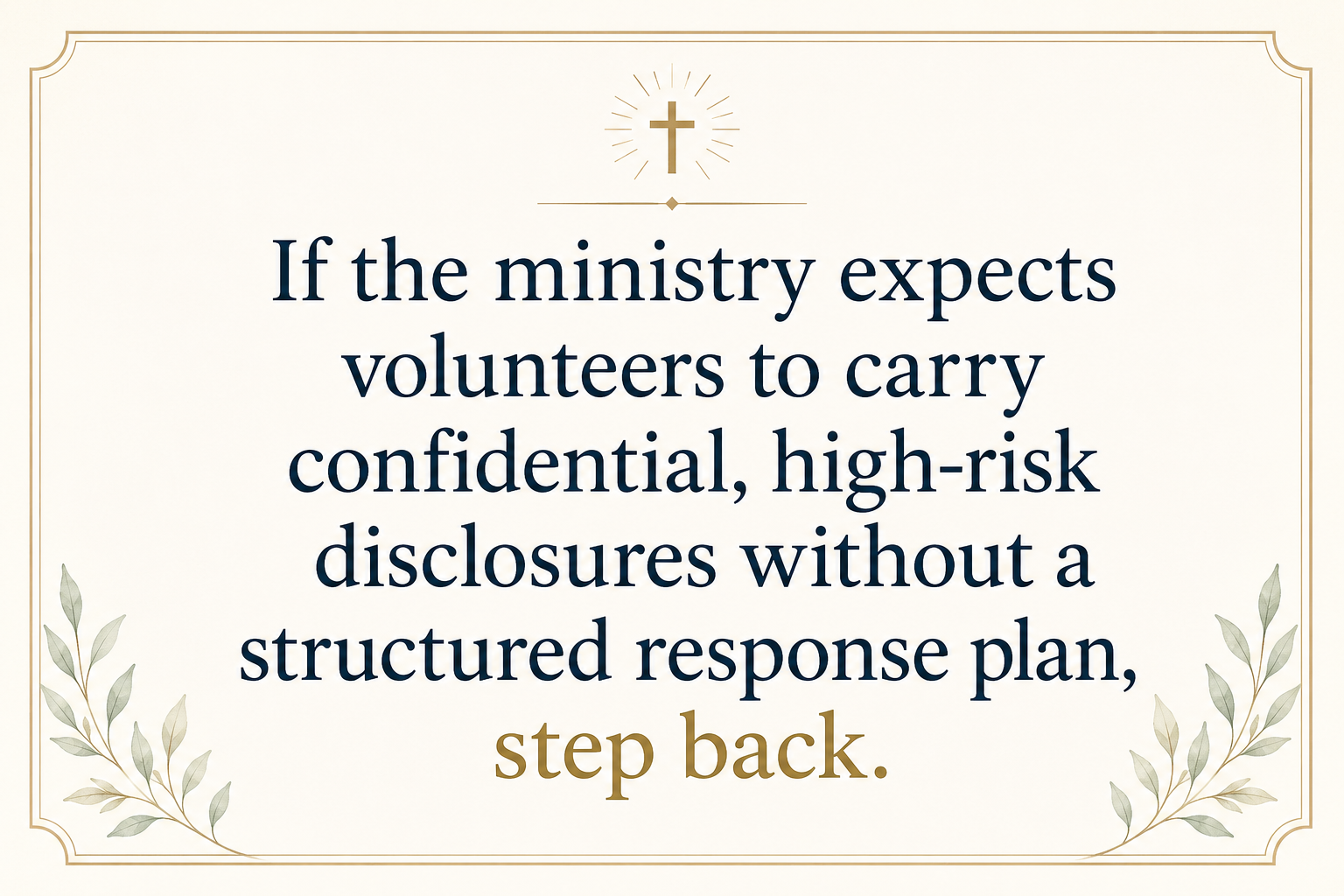
If the ministry expects volunteers to carry confidential, high-risk disclosures without a structured response plan, step back. Love of neighbor includes refusing responsibilities that exceed our capacity and could harm those we mean to serve.
Evaluate safeguards, governance, and financial integrity before you commit
Use a verification mindset as part of discipleship
Christian giving is not only about sincerity; it is also about truthfulness. Scripture’s warnings about partiality, dishonest scales, and false shepherds assume that God’s people must practice discernment. For donors who volunteer, that discernment extends to the ministry’s operations and accountability.
Across our verification work at Most Trusted, we observe that durable ministries tend to explain their governance plainly: who the board is, how conflicts of interest are handled, what financial reviews occur, and how leadership is evaluated. The ministries that meet The Most Trusted Standard show evidence across faith foundation, financial integrity, governance and leadership, and transparency and effectiveness. Volunteers benefit from those same guardrails because they reduce the likelihood of moral compromise, reputational risk, or misuse of authority.
Practical diligence questions to ask before serving
We recommend asking for written answers, not merely verbal assurances. A trustworthy ministry will not treat these questions as suspicion; it will treat them as stewardship.
- Do you run background checks for volunteers who work with minors or vulnerable adults?
- What is your child protection policy, and how is it enforced?
- How do you handle mandatory reporting and safety concerns?
- Do you publish financial statements, and who reviews them?
- How do you measure whether your programs actually help military families and service members?
Financial transparency is especially important because military-themed causes can attract generous giving and strong emotions. Donor trust is not strengthened by vague claims of “impact,” but by clear reporting and governance that can withstand scrutiny.
Serve with cultural competence, confidentiality, and long obedience
Learn the culture without baptizing it
Military culture prizes loyalty, competence, and mission focus. Those can be virtues. They can also become idols when they crowd out confession, rest, or the acknowledgment of limits. Christian volunteers should respect the culture without romanticizing it. We can honor sacrifice without treating the uniform as moral insulation from sin or suffering.
For donors who are used to strategic philanthropy, this is a sobering shift: we are not funding an abstract mission; we are entering a community that has endured loss and carries responsibilities most civilians never face. That posture should make us slower to speak and quicker to learn.
Protect trust through disciplined confidentiality
Gossip travels quickly in small communities, and it can do disproportionate damage. Many families have reasons to be cautious: security clearances, career implications, and personal safety concerns. A serious ministry trains volunteers to keep confidences, to document only what must be documented, and to share information only with those who are responsible to act.
This is also where volunteers sometimes overreach. Posting photos, tagging locations, or telling “inspiring stories” without consent can undermine the very trust a ministry needs to operate. We recommend treating confidentiality as a spiritual discipline—one that honors the image of God in the person being served.
To understand the broader landscape of faithful work in this field, many donors find it helpful to track the range of Military Outreach Ministries operating across chaplain support, base-adjacent church partnerships, veteran care, and family resilience.
Pair volunteer service with wise giving and measured expectations
Do not confuse low overhead with high integrity
Some donors hesitate to support ministries that invest in training, evaluation, or professional counseling partnerships. Yet under-resourcing those functions can place volunteers and participants at risk. The nonprofit sector has had to reckon with the “overhead myth”—the mistaken idea that the best organizations keep administrative and fundraising costs as low as possible. Charity Navigator, Candid (formerly GuideStar), and the BBB Wise Giving Alliance jointly warned that overhead ratios are a poor measure of nonprofit performance and can incentivize harmful underinvestment (Charity Navigator).
What this means for volunteering is straightforward: if a military outreach ministry has no budget for volunteer training, background checks, or program evaluation, that is not a sign of purity. It may be a sign of fragility.
Set expectations that honor both faith and reality
Military outreach often progresses slowly. Relationships deepen over months, not weekends. People may disappear after a PCS move, return years later, or decline help even when it is offered well. Christian donors sometimes carry an implicit expectation of measurable results on a predictable timeline. Some forms of measurable evaluation are necessary; demanding immediate visible outcomes can become a subtle refusal of the cross-shaped nature of love.
We recommend a dual commitment: insist on honesty about outcomes, and accept that discipleship and restoration are rarely linear. If you are looking for volunteer opportunities organized by role and context, Volunteering with Military Outreach Ministries is a helpful place to compare options without rushing past diligence.
FAQs for How to volunteer with a local military outreach ministry
Do we need military experience to volunteer effectively?
No. Many healthy ministries rely on civilians who are willing to learn and serve with humility. What matters most is cultural respect, willingness to follow policies, and the discipline to keep confidences. Military experience can be an asset, but it is not a substitute for spiritual maturity and accountability.
What should we do if we hear something that suggests self-harm or abuse?
We should treat it as a safety matter, not as a private spiritual burden to carry alone. A credible ministry will have clear escalation steps and mandatory reporting guidance, and it will tell volunteers exactly whom to contact. If a ministry does not have such protocols, we recommend pausing involvement until leadership can provide written policies and training.
Serving with steadiness and credible accountability
Military outreach is often measured in quiet faithfulness: a family welcomed after a move, a marriage strengthened under strain, a veteran accompanied through a long season of readjustment, a service member reminded that Christ’s lordship reaches even into fear and grief. Volunteering with a local military outreach ministry should be undertaken with spiritual seriousness and operational clarity, because the people being served deserve more than goodwill.
When donors bring both presence and discernment—asking careful questions, accepting appropriate limits, and supporting ministries that can demonstrate integrity—we strengthen the credibility of Christian witness in a community that has learned to evaluate trust by costly experience.



