
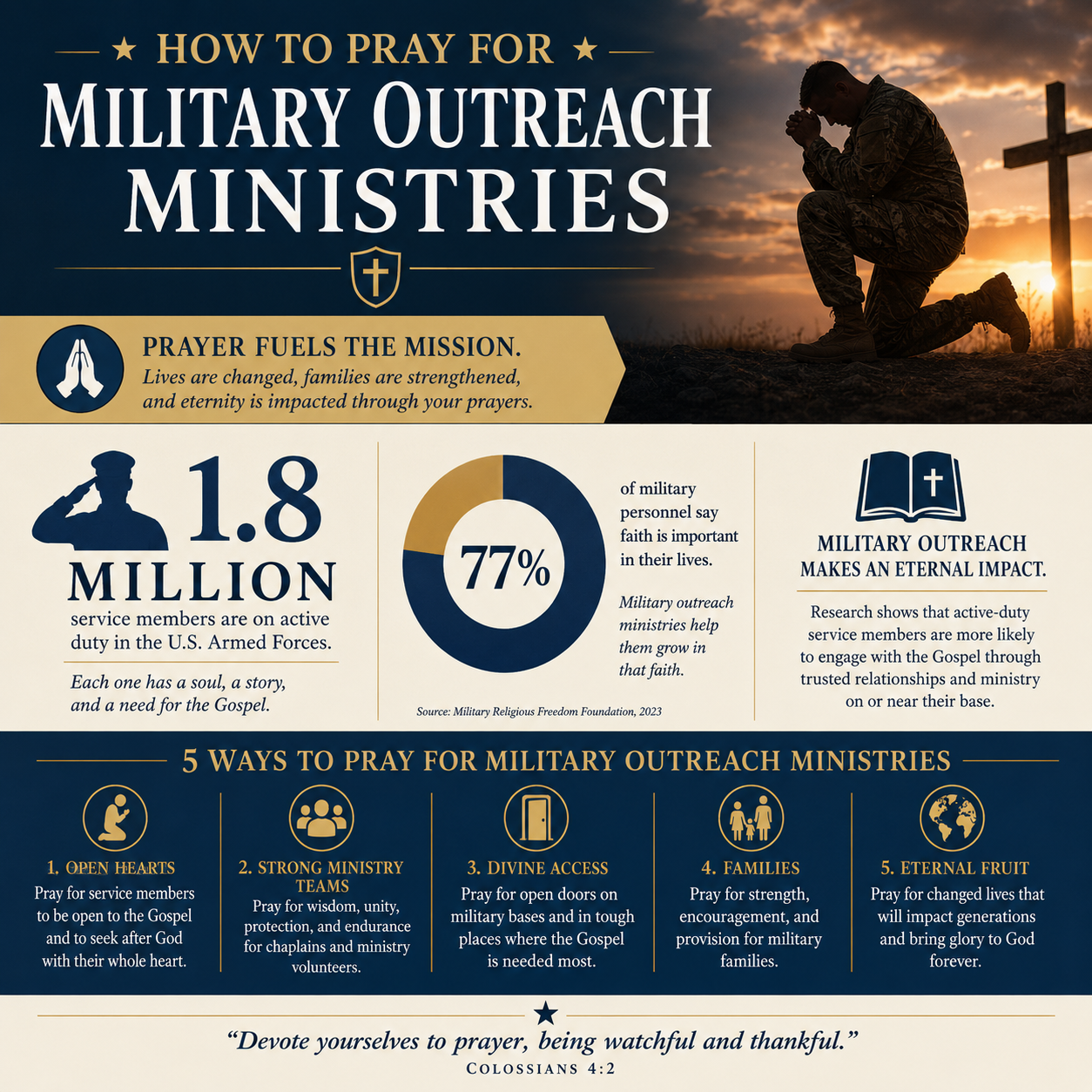
How to pray for military outreach ministries is not a sentimental question; it is a stewardship question. These ministries stand near the moral injuries of war, the loneliness of deployment cycles, and the quiet spiritual pressures that accompany disciplined service. Christian donors often want to help in concrete ways, but prayer is not the “soft” alternative to strategy; it is a form of participation in the Church’s care for those who bear heavy burdens.
Military outreach also carries complexities that resist easy Christian slogans. Command structures, operational security, trauma care, and the pluralism of the modern armed forces shape what ministry can responsibly do. Praying well means praying with theological clarity, institutional wisdom, and a steady concern for integrity.
Pray with a theology worthy of the burden
Ask for formation, not only relief
Scripture does not minimize suffering, but it consistently frames endurance as a place where God forms his people. Peter wrote to believers under pressure that they had been grieved “by various trials” so that the tested genuineness of their faith might result in “praise and glory and honor at the revelation of Jesus Christ” (1 Peter 1:6–7). For service members, those trials can include fear, grief, moral compromise, and a hardening that begins as self-protection. Pray that military outreach ministries would help men and women in uniform become spiritually resilient, not merely temporarily comforted.
That prayer should include leaders and chaplains who often carry the hidden weight of others’ stories. Many military outreach teams are small, stretched, and exposed to secondary trauma. Ask the Lord to grant them wisdom to recognize the limits of pastoral competence and the humility to refer service members to qualified clinical care when necessary. The goal is not to replace professional treatment but to provide distinctively Christian presence, counsel, and community under the authority of Christ.
Pray for courage shaped by gentleness
Military culture rightly values strength, but Christian discipleship insists that true strength includes tenderness. Paul instructed Timothy that “the Lord’s servant must not be quarrelsome but kind to everyone… correcting his opponents with gentleness” (2 Timothy 2:24–25). Pray that military outreach ministries would embody that posture in barracks conversations, on bases, and in veteran communities. In practice this can mean listening without rushing to a verdict, offering biblical counsel without harshness, and refusing to use patriotic rhetoric as a substitute for gospel clarity.
Pray, too, for the courage to speak honestly about sin and grace. Some service members carry real guilt for actions taken in war or for personal decisions made under stress. The gospel offers neither denial nor despair; it offers confession, forgiveness, and new obedience through Christ.
Pray for integrity under institutional pressures
Ask for governance strong enough for a sensitive field
Military outreach ministries operate at the intersection of public trust, donor expectations, and vulnerable people. That is exactly where governance and accountability matter. Across our verification work at Most Trusted, we observe that ministries serving high-trust communities often face an unspoken temptation: to rely on reputation rather than documented controls. Pray that boards and executive leaders would welcome scrutiny, treat policies as pastoral safeguards, and cultivate a culture where concerns can be raised without retaliation.
When ministries pursue access to bases, units, or chaplain networks, the pressure to “keep doors open” can subtly reshape messaging or reporting. Ask God for leaders who can maintain integrity even when it costs opportunities. “Whoever walks in integrity walks securely” (Proverbs 10:9) is not a marketing line; it is a spiritual reality that protects both the ministry and those it serves.
Pray for financial practices that honor donors and beneficiaries
Christian donors are right to care about how funds are handled, especially when a ministry solicits support around stories of trauma, suicide, or family hardship. Pray for sober, transparent fundraising that refuses exaggeration and respects the dignity of service members and veterans. Where ministries communicate impact, ask that they do so with truthful measures and appropriate confidentiality.
Donors sometimes assume overhead minimization is the same as faithfulness. The nonprofit sector has pushed back on that assumption for good reason. The “Overhead Myth” letter, signed by GuideStar, Charity Navigator, and the BBB Wise Giving Alliance, argued that overhead ratios are a poor proxy for effectiveness and can incentivize underinvestment in systems that protect beneficiaries and ensure results GuideStar. Pray that military outreach ministries would resist simplistic metrics while still pursuing strong stewardship: clear budgets, documented controls, and spending that serves mission rather than image.
Pray for spiritual care that is trauma informed and gospel centered
Ask for wisdom with moral injury and grief
Not every wound is the same. Some service members carry fear and sorrow; others carry what clinicians and pastoral caregivers often call moral injury: the anguish that can follow perpetrating, witnessing, or failing to prevent acts that violate a person’s moral framework. Christians genuinely disagree about the best language to use here, and not every model fits every case. Still, prayer can be specific: ask that outreach leaders would have wisdom to discern guilt from shame, confession from coercion, and lament from fatalism.
Pray that ministries would recover biblical lament as a legitimate Christian practice. The Psalms give God’s people words for grief that do not sanitize pain. Lament can be a bridge for those who feel numb or spiritually stuck, and it can keep counselors from offering premature closure.
Pray for sound care pathways and right limits
Trauma care is not a matter of good intentions alone. The U.S. Department of Veterans Affairs reports that on an average day in 2021, 17 veterans died by suicide U.S. Department of Veterans Affairs. That reality does not mean every outreach context is an acute crisis setting, but it does mean ministries must be prepared for high-risk conversations.
Pray that ministries would have clear protocols: when to involve chaplains, when to encourage emergency services, how to document appropriately, and how to follow up. Ask the Lord to protect them from two equal and opposite errors: treating spiritual counsel as a substitute for clinical intervention, and treating spiritual counsel as irrelevant once clinical care begins.
- Pray for discernment to recognize crisis signals early.
- Pray for partnerships with chaplains, counselors, and veteran service networks.
- Pray for confidentiality practices that are ethical and lawful.
- Pray for healthy boundaries that prevent savior complexes.
- Pray for patient discipleship that continues after immediate crises pass.
Those prayers align with the kind of operational maturity we often see in ministries that meet The Most Trusted Standard: clear leadership accountability, documented care practices, and transparency that protects both donors and beneficiaries.
Pray for families, relationships, and the long return home
Intercede for spouses, children, and the hidden congregations around the uniform
Military outreach is rarely only about the individual in uniform. Spouses carry the strain of solo parenting, uncertainty, and repeated transitions. Children absorb stress they cannot name. Communities rotate, friendships rupture, and routines reset. Pray that outreach ministries would see the whole household and coordinate care accordingly, including referrals to local churches that can provide ordinary, long-term community.
When deployments end, the hardest work can begin. Reintegration often exposes what was held together by adrenaline and mission focus. Pray for ministries that will not abandon service members once the dramatic season ends. Ask that they would help families rebuild trust, practice forgiveness, and establish rhythms of worship and rest.
Pray for the local church to receive veterans with humility
Many veterans describe a gap between their experience and what congregations know how to hold. Some churches unintentionally politicize veterans; others avoid the subject entirely. Pray that pastors and elders would welcome veterans without reducing them to symbols. Pray that churches would provide space for testimony, grief, and honest questions, while still offering the steady means of grace: preaching, sacraments, prayer, and mutual care.
For donors who want to understand the broader landscape, engagement with Military Outreach Ministries can sharpen prayer by clarifying the range of models—from base-adjacent discipleship to veteran recovery programs—and the distinct risks each model carries.
Pray for transparency, effectiveness, and truth in storytelling
Ask for measurable faithfulness, not performative impact
Some outcomes in military outreach are difficult to quantify without turning people into projects. Yet donors rightly expect ministries to demonstrate faithful stewardship. Pray that leaders would pursue evaluation that is honest about limits: tracking participation, retention, referrals, and pastoral follow-up without violating privacy or inflating claims. Ask that they would resist the temptation to treat a single dramatic conversion story as the whole proof of mission.
Where program claims touch public questions—suicide prevention, PTSD support, family stability—pray that ministries would cite evidence carefully and avoid overstating what their programs can accomplish. The research on prevention and recovery is complex, and simplistic claims can mislead donors and harm those seeking help.
Pray for donor partnership shaped by discernment
Donors are not outsiders to ministry; they are participants with responsibility. Pray for your own discernment, especially when a ministry’s mission resonates emotionally. Ask for clarity to distinguish between compelling branding and credible operations. Our team at Most Trusted evaluates ministries against The Most Trusted Standard in part because faithful giving requires more than goodwill; it requires the willingness to test what is true.
Prayer and due diligence are not rivals. Prayer keeps due diligence from becoming cynicism. Due diligence keeps prayer from becoming naivete. For donors who want to focus their intercession on care practices and pastoral credibility, Prayer and Spiritual Care in Military Outreach Ministries is often the most direct place to compare how ministries describe spiritual care, crisis response, and ongoing discipleship.
FAQs for How to pray for military outreach ministries
Should donors pray differently for chaplains than for civilian outreach staff?
Yes, in emphasis. Chaplains serve within institutional constraints and must care for a pluralistic population while remaining faithful to their own confession. Civilian outreach staff often have more freedom to speak explicitly about Christ, but less institutional access and fewer built-in support structures. Pray for chaplains’ courage and wisdom under authority, and for civilian teams’ integrity, safety, and fruitful partnership with chaplains and local churches.
How can we pray when we do not know operational details and cannot ask?
Pray for the things that do not require sensitive information: protection, moral clarity, wise leadership, faithful presence, and appropriate care pathways. Ask God to guard communications, decisions, and relationships. Then pray for transparency where it is appropriate: that ministries would still provide donors with clear financial reporting, governance accountability, and credible descriptions of outcomes without compromising operational security or personal privacy.
Praying as stewardship
The most responsible prayer for military outreach ministries is both tender and rigorous: tender toward those who carry visible and invisible wounds, rigorous about the moral and operational seriousness of serving them. When donors intercede for holiness, integrity, wise care, and truthful reporting, they are praying for the kind of faithfulness that can endure beyond one deployment cycle and beyond one moving story.



