
What prayer requests are common in military communities is not a sentimental question. It is a window into the pressures borne by service members, spouses, children, chaplains, and the ministries that walk with them. For Christian donors, it also clarifies what “faithful care” should actually mean when a family lives under orders they did not choose and timelines they cannot control.
Across military culture, prayer is often asked for with restraint. Many requests arrive indirectly: “Pray for patience,” “Pray for wisdom,” “Pray for safety.” Beneath that careful language are specific burdens—moral injury, fractured family rhythms, housing and employment instability, and the disorienting pace of deployment and reintegration—that require more than generic concern.
Safety and providence when risk is not theoretical
Military communities live with real exposure to harm. Service members train for violence, deploy into uncertainty, and return with experiences most civilians never have to imagine. Prayer requests about safety are not naïve; they are the language of dependence when control is thin.
Protection in deployment and training
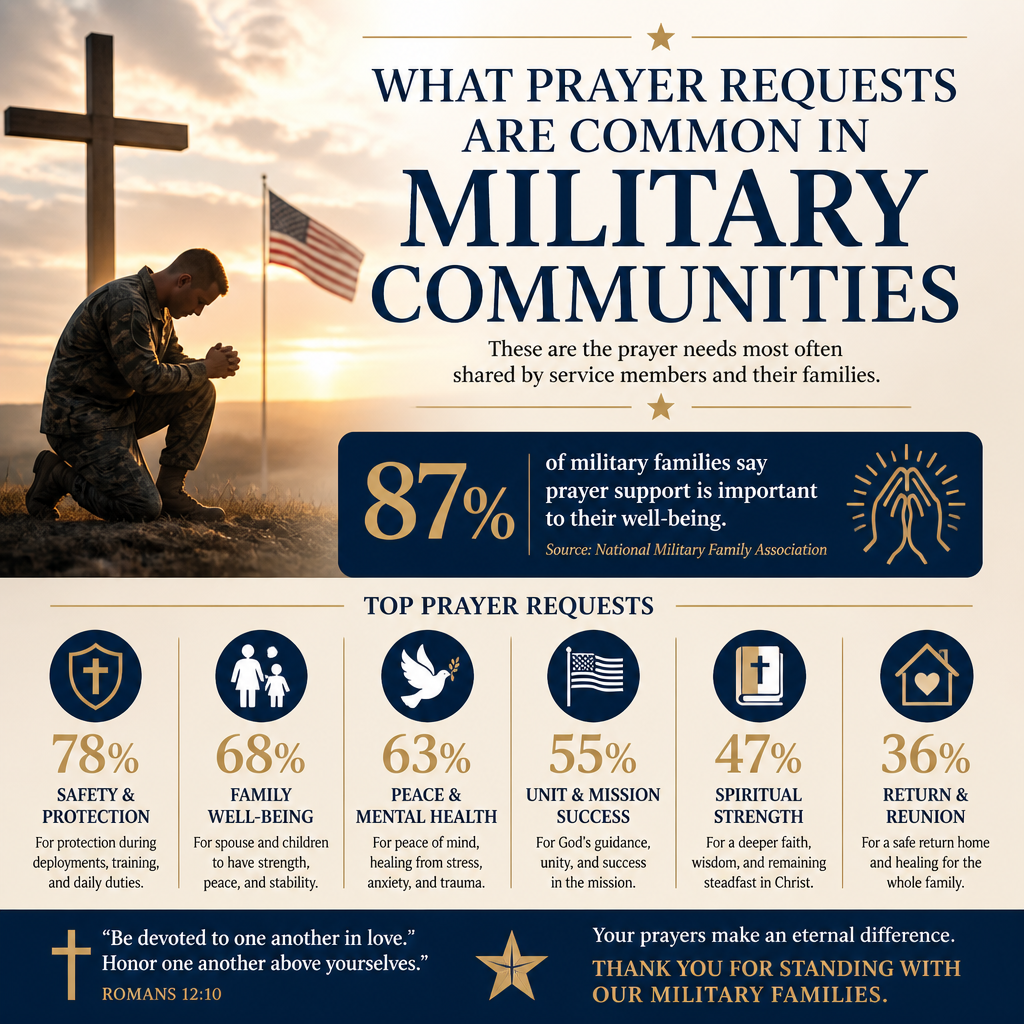
Requests for safe travel, safe missions, and safe training cycles remain among the most common. These prayers often include the “unknown unknowns” of modern warfare: improvised threats, ambiguous front lines, and the spiritual strain of vigilance. They also include the mundane risks of military life—accidents, equipment failures, and the fatigue that makes small errors costly.
Donors sometimes underestimate the scale and churn of deployments and temporary duty assignments. The Department of Defense describes a force measured in the millions across active duty, Guard, Reserve, and civilian personnel, with families woven through that footprint Department of Defense. Even without quoting granular numbers, the pastoral reality is clear: many congregations near installations are always praying over someone leaving, someone returning, and someone waiting.
Trust in God’s rule when outcomes are not promised
Christians genuinely disagree about how to speak of protection without implying a guarantee. Mature prayer in military communities often holds two truths together: God is sovereign, and suffering is not foreign to the Christian life. The Psalms give language for this—confidence without triumphalism, lament without despair. A donor’s role is not to demand “results,” but to fund the kind of care that helps people persevere faithfully when outcomes are not theirs to command.
Family strain and the hidden costs of constant transition
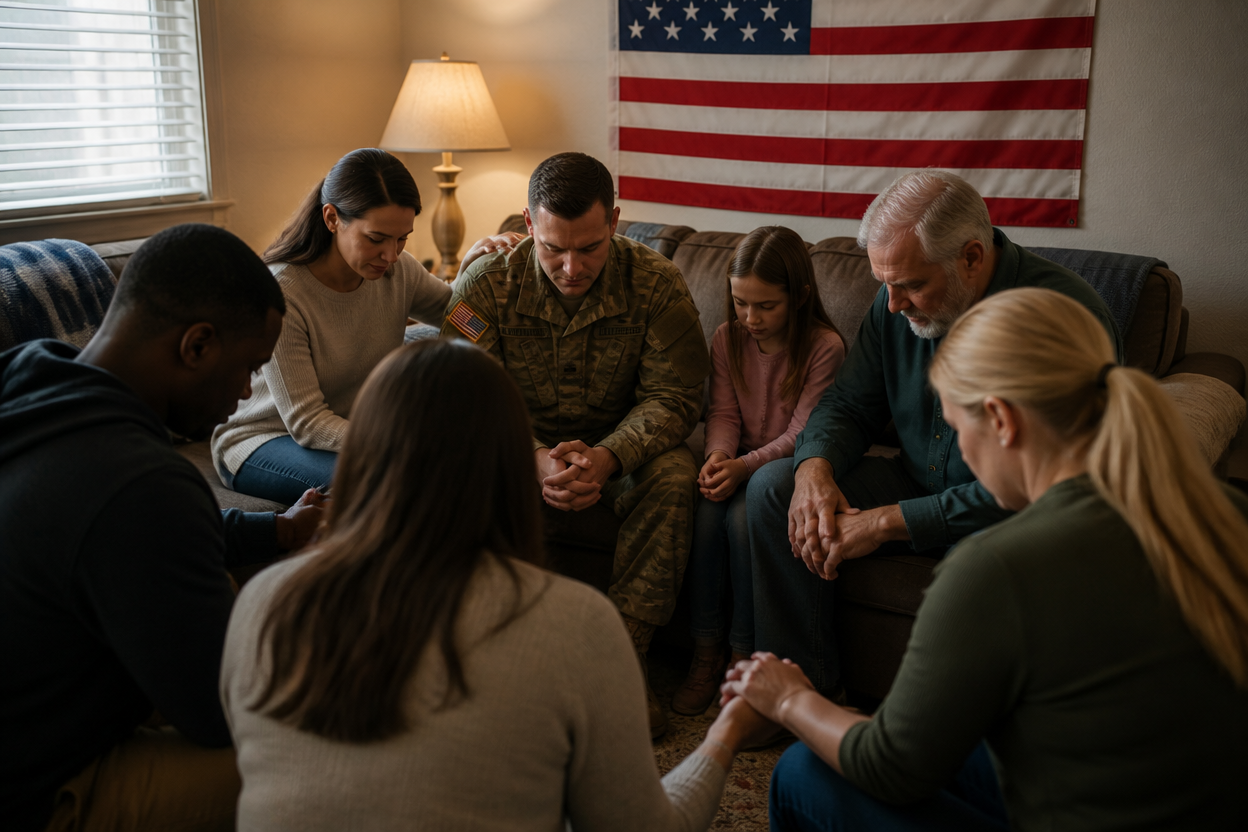
Military families often ask for prayer over stability—emotional, relational, and practical. Permanent change of station moves, deployment cycles, and the demands of readiness compress ordinary family formation into a more fragile space. Prayer requests in this category can sound routine (“pray for our move”), but the cumulative effect is not routine at all.
Marriages under asynchronous life
Military marriages frequently operate under “asynchronous life”: one spouse in training while the other manages the household, one spouse awake while the other sleeps, one spouse in danger while the other carries the mental load at home. Common requests include unity, patience in communication across time zones, fidelity under loneliness, and tenderness after conflict. Reintegration can be as difficult as separation, because habits formed in survival mode do not always yield easily to shared life.
Children carrying adult-sized uncertainty
Parents ask for prayer for their children’s anxiety, social disruption, and school transitions. Even when parents shield details, children absorb uncertainty through changes in routines, sudden goodbyes, and the emotional weather of the home. Donors who support military outreach ministries are often funding the slow work of accompaniment: child care during chapel services, mentoring, youth groups that welcome the “new kid” again and again, and counseling referrals that reduce isolation.
When donors evaluate ministries serving military families, it is worth remembering that measurable outcomes may be less visible than in other fields. Prevented crises rarely appear in a report. This is one reason Most Trusted emphasizes verification that includes both theological fidelity and operational integrity, so donors can fund ministries that are steady when the family’s life is not.
Moral injury, trauma, and the long road to interior healing
Many military prayer requests circle around what people cannot easily name in church settings: memories that intrude, guilt that does not lift, anger that feels rational, and a fear of being known. Ministry in this space requires theological seriousness, clinical humility, and deep respect for confidentiality.
PTSD and the reality of psychological injury
Some requests are explicit—“pray for my nightmares,” “pray for my panic,” “pray for my counseling appointment.” Others are coded as “pray for my temper” or “pray for sleep.” The U.S. Department of Veterans Affairs describes PTSD as a condition some people develop after experiencing or witnessing life-threatening events and notes that veterans can be affected at meaningful rates U.S. Department of Veterans Affairs. These realities shape prayer: not a simplistic request for willpower, but prayer for competent care, courage to seek help, and communities that do not stigmatize treatment.
Moral injury and spiritual disorientation
The harder category is moral injury—anguish tied not only to fear, but to perceived wrongdoing, betrayal, or participation in actions that violate one’s moral framework. Christians in uniform may wrestle with questions of just war, rules of engagement, and the moral ambiguity that can accompany combat and command decisions. Prayer requests here often sound like “pray that God would forgive me,” “pray that I could feel clean,” or “pray that I can face what I did and what I saw.”
Some ministries are tempted to offer quick absolution without repentance, or quick repentance without trauma-informed care. Both are pastorally dangerous. Scripture gives us categories for confession, forgiveness, and restoration, and it also gives us a Savior who meets people in the long middle where consequences remain. Donors should prioritize ministries that combine clear gospel proclamation with appropriate partnerships—chaplaincy coordination, licensed counseling referrals when needed, and careful safeguarding around vulnerable disclosures.
Community, belonging, and the spiritual loneliness of service
Prayer requests in military communities frequently return to belonging. People who move often can be surrounded and still lonely. A service member can be integrated into a unit and still feel spiritually unknown. A spouse can attend a base event and still carry isolation at home. The church’s answer cannot be generic friendliness; it must be durable community.
Finding a church that understands without idolizing the military
Many families ask for prayer to find a healthy church near a new duty station—one that neither ignores their context nor makes the uniform an identity replacement for baptism. Some congregations near installations become “military-heavy” by proximity. That can be a gift, but it also creates volatility as trained leaders move away with little notice. Prayer requests often include “pray for leadership,” “pray for volunteers,” and “pray for continuity.”
For donors exploring the broader landscape of Military Outreach Ministries, this is a central question: is the ministry building spiritual consumers who disappear when they PCS, or forming disciples who can join and strengthen the next church they attend?
Isolation, shame, and confidentiality
Military culture can discourage vulnerability, especially when career implications feel possible. Prayer requests may be filtered through fear: “pray for discernment” can mean “pray that I would know whether it is safe to tell anyone the truth.” Faithful ministries set clear boundaries and communicate confidentiality policies with precision. They also avoid pressuring public testimony where privacy is ethically required.
In practice, donors can listen for whether a ministry speaks about people as image-bearers rather than as inspirational stories. The goal is not to harvest dramatic narratives; it is to cultivate holiness, healing, and endurance.
Praying wisely as donors and funding ministries that bear weight
Christian donors often ask how to pray without being intrusive, and how to give without funding sentimentality. The strongest giving is both compassionate and disciplined: it funds ministries that can carry pastoral complexity, document stewardship, and maintain theological clarity under pressure.
What mature prayer sounds like in this context
Helpful prayer requests are specific enough to be real and modest enough to respect operational security and family privacy. Many military families appreciate donors who pray consistently, not theatrically. A short list can guide intercession without requiring sensitive detail:
- Endurance and wisdom for service members facing decisions with moral weight
- Peace and protection for spouses managing home life in prolonged absence
- Stability and friendship for children navigating repeated transitions
- Healing for trauma, nightmares, anxiety, and anger that fractures relationships
- Church communities near bases that offer durable discipleship and practical help
How to evaluate the ministries you fund
Prayer and giving belong together. But military-related causes can also attract emotionally compelling fundraising that is thin on accountability. Donors should not have to choose between compassion and careful verification. At Most Trusted, we evaluate Christian nonprofits against The Most Trusted Standard, a 15-criteria framework spanning faith foundation, financial integrity, governance and leadership, and transparency and effectiveness. The point is not bureaucratic control; it is stewardship worthy of the gospel and worthy of the people these ministries serve.
For donors focusing on care that is explicitly spiritual—chaplain support, pastoral counseling, Scripture distribution, and local church partnership—our team encourages attention to whether a ministry demonstrates sound doctrine, clear safeguarding practices, and financial reporting that can be tested. The category of Prayer and Spiritual Care in Military Outreach Ministries includes some of the most beautiful work in the field, and also some of the easiest places for vague claims to hide.
FAQs for What prayer requests are common in military communities
How can donors ask for prayer needs without pressuring military families to disclose too much?
We recommend asking for “prayer categories” rather than operational details: safety, unity in marriage, wise leadership, good sleep, freedom from fear, and access to care. It honors both confidentiality and the reality that some information should not be shared widely. A ministry that serves military communities well will also coach supporters on appropriate language.
What should donors listen for when a ministry shares military prayer requests publicly?
Healthy ministries protect dignity. They avoid exposing identifiable details, sensationalizing trauma, or implying that spiritual maturity is proven by sharing everything. They also connect prayer to concrete care: pastoral follow-up, referrals when clinical treatment is needed, and accountable financial stewardship so that donor compassion is translated into durable support.
A donor’s prayer can be steady when military life is not
Common prayer requests in military communities—safety, family stability, trauma recovery, moral clarity, and belonging—reflect the fact that service tests both body and soul. The Christian donor is not merely funding “support for the troops.” We are sustaining ministries that help people endure suffering without losing faith, seek healing without shame, and return to ordinary life with integrity. That is a work worthy of careful prayer and careful verification.



