

How military outreach ministries provide Bibles and devotionals is not primarily a logistics question. It is a discipleship question shaped by the realities of military life: distance from home church, irregular schedules, moral injury, and the quiet loneliness that can settle in even among tightly bonded units.
For Christian donors, the aim is not simply to place printed material in camouflage-patterned hands. The aim is to ensure that Scripture and faithful devotional teaching are present where the burdens are real, the time is limited, and the stakes are high. Done well, Bible and devotional distribution becomes a form of spiritual care that honors both the Word of God and the service member’s lived constraints.
Scripture distribution in the military is spiritual care under unusual constraints
The pastoral gap created by mobility and operational tempo
Military communities are built for movement. Frequent relocations, deployments, and training cycles fracture normal patterns of church membership and ongoing discipleship. Even where chaplains serve faithfully, the scale of need and the diversity of faith traditions mean that many service members will not receive sustained, Scripture-rich care from a consistent pastor or small group.
This is part of why military outreach ministries place such emphasis on portable, durable resources: a New Testament that fits into a uniform pocket, a devotional that can be read in ten minutes, a study guide suited to a barracks room. The objective is not to replace the local church or the chaplaincy, but to place means of grace within reach when ordinary rhythms are interrupted.
Why Bibles and devotionals remain central rather than ancillary
Christian tradition has never treated Scripture as a mere reference text. “Man shall not live by bread alone, but by every word that comes from the mouth of God” (Matthew 4:4). When donors fund Bible and devotional distribution, they are funding access to the ordinary instrument God uses to convict, comfort, and form his people. The question is whether the ministry is distributing faithfully, thoughtfully, and accountably.
Christians genuinely disagree about the best devotional styles for military contexts—short excerpts versus longer readings, topical themes versus sequential Bible plans, and the line between accessible language and theological thinness. Mature ministries name those tensions, choose resources with care, and explain their choices rather than relying on sentiment.
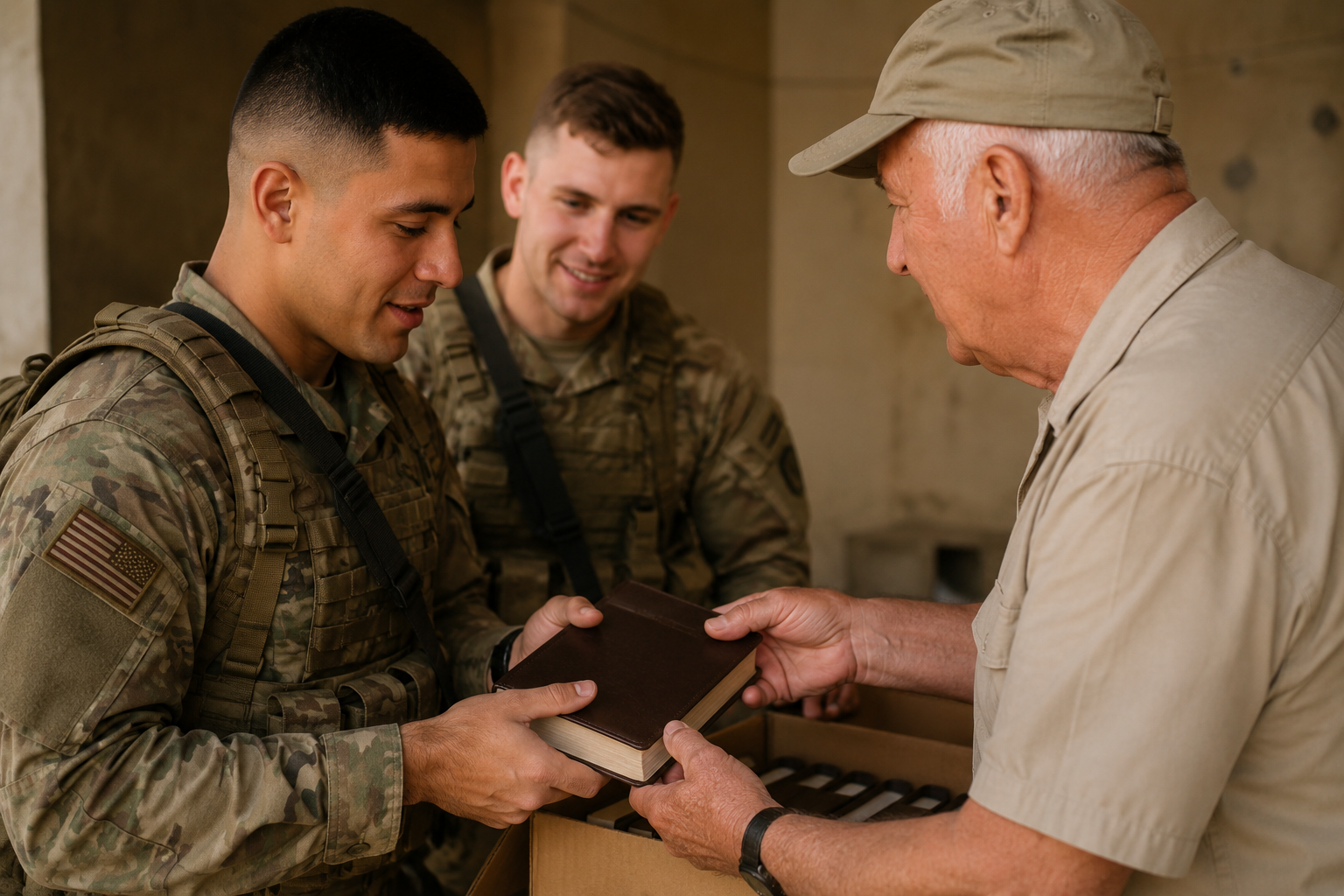
How ministries choose Bibles and devotionals that fit military realities
Translation, format, and durability as theological and practical decisions
Resource selection begins with straightforward constraints: readability under stress, physical durability, and the likelihood that a Bible will be carried rather than shelved. That often leads ministries toward compact New Testaments, rugged covers, and layouts that do not assume long uninterrupted reading sessions.
Translation choices carry pastoral implications. A highly literal translation may preserve wording helpful for study, while a more dynamically equivalent translation may serve a new believer better in the first months of serious engagement. Responsible ministries avoid “one-size-fits-all” thinking and instead match resources to audience: recruits, deployers, spouses, wounded veterans, or those in recovery programs.
Doctrinal alignment and the limits of generic inspiration
Devotionals vary widely in theological depth and ecclesial assumptions. Some are catechetical and church-oriented; others are loosely motivational. For donors concerned with fidelity, the key question is whether the devotional content is anchored in Scripture, confesses historic Christian orthodoxy, and avoids reduction of the gospel to self-improvement.
Across our verification work at Most Trusted, ministries that meet The Most Trusted Standard tend to treat content selection as a governance issue, not an intern task. They document why particular devotionals are used, who reviews them, and what safeguards exist against drift over time.
Distribution channels that actually reach service members
Chaplains, installations, and the ethics of access
Some of the most effective distribution occurs through partnership with military chaplains, who understand installation rules, sensitive contexts, and how to serve pluralistic environments while honoring free exercise. Many ministries provide resources to chaplains who request them, rather than forcing access. This posture matters. It protects the integrity of the chaplaincy and reduces the risk of perceived coercion.
Donors should be aware that military policy and installation practices vary. Service members’ religious liberty is protected, but ministries still need permission to operate in particular spaces. Ministries that work carefully within appropriate channels tend to preserve long-term access and avoid reputational damage that can close doors for others.
Deployment pathways and the long tail of spiritual care
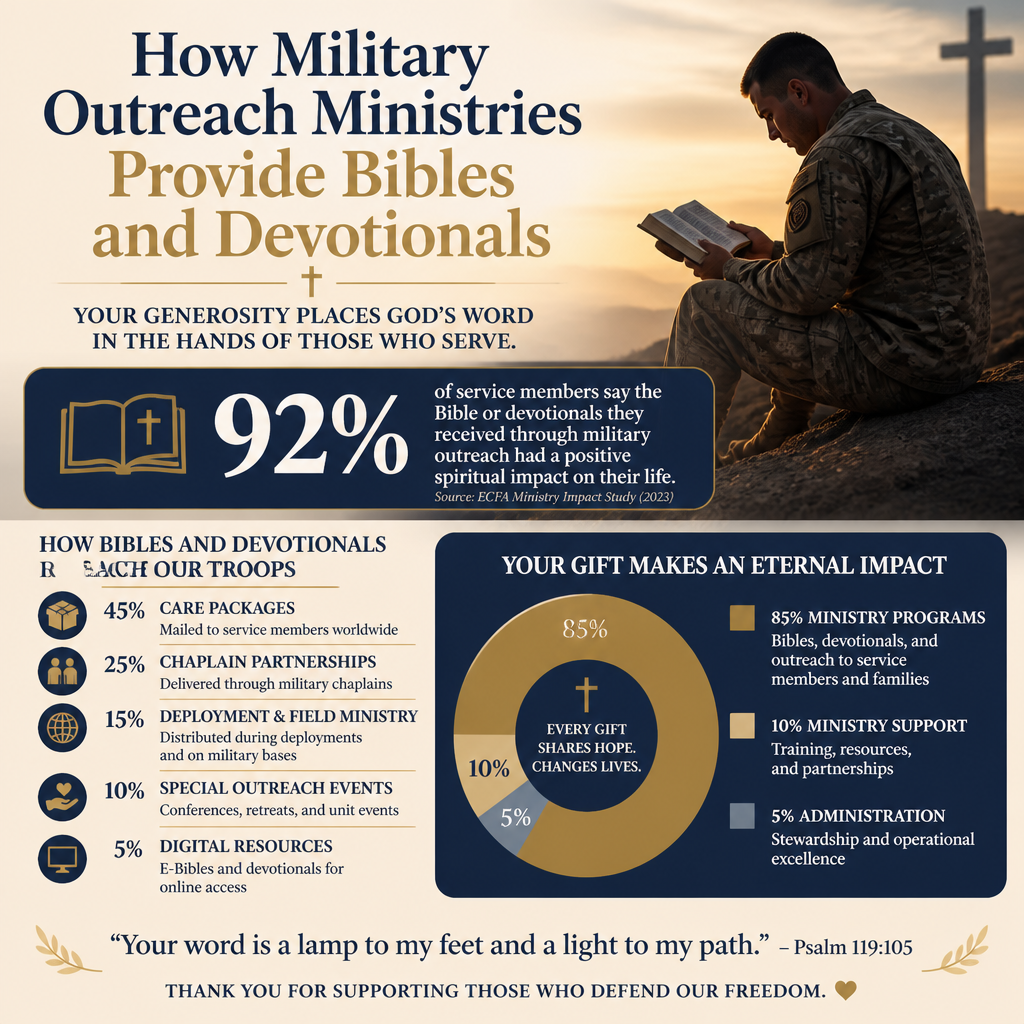
Distribution often follows the rhythms of deployment: pre-deployment briefings, send-off services, family readiness events, care package networks, and post-deployment reintegration programs. A Bible handed to a service member before a nine-month deployment may be read in ways neither donor nor distributor can see, but those unseen moments are often where spiritual formation occurs.
For donors seeking broader context on the field, we track recurring patterns and safeguards across Military Outreach Ministries—including how ministries maintain access without compromising integrity.
What donors should evaluate before funding Bible and devotional distribution
Financial integrity beyond unit cost
Bibles and devotionals can be purchased at scale, donated in-kind, or funded through designated giving. Each pathway has accountability questions. Donors should look for clear reporting on how many items were purchased, the all-in cost per item after shipping and handling, and whether restricted gifts are honored as restricted gifts. A ministry that cannot explain its cost structure with clarity is unlikely to steward distribution well over time.
When donors evaluate print-resource programs, it is also worth remembering the broader philanthropic caution against simplistic “overhead” metrics. The sector’s “Overhead Myth” statement—signed by leading evaluators—argues that administrative costs alone are not a proxy for impact and that transparency and results matter more than a single ratio (Candid/GuideStar).
Governance, content controls, and measuring what can be measured
Bible distribution does not lend itself to laboratory-style measurement. A ministry cannot and should not attempt to surveil reading habits. Yet a serious ministry can still evaluate reach and stewardship: fulfillment accuracy, chaplain reorders, follow-up requests, small group formation, and qualitative feedback from credible partners.
The ministries that show the strongest stewardship discipline typically have:
- Documented policies for theological review of devotionals and study guides
- Clear boundaries for working with chaplains and installation authorities
- Auditable inventory and shipping controls
- Transparent reporting that distinguishes Bibles from other printed materials
- A plan for pastoral follow-up when a recipient asks for discipleship help
Those practices align with the kinds of questions we press in verification, because The Most Trusted Standard is designed to protect both donor confidence and ministry integrity: faith commitments that are explicit, financial stewardship that is documented, leadership that is accountable, and communication that is truthful about what the ministry can and cannot claim.
Common tensions in Bible distribution and how mature ministries address them
Proselytism concerns and the difference between coercion and availability
Christian ministry in military settings sits under heightened scrutiny, sometimes for good reason. When authority and hierarchy are built into daily life, the line between invitation and pressure can feel thin to those on the receiving end. Mature ministries therefore emphasize voluntariness: resources are offered, not imposed; participation is opt-in; and distribution does not ride on a commander’s implied endorsement.
This posture is not timidity. It is a form of neighbor-love and a recognition that the gospel does not need coercion to be effective. It also helps preserve the credibility of Christian witness across an installation.
Digital resources, literacy, and the realities of attention
Some donors assume digital delivery is the obvious next step: apps, PDFs, and online devotionals. Sometimes it is. But in military contexts, connectivity is uneven, device rules vary, and attention is often fragmented. Printed Scripture remains uniquely resilient: it works when the battery dies, when internet access is restricted, and when a service member wants privacy.
What this means in practice is that wise ministries offer multiple formats without romanticizing any of them. They also avoid overstating outcomes. A Bible distributed is not the same as a disciple made, yet Scripture placed in reach is often the first step toward the deeper work of repentance, faith, and sustained formation.
Donors who focus on prayerful discernment and verifiable accountability tend to support ministries with lasting credibility. For adjacent work in spiritual support and care, we maintain coverage of Prayer and Spiritual Care in Military Outreach Ministries, where these questions surface repeatedly.
FAQs for How military outreach ministries provide Bibles and devotionals
Do military outreach ministries work through chaplains or independently?
Many of the most effective programs work through chaplains because chaplains understand installation policies, have pastoral visibility, and can distribute resources in ways that respect voluntariness and pluralism. Some ministries also distribute through churches, family readiness networks, and care package partners. Donors should prefer ministries that can explain their access pathways and boundaries with clarity.
What should donors look for to ensure Bibles and devotionals are handled responsibly?
Donors should look for doctrinal clarity in the ministry’s faith commitments, documented review of devotional content, auditable inventory and shipping controls, and transparent reporting about what was purchased and where it was sent. The strongest ministries avoid exaggerated impact claims and instead show disciplined stewardship and credible partner feedback.
Why this particular work merits careful, confident giving
Providing Bibles and devotionals to service members is one of the simplest forms of Christian generosity, and it can also be one of the most easily romanticized. The mature donor posture holds both truths: Scripture is powerful, and distribution programs require sober accountability. When donors fund ministries that honor the Word, respect the military context, and operate with verifiable integrity, they help place enduring spiritual resources where fleeting opportunities often define a service member’s life.



