
When Christian donors ask what share of donations funds military outreach programs, they are usually seeking more than a ratio. They are asking whether a ministry’s public story matches its internal realities: whether support truly reaches chaplains, counselors, peer-to-peer discipleship, and the spiritual care that service members and families quietly carry as a burden.
The harder question is that “share” is not always a single line item. Military outreach can be delivered through base access partnerships, local church networks, retreat counseling, digital follow-up, or grantmaking to embedded chaplaincy work. A mature answer distinguishes mission-critical program costs from necessary support functions, and it evaluates whether the ministry’s financial presentation is honest, coherent, and governable.
Why the share question matters and why it is easy to misunderstand
Donors are right to ask where funds go
Scripture treats stewardship as a moral matter, not a branding preference. Jesus’ warnings about wealth and integrity are not abstract. For donors, the question “how much reaches the field” is part of guarding the heart against sentimentality and honoring the labor of those who serve those in harm’s way.
Military communities often carry invisible costs: moral injury, family strain during deployments, spiritual isolation, and the aftershocks of transition to civilian life. A ministry can claim to “serve troops” while spending heavily on media, events, or fundraising apparatus that produces inspiration without sustained pastoral presence. The share question presses ministries to demonstrate that their claims correspond to verifiable activity.
Percentages can reward the wrong behavior
Christians genuinely disagree about how much weight to place on “program percentage” versus outcomes, faithfulness, and long-term fruit. The nonprofit sector has had to reckon with the fact that simplistic overhead targets can incentivize underinvestment in staff development, cybersecurity, internal controls, and evaluation—exactly the things that prevent scandal and protect beneficiaries.
Major charity evaluators have explicitly warned against using overhead ratios as the primary indicator of effectiveness. The widely cited “Overhead Myth” letter—signed by GuideStar, BBB Wise Giving Alliance, and Charity Navigator—argues that overhead measures are poor proxies for impact and can distort giving decisions (GuideStar).

What counts as military outreach program spending
Program spending should map to beneficiary-centered activity
For military outreach ministries, program spending should be traceable to activities that directly serve service members, veterans, and their families: pastoral counseling, spiritual formation, crisis response, trauma-informed care, chaplain support, family retreats with follow-up, mentoring relationships, and local partnerships that keep ministry close to the community rather than only at headquarters.
In our verification work at Most Trusted, the ministries that meet The Most Trusted Standard tend to describe program costs in ways that correspond to identifiable services, personnel, and locations. They can name what happens after the event, after the retreat, after the distribution—because discipleship is rarely a one-time contact.
Some costs look like overhead but are mission-protective
Military-facing ministry has compliance realities that many donors never see: background checks for volunteers, safeguarding and reporting protocols, secure data practices for counseling records, and careful governance around base access and partnerships. These do not always sit neatly under “program” on a Form 990, yet they are often part of responsible ministry in high-trust environments.
The same is true for staff training in trauma care, supervision for counselors, and risk management. A ministry that pushes those costs down to inflate a program ratio may appear efficient while quietly increasing risk to those it serves.
How to read the financials without being misled
Start with the Form 990 and audited statements when available
For most U.S.-based ministries, the IRS Form 990 provides a standardized window into revenue, expenses, compensation governance, and functional expense allocation. When a ministry is large enough to have an audit, audited financial statements and a management letter add another layer of accountability. The question is not whether the numbers look impressive, but whether they are consistent across documents and over time.
Donors can access Form 990 filings through the IRS’s tax-exempt organization search tools (Internal Revenue Service). When a ministry presents curated ratios on its website, we recommend checking whether those ratios can be reconciled to the Form 990’s functional expense reporting.
Watch for common signals of distorted reporting
Certain patterns deserve scrutiny, especially when a ministry’s narrative emphasizes heroism and urgency—both of which can be real, and both of which can be used to lower a donor’s guard. A single-year ratio can be unusually high or low for non-recurring reasons, so trends matter.
- Large “program” allocations for broad awareness media with limited evidence of follow-up care
- Fundraising expenses that are unusually hard to find or explained only in vague terms
- Fast-growing revenue without corresponding investment in finance, HR, or safeguarding
- Inconsistent definitions of “program” across donor materials and public filings
- Heavy reliance on restricted gifts without clear policies for honoring donor intent
None of these automatically disqualifies a ministry. They are prompts for deeper questions and clearer documentation.
Reasonable ranges and the deeper question behind them
What donors often expect and what ministries can sustain
Many donors have been taught to look for a single “good” program percentage. The reality is that sustainable military outreach can legitimately require meaningful spending on competent leadership, pastoral supervision, systems, and compliance. A ministry that serves across installations or internationally will often have additional costs that do not exist in a purely local model.
Rather than fixating on a universal threshold, we recommend asking whether the ministry’s spending patterns are intelligible for its strategy. A peer-to-peer discipleship model in local congregations will allocate differently than a counseling-heavy model for veterans and spouses. A chaplain-equipping ministry may have fewer direct-service line items but still deliver significant field effect through training and resourcing.
Faithfulness is not opposed to measurable accountability
Christian ministry is not a commodity, and not all fruit is countable. Yet Scripture also commends transparency and integrity. The ministries that operate with maturity tend to report both activity and effectiveness in a way that resists manipulation: what they did, whom they served, what follow-up occurred, and what safeguards exist for those who are vulnerable.
For donors seeking to compare approaches within Military Outreach Ministries, the most useful comparison is often not “who has the highest program percentage,” but “who can demonstrate that their resources reliably produce sustained spiritual care, with governance and financial controls worthy of the trust given.”
Practical questions to ask before you give
Questions that clarify what the ratio actually means
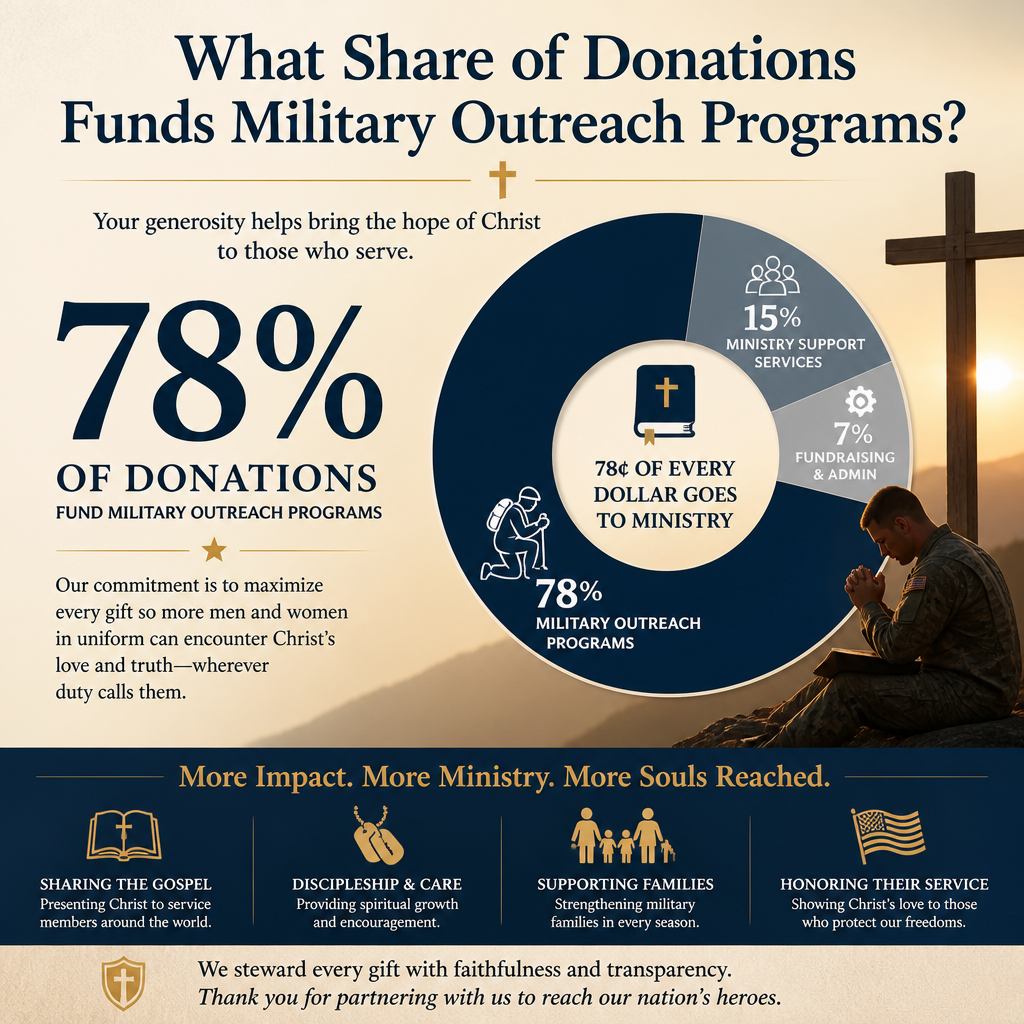
The share of donations funding military outreach programs becomes meaningful when a ministry can explain what it counts as program, why that definition is appropriate, and how leadership ensures accuracy. What this means in practice is asking for plain answers that can be corroborated by documents, not merely by testimonials.
We recommend asking:
- Which activities are classified as “program” and which are classified as “fundraising” and “administration”?
- Do you have audited financial statements, and are they available to donors?
- How do you safeguard counseling data, volunteer access, and beneficiary privacy?
- What is your approach to follow-up after initial contact with service members or families?
- How does your board review compensation, conflicts of interest, and major expenditures?
These questions do not treat ministry as a business. They treat ministry as a trust—one that involves money, people, and the name of Christ.
How Most Trusted fits in for donors who want verification
Most donors cannot perform full due diligence alone, especially when giving across multiple causes. Most Trusted exists to help Christian donors give with confidence by evaluating ministries against The Most Trusted Standard, a 15-criteria framework spanning faith foundation, financial integrity, governance and leadership, and transparency and effectiveness. When a military outreach ministry meets those criteria, donors gain a clearer basis for trust than a single overhead ratio can provide.
For donors comparing options within How to Give Wisely to Military Outreach Ministries, verification is most helpful when it strengthens both clarity and humility: clarity about where funds go, and humility about what cannot be reduced to a marketing number.
FAQs for What share of donations funds military outreach programs
Is a higher program percentage always better for military outreach ministries?
No. A higher program percentage can be consistent with faithful, efficient ministry, but it can also reflect aggressive accounting choices or underinvestment in governance, staff development, safeguarding, and compliance. Donors should treat the ratio as one indicator and then test whether the ministry’s definition of “program” matches real beneficiary-centered activity and is consistent with public filings.
What documents should a military outreach ministry provide to support its claims?
At minimum, donors should be able to review recent IRS Form 990 filings and clear annual reporting that connects spending to ministry activities. When available, audited financial statements strengthen confidence. Policies around conflicts of interest, board oversight, and safeguarding procedures are also relevant for ministries serving populations where privacy, trauma care, and trusted access are central to the work.
Giving that honors both compassion and truth
What share of donations funds military outreach programs is a legitimate stewardship question, but it should not be the only one. Mature giving asks whether a ministry’s finances, governance, and reporting sustain the kind of long-term pastoral presence that military life requires.
Donors are not merely purchasing services. We are participating in a shared responsibility before God to serve those who bear the sword on our behalf and those who carry the cost at home, with integrity that can withstand honest scrutiny.



