

How to give monthly to military outreach ministries is ultimately a question of stewardship under pressure: how to sustain long-term pastoral and practical care for men and women who live with unique burdens, while keeping faith with the church’s obligation to give with discernment. Military life concentrates hardship—separation, moral injury, frequent moves, and the quiet loneliness that can follow service—yet it also concentrates courage and sacrifice worthy of honor.
Monthly giving is one of the most effective ways donors can underwrite the steady presence that ministry requires. A chaplaincy partnership, a counseling referral network, or a local ministry team welcoming a newly relocated family cannot be funded on sporadic generosity alone. Scripture commends both generosity and order: “Let all things be done decently and in order” (1 Corinthians 14:40). Regular giving is not less spiritual; it is often more faithful.
Why monthly giving fits the realities of military ministry
Military communities require continuity, not bursts of attention
Military outreach is shaped by schedules that civilians rarely see. Deployments extend beyond headlines. Training cycles and duty rosters make “normal” church rhythms difficult. Families may move multiple times in a few years, and a spouse may carry heavy responsibility alone. Ministries that serve this community need predictable support so they can plan counseling capacity, staff care, and emergency assistance without gambling on seasonal fundraising.
Monthly donors make that continuity possible. They also reduce the ministry’s administrative burden by stabilizing cash flow, which can lower the temptation to chase donor emotion rather than maintain disciplined programming. For donors, monthly giving becomes a form of quiet solidarity: an ongoing commitment that mirrors the long obedience often required of military families.
The Christian obligation is compassion joined to discernment
Christians genuinely disagree about the best models of military outreach—particularly around the relationship between local congregations, parachurch ministries, and government chaplaincy structures. The field has also had to reckon with the dangers of politicization: ministry can drift into partisan identity, or it can flatten complex moral questions into slogans. Mature giving faces these tensions directly and asks whether a ministry keeps the gospel central while serving the whole person.
When donors consider how to support this work, it helps to keep Romans 12:9 in view: “Let love be genuine. Abhor what is evil; hold fast to what is good.” Genuine love does not suspend judgment; it disciplines it toward truth.

What to evaluate before you commit to a monthly gift
Clarity of mission and theological seriousness
Military outreach ministries vary widely: some focus on evangelism near bases, others on counseling and trauma care, others on marriage and family resilience, and others on discipleship among veterans. A sound monthly commitment begins with clarity about what the ministry exists to do, whom it serves, and what it considers success. Vague mission language often hides either mission drift or an attempt to be everything to everyone.
Theological seriousness should be visible, not presumed. Does the ministry articulate the gospel clearly? Does it present the Christian life as formation, not merely crisis management? A ministry can be both deeply compassionate and spiritually thin. Donors should not treat that as an acceptable trade.
Governance, financial integrity, and credible reporting
Military contexts can create an aura of unquestioned legitimacy—especially when an organization uses patriotic imagery or the language of sacrifice. That makes governance and financial integrity even more important. Donors should look for independent board oversight, conflict-of-interest safeguards, and financial statements that can be understood by a careful reader.
Two common mistakes appear here. The first is treating overhead as the enemy. The second is treating overhead as irrelevant. The better path is to ask whether spending choices are aligned with mission and whether the organization reports them transparently. Sector leaders have repeatedly warned against simplistic overhead ratios; Charity Navigator, Candid (formerly GuideStar), and the BBB Wise Giving Alliance jointly argued that “overhead ratios…are not a measure of nonprofit performance” and can mislead donors if used alone Charity Navigator.
Across our verification work at Most Trusted, the ministries that meet The Most Trusted Standard tend to communicate financials and outcomes in a way that invites scrutiny rather than managing perception. That posture is not cosmetic. It is a moral discipline.
How to structure a monthly gift with integrity and wisdom
Choose a purpose that matches the ministry’s actual capacity
Some donors want to designate every dollar; others prefer unrestricted giving. The reality is more complex. Restricted gifts can protect donor intent, but they can also starve core operations if donors over-restrict. Unrestricted giving can strengthen resilience, but it requires high trust in leadership and governance.
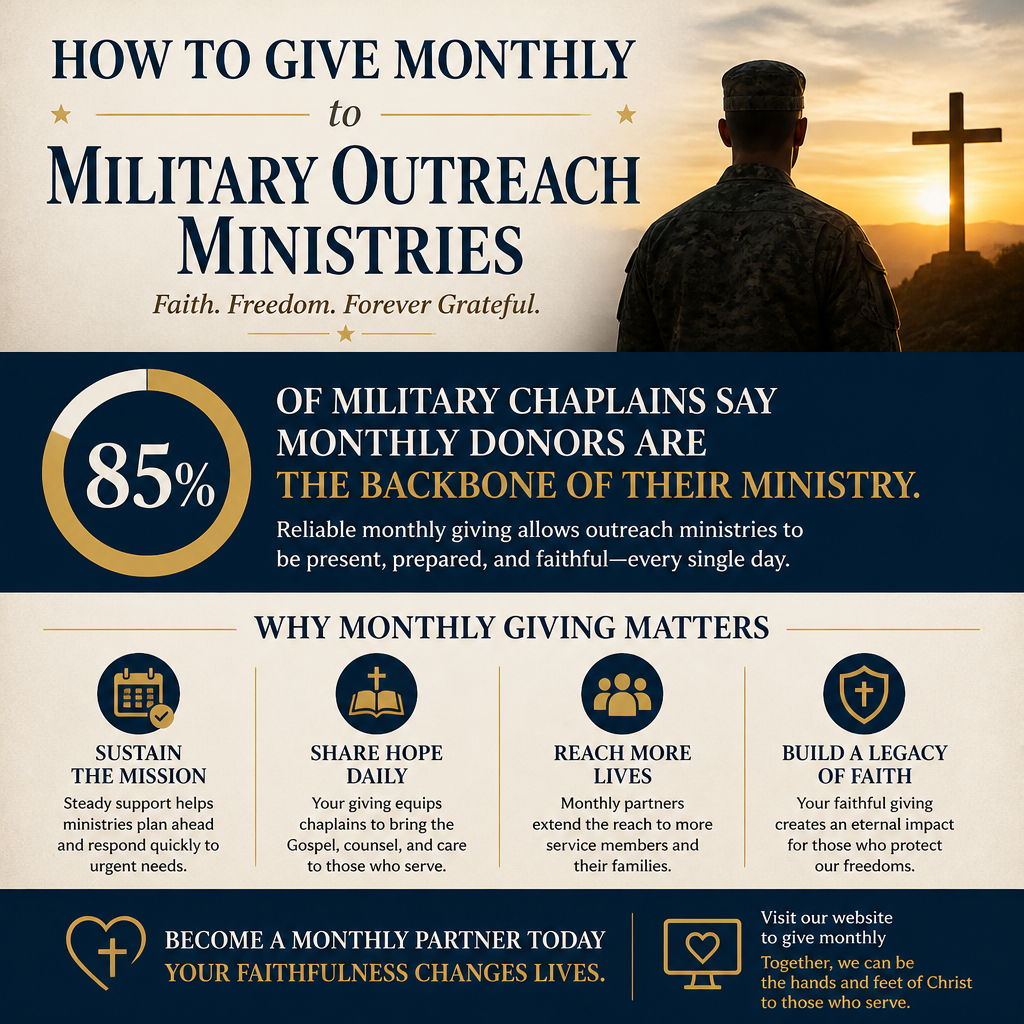
A prudent middle way is to give monthly toward a defined program area that still allows the ministry to manage staffing and operations responsibly. If a ministry offers clear options—such as “chaplain support,” “counseling scholarships,” “base outreach,” or “veteran discipleship”—ask how each is budgeted and reported, and whether monthly giving is applied consistently rather than absorbed into marketing.
Set a review rhythm without turning support into suspicion
Monthly giving should not mean disengagement. Neither should it mean constant second-guessing that erodes the relationship. Many donors find it wise to set a regular annual review: read the ministry’s year-end report, scan audited financials if available, and assess whether messaging and programming remain faithful to stated mission.
In practice, a simple checklist keeps the review concrete and avoids drifting into impressions.
- Does the ministry’s stated mission remain stable and specific?
- Are financial statements and board oversight publicly explained?
- Are outcomes described with clarity rather than promotional vagueness?
- Is the ministry’s theological center of gravity recognizably Christian?
- Do communications respect service members rather than commodify them?
If this kind of disciplined review is unfamiliar, donors often benefit from reading broadly across the field. Our coverage of Military Outreach Ministries is designed to help donors compare approaches without collapsing everything into a single model.
Common pitfalls in military outreach giving and how to avoid them
Confusing emotional resonance with demonstrated faithfulness
Stories matter. Jesus himself taught through stories. Yet donors should be wary of storytelling that cannot be reconciled with sober reporting. A ministry may share compelling testimony while failing to disclose governance weaknesses, staff turnover, or unclear program design. Mature compassion asks for both narrative and evidence.
Christians are not called to cynicism, but neither are we called to credulity. “Test everything; hold fast what is good” (1 Thessalonians 5:21) applies to giving as surely as it applies to teaching.
Ignoring the limits of a ministry’s scope
Military communities face complex needs: PTSD and trauma, addiction, suicide risk, marital strain, financial stress, and spiritual disorientation. Not every ministry should attempt to address all of them. Donors should treat overreach as a warning sign. If an organization claims to solve every problem for every branch, it may lack the humility and referral partnerships that effective care requires.
Responsible ministries often build relationships with clinicians, churches near bases, chaplains, and veteran networks so that care is coordinated. When donors see this kind of collaboration, it usually indicates leadership that understands its lane.
Making monthly giving a part of your broader stewardship
Integrate monthly giving with local church faithfulness
For Christian donors, monthly giving to a military outreach ministry should ordinarily complement, not replace, committed giving to the local church. The New Testament pattern assumes a gathered people, accountable leadership, and ordinary means of grace. Parachurch ministry can extend the church’s reach, but it should not become a substitute for ecclesial commitment.
That balance also protects donors from treating military outreach as an isolated cause rather than part of Christian discipleship. It is easier to fund a cause than to inhabit a community; the church trains us to do the latter.
Use verification as a form of neighbor love
Wise giving is not merely self-protection. It is a way of loving both the people served and the staff doing the work. When donors fund ministries with weak governance, opaque finances, or inflated claims, the eventual cost is borne by vulnerable people and by faithful workers whose efforts are undermined by preventable distrust.
Most Trusted exists to help donors give with confidence by evaluating ministries against The Most Trusted Standard, a 15-criteria framework spanning faith commitments, financial integrity, governance, and transparent reporting. Donors who want to focus their monthly giving within a defined set of practices often begin with our evaluations within How to Give Wisely to Military Outreach Ministries.
FAQs for How to give monthly to military outreach ministries
Should we give monthly as unrestricted support or designate our gift?
Both can be faithful, and each carries trade-offs. Unrestricted monthly support strengthens a ministry’s ability to plan and retain staff, but it requires confidence in governance and reporting. Designated giving can reflect donor intent and fund clear needs, but excessive restriction can weaken core operations. We recommend asking how the ministry budgets designated funds, whether it reports program spending clearly, and whether leadership can explain why some unrestricted support is necessary for long-term effectiveness.
What documentation should we expect before committing to a monthly gift?
At a minimum, donors should be able to find current leadership and board information, a clear doctrinal statement or faith commitments, accessible financial reporting, and a credible description of programs and outcomes. If a ministry claims large-scale impact, it should be prepared to explain methodology and limits, not only share testimonials. When information is withheld or only available through private requests, donors should treat that opacity as a meaningful signal.
A monthly gift that honors both service and stewardship
Monthly giving to military outreach ministries is most faithful when it is steady, discerning, and anchored in the church’s larger moral imagination. The goal is not to reward compelling narratives or cultural symbols, but to sustain ministries that serve service members and families with Christian seriousness, practical competence, and transparent accountability. When donors bring that posture to their monthly commitments, generosity becomes not only consistent, but trustworthy.



