

What military outreach ministries do on bases is more than “holding a chapel service.” The strongest work is often quiet, relational, and sustained: helping service members endure moral injury, family strain, isolation, and the spiritual disorientation that can accompany military life.
For Christian donors, this category raises a second question alongside compassion: what does responsible ministry look like in a regulated environment where command authority, pluralism, and security concerns shape what can and cannot happen? The answer is not to retreat from the work, but to support ministries that operate with theological clarity, institutional humility, and demonstrable accountability.
Ministry on base is shaped by law, policy, and command authority
Military installations are not typical ministry settings. They are federal workplaces with strict rules around access, solicitation, and the role of chaplains. When donors understand those constraints, they are better equipped to evaluate a ministry’s claims and methods.
Chaplains have a defined role and outside ministries must respect it
In the U.S. system, chaplains are commissioned officers tasked with protecting the free exercise of religion for service members, while also advising commanders on religion, ethics, and morale. Outside ministries that work well on bases typically do so in cooperation with chapels and commanders, rather than bypassing them.
Many base-adjacent efforts exist because a chaplaincy cannot do everything. Chaplains rotate, carry heavy caseloads, and must provide for diverse faith needs. The healthiest outside ministries treat chaplains as partners and refuse to exploit access as a marketing channel.
“Access” is not the same as “effectiveness”
Some organizations describe their work primarily in terms of how many bases they reach or how many events they run. Those numbers may have meaning, but donors should not confuse reach with pastoral fruit. On-base ministry is often measured in retention of relationships, consistent presence, and non-coercive care over time.
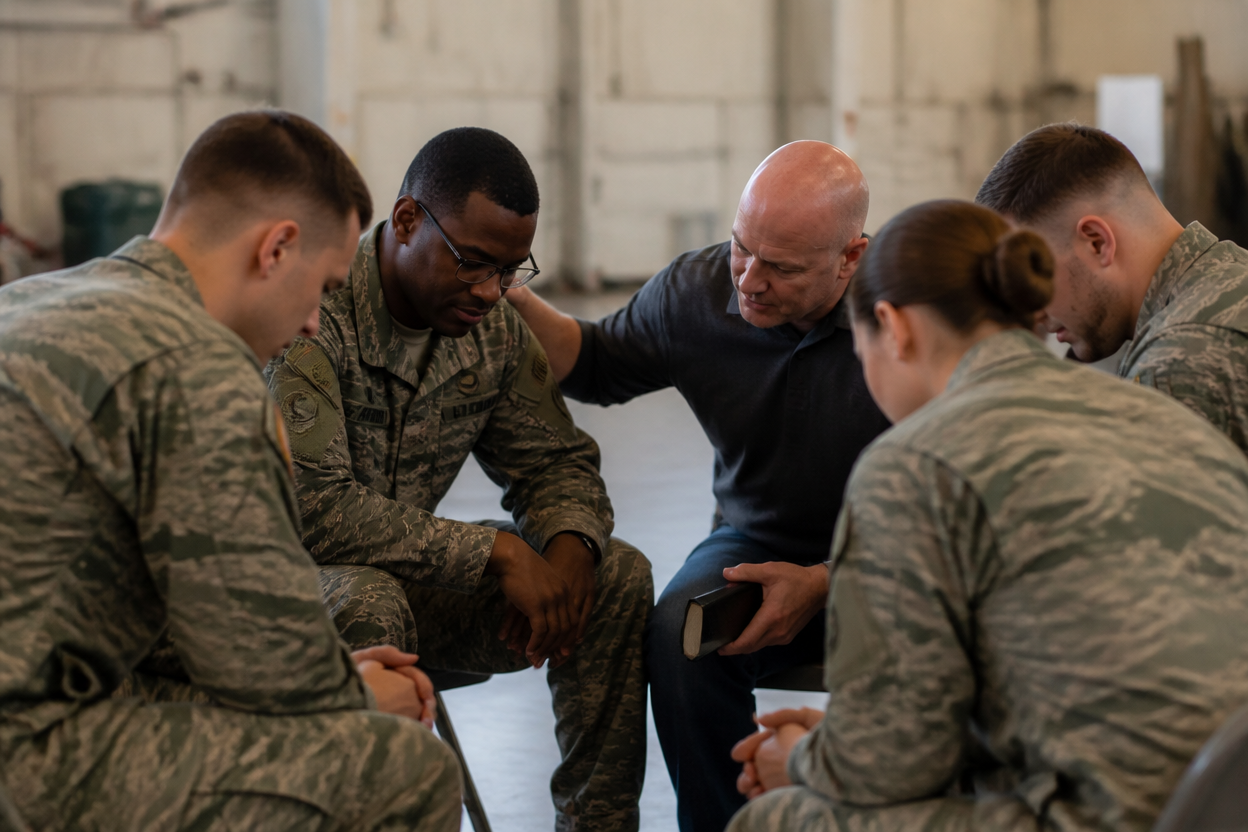
Most on-base outreach is pastoral presence under pressure
The daily realities of military life create a distinctive pastoral landscape. Service members are trained for competence and resilience, yet many carry burdens they do not easily name in public. Effective ministries meet those burdens with patient discipleship rather than crisis-driven programming.
Moral injury and spiritual dislocation are real ministry terrain
Combat, training accidents, and even routine operational decisions can leave people with guilt, shame, grief, and spiritual confusion that does not fit neatly under a clinical category. Christian ministry does not replace professional mental health care, but it can provide something secular systems often cannot: a coherent account of sin and suffering, confession and forgiveness, and hope rooted in the crucified and risen Christ.
Scripture gives language for this burden. David’s psalms refuse denial and yet refuse despair; they model lament offered to God rather than hidden from him (Psalm 42). On-base outreach at its best creates space for truth-telling without performance.
Relationships, not events, carry much of the spiritual weight
Many of the most faithful interventions are ordinary: a consistent small group for junior enlisted, a steady Bible study for spouses, rides for service members without cars, meals during difficult seasons, or a pastor who reliably answers the phone at midnight. The visible program is often just a framework for long-term spiritual attention.

What this means in practice is that donors should ask how a ministry trains volunteers for endurance and discretion. A high-energy event may encourage someone for a weekend; a well-led community can sustain someone through a deployment cycle.
Family care is not optional in military outreach
Military service is rarely an individual calling in practice. It is a family system under strain: frequent moves, separations, child care disruptions, and the psychological weight of unpredictability. Ministries that focus only on the uniformed member often miss the place where pressure accumulates most.
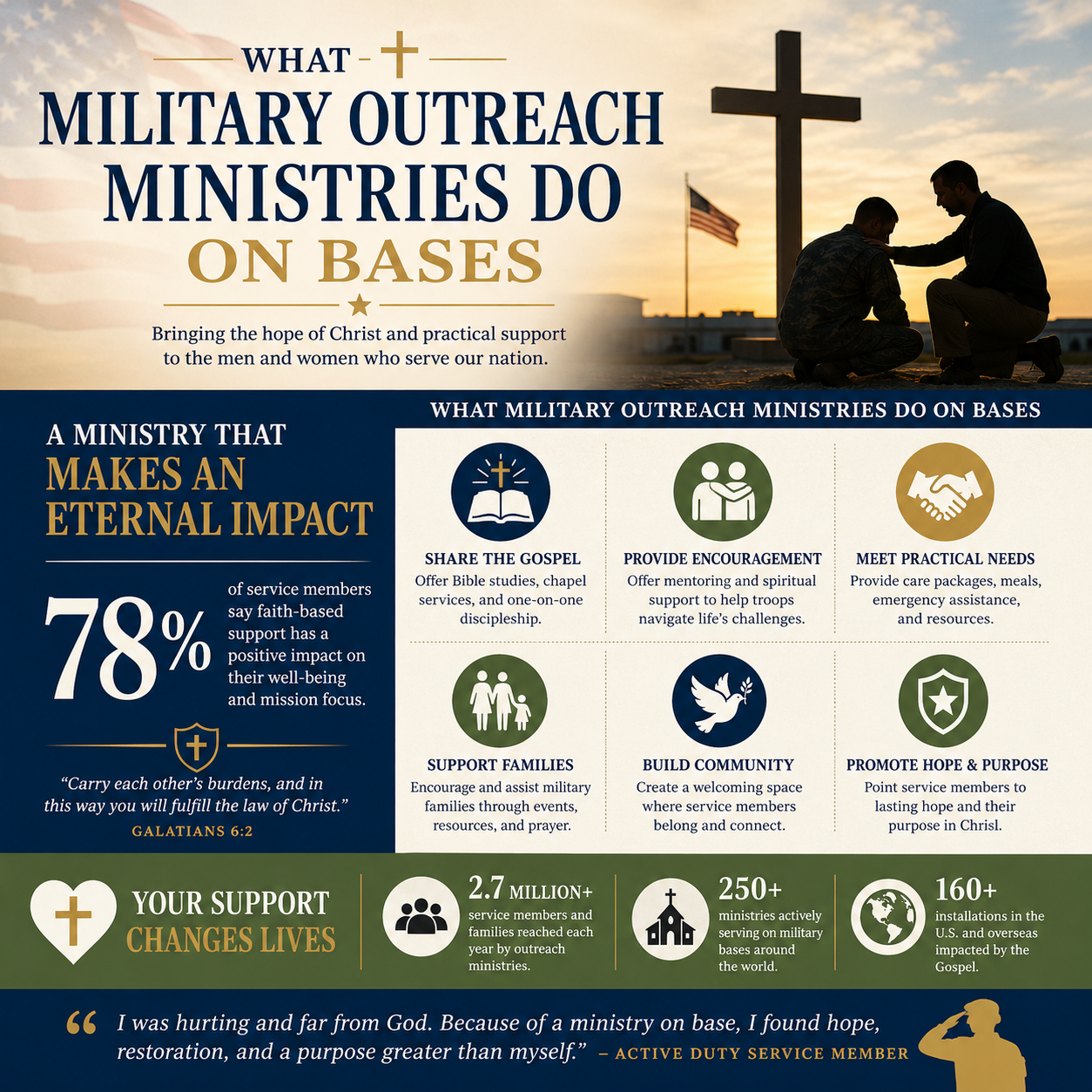
Deployments test marriages, parenting, and spiritual habits
Military families often live with “accelerated adulthood,” where young couples and young parents navigate responsibilities under unusual stress. Ministries serving on or near bases commonly provide marriage mentoring, parenting groups, emergency financial coaching, and practical support around childbirth, sickness, and crisis.
Donors sometimes underestimate how significant these “ordinary” services are. A meal train and child care can be the difference between a spouse staying connected to church or drifting into isolation. Christian love is not abstract; it takes form (1 John 3:18).
Spouses and children also need spiritual community that stays
Because families move frequently, they are vulnerable to being treated as temporary. A mature ministry builds continuity through repeatable rhythms, transferable discipleship tools, and partnerships with local churches that can receive families when they arrive and bless them when they leave.
For donors seeking a wider frame of the field, we maintain editorial coverage on Military Outreach Ministries with attention to how organizations describe their mission, governance, and outcomes.
Good ministries understand evangelism, pluralism, and power
Christians genuinely disagree about strategy and emphasis in military contexts. Some prioritize explicit evangelism; others stress pastoral care for those who already identify as Christian; many attempt both. The question for donors is not whether a ministry is “bold,” but whether it is faithful, wise, and respectful of the unique power dynamics of military life.
Ethical evangelism avoids coercion and respects agency
A base is a hierarchy. Rank shapes relationships, and service members cannot easily walk away from certain environments. That reality raises ethical questions about religious influence. Ministries that deserve donor confidence take care not to pressure people through social leverage, access, or benefits offered as implicit exchange for participation.
Healthy ministries articulate clear boundaries: participation is voluntary; leadership does not manipulate rank; material assistance is not conditioned on spiritual response. They aim to commend Christ, not to “close a sale.”
Trauma-informed care and referrals are part of integrity
Some needs are pastoral; some are clinical; many are both. Credible ministries train staff and volunteers to recognize risk factors (suicidality, domestic violence, severe depression) and to refer appropriately. Donors should ask whether a ministry has a documented safeguarding policy and relationships with professional resources.
For context on the scale of mental health need in the broader population, the National Institute of Mental Health reports that a substantial share of U.S. adults live with mental illness in a given year, a reality that inevitably touches military communities as well National Institute of Mental Health.
What donors should look for when funding on-base outreach
Because military outreach often happens in dispersed locations and through many small interactions, accountability can be harder to see. That does not mean it is impossible. It means donors should prioritize verifiable commitments over inspiring stories alone.
Evidence of credibility tends to cluster in a few concrete areas
Across our verification work at Most Trusted, the ministries that meet The Most Trusted Standard tend to show discipline in governance, clarity in doctrine, and transparency about how they measure effectiveness. They also tend to resist simplistic fundraising narratives that imply spiritual results can be purchased.
- Clear theological commitments that explain what the ministry believes and how that shapes practice
- Documented safeguarding for minors and vulnerable adults, including screening and reporting procedures
- Financial transparency with accessible, current financial statements and a coherent budget narrative
- Governance independence with an active board that provides real oversight
- Defined outcomes that go beyond attendance counts to retention, discipleship pathways, and referrals
Be realistic about measurement, then insist on honesty
Military outreach does not always lend itself to simple metrics. Confidentiality matters. Spiritual growth is not reducible to a spreadsheet. Yet donors can still ask for disciplined reporting: what programs ran, who led them, what training was completed, what partnerships exist with chaplains and local churches, and what risks were identified and mitigated.
When evaluating any ministry’s spending claims, it is also worth remembering the broad consensus among nonprofit evaluators that overhead ratios are a poor proxy for effectiveness. The “Overhead Myth” letter—endorsed by Charity Navigator, GuideStar (now Candid), and the BBB Wise Giving Alliance—explains why governance, strategy, and transparency matter more than simplistic percentages Candid.
Donors looking for adjacent analysis can also review our coverage within How Military Outreach Ministries Support Service Members, where we examine how different approaches address the real pressures of service life.
FAQs for What military outreach ministries do on bases
Do military outreach ministries replace chaplains?
No. Chaplains have an official role within the military to provide for service members’ free exercise of religion and to advise commanders. Outside ministries can serve faithfully when they cooperate with chapel leadership, respect base policies, and focus on complementary support rather than competing authority.
What should donors ask before funding an on-base ministry?
Donors should ask about access and authorization, safeguarding policies, volunteer screening and training, partnerships with chaplains and local churches, financial transparency, and how outcomes are defined. Because power dynamics are real on bases, donors should also ask how the ministry prevents coercion and handles referrals for clinical mental health needs.
A responsible generosity for a demanding mission field
Military outreach ministries do on bases what the Church has always done at its best: bring the Word of God to people under strain, practice mercy with tangible steadiness, and form disciples in communities that must often be rebuilt from scratch. Donors serve this work well by funding ministries that combine spiritual seriousness with institutional integrity, so that care offered in Christ’s name is worthy of the people who receive it.



