

How military outreach ministries support faith during reintegration is not primarily a question of programming. It is a question of formation under strain: whether a man or woman trained for vigilance can learn again to live as a neighbor, a spouse, a parent, and a worshiper without pretending that war left no mark. Reintegration presses on identity, trust, moral memory, and belonging—realities Scripture treats with gravity rather than sentiment.
Donors often ask for measurable outcomes, and they should. Yet reintegration ministry also requires patience with work that is not easily counted: restoring the ability to pray, to receive grace without self-justification, and to re-enter Christian community without either pedestal or pity. The churches and ministries that serve service members well tend to hold both truths together—rigorous stewardship and theological realism about the human heart.
Reintegration is a spiritual and moral transition, not only a logistical one
From operational identity to covenantal identity
Military life shapes identity through role, unit cohesion, and mission clarity. Civilian life is less defined, and that ambiguity can expose a deeper question: who am we when the uniform comes off and the urgent purpose recedes. Christian discipleship speaks directly here. Scripture repeatedly roots identity not in function but in covenant belonging: “You are a chosen race, a royal priesthood, a holy nation” (1 Peter 2:9). That declaration is not a slogan; it is a re-narration of self that can slowly displace shame, isolation, and performative toughness.
Effective military outreach ministries do not treat faith as a therapeutic accessory. They treat the gospel as a public truth with private consequences: confession, repentance, forgiveness, reconciliation, and durable hope. Reintegration often surfaces moral injury—wounds of conscience tied to perceived betrayal, participation in violence, or responsibility for decisions with life-and-death consequences. Christians genuinely disagree about clinical categories and the best language for these experiences, but the pastoral burden is consistent: sin and suffering intertwine, and both require more than willpower.
Why community often matters more than content
Much reintegration support is framed as education: workshops on resilience, budgeting, or job placement. These can be valuable. Yet for many service members, the deeper challenge is relational. A person can know what they “should do” and still feel unable to re-enter ordinary life without bracing for threat. Ministries that support faith during reintegration usually prioritize embodied community—consistent relationships, shared worship, and a place to be known without being managed.
At scale, the need is significant. The U.S. Department of Veterans Affairs reports that in 2023, 6,392 Veterans died by suicide, a sober reminder that transition stress can be lethal for some and spiritually disorienting for many others U.S. Department of Veterans Affairs. Not every case is tied to reintegration, and suicide is never reducible to a single cause. But the moral imperative for durable care is not in question.
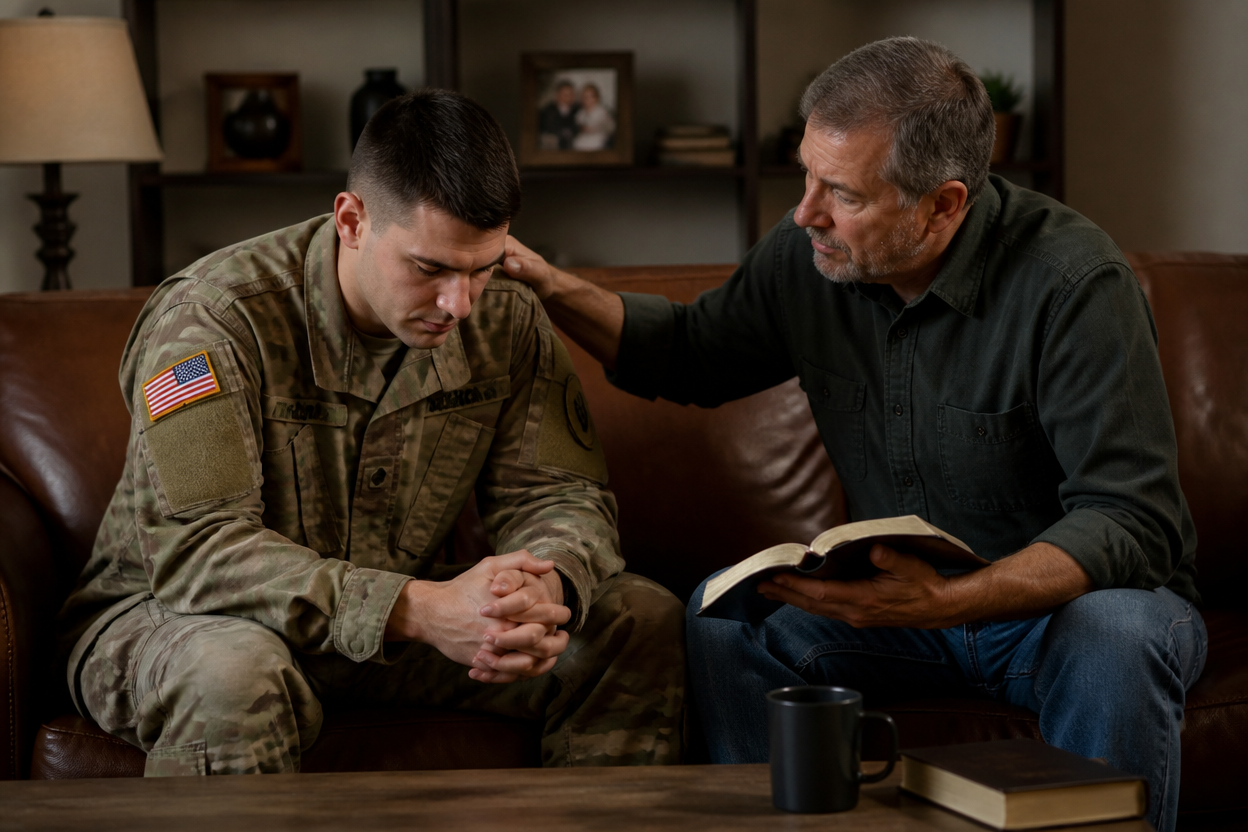
What faithful reintegration care looks like on the ground
Pastoral competence without replacing the local church
Military outreach ministries are at their best when they are explicitly Christian and strategically humble. Reintegration is not solved by parachuting in specialists who become the permanent center of gravity. The healthiest models strengthen the service member’s connection to a local church while offering targeted support the church may not be equipped to provide alone: peer groups with shared experience, trauma-informed pastoral counseling, chaplain partnerships, and family support that understands military rhythms.
This is where donors can press for clarity. A ministry should be able to explain how it relates to the local church, what it does directly, and what it refers out. When a ministry quietly becomes a substitute for church life, the service member may receive services but remain spiritually unrooted.
Practices that rebuild trust and spiritual agency
Reintegration often erodes agency. A service member may feel managed by systems: medical, benefits, employment, or even well-meaning ministry staff. Christian care should restore agency without abandoning accountability. We have seen ministries succeed when they design pathways that are simple, relational, and respectful—inviting participation rather than requiring performance.
Concrete practices vary by context, but a donor can look for a pattern like this:
- Peer groups led by trained facilitators who can recognize crisis risk and refer appropriately
- Pastoral care that includes confession, lament, and forgiveness without coercion
- Family support that treats marriage and parenting as covenant work, not merely “adjustment”
- Partnerships with clinicians when PTSD, addiction, or suicidality are present
- Meaningful service opportunities that restore dignity through contribution to others
Some of these components can be delivered by churches; others require specialized partnerships. The harder question for donors is not whether a ministry offers a menu of services, but whether its model consistently moves people toward worship, truth-telling, and durable belonging.

The family and the congregation are the primary reintegration environment
Marriage and parenting under the pressure of transition
Reintegration does not happen in isolation; it unfolds in kitchens, bedrooms, and Sunday pews. Families often carry unseen burdens: emotional distance, hypervigilance, irritability, sleep disruption, or a service member’s quiet conviction that no one can understand. The church can be tempted to treat these as merely “hard seasons.” Yet the New Testament’s household ethics assume a real moral world where patience, gentleness, and mutual submission are learned through suffering, not around it.
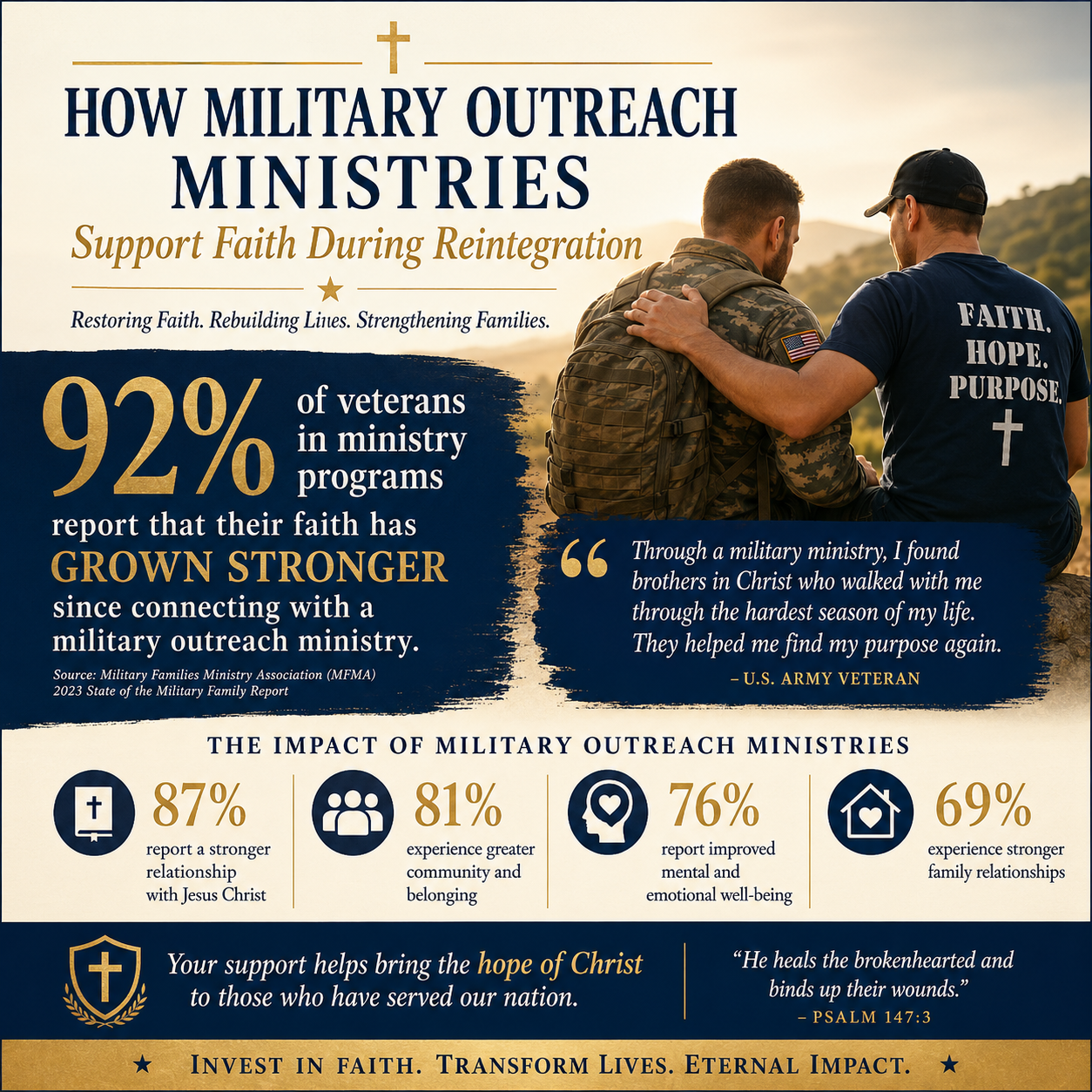
Wise ministries offer couples and families support that is both spiritually grounded and practically credible. They avoid simplistic exhortations that can shame spouses who are already exhausted. They also resist narratives that excuse sin under the banner of “what they have been through.” Reintegration care must hold compassion and moral clarity together.
Congregational hospitality that is not performative
Many churches want to honor veterans and service members. Honor is appropriate; flattery is not. Reintegration can be complicated by public recognition that pressures a person to appear strong. Ministries can help congregations practice hospitality that is ordinary and durable: invitations to meals, small groups that do not treat military experience as a curiosity, and leaders trained to respond well when someone shares trauma, doubt, or anger at God.
Across our verification work at Most Trusted, we observe that ministries most aligned with The Most Trusted Standard tend to articulate clear theological commitments about suffering, sin, and grace—then translate those commitments into repeatable pastoral practices. They do not rely on emotional storytelling to carry the donor relationship. They build structures that outlast a charismatic leader or a news cycle.
For donors seeking a broader view of the field, it helps to understand how military outreach fits into the wider landscape of Christian service and reintegration support within Military Outreach Ministries.
Where reintegration ministries can go wrong and how donors can discern maturity
The risks of spiritual overconfidence
Christian ministry is always tempted toward overconfidence: implying that prayer plus sincerity is a substitute for competent care. Reintegration is one domain where that temptation can do direct harm. Some service members need clinical treatment for trauma, depression, or substance misuse. A ministry that treats mental health care as inherently suspect may leave people isolated and endangered. At the same time, a ministry that reduces care to clinical categories can fail to speak of guilt, forgiveness, and the moral weight of violence. The wisest approach is integrated: pastoral seriousness and appropriate referral.
Donors can ask whether staff and volunteers receive training in safeguarding, crisis response, and referral protocols. They can also ask whether the ministry has relationships with local churches and licensed providers. These questions are not a lack of faith; they are a form of neighbor-love.
The risks of weak governance and untested claims
Reintegration ministry can attract strong personalities and significant donor loyalty. That combination makes governance unusually important. A ministry may do good work on the ground while operating with informal financial controls, limited board oversight, or vague reporting. The result is fragility: a single failure can undermine trust and harm those the ministry serves.
We recommend donors prioritize ministries that can demonstrate clean financial practices, accountable leadership, and honest reporting about both successes and limits. The sector has rightly absorbed the “Overhead Myth” critique—that administrative spending is not inherently wasteful—yet the deeper principle remains: stewardship must be visible and verifiable. The joint statement often cited in this conversation was issued by GuideStar, Charity Navigator, and the BBB Wise Giving Alliance Candid Guidestar.
When a ministry claims outcomes—reduced relapse, improved family stability, spiritual growth—donors should ask how those outcomes are tracked and what the ministry does when data contradicts expectations. Mature organizations have the humility to learn, adjust, and report candidly.
How donors can fund reintegration work with confidence and theological integrity
What to look for under The Most Trusted Standard
Donors are not obligated to become auditors, but serious Christian giving does require discernment. At Most Trusted, we evaluate ministries against The Most Trusted Standard, a 15-criteria framework spanning Faith Foundation, Financial Integrity, Governance and Leadership, and Transparency and Effectiveness. For reintegration-focused work, several indicators are especially consequential: clear doctrinal commitments, safeguarding and referral practices, board accountability, transparent financial reporting, and credible evidence that programs are doing what they claim.
What this means in practice is that donors can ask a short set of questions and learn a great deal. Who provides spiritual oversight? What is the ministry’s relationship to local churches and chaplains? What training is required before someone offers counsel to a traumatized person? How are funds restricted and reported? What does the board do besides meet?
Funding priorities that tend to strengthen long-term impact
Reintegration care is often underfunded because it is slow and relational. Donors can strengthen the field by funding unglamorous essentials: staff training, counseling subsidies, leader development, evaluation, and partnerships that reduce fragmentation. It can also be wise to fund capacity for case management that helps service members navigate practical burdens without being consumed by them.
Donors weighing options within this space may also benefit from seeing how different approaches serve different populations across How Military Outreach Ministries Support Service Members. Reintegration needs can vary significantly by component (active duty, Guard, Reserve), by combat exposure, and by family circumstances, and a ministry’s focus should be clear rather than universal in name only.
FAQs for How military outreach ministries support faith during reintegration
Do reintegration ministries replace what a local church should do?
They should not. The healthiest military outreach ministries treat the local church as the primary community for discipleship and worship, while offering specialized support the church may lack: peer groups with shared experience, chaplain coordination, family coaching attuned to military culture, and referral pathways for clinical care. Donors can ask how the ministry strengthens church connection rather than drawing people into a parallel spiritual life.
How can donors assess whether a ministry is handling trauma responsibly?
Responsible trauma care usually shows up in ordinary operational evidence: screening and safeguarding policies, training requirements for volunteers, referral relationships with licensed clinicians, and clear boundaries about what pastoral counseling can and cannot do. Donors can also look for humility in reporting—ministries that acknowledge limits and collaborate well tend to protect those they serve more consistently than ministries that promise quick transformation.
Reintegration support is discipleship under pressure
Military outreach ministries support faith during reintegration when they help service members move from survival to worship, from isolation to communion, and from moral confusion to truthful grace. This work is rarely efficient, and it is not reducible to a single intervention. But it is profoundly Christian: to bear one another’s burdens, to practice confession and forgiveness, and to form communities where those shaped by war can again learn the peace of Christ without denying what they have carried.



