
During a permanent change of station, the resources military outreach ministries provide during PCS moves often determine whether a military family experiences the transition as ordered chaos or as pastoral care in motion. For Christian donors, the question is not whether PCS stress is real, but whether our giving supports ministries that respond with competence, theological depth, and accountable stewardship.
PCS moves are frequent, and frequency changes what help must look like. When a family relocates every few years, they are repeatedly severed from the relationships that normally carry burdens: a trusted church, a small group, a consistent youth leader, a doctor who knows a child’s history. Military outreach ministries cannot replace those long-term structures, but they can provide immediate support that is practical, relational, and spiritually attentive.
PCS moves create predictable pressures that ministries can prepare for
Military families do not encounter transition as an occasional disruption; for many, it is a way of life. The Department of Defense has long described the tempo of service life as one that places stress on spouses and children through repeated moves and separations, and that framing matters because it implies the need for repeatable, not one-off, care systems.
The most faithful ministry responses are rarely improvised. They are built on patterns: advance contact, local partnerships, clear boundaries, and a willingness to serve the whole household rather than only the service member. In our review work at Most Trusted, ministries that meet The Most Trusted Standard tend to show evidence of these systems: documented processes, trained volunteers, and clear lines of accountability when a family is in a vulnerable moment.
Transition is both logistical and spiritual
Scripture does not treat the material and the spiritual as separate compartments. James ties “pure and undefiled religion” to concrete care for the vulnerable (James 1:27), and in the PCS context vulnerability often presents as a moving truck, a school transfer, and a spouse trying to hold the household together while the service member is absorbed by reporting requirements. A ministry that offers prayer but cannot coordinate basic help is not fully attending to the person; a ministry that only offers logistics without spiritual care risks becoming a generic social service.
Some needs are hidden in plain sight
Families often hesitate to ask for help because military culture prizes competence and resilience. That reluctance is not sin; it is often learned survival. It does mean that outreach ministries must design resources that can be accepted without shame: discreet gift cards, child care during essential appointments, a newcomer dinner where questions can be asked indirectly, and clear communication that assistance is normal during transition.

Practical resources that reduce instability in the first ninety days
Most PCS stress concentrates in a narrow window: the weeks leading up to departure and the first months after arrival. Ministries that serve well focus on predictable friction points, offering support that prevents small problems from turning into crises. Donors can recognize this maturity when a ministry’s programs map to the transition timeline rather than to what is most visible to outsiders.
Arrival support and household stabilization
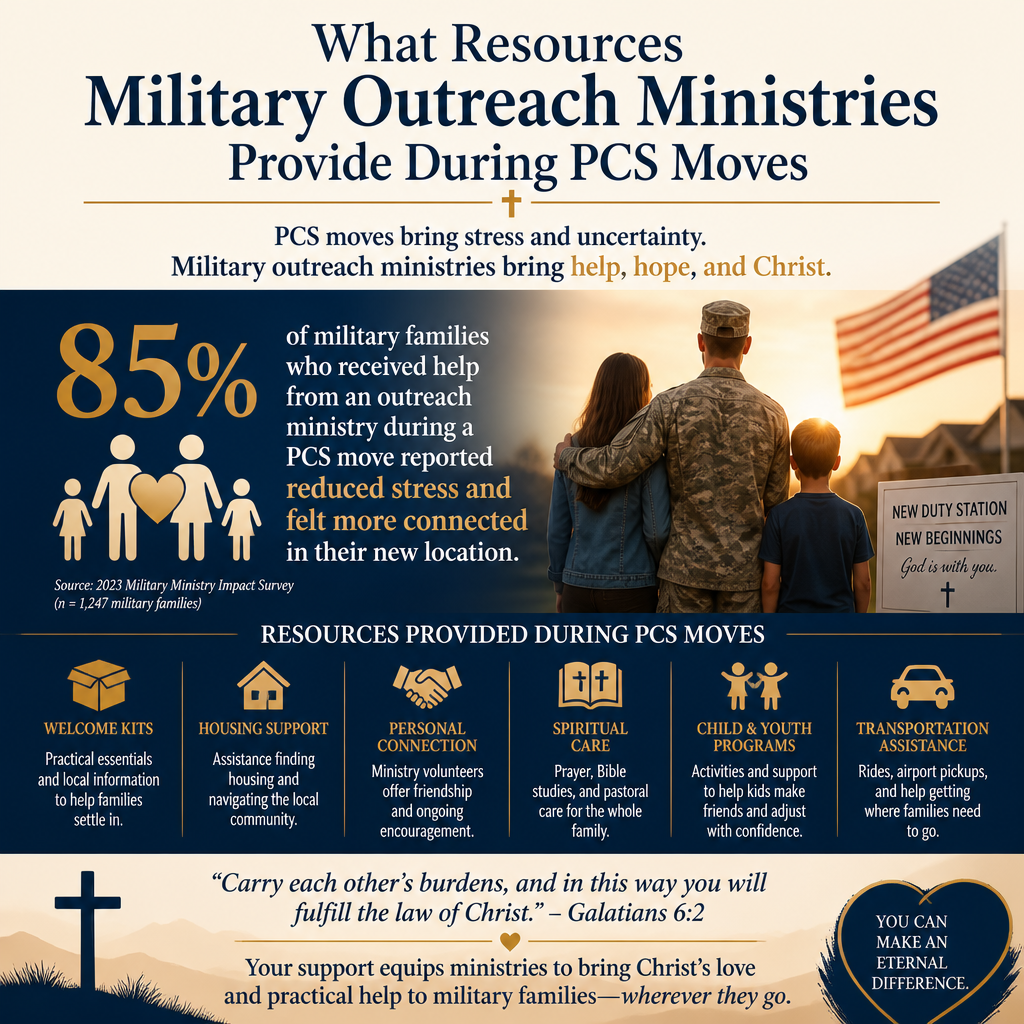
At a minimum, effective military outreach ministries help families land. That may include “welcome team” contact, rides for families without a second vehicle yet, meals during the unpacking week, and local orientation that reduces the cognitive load of learning a new base and community. Some ministries coordinate short-term lodging with vetted host families or partner churches when housing delays arise; such arrangements require careful screening and written policies to protect both guests and hosts.
Education transition support is also common. School enrollment, special education documentation, and child care waitlists can quickly overwhelm a parent. Ministries sometimes provide advocates who understand local systems and can accompany families to appointments. This is not glamorous work, but it is often the difference between a child starting school with stability or with disruption that echoes for months.
Emergency and gap funding with clear controls
Even stable families can face cash-flow gaps: delayed reimbursements, overlapping housing costs, unexpected travel, or childcare expenses during in-processing. Some ministries maintain benevolence funds to cover narrow, defined needs. Donors should not assume all benevolence is equally wise. Good programs set eligibility criteria, require documentation appropriate to the amount, and coordinate with chaplains and local churches to avoid duplication or unhealthy dependency.
- Groceries or meal support during the first week in a new home
- Short-term child care during in-processing appointments
- Gas cards or local transit assistance for families still awaiting a vehicle
- School uniform or supply assistance when a change in district creates unplanned costs
- Limited help with utility deposits when housing transitions create overlapping bills
When donors ask how to distinguish compassion from carelessness, we look for policies, oversight, and reporting that respect both the family and the donor. The work is mercy, but mercy is not the absence of governance.
Relational and spiritual care that rebuilds community after the move
PCS moves do not only move bodies; they scatter relationships. Many families describe the most painful part as starting over spiritually: finding a church, building trust, and trying to explain military life to people who have never lived it. Military outreach ministries often serve as a bridge—sometimes to a base chapel, sometimes to local congregations, and sometimes to parachurch communities that understand the rhythms of deployment and training cycles.
Connection to congregations that can receive military families well
Healthy ministries resist becoming a substitute church. They instead help families connect to congregations that can provide long-term pastoral oversight, discipleship, and sacramental life. This is where donors can ask a hard question: does the ministry have a theology of the local church and an operational commitment to partnership, or does it inadvertently keep families in a perpetual “program” that never becomes a spiritual home?
What this means in practice is that ministries may maintain referral lists of churches near installations, facilitate introductions, or host joint events with local congregations. When done with integrity, referrals are not transactional; they are curated relationships grounded in shared doctrine and clear safeguarding expectations. For broader context on the ecosystem these ministries inhabit, see Military Outreach Ministries.
Pastoral presence and resilient discipleship rhythms
Military life tests faith in specific ways: uncertainty, moral injury, chronic fatigue, and the ache of absence. Outreach ministries commonly provide small groups, Bible studies, mentoring, and prayer teams that can adapt to transient attendance. Some use hybrid models that allow a spouse to remain connected when a move separates them from the group, though digital connection is not a full replacement for embodied community.
Here the tension is real. Ministries can overpromise continuity, implying they can provide what only stable local relationships can supply. The best ministries name the limitation honestly while still offering meaningful pastoral care. They can speak to military families with the gravity of Psalm 121: not as a sentimental verse on a moving day, but as a confession that God keeps his people when human supports are repeatedly disrupted.
Specialized support for spouses and children who bear unique burdens
PCS moves affect every member of a household, but the burdens are not evenly distributed. Spouses often carry the administrative load of the move, and children absorb the relational cost. Donors who care about long-term faith formation should pay close attention to whether ministries can serve these groups with competence rather than generic good intentions.
Spouse support, employment disruption, and isolation
Frequent moves interrupt careers, sever friendships, and intensify isolation, especially for spouses far from extended family. Military outreach ministries may provide spouse mentoring, support groups, and practical help such as résumé workshops or networking connections with employers who understand military spouse licensing and relocation challenges. This is not merely “women’s ministry” rebranded; it is neighbor love applied to a structural reality of service life.
Some ministries coordinate with installation resources rather than duplicating them. The Department of Defense’s Military OneSource network is a widely used entry point for confidential counseling and relocation support, and it provides practical PCS tools that ministries can point families toward when appropriate (Military OneSource).
Children and teens need continuity more than events
Children experience repeated goodbyes, new classrooms, and the strain of trying to belong again. Ministries sometimes respond with camps, youth nights, or special events, and these can be genuine gifts. But donors should ask whether a ministry is building durable discipleship and pastoral attention for military kids, or primarily offering high-energy experiences that do not translate into steady formation.
Church-based youth leaders who understand military life can make an outsized difference. Outreach ministries often train volunteers to recognize signs of anxiety, grief, or behavioral changes that may follow a move. When counseling needs exceed volunteer competence, responsible ministries refer families to licensed professionals, with clear safeguarding policies and confidentiality boundaries.
How donors can evaluate PCS-focused ministries with confidence
Christian donors are right to expect both compassion and credibility. Military families deserve ministries that will not collapse under the weight of real need, and donors deserve evidence that funds are handled with integrity. At Most Trusted, our role is to help donors give with confidence by assessing Christian nonprofits against The Most Trusted Standard, a 15-criteria framework that examines faith commitments, financial integrity, governance, and transparency and effectiveness.
What strong ministries tend to document and disclose
Not every good ministry has sophisticated infrastructure, and smaller ministries can still be faithful. Still, donors can ask for verifiable indicators of health: audited or reviewed financial statements when feasible, a functioning board with recorded oversight, clear conflict-of-interest policies, and program reporting that goes beyond stories to include measurable outputs.
Donors should also be cautious about simplistic ratios and overhead suspicion. The nonprofit field has had to reckon with the “Overhead Myth,” a critique of using administrative expense alone as a proxy for impact. Charity Navigator, Candid, and the BBB Wise Giving Alliance have jointly argued that overhead is a poor standalone measure and that donors should consider governance, transparency, and results instead (Charity Navigator).
PCS ministry raises specific safeguarding and partnership questions
Programs that place volunteers in close contact with families—especially those involving child care, temporary housing, or transportation—require stronger safeguarding protocols than a typical event-based ministry. Donors should ask whether background checks are required, whether two-adult rules are enforced, and how the ministry handles incident reporting. The closer the ministry comes to the intimate spaces of family life, the higher the duty of care.
Partnership discipline matters as well. A ministry serving PCS moves should be able to describe how it coordinates with chaplains, family readiness resources, and local churches, rather than competing for attention or duplicating services. For readers examining a broader range of ministry approaches in this space, see How Military Outreach Ministries Serve Military Families.
FAQs for What resources military outreach ministries provide during PCS moves
What should donors prioritize when giving to PCS-related military outreach?
Donors should prioritize ministries that combine practical transition help with relational and spiritual care, and that can document responsible governance. Evidence of clear safeguarding policies, defined benevolence guidelines, and partnerships with local churches and installation resources is often more predictive of long-term faithfulness than program novelty.
Do the best ministries provide direct financial assistance during PCS moves?
Some do, but direct aid should be structured and limited, with eligibility criteria and oversight that protect both families and donors. Other ministries focus on stabilizing support—meals, transportation, child care coordination, and church connection—which can reduce financial stress without creating ongoing dependency. Donors can evaluate whether the ministry’s approach fits its competence and accountability.
Giving that steadies families at the moment they are most exposed
The resources military outreach ministries provide during PCS moves are most credible when they address what a move actually does: it disrupts routines, relationships, and spiritual continuity. Christian donors can honor military families not only with gratitude but with disciplined generosity—supporting ministries that practice mercy with governance, and pastoral care with theological seriousness. When that alignment is present, giving becomes one more way the Church bears burdens that PCS life repeatedly places on faithful households.



