
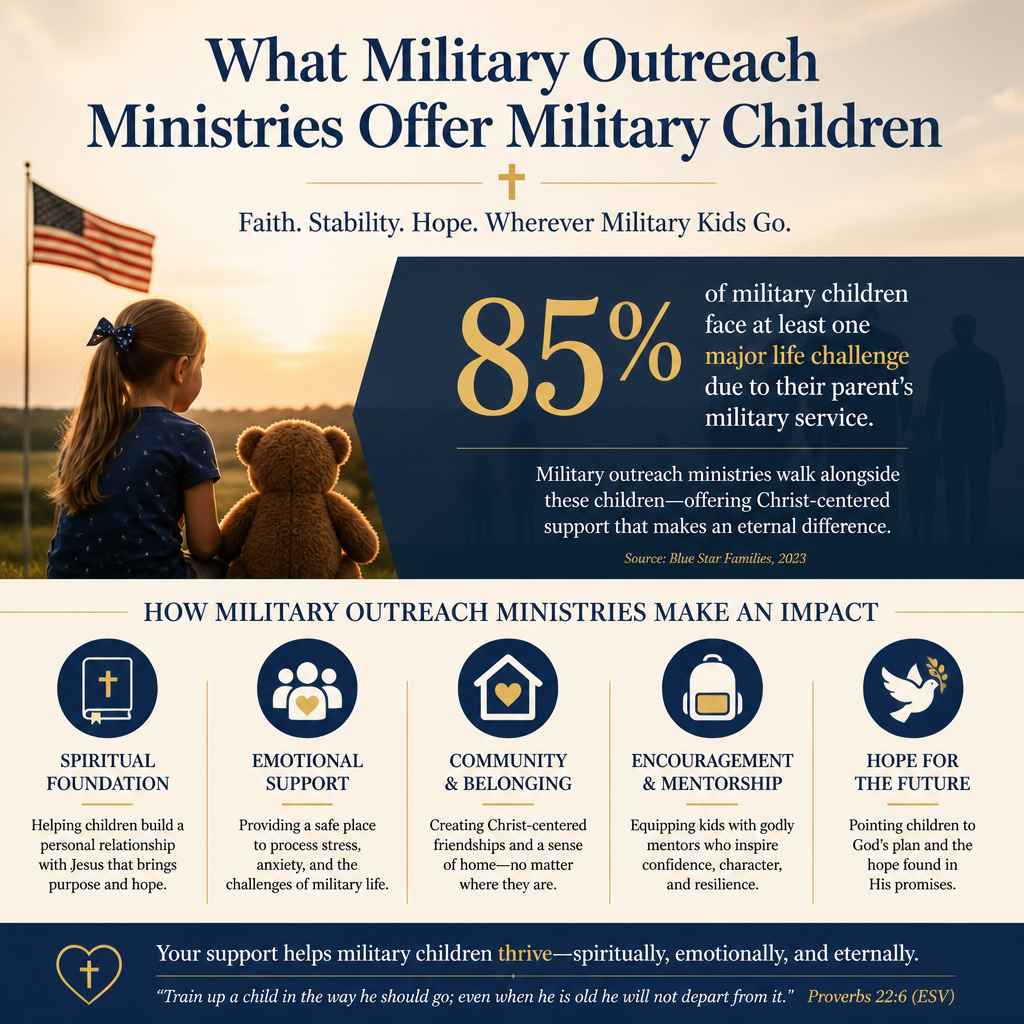
What military outreach ministries offer military children is not merely “support” in a generic sense. At their best, these ministries offer a steady, Christ-centered ecology of belonging for children formed by frequent transitions, parental absence, and the moral weight that military service places on a household.
For Christian donors, the question is not whether military kids deserve care. Scripture’s concern for the vulnerable is unambiguous, and children bearing adult-sized anxieties belong in that category. The harder question is whether the ministries we fund are sufficiently grounded, competently governed, and honest about outcomes to serve these children without turning them into a fundraising motif.
Military children live in a distinctive pressure field
Mobility reshapes attachment and discipleship
Many military-connected children grow up with repeated school changes, ruptured friendships, and a persistent awareness that “home” can be reassigned. That pattern does not automatically produce pathology, but it does create predictable strain: the child must repeatedly re-establish trust with adults, peers, and institutions. For Christian formation, that can mean a revolving door of youth groups, mentors, and church relationships unless a deliberate continuity plan exists.
Military outreach ministries that serve children well treat mobility as a spiritual and developmental reality, not merely a logistical inconvenience. They build programs that travel with the family—portable curricula, consistent small-group practices, and relationships that can continue across postings. This is one reason donor due diligence matters: a ministry’s program design often reveals whether it understands the child’s lived experience.
Deployment and reintegration are pastoral events for children too
Families often describe deployment as a long season of “present absence,” followed by reintegration that can feel like another disruption. Children can internalize responsibility for household stability, become hypervigilant, or quietly withdraw. Effective ministries acknowledge these dynamics directly and offer child-appropriate pastoral care rather than only adult-facing services.
Donors sometimes assume that chaplaincy or base services cover these needs. In reality, the ecosystem is complex and uneven by installation, branch, and access. What this means in practice is that high-quality nonprofit ministries frequently fill relational and spiritual gaps that public systems are not designed to meet.

What faithful ministries provide is stability, not spectacle
Safe adults and durable relationships
For military children, stability is often synonymous with trustworthy adults who stay involved across seasons. The ministries most worth a donor’s attention are those that train mentors, screen volunteers rigorously, and keep adult-to-child interactions within clear safeguarding policies. This is not bureaucratic fussiness; it is a moral obligation.
Across our verification work at Most Trusted, we observe that ministries meeting The Most Trusted Standard tend to document child protection policies, background-check procedures, and incident response practices with a seriousness that matches the stakes. Donors should expect this level of discipline, particularly in programs involving camps, overnight events, and one-on-one mentoring.
Peer community that normalizes sacrifice without romanticizing it
Military kids often report that civilians do not understand their routines: sudden moves, missed holidays, and the quiet fear that accompanies news alerts. Peer community can relieve isolation, but it must avoid two distortions. The first is romanticizing hardship as heroism, which can pressure children to suppress grief. The second is cultivating cynicism, where shared pain becomes the primary identity.
Mature ministries create spaces where children can speak honestly, lament without shame, and learn resilience as a Christian virtue rather than a forced personality trait. The Psalms are not sentimental; they give language for fear, anger, and hope. A ministry that teaches children to pray truthfully is offering more than emotional relief—it is shaping a lifelong spiritual reflex.
Programs that consistently help military children flourish
Discipleship that survives a change of address
The most credible ministries aim for continuity: a child should not have to start over spiritually every time orders change. Some organizations do this through multi-installation networks, digital discipleship complemented by local partnerships, or standardized curricula that integrate easily into chaplain or church settings.
When donors evaluate these approaches, the question is not whether digital tools are “good” or “bad.” The question is whether the ministry has a coherent theology of the church and a realistic strategy for embodied community. Christians genuinely disagree about how much online formation can substitute for face-to-face discipleship. A trustworthy ministry will name the limitation and design accordingly rather than making grand promises.
Camps and retreats that handle the heart carefully
Camps can be pivotal for military children because they compress community, fun, and spiritual instruction into a concentrated experience. They can also be mishandled. The risks are familiar in youth ministry: emotional pressure tactics, thin follow-up, and unrealistic expectations that a single week resolves long-term stress.
Well-governed camps set clear spiritual aims, train counselors thoroughly, and coordinate follow-up with parents, chaplains, and local churches. They also treat trauma-informed care as a competency rather than a marketing phrase. Donors should ask how a ministry handles disclosures, mandatory reporting, and referral pathways for professional counseling when needed.
How donors can discern credibility without cynicism
What to look for in a ministry’s public record
Military family work can be emotionally compelling, which makes it vulnerable to glossy storytelling that outruns operational maturity. The donor’s task is not to become suspicious of every heartfelt narrative. It is to insist that compassion be paired with verifiable integrity.
We recommend looking for a ministry that can clearly explain how it is accountable—financially, organizationally, and spiritually. As a starting point, donors can ask for a recent annual report, audited financials or reviewed statements where appropriate for size, a board roster, and policies related to child safeguarding and conflicts of interest.
- Clear doctrinal commitments that are more than branding
- Documented child protection standards and volunteer screening
- Board governance that is independent enough to provide real oversight
- Financial statements that show disciplined stewardship, not vague categories
- Evidence of program learning, including what has not worked as hoped
Why outcomes are difficult and still necessary
Measuring spiritual and relational outcomes in children is inherently complex. A ministry cannot quantify the work of the Holy Spirit, and it should not pretend otherwise. Yet the absence of simplistic metrics does not excuse the absence of evaluation. Ministries can track participation, retention, volunteer training completion, referral follow-through, and parent feedback. They can also articulate a plausible theory of change that is consistent with Christian anthropology: children are not projects, but persons formed over time through relationships, truth, and worship.
Most Trusted exists to help donors give with confidence by evaluating Christian nonprofits against The Most Trusted Standard, a 15-criteria framework spanning faith foundation, financial integrity, governance and leadership, and transparency and effectiveness. In practice, that means we look for ministries that can show their work: not perfection, but credible processes and honest reporting.
Integrating military kids into the life of the church
Partnership rather than substitution
Some military outreach ministries function as a bridge between families and local churches; others operate as stand-alone communities. The more sustainable approach usually treats the local church as central, while acknowledging that families in transition need immediate relational scaffolding. The goal is not to replace congregational life, but to make it accessible to families who arrive midstream and often leave before deep roots can form.
Donors evaluating this landscape benefit from seeing the wider field of Military Outreach Ministries and how organizations position themselves within it. The best ministries can describe their partnership posture without defensiveness and can point to concrete collaborations with chaplains, churches, and other care providers.
A sober view of trauma and moral injury in the household
Not every military child lives in a home touched by combat trauma, but enough do that ministries must be prepared. The Department of Veterans Affairs recognizes PTSD as a clinical condition affecting some who have experienced trauma, including combat exposure, and the effects can ripple through family systems when untreated or compounded by substance use and isolation U.S. Department of Veterans Affairs. Ministries serving children should know their limits and maintain referral relationships with licensed clinicians and military family life counselors where available.
For donors, this is where theological seriousness matters. Christians believe in prayer, deliverance from sin, and the healing power of the gospel. We also believe in truthfulness about the human person and the ordinary means God uses, including wise counsel and appropriate medical care. A ministry that treats mental health care as a threat to faith, or as a substitute for faith, is likely to drift from balanced pastoral wisdom.
Military families also face practical stressors. The Department of Defense notes that military family life includes recurring transitions and separations that can affect family well-being Military OneSource. A ministry that offers tangible support—meals, childcare during appointments, transportation help—may be doing deeply spiritual work through ordinary mercy, provided it does so with accountability and without creating dependency.
Donors who want to understand how ministries engage the full household, not only children’s programming, will often benefit from exploring How Military Outreach Ministries Serve Military Families and the range of models currently operating.
FAQs for What military outreach ministries offer military children
Do military outreach ministries duplicate what chaplains and base programs already provide?
They can, but the best ministries are additive rather than redundant. Chaplains provide essential pastoral care within a military framework, while nonprofit ministries often supply continuity across moves, specialized children’s programming, and volunteer-driven relational support that is difficult for base systems to sustain. Donors should prioritize ministries that can articulate how they coordinate with chaplains and avoid competing for the same limited attention and trust.
What is the most reliable indicator that a ministry is safe for children?
No single indicator is sufficient, but documented safeguarding practices are foundational: background checks, two-adult rules, clear reporting pathways, training requirements, and transparent incident response. Governance matters as well, because policies without oversight tend to erode. Ministries worthy of funding will treat child safety as a core obligation and will be prepared to show donors the relevant policies and accountability structures.
A donor’s calling is to pair compassion with accountability
Military outreach ministries can offer military children something rare: steady adults, truthful spiritual formation, and a peer community that honors sacrifice without demanding emotional silence. That work is not glamorous, and it does not fit neatly into single-weekend stories. It is long obedience in the same direction, often across many addresses.
Christian donors serve these children well when we fund ministries that are theologically clear, operationally competent, and transparent about both fruit and limits. When giving is disciplined in this way, it becomes a form of neighbor-love that respects military families not as symbols, but as households God calls the church to serve faithfully.



