

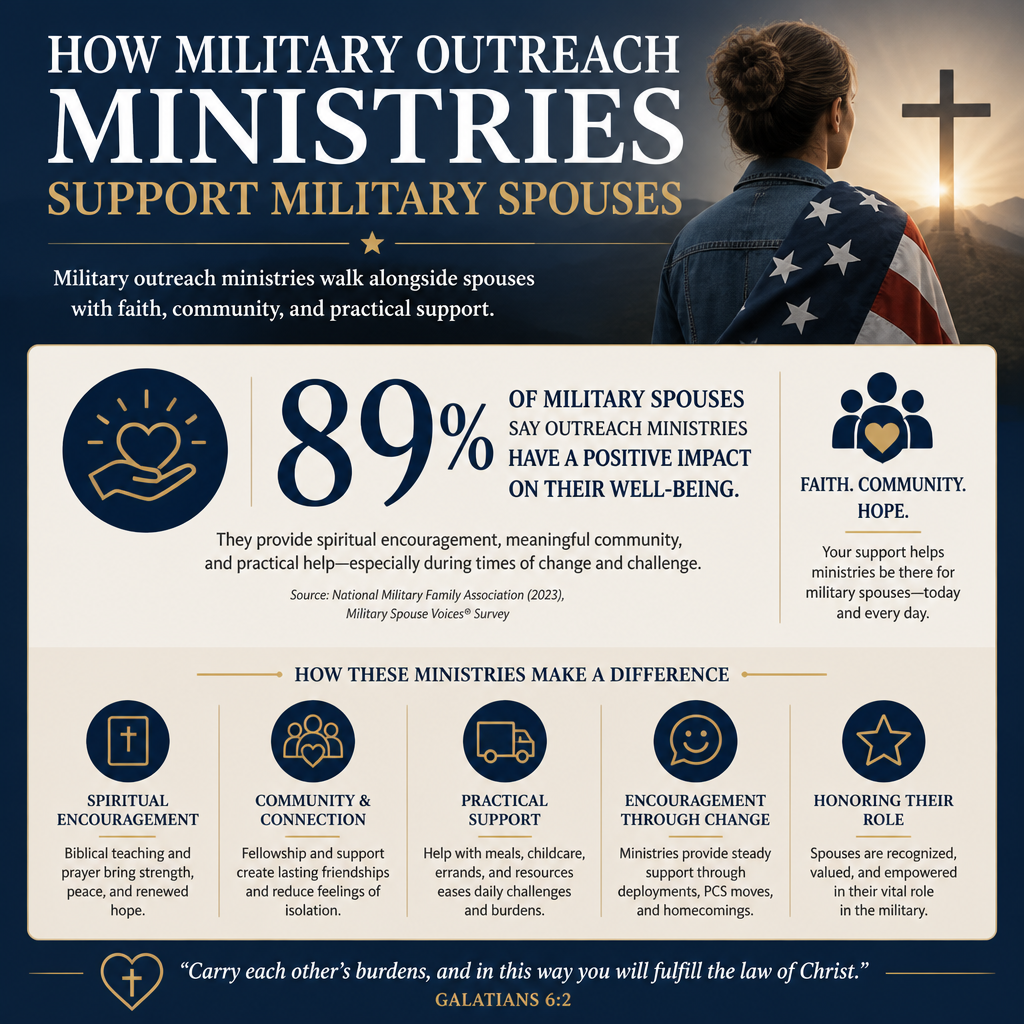
How military outreach ministries support military spouses is a question of spiritual care, community formation, and practical endurance under strain. The military spouse often carries a disproportionate share of the hidden costs of service: recurring separations, frequent relocations, parenting under pressure, and the quiet fatigue of holding a household together while a loved one trains, deploys, or returns changed.
For Christian donors, the point is not merely compassion in general. Scripture repeatedly ties faithful love to concrete attention to those bearing heavy loads. Paul’s instruction to “bear one another’s burdens” is not sentimental counsel; it is a description of the church’s moral economy, where strength is leveraged for the sake of the vulnerable and the weary. Military spouses are not a special-interest category; they are neighbors in a specific form of trial.
Military spouse strain is predictable and often unseen
Separation creates spiritual and emotional pressure points
Deployments and training cycles reshape a marriage’s daily reality. Communication becomes intermittent, decision-making concentrates in the at-home spouse, and the rhythm of ordinary discipleship can erode under exhaustion. Many spouses report that the hardest moments are not dramatic crises but the slow accumulation of responsibility without respite.
Evidence suggests that military families face distinct mental health pressures. The U.S. Department of Defense has reported elevated rates of anxiety and depression among spouses during deployment periods, with stress shaped by isolation and parenting demands as much as fear for the service member’s safety. U.S. Department of Defense
Frequent moves fracture community and formation
Relocation is not simply “starting over” socially; it interrupts long-term pastoral care, women’s Bible studies, trusted friendships, and the quiet accountability that sustains Christian maturity. A spouse can be competent, faithful, and still profoundly alone. Churches near installations often see a constant flow of new families who arrive without history and leave before they are fully known.
What this means in practice is that ministries serving military spouses cannot assume stable networks. They must build forms of care that travel: portable discipleship, rapid-onboarding community, and leadership development that does not depend on multi-year continuity.

The best ministries serve spouses as whole persons, not as accessories to the service member
Spiritual care is not optional support
The most credible military outreach ministries resist a common distortion: treating the spouse primarily as a means to stabilize the service member. A spouse is not an auxiliary tool for readiness. She or he is a disciple, with a calling, gifts, wounds, and a life with God that deserves direct attention.
Healthy ministries provide pastoral presence, biblical counseling referrals when appropriate, and durable spiritual practices that can survive geographic and relational disruption. Some partner with chaplains and local churches; others operate as parachurch bridges that help spouses find a church and small group quickly after a move.
Practical support is often the doorway to deeper care
Christian ministry has long recognized that works of mercy are not a distraction from spiritual work. They are often the entry point for it. For military spouses, childcare during a deployment briefing, a meal train after a difficult birth while the service member is away, or a ride to a medical appointment can create the trust that makes deeper pastoral conversations possible.
Donors should not dismiss these “ordinary” supports as mere logistics. The New Testament’s vision of love is resolutely material. When a ministry helps a spouse sleep for a night, or attend church without managing three small children alone, it is serving the conditions under which faith can be sustained.
Effective programs are specific to the realities of military life
Community that can absorb turnover
The strongest models build community with a realistic anthropology: people need belonging, and belonging takes time, yet military life disrupts time. Ministries that meet military spouses well usually do three things: they make entry easy, they train leaders quickly, and they keep relationships alive across distance through structured touchpoints.
These ministries also guard against overpromising. Not every spouse wants a highly programmed experience; some want quiet companionship and a trustworthy church connection. A mature ministry offers multiple pathways rather than forcing every spouse into the same mold of “engagement.”
Support at predictable high-risk transitions
Across our verification work at Most Trusted, we observe that ministries with the clearest outcomes focus on transition points where stress clusters. Military spouses often name similar pressure points: the first duty station, the first deployment, reintegration after return, a major move during a child’s school year, and seasons when the service member’s training tempo becomes relentless.
Programs that consistently serve these moments tend to include:
- Peer mentoring that pairs newer spouses with experienced spouses for time-bound support
- Deployment and reintegration groups that address expectations, conflict, and spiritual resilience
- Childcare-supported gatherings so participation is realistic
- Church connection assistance that is more than a list of local congregations
- Referral relationships for counseling, crisis care, and financial coaching when needed
Some donors hesitate when they hear terms like “resilience,” concerned that ministry is drifting toward therapeutic language. The harder question is whether the ministry’s framing remains explicitly Christian: sin and suffering named honestly, grace offered concretely, marriage honored without being idolized, and hope anchored in Christ rather than in mere coping strategies.
What donors should look for in ministries serving military spouses
Accountability that matches the moral weight of the work
Ministry to military families operates close to trauma, confidentiality, and family systems under pressure. That demands governance and safeguarding practices that are clear, enforced, and externally accountable. Donors should ask whether the ministry has documented policies for working with minors, mandated reporting training where relevant, and a serious approach to pastoral and peer-leader boundaries.
Financial integrity matters here not because overhead is shameful, but because unstable organizations tend to offload costs onto already-strained volunteers. The “Overhead Myth” statement signed by GuideStar, Charity Navigator, and BBB Wise Giving Alliance helped correct the simplistic assumption that low overhead automatically signals virtue. Candid GuideStar
Clarity about partnership with chaplains and local churches
Chaplains occupy a unique role, serving pluralistic commands while providing confidential care. Some Christian ministries partner closely with chaplaincy; others focus on church integration in the surrounding community. Christians genuinely disagree about how explicitly evangelistic parachurch efforts should be in military settings, given constraints and the need for trust. What should be non-negotiable is honesty: donors deserve clear statements about how the ministry relates to chaplaincy, installation rules, and local congregations.
A ministry that presents itself as a substitute for the local church should be evaluated carefully. Often the most sustainable impact comes from ministries that strengthen the spouse’s connection to a healthy church, even if the ministry itself remains a meaningful long-term support. For donors seeking broader context on this field, Military Outreach Ministries is a useful starting point for understanding the ecosystem of programs and claims.
Verification protects donors and honors the people served
Why credibility is part of ministry effectiveness
Military spouses are accustomed to institutions with clear standards, documented procedures, and accountability. Ministries that operate with vague claims and informal governance often struggle to earn trust, even when their intentions are sincere. Donors should see verification as a form of neighbor-love: it reduces the likelihood that families under pressure will be drawn into disorganized programs or spiritually manipulative environments.
Most Trusted evaluates Christian nonprofits against The Most Trusted Standard, a 15-criteria framework across Faith Foundation, Financial Integrity, Governance and Leadership, and Transparency and Effectiveness. In this area, strong ministries tend to communicate a theologically coherent mission, publish clear financial reporting, maintain independent oversight, and define outcomes that match what they actually do rather than what sounds inspiring.
A measured view of outcomes and spiritual fruit
Donors rightly want evidence of impact. Yet this category requires maturity about what can and cannot be quantified. Attendance counts are easy to report and often misleading. Marital stability, spiritual renewal, and reduced isolation are real goods, but they are not always reducible to clean metrics.
We recommend looking for ministries that combine modest, honest measures with transparent storytelling that protects privacy. They should be willing to name limits: which spouses they can serve, what they refer out, and how they handle crises. For donors who want to understand the broader family-support context in which spouse care sits, How Military Outreach Ministries Serve Military Families provides additional perspective.
FAQs for How military outreach ministries support military spouses
Do ministries that focus on military spouses duplicate what military family readiness programs already provide?
Sometimes there is overlap in practical information, but the core contribution is usually different. Government and installation programs can offer important resources, yet they are not designed to provide Christian discipleship, pastoral care, prayerful community, or church connection. The best ministries avoid redundancy by partnering well, referring appropriately, and focusing their distinctively Christian work on spiritual formation, relational support, and sustained community.
What should donors ask before funding a ministry serving military spouses?
Donors should ask how the ministry safeguards spouses and children, how leaders are trained and supervised, how finances are reported, and what relationship the ministry has to chaplaincy and local churches. It is also wise to ask what the ministry does when needs exceed its competence, including referral pathways for counseling, domestic violence concerns, or acute mental health crises. Serious ministries welcome these questions because accountability protects the families they serve.
Stewardship that strengthens the one who stays
Military service asks much of the service member, but it also asks much of the spouse who carries continuity at home. Christian donors are in a position to fund care that is both spiritually serious and practically competent: ministries that build community fast, speak the gospel plainly, and treat trust as a sacred responsibility.
When military outreach ministries support military spouses well, they do more than reduce isolation. They help a Christian endure faithfully through repeated upheaval, and they honor the covenant commitments and quiet sacrifices that military life so often conceals.



