
How military families can access chaplain counseling is often less a question of eligibility than of clarity: which chaplain, which channel, and which confidentiality rules apply in a given circumstance. When a service member is carrying operational stress, moral injury, or family strain, the first barrier is rarely spiritual willingness; it is usually uncertainty about where to turn and what will happen after the first conversation.
For Christian donors, this is also a stewardship question. Chaplaincy is one of the few places in the U.S. military where explicitly pastoral care remains institutionally protected, and it often sits at the intersection of faith, mental health, marriage stability, and suicide prevention. Funding decisions that strengthen biblically grounded care, while honoring military policy and professional ethics, can materially change outcomes for families under strain.
Chaplain counseling is pastoral care within a regulated system
What chaplains are authorized to provide
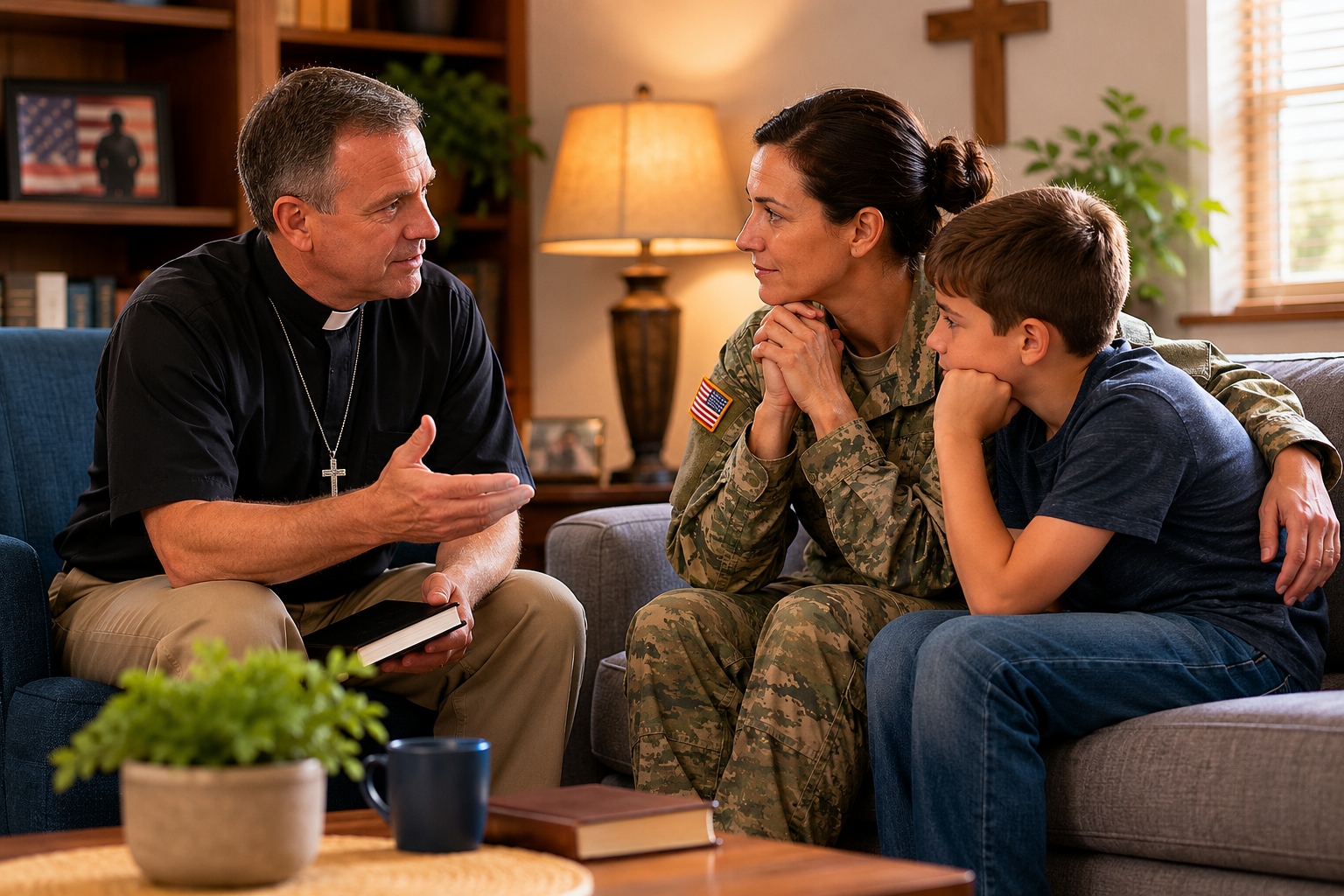
Military chaplains provide spiritual care and pastoral counseling to service members and, in many cases, their families. This can include grief counseling, marital support, crisis intervention, faith-based counsel, and guidance for ethical and moral dilemmas. Many chaplains also function as a bridge to other supports, including behavioral health, Military OneSource, and installation family programs, especially when a situation exceeds pastoral scope or requires clinical care.
Chaplains operate under both ecclesial endorsement and military command structures. That dual accountability is not a contradiction; it is the design. The chaplain’s vocation is to provide for the free exercise of religion and to care for the whole person, while remaining a noncombatant adviser who serves people across faith backgrounds.
Why confidentiality is central and why it has limits elsewhere
One of the most important practical distinctions is confidentiality. Under DoD policy, communications with chaplains can be privileged. That privileged status is one reason chaplain counseling becomes a first stop for service members who fear professional repercussions or stigma if they speak to clinical providers. The details of privileged communication can vary by context and service, but the basic principle is that chaplains have a unique ability to receive disclosure without mandatory reporting in many circumstances where other professionals would not.
What this means in practice is that chaplain counseling is not simply a “less formal” alternative to therapy. It is a distinct kind of care within a regulated system, with its own protections and constraints, and it should be treated with appropriate seriousness by donors supporting military ministry.
Practical pathways to access chaplain counseling
On-base and unit access for active duty
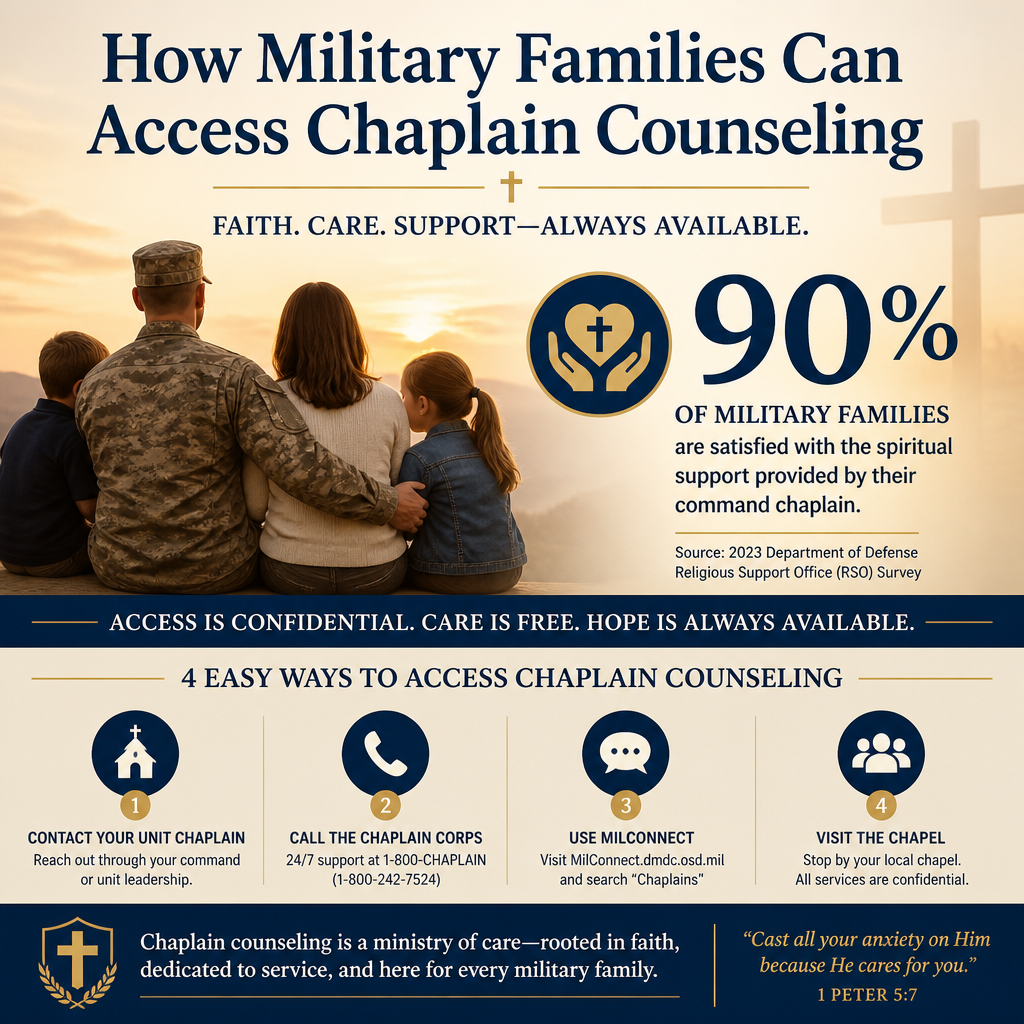
The most direct route is often the simplest: contacting the unit chaplain or the installation chapel office. Service members can typically request an appointment without a medical referral. Many chaplains also maintain walk-in hours or respond to urgent calls through duty lines. For families living near an installation, the installation chaplaincy office is usually the best initial point of contact because it can direct the family to the appropriate chaplain and clarify availability.
Access patterns differ across services and duty stations. Some units have a dedicated chaplain and religious affairs specialist embedded with them; others rely on installation support. Deployments, training cycles, and manning levels can create real constraints. A mature expectation is that availability may be uneven, not because chaplains are indifferent, but because the system is under strain.
Guard, Reserve, and geographically dispersed families
Guard and Reserve families face a distinct access challenge: they may live far from a military installation and may not have a regular relationship with a unit chaplain outside drill weekends or mobilization windows. In those cases, families can often still contact their unit chaplain, request connection to an installation chaplain near them, or seek support through community-based military ministry partners that coordinate with chaplain channels.
Military OneSource is frequently part of the overall support ecosystem, particularly for non-medical counseling and referrals. It is not chaplain counseling, and it is not inherently faith-based, but it can be a practical complement when families need rapid access to professional services. The Department of Defense describes Military OneSource and its non-medical counseling services on its public site at Military OneSource.
- Call the installation chapel office and request an appointment with a chaplain.
- Contact the unit chaplain directly through unit channels, especially for urgent or deployment-related strain.
- Ask for clarification on privileged communication before sharing sensitive details.
- Request a referral to marriage enrichment, family life chaplaincy, or specialized pastoral care if available.
- If geographically distant, ask the unit chaplain to connect you with a nearer installation or partner resource.
What military families should expect from chaplain counseling
Common reasons families seek chaplain support
Families commonly seek chaplain counseling during reintegration after deployment, marital conflict, parenting stress, grief, infertility and pregnancy loss, addiction concerns, and spiritual disorientation. Some situations are explicitly theological. Others are practical crises that still carry spiritual weight: betrayal, fear, shame, anger, or a sense of abandonment.
For Christian readers, it is worth naming the pastoral category that many chaplains recognize even when they do not use the term publicly: moral injury. Moral injury is not simply trauma from danger; it is anguish related to perceived violations of moral conviction. Donors sometimes assume the presenting issue is “stress,” when the deeper reality is a burden of conscience.
When chaplain counseling is not enough by itself
Chaplains are trained for pastoral counseling, crisis response, and referral, but they are not always the right provider for every clinical need. Severe depression, PTSD, active substance dependence, or ongoing domestic violence typically requires clinical and legal interventions beyond pastoral scope. Wise chaplains do not compete with clinicians; they coordinate care while continuing pastoral presence.
The harder question is how families discern escalation without feeling they are betraying trust or faith. Christian tradition has never treated embodied suffering as purely “spiritual.” Elijah’s despair in 1 Kings 19 is met with both spiritual reassurance and tangible care. In the same spirit, many families need both pastoral counsel and clinical treatment, and receiving both is not a compromise of faithfulness.
Donor concerns about effectiveness, safety, and integrity are legitimate
Why chaplain-adjacent ministry can drift without accountability
Many Christian donors want to fund care for military families because the need is real and the calling is clear. Yet donor concern about effectiveness and safety is not cynicism; it is stewardship. Ministries working around chaplaincy can become personality-driven, lightly governed, or vague about outcomes. Others can promise more confidentiality than they can actually provide when they are operating outside the chaplain privilege framework. These are not theoretical risks; they are predictable failure modes in any high-emotion, high-need environment.
Across our verification work at Most Trusted, we observe that strong ministries tend to be explicit about their relationship to the military system: what they are authorized to do, what they are not, and how they handle referrals when situations exceed their scope. They also avoid romanticizing resilience. Military families are not a marketing segment; they are neighbors bearing heavy loads.
What The Most Trusted Standard looks for in military family care
Most Trusted evaluates Christian nonprofits against The Most Trusted Standard, a 15-criteria framework that examines faith commitments, financial integrity, governance and leadership, and transparency and effectiveness. In the military family care space, that translates into practical questions donors should ask:
Is the ministry clear about its statement of faith and the nature of its pastoral counsel? Does it have policies for safeguarding, crisis escalation, and mandatory reporting in the jurisdictions where it operates? Are finances auditable and presented transparently? Does leadership include independent oversight? Can the ministry describe what it measures, and what it has learned, without resorting to inflated claims?
Donors who want a wider view of vetted work in this area can follow Most Trusted’s coverage of Military Outreach Ministries, where we examine patterns that distinguish durable, accountable care from well-intentioned but fragile efforts.
How churches and ministries can support access without overstepping
Strengthening the bridge between local church and chaplain channels
Local churches often want to help but do not know how to do so without creating additional pressure for the family. A faithful posture begins with honoring the military family’s chain of care: chaplain, clinical supports, and community supports, each in its proper place. Churches can offer stable relationships and practical help while encouraging families to use chaplain counseling when appropriate.
There is a related theological tension donors should name clearly. Some Christian communities have treated counseling as suspect or as a replacement for discipleship. Others have treated discipleship as irrelevant to psychological suffering. Both errors misread the human person. Pastoral care and disciplined spiritual formation belong together, and chaplain counseling—when properly supported—can be one of the few places where that integration is pursued within the military environment.
Funding priorities that tend to serve families well
Effective donor support usually strengthens capacity rather than creating parallel, unaccountable systems. That can include resourcing chaplain-led marriage enrichment, supporting vetted retreats that coordinate with chaplain offices, funding crisis response infrastructure, or underwriting training that improves referral pathways and safeguarding. It can also include supporting research-informed programs that have demonstrated competence in trauma-aware pastoral care, without collapsing pastoral counseling into generic wellness coaching.
Donors who want to understand the broader set of ways these ministries serve families can also review How Military Outreach Ministries Serve Military Families, where we address the practical realities donors should weigh when funding care in a military context.
FAQs for How military families can access chaplain counseling
Do military spouses and children have access to chaplain counseling?
In many contexts, yes. Installation chaplains commonly provide pastoral care to spouses and dependents, particularly when the family is connected to an active duty service member or lives near an installation. Availability and procedures can vary by installation and service branch, so the most reliable first step is contacting the local installation chapel office to ask what support is available and how appointments are scheduled.
Is chaplain counseling confidential in the same way as therapy?
Chaplains may offer privileged communication under DoD policy, which is a distinct form of confidentiality. That protection is one reason service members may prefer chaplain counseling for spiritually sensitive or career-sensitive concerns. Clinical counseling follows different rules and documentation practices, and community-based ministries are generally not covered by military chaplain privilege. Before disclosing highly sensitive information, families should ask the chaplain to clarify what confidentiality applies in their specific setting.
Stewardship that strengthens the first line of pastoral care
Military families often do not need a novel solution; they need reliable access to trustworthy care. Chaplain counseling is frequently the first place a service member or spouse can speak plainly about fear, guilt, grief, or spiritual confusion without being reduced to a case file or a talking point.
For Christian donors, the opportunity is to fund ministries that strengthen that first line of pastoral care with integrity: clear theological commitments, prudent governance, transparent finances, and evidence of thoughtful practice. When support is accountable and well-ordered, it reflects the character of the God who does not break the bruised reed, and it honors the families who bear the hidden costs of service.



