

How military outreach ministries report impact to donors is not a peripheral communications question; it is a theological and stewardship question. When a ministry asks Christians to give toward spiritual care in high-stress units, marriages under strain, and moral injury after combat, donors rightly ask what fruit is being borne—and how anyone can speak honestly about it.
The tension is real. Military ministry often touches work that is sacred and private: confession, repentance, counseling, chaplaincy partnerships, and crisis intervention. Yet Scripture does not permit ministries to hide behind holy language to avoid accountability. “Moreover, it is required of stewards that they be found faithful” (1 Corinthians 4:2). Faithfulness includes candor about what can be measured, what cannot, and what is being done to learn and improve.
Impact reporting in military ministry begins with clear theological and program aims
Many donor reports fail before they reach a spreadsheet. They start with mission statements that sound inspiring but cannot be evaluated: “support the troops,” “share hope,” “be a light.” Those are worthy impulses, but they do not yet define an outcome a donor can understand or a ministry can verify.
Stronger ministries articulate outcomes that fit both the gospel and the military context. They distinguish between evangelism and discipleship, between crisis response and long-term care, and between direct ministry and equipping chaplains or local churches to serve service members and families.
Define spiritual outcomes without reducing them to a scorecard
Christians should not be embarrassed to name spiritual aims plainly: conversions, baptisms, recommitments, Scripture engagement, prayer, repentance, reconciliation, and vocation lived under Christ’s lordship. At the same time, mature reporting resists treating the Holy Spirit’s work as a quarterly production target.
What this means in practice is that ministries can describe spiritual outcomes with integrity by pairing clear definitions with careful evidence. For example: what counts as a “decision,” what follow-up occurred, whether the person connected to a local church, and how the ministry avoids emotional pressure in vulnerable moments.
State program outcomes in language donors can test
Military outreach ministries commonly operate programs such as counseling referrals, marriage retreats, small-group discipleship, peer mentorship, emergency financial assistance, deployment care packages, and transition support for veterans. Donors need to know which of these the ministry actually does, for whom, at what frequency, and with what intended change.
For donors evaluating ministries across Military Outreach Ministries, the most reliable impact reporting usually starts with a simple chain: who is served, what is delivered, and what change is expected in a defined timeframe.

What credible military impact reporting measures and what it does not
Christian donors often ask for “metrics,” and ministries sometimes respond with whatever is easiest to count. The result can be impressive numbers with little interpretive value: “contacts,” “touchpoints,” “hours,” “materials distributed.” Those are not meaningless, but they are not impact by themselves.
Outputs, outcomes, and the discipline of interpretation
Outputs are activities delivered: counseling sessions provided, retreats held, Bibles distributed, leaders trained. Outcomes are changes: increased retention in a discipleship group, reduced isolation, improved marital communication, successful connection to a church after a PCS move, sustained engagement with pastoral care after a crisis.
Military ministry also includes “intermediate outcomes” that are both measurable and spiritually appropriate: consistent participation, voluntary follow-up, stable mentoring relationships, documented referral completion, or the establishment of a care plan with a chaplain and local church.
Respecting the limits of measurement in sacred care
Not everything should be measured publicly. Trauma disclosures, marital conflicts, addiction, suicidal ideation, and pastoral counseling are areas where privacy is not a nuisance but a moral obligation. The donor’s desire for transparency does not override the service member’s right to confidentiality, and ministries must comply with applicable privacy and safeguarding standards.
Credible reporting names these limits directly and then explains how accountability is still maintained: secure case management, supervisory review, anonymized aggregate reporting, qualified oversight, and careful boundaries about what is shared with commanders or third parties.
Donors should expect transparency that honors operational security and pastoral confidentiality
Military contexts raise two constraints that many civilian donors underestimate: operational security and chain-of-command realities. A ministry may be restricted in what it can publish about locations, unit access, or certain events. That constraint is legitimate, but it can also be misused as a blanket excuse to avoid scrutiny.
Operational security is not a license for vague reporting
Donors can still receive meaningful reporting without names, units, or dates that could compromise safety or access. Ministries can report by region, installation type, program category, and aggregate participation. They can also provide third-party verification of activities and finances when direct disclosure is limited.
Many sophisticated donors already understand the “Overhead Myth” conversation: simplistic overhead ratios do not tell the truth about effectiveness. The authors of the Overhead Myth letter—GuideStar, BBB Wise Giving Alliance, and Charity Navigator—argued that donors should look beyond overhead and focus on results, transparency, and governance (BBB Wise Giving Alliance).
Confidentiality requires governance, not just discretion
Pastoral confidentiality and trauma-informed care require more than a promise to be discreet. Donors should look for policies: safeguarding practices, mandatory reporting boundaries, credentialing requirements where counseling is offered, and documented supervision structures. When ministries partner with chaplains, donors should also understand the nature of that partnership and the accountability lines.
Across our verification work at Most Trusted, the ministries that meet The Most Trusted Standard tend to treat confidentiality as a governed commitment—supported by written policy, oversight, and internal controls—not merely a cultural norm.
How strong ministries report stories without manipulating donors
Stories are not the enemy of accountability. Jesus himself taught with parables because narrative can carry truth to the heart. The moral hazard is when stories are curated to produce giving rather than to bear witness to God’s work in a way that respects the dignity of the person helped.
Ethical storytelling standards donors can ask about
A ministry’s reporting should describe how stories are collected and shared: consent processes, options to decline without consequence, protection for vulnerable individuals, and avoidance of details that could expose a service member within a unit. Donors should also expect clarity about whether photos are staged, whether individuals are compensated, and whether testimonies are edited for fundraising effect.
Responsible ministries also avoid implying that a donor “bought” someone’s spiritual outcome. Giving supports faithful presence, trained staff, and durable programs; God gives growth (1 Corinthians 3:6–7). That framing is not pious hedging. It is theological accuracy that protects both the ministry and the donor from a transactional view of grace.
A brief checklist for donor-facing impact reports
- Definitions: clear meaning of key claims such as “discipleship,” “counseling,” “chaplain partnership,” and “decision.”
- Follow-through: evidence of next steps after contact, including referrals completed and church connections when appropriate.
- Safeguarding: privacy and consent standards for counseling, testimonies, and photographs.
- Independent oversight: board review, financial audits or reviews where feasible, and documented leadership accountability.
- Limits: explicit description of what cannot be disclosed due to operational security or confidentiality, and what substitutes are provided.
What verification adds beyond self-reported outcomes
Most ministries report impact based on internal records and good faith. Many do this well. But self-reporting has structural weaknesses: incentives to highlight wins, inconsistent definitions across years, and difficulty comparing programs across contexts. This is not unique to Christian organizations; it is a basic governance problem in any donor-funded work.
Independent review strengthens both credibility and humility
Independent verification does not replace the Spirit’s work, and it cannot fully adjudicate spiritual fruit. It can, however, test whether a ministry is telling the truth about its programs, whether finances are handled with integrity, whether governance is functional, and whether transparency is practiced in ways donors can rely on. These are not secondary matters for Christian giving. They are expressions of honesty, justice, and neighbor-love.
At Most Trusted, we evaluate ministries against The Most Trusted Standard, a 15-criteria framework across four areas: Faith Foundation, Financial Integrity, Governance and Leadership, and Transparency and Effectiveness. For military outreach ministries, this framework is particularly helpful because it requires ministries to articulate how they pursue spiritual ends while maintaining disciplined stewardship and accountability under real-world constraints.
Accountability and clarity help donors resist false choices
Christians genuinely disagree about which military outreach strategies are most effective: direct evangelism on bases, chaplain support, marriage and family programs, veteran reintegration, or local church mobilization near installations. Donors should not be forced into a false choice between “measurable” programs and “spiritual” programs. The stronger question is whether a ministry can explain its theory of ministry, show evidence appropriate to its work, and submit to oversight without defensiveness.
For donors who want to compare practices within Accountability and Transparency in Military Outreach Ministries, the ministries that communicate with greatest credibility typically share not only outcomes but also methods: how data is collected, how leaders review it, what changes were made when programs underperformed, and what risks the board is actively managing.
FAQs for How military outreach ministries report impact to donors
Should we expect a military outreach ministry to report conversion numbers?
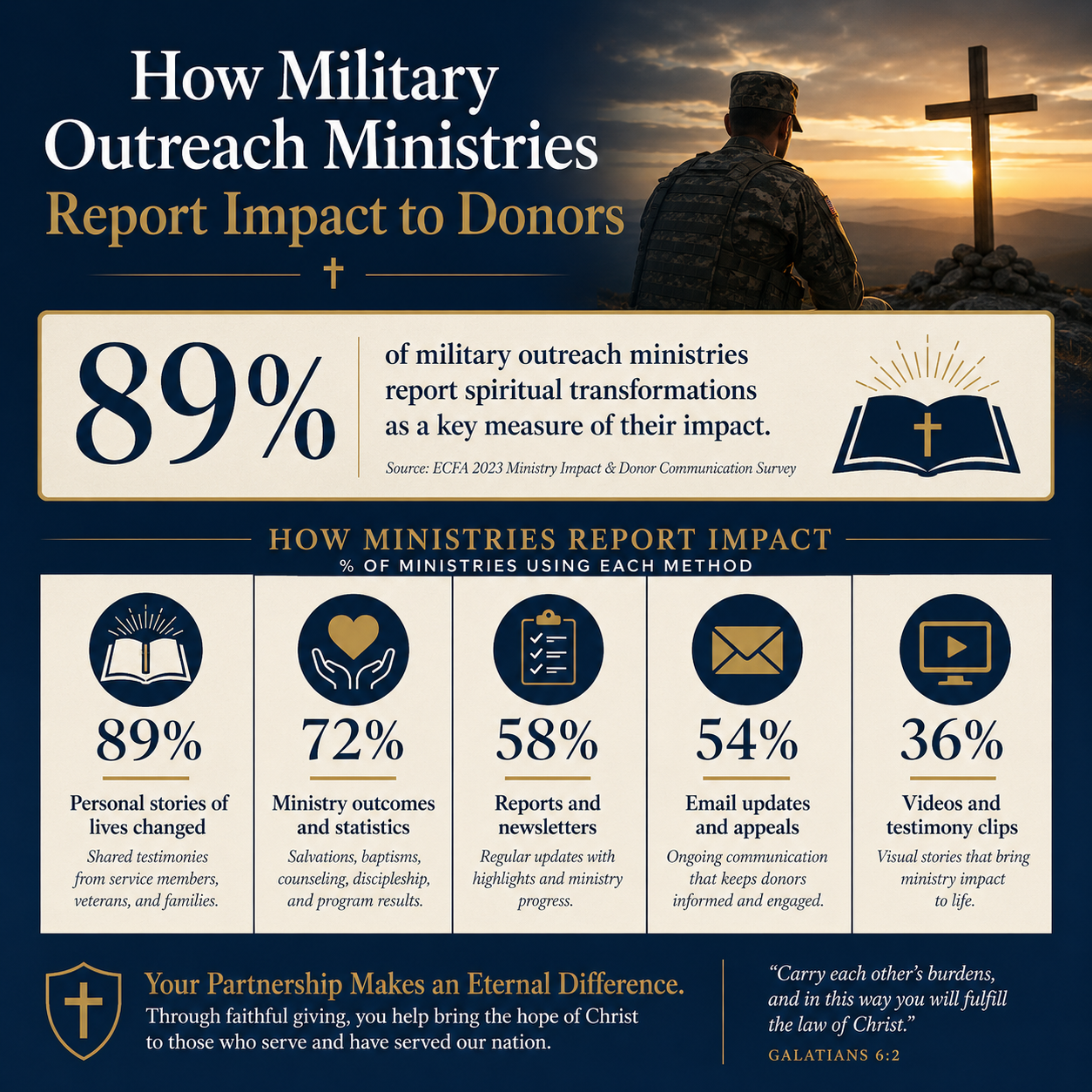
It is reasonable for a ministry to report spiritual outcomes when evangelism is a central part of its work, but donors should also expect careful definitions and follow-up evidence. A simple count of “decisions” can mislead if it obscures coercive practices, crisis vulnerability, or lack of discipleship pathways. Mature reporting pairs any conversion-related numbers with discipleship indicators, pastoral safeguards, and clear explanation of how the ministry avoids inflating claims.
How can a ministry be transparent if it cannot disclose locations or personal details?
Operational security and confidentiality are legitimate constraints, yet they do not eliminate accountability. Ministries can report aggregated activity by region or program category, disclose policies and oversight mechanisms, and provide independent financial and governance documentation. Donors should expect candor about what cannot be shared and credible substitutes that still allow meaningful evaluation.
Faithful impact reporting strengthens the church’s witness
Military outreach ministries serve in environments marked by sacrifice, hierarchy, and profound moral complexity. Donors honor that service best by asking for reporting that is neither sensational nor evasive: clear aims, honest evidence, governed confidentiality, and the humility to name limits. When ministries speak truthfully about their work, they protect service members, strengthen donor trust, and align their stewardship with the God who “requires that those who have been given a trust must prove faithful” (Luke 12:48).



