
Prayer and spiritual care in military outreach ministries sit at the intersection of moral injury, chronic uncertainty, and a vocation that can require lethal force. Donors often ask what “faithful support” looks like when troops and families are carrying burdens that do not resolve on a timeline, and when the public story of war rarely matches the private cost.
The best ministries neither romanticize military service nor treat service members as projects. They offer steady pastoral presence, Scripture that can bear weight, and prayer that names reality without collapsing into despair. For donors, the question becomes discernment: which ministries build durable spiritual care, and which mainly deliver activity.
Prayer in military communities is pastoral care, not merely encouragement
Military life forms people through repeated exposure to risk, separation, and institutional demands. For many troops and spouses, prayer is not an “add-on” to resilience; it is where fear, anger, grief, and guilt are brought before God with enough honesty to be healed. The Psalms matter here precisely because they give God-reverent language for distress. Jesus’ own prayer in Gethsemane (Matthew 26:36–46) legitimizes anguish without sanctifying it.
Spiritual care in this context often includes what clinicians and chaplains describe as moral injury: the experience of having transgressed, or felt betrayed in, a moral framework that once seemed stable. Not every difficult deployment produces moral injury, and Christians genuinely disagree about how to describe its spiritual dimensions. But donors should understand that many prayer requests arise from wounds that are not solved by optimism, and not always by a single counseling referral.
Deployment amplifies ordinary discipleship pressures
Marriage strain, parenting fatigue, and loneliness are not unique to the military. What is distinct is the rhythm of accelerated departures, prolonged ambiguity, and reintegration after high-alert living. Military spouses often carry “single-parent intensity” for months while trying to preserve a home culture of calm, and service members return to a family that learned to function without them.
Prayer that serves these families well is specific: for unity amid distance, for patience in communication, for protection from bitterness, and for wisdom in reintegration decisions. Many ministries support this by providing devotionals and Scripture resources that give a shared spiritual vocabulary across time zones and schedules.
Combat and training environments raise uniquely serious questions
Even outside direct combat, the military environment can require rapid decisions with real consequences, including lethal outcomes. The Christian tradition has long wrestled with just war reasoning and the ethics of force; donors should not assume the audience has resolved these matters. A ministry’s prayer culture should make room for lament, confession, and theological inquiry rather than forcing simplistic answers.
That posture does not dilute the gospel. It reflects the biblical pattern: truth spoken in love, and repentance as a path to restoration rather than humiliation. Healthy spiritual care keeps returning to the character of God, the cross of Christ, and the hope of resurrection as the ground for honest prayer.
The chaplaincy is essential but not sufficient
In the U.S. system, military chaplains are a primary channel of spiritual care. Their role is both protected and complex: they serve within command structures while maintaining religious ministry responsibilities and confidentiality obligations. Donors sometimes assume the chaplaincy makes civilian ministries unnecessary. In practice, many service members and families still need local church integration, denominationally specific discipleship, and relational continuity that outlasts a posting.
Effective outreach ministries respect chaplains, coordinate when appropriate, and avoid adversarial postures. They also provide complementary care that chaplains may not be positioned to deliver at scale, especially for spouses, children, and veterans navigating a long spiritual aftermath.
What prayer requests are common, and what mature ministries do with them
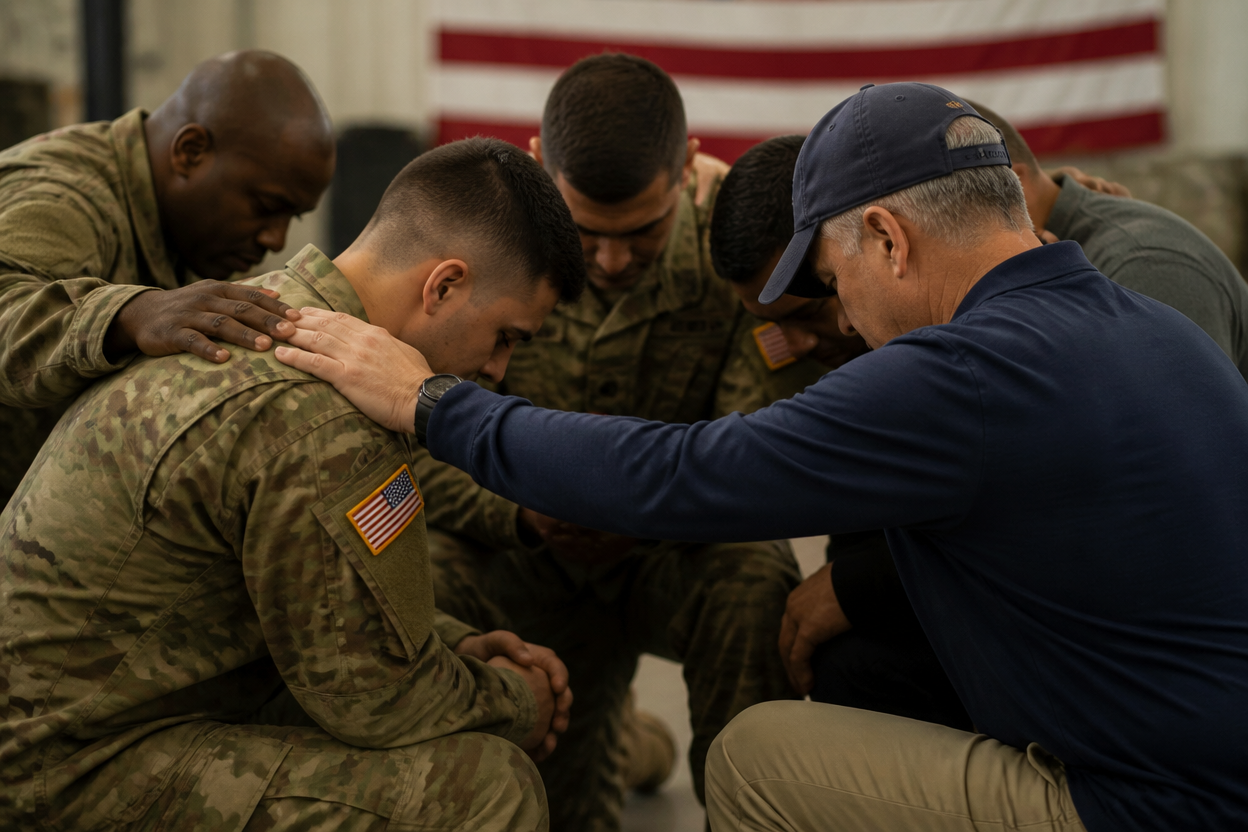
Prayer requests in military communities tend to cluster around safety, unity, and endurance. Yet the deeper requests often emerge only after trust is established: “help us forgive,” “help us sleep,” “help us speak without exploding,” “help us stop replaying what happened,” “help us believe God is still near.” Donors should expect ministries to move beyond public prayer lists toward careful, consent-based pastoral listening.
Safety is real, but it is not the only request
Prayers for protection are biblical and appropriate. Still, the most mature spiritual care does not frame God primarily as a risk-management tool. It teaches people to pray for courage and integrity alongside safety, and to locate ultimate security in Christ rather than outcomes. This is where ministries that emphasize discipleship over events often prove their value: discipleship prepares believers for unanswered prayer without severing their trust in God.
Family stability and communication are recurring burdens
Many donors underestimate how much spiritual pressure concentrates in ordinary decisions: what to tell children, how to manage finances when a spouse is absent, how to rebuild trust after emotional distance, how to handle pornography temptations, and how to keep church involvement from collapsing under exhaustion. Some ministries respond by facilitating prayer gatherings for troops and families, but the healthiest versions of these gatherings are not performative. They are confidential, consistent, and pastorally guided.
When prayer gatherings are tied to Scripture and follow-up care, they can become a “front door” to deeper formation: mentoring, Bible study, pastoral counseling referrals, and practical support coordinated with local churches.
Trauma, grief, and moral injury require patient spiritual care
We recommend that donors look for ministries that are careful with language around trauma and that respect clinical boundaries. Prayer is not a replacement for medical or psychological care, and faithful ministries do not shame people for needing treatment. The harder question is whether the ministry can hold both realities: that spiritual practices matter deeply and that trauma-informed care often requires professional collaboration.
Donors can also look for a ministry’s theological steadiness under strain. Scripture used as a slogan can deepen alienation; Scripture used as witness to God’s nearness can sustain. Passages often cited in military communities—Psalm 46, Psalm 121, Isaiah 41:10, John 14, Romans 8—should be handled as promises anchored in God’s character, not as guarantees of a particular timeline.
How donors can evaluate spiritual care without reducing it to numbers
Spiritual care is difficult to quantify, and the field has had to reckon with the limits of simplistic metrics. Donors still have legitimate accountability questions: Are people being discipled, or merely gathered? Are leaders safe and qualified? Are funds used with integrity? Are outcomes reported with honesty?
At Most Trusted, we verify Christian nonprofits against The Most Trusted Standard, which examines faith commitments, financial integrity, governance, and transparency. In military outreach ministries, those criteria matter because spiritual authority and access to vulnerable people increase the harm of weak oversight.
Verify doctrinal clarity and pastoral competence
Doctrinal statements should be specific enough to guide pastoral practice, especially around repentance, forgiveness, suffering, and the nature of the church. Ministries serving military communities also benefit from leaders trained in pastoral care and familiar with the realities of military culture. This does not require every staff member to be a veteran, but it does require humility, listening, and competence.
Donors should ask whether the ministry has clear policies for confidentiality, mandatory reporting, and spiritual counseling boundaries. A ministry that regularly prays with service members dealing with trauma should also have documented pathways for referral and crisis response.
Look for governance that protects people, not merely reputation
Military communities can be tight-knit, and scandals travel quickly. The temptation for ministries is to manage optics rather than address root problems. Strong boards, independent oversight, and clear conflict-of-interest policies are not distractions from mission; they are part of loving one’s neighbor when spiritual care involves real power.
Donors should also be attentive to how a ministry handles authority. If prayer gatherings or discipleship groups revolve around a single charismatic leader without accountability, the risk profile rises. The ministries that meet The Most Trusted Standard tend to show durable institutional practices: board engagement, audited or review-level financials when appropriate to size, and transparent reporting that does not exaggerate.
Ask for evidence of formation and long-term connection
Some outcomes can be responsibly described without reducing spiritual life to a scorecard: retention in small groups, referrals to local churches, completion of Bible study pathways, distribution of Bibles and devotionals accompanied by follow-up, and documented care for spouses and children. Donors can also ask whether the ministry’s approach reinforces the local church rather than competing with it.
Where ministries cite prevalence claims about trauma or mental health, donors should expect careful sourcing and modesty. For example, the U.S. Department of Veterans Affairs discusses PTSD and related concerns among veterans, including the reality that not all who experience trauma develop PTSD, and that treatment and recovery are possible (U.S. Department of Veterans Affairs). A credible ministry will not inflate figures to raise funds; it will describe needs in a way that honors the people it serves.
How donors can pray and give with integrity in this field
Many donors want to pray for military outreach ministries in a way that is both tender and theologically sound. We encourage prayer that is concrete: for protection, yes, but also for sanctification under pressure; for marriages to endure; for children to be shepherded; for leaders to resist cynicism; and for churches near bases to become stable homes for transient families. Prayer should also include repentance where needed—personal and institutional—because the gospel addresses not only suffering but sin and its consequences.
Giving decisions should align with that seriousness. The most faithful ministries often invest in slow work: chaplain partnership, small-group leaders, discipleship materials, pastoral counseling networks, and consistent prayer gatherings that do not photograph well. Donors can support this by favoring unrestricted gifts when governance is trustworthy and by valuing transparency over spectacle.
For readers who want a broader view of how ministries serve troops, veterans, and families, we direct attention to Military Outreach Ministries. The category includes related topics such as praying wisely for service members, common prayer requests in military communities, how ministries provide Bibles and devotionals, why discipleship often matters more than events, how prayer gatherings are conducted, and what Scriptures steady families during deployment.
Prayer that endures becomes a witness
Christian prayer in military communities is not sentimental. It is the church’s insistence that no one is beyond the reach of Christ’s mercy, and no sorrow is beyond the range of God’s consolation. When ministries practice spiritual care with humility, theological seriousness, and accountable leadership, they do more than “support the troops.” They bear witness to the presence of God in places where fear and loss often dominate the story.
Donors serve this work best by praying with discernment, giving with integrity, and insisting that ministries be both spiritually faithful and operationally trustworthy. That combination does not guarantee easy outcomes, but it does align with the kind of truthfulness Scripture commends and the kind of stewardship mature Christian givers rightly expect.



