
How military outreach ministries support service members is ultimately a question of spiritual presence under constraint: the Gospel offered with clarity, humility, and respect for a chain of command that exists for good reasons. Donors who have funded church planting, discipleship, and crisis care will recognize familiar dynamics here—only intensified by mobility, danger, and the moral weight of military vocation.
Most service members are not asking for novelty. They are asking for durable pastoral care amid deployments, training cycles, and reintegration pressures that can fracture family life and spiritual habits. The ministries worth supporting understand that faithful ministry in military contexts is often quiet, patient work: building trust, showing up repeatedly, and honoring both the person and the institution that has been entrusted with public authority (Romans 13:1).
Service members face distinct spiritual pressures that ordinary church life does not always absorb
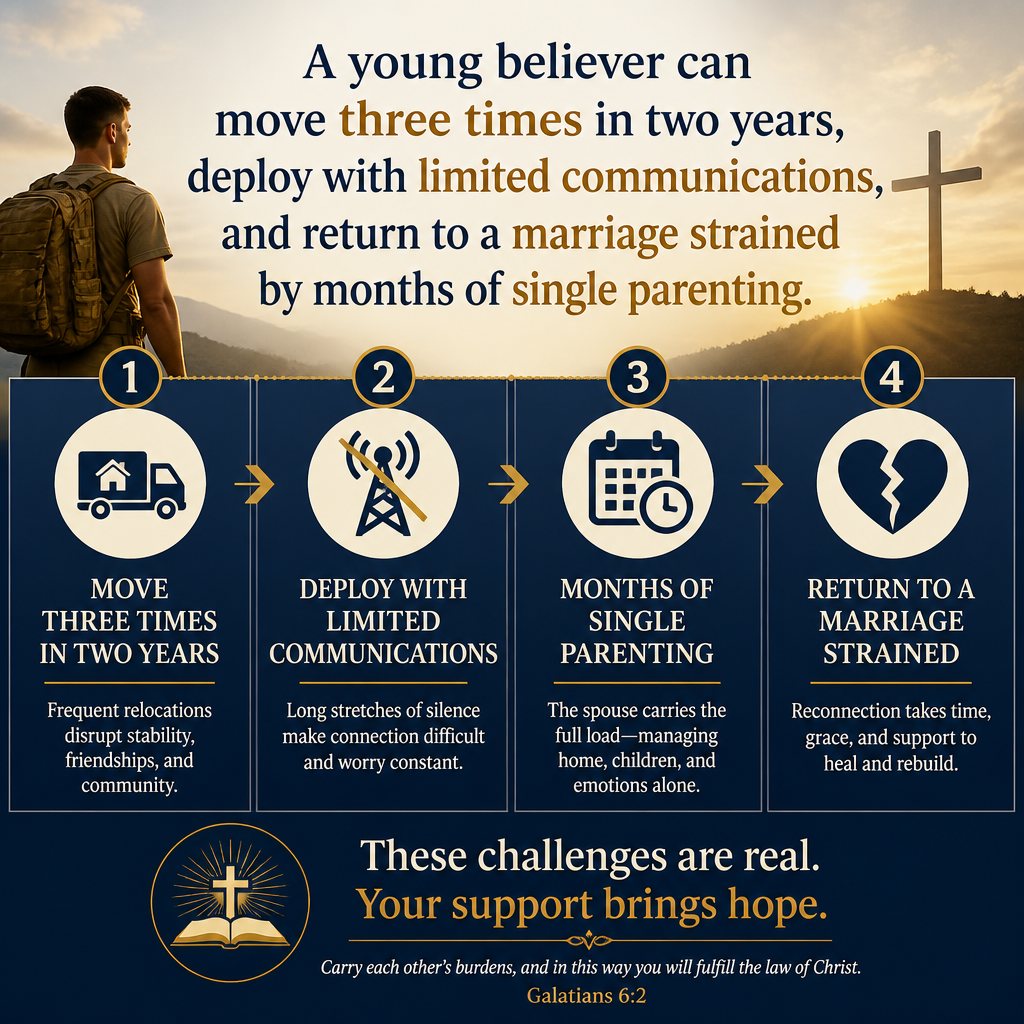
Military life compresses time and intensifies consequence. A young believer can move three times in two years, deploy with limited communications, and return to a marriage strained by months of single parenting. In that environment, many of the church’s ordinary formation pathways—consistent Sunday worship, stable small groups, multi-year mentoring—become difficult to sustain. The question for donors is not whether military members should simply “plug in more,” but whether the Body of Christ is meeting them where the vocation places them.
Verifiable data underscores the scale of the environment in which these ministries operate. The U.S. Department of Defense reports a force that includes roughly 1.3 million active-duty service members, with additional components in the Guard and Reserve, all supported by families who share the burdens of service (U.S. Department of Defense).
Moral injury and grief are pastoral realities, not only clinical categories
Combat exposure is not the only spiritual stressor, but it is a defining one for many. Even when actions are legally and tactically justified, service members may carry a deep sense of defilement, complicity, or unresolved lament. The field commonly refers to this as moral injury, and the best ministries do not treat it as a slogan. They offer confession and forgiveness without minimizing responsibility; they make room for grief without surrendering to despair; they direct men and women toward the crucified and risen Christ, whose atonement is not fragile.
Family strain is often the frontline of discipleship
Military spouses and children live with repeated separations, disrupted schooling, and the chronic uncertainty of assignments. Scripture’s charge to care for households (1 Timothy 5:8) is not suspended during deployments. Strong outreach ministries therefore treat marriage counseling, parenting support, and practical care for spouses as core spiritual work rather than “extras,” and they collaborate rather than compete with chaplains and local churches.
Isolation makes ordinary temptations more corrosive
Sexual sin, alcohol misuse, and despair are not unique to the military, but isolation and high stress can make them more destructive. Donors should expect faithful ministries to combine clear moral teaching with credible care pathways: accountability that protects confidentiality, referrals to qualified mental health professionals when needed, and a refusal to spiritualize what also requires clinical attention.
Faithful military ministry requires operating within protocols without diluting the Gospel
Christians genuinely disagree about the best posture toward military institutions, but serious donors should reject two simplistic extremes: treating the military as hostile territory where any compromise is capitulation, or treating it as a cultural ally that needs only chaplaincy and morale. In practice, ministry in this space is governed by policy, pluralism, and legitimate concerns about coercion. A credible military outreach ministry understands these constraints and still finds lawful, ethical ways to offer the Gospel.
On-base ministry is shaped by permissions, access, and trust
When ministries engage service members on bases, they do so by invitation, partnership, and established procedures. This often includes coordinating with chaplains, adhering to installation rules for gatherings, and respecting commanders’ responsibility for good order and discipline. Donors should be wary of organizations that boast about “getting around” protocols. Wise ministries build long-term access by being transparent and dependable.
Voluntary participation protects both integrity and witness
The military’s concern about coercion is not merely bureaucratic; it is a moral issue. Service members in hierarchical environments can feel pressured to comply with a superior’s preferences. Ministries that honor the Gospel will also honor voluntariness: invitations are clear, participation is optional, and spiritual conversations are offered without manipulation. That posture strengthens witness over time, especially among those who are skeptical of religion as a tool of power.
Deployed environments require restraint and competence
Some ministry activity is possible in deployed settings, but it is more limited and carefully governed, often through chaplain channels or approved morale and welfare frameworks. Donors should expect prudence: cultural awareness, security discipline, and realistic claims about what “access” means. Where a ministry cannot responsibly enter a theater, it may still serve deployed troops through care packages, virtual discipleship, or coordinated support for families at home—work that is less visible but often more sustainable.
The most effective ministries pair chaplain partnerships with local church continuity
Chaplains hold a unique role: commissioned officers tasked to provide for the free exercise of religion and to advise commanders on moral and religious matters. Outreach ministries that treat chaplains as competitors usually harm the very people they claim to serve. The better pattern is collaboration that respects the chaplain’s office while extending the Church’s broader capacity for discipleship, community, and long-term pastoral relationships.
Chaplains can open doors that outsiders cannot
Chaplains have authorized presence in places where civilian ministries cannot reliably operate: training pipelines, deployed units, crisis response environments, and moments of acute grief after loss. The U.S. Army’s chaplaincy remains a central channel for religious support within the force, which is precisely why wise outreach ministries learn how to partner rather than posture (U.S. Army).
Local churches provide the long arc of formation
Even when a ministry has meaningful on-base work, it cannot replace the ordinary means of grace: preaching, sacraments, accountable membership, and multi-generational community. The most credible outreach models actively connect service members to biblically faithful local churches near installations and, as much as possible, help them transfer those relationships when they move. Donors should listen for ministries that speak well of the local church and can describe concrete pathways for handoff and continuity.
Reintegration is a discipleship moment, not only a homecoming
Return from deployment can expose what adrenaline and mission focus were masking: trauma symptoms, anger, numbing, marital distance, and spiritual disorientation. Ministries that understand reintegration build rhythms of care before the return—support for spouses, prayer networks, pastoral check-ins—and sustain it afterward with counseling referrals, peer groups, and renewed engagement in church life. What this means in practice is that “welcome home” is not the end of the story; it is often where the harder pastoral work begins.
Donors should fund military outreach with the same rigor they bring to any ministry
The military context can heighten donor emotion: patriotism, gratitude, and a sincere desire to honor sacrifice. Those motives can be godly, but they can also reduce discernment. Christian donors serve both service members and the credibility of the Church when they give with clear eyes—asking how the ministry handles money, governance, safeguarding, and truthfulness in reporting outcomes.
At Most Trusted, our verification work evaluates Christian nonprofits against Military Outreach Ministries as a giving category through The Most Trusted Standard, a 15-criteria framework across Faith Foundation, Financial Integrity, Governance and Leadership, and Transparency and Effectiveness. The point is not to burden good ministries with paperwork; it is to ensure that donor generosity does not unintentionally subsidize dysfunction, exaggeration, or preventable harm.
Evidence donors can reasonably ask to see
Military outreach is not always easily quantified, and donors should resist crude scorekeeping. Still, mature ministries can provide verifiable indicators of stewardship: clear financial statements, independent oversight, and consistent reporting about activities without inflating access or conversion claims. Many credible organizations also align with the consensus guidance that overhead ratios alone are a poor proxy for effectiveness, a point articulated by leading charity evaluators and watchdogs (Charity Navigator).
Governance and safeguarding matter in high-trust environments
Service members are frequently young, geographically distant from their home churches, and often under stress. That combination creates vulnerability. Donors should expect strong child protection policies for family programming, appropriate boundaries in counseling settings, and a governance structure that prevents charismatic leaders from operating without accountability. Where a ministry is embedded in military-adjacent networks, it should also show prudence about access to sensitive environments and personal data.
Clarity about theology and pluralism protects the ministry’s integrity
Because military life includes people of many faiths and no faith, ministry leaders must distinguish between honoring religious liberty and collapsing the distinct claims of Christianity. Donors can ask direct questions: Is the Gospel clearly taught? Are conversions reported with integrity? Does the ministry affirm historic Christian orthodoxy and the authority of Scripture? A ministry can respect pluralism without adopting a lowest-common-denominator message that leaves service members with inspiration rather than Christ.
Giving that strengthens faithful presence
Military outreach ministries support service members most effectively when they commit to long-term pastoral presence, respect lawful military protocols, and work in concert with chaplains and local churches. Donors serve this field well by funding ministries that combine theological clarity with institutional maturity: transparent finances, accountable leadership, and honest reporting about what ministry in constrained environments can and cannot do. When we give with that kind of rigor, we honor both the service member’s dignity and the Church’s calling to bear truthful witness.



