
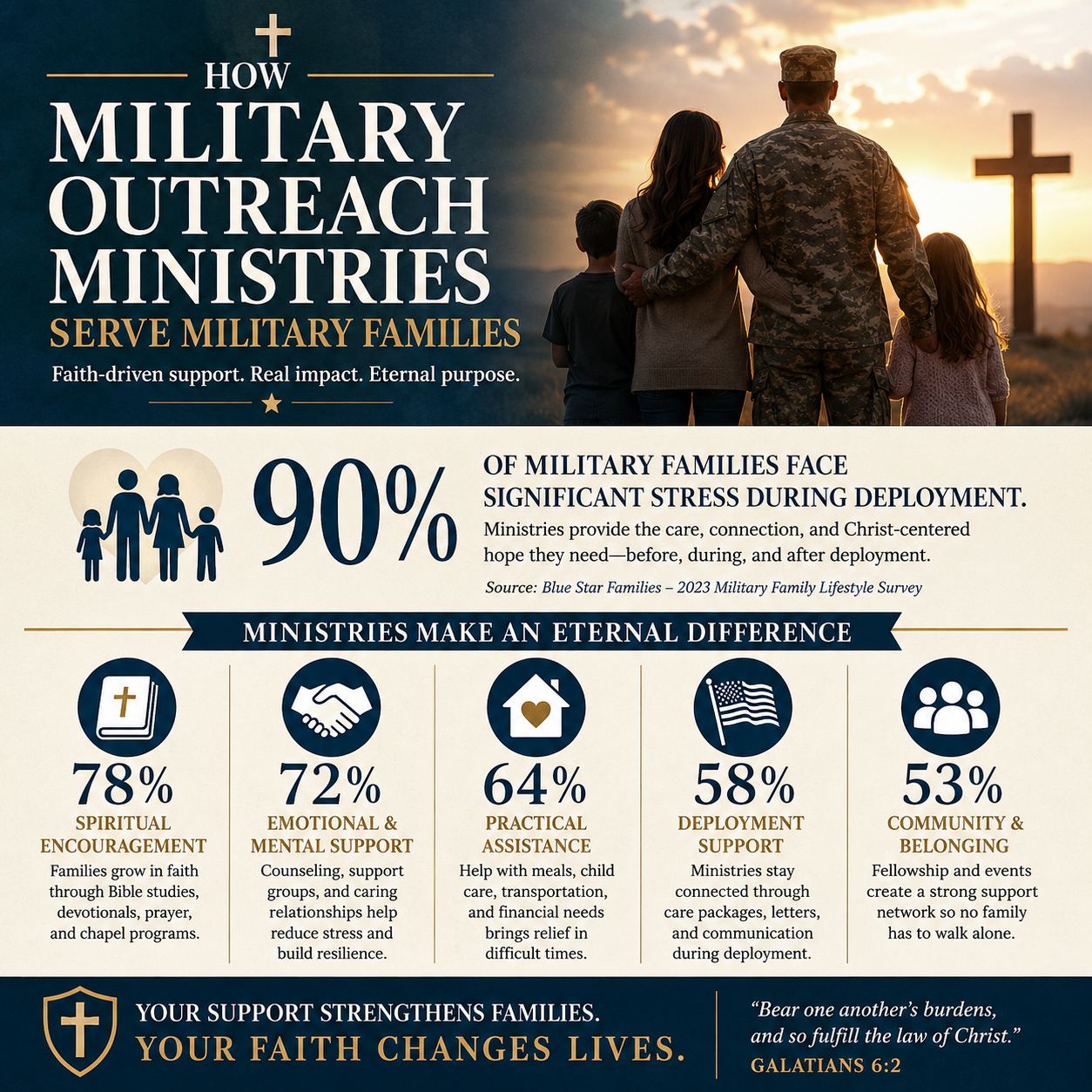
How military outreach ministries serve military families is ultimately a question of ecclesial responsibility in a high-strain vocational context. The modern volunteer force asks a comparatively small portion of Americans to bear repeated deployments, injury risk, and geographically dislocating careers; Christian compassion cannot be confined to admiration for service at a distance. Scripture’s logic is nearer: “Bear one another’s burdens, and so fulfill the law of Christ” (Gal. 6:2).
For donors, the challenge is not whether military families deserve care, but what faithful, effective care looks like when the needs are practical, relational, spiritual, and often private. Military culture carries real strengths—duty, cohesion, sacrifice—and real vulnerabilities: frequent separation, chronic stress, moral injury, and the invisible weight spouses and children carry. Serious support is rarely a single program. It is a set of coordinated ministries that can accompany a family across seasons, posts, and crises without reducing them to a fundraising narrative.
Military family strain is predictable, and ministry can be designed for it
Military life compresses many stressors into one household: separations that upend parenting rhythms, relocations that sever community, and occupational exposures most civilians never face. Ministries serve well when they treat these stressors as structural rather than exceptional. That posture changes program design. It pushes leaders toward repeatable care pathways instead of one-off encouragement.
Reliable public data helps donors understand why this work is not niche. The Department of Defense reports that the active-duty force includes more than a million service members, alongside hundreds of thousands of spouses and over a million dependent children; those family numbers are large enough to shape entire local church ecosystems around installations (U.S. Department of Defense). And the stressors are not merely “busy schedules.” The VA has documented elevated suicide risk among veterans compared to non-veterans, a sobering indicator of the mental and moral weight carried home from service (U.S. Department of Veterans Affairs).
What faithful care acknowledges about vocation and cost
Christian donors sometimes wrestle with how to speak about military service without baptizing violence or turning war into a simplistic morality play. Christians genuinely disagree about just war reasoning, pacifism, and the ethics of particular conflicts. Military outreach ministries serve families best when they do not require theological shallowness as the price of belonging. A chaplaincy-minded ministry can honor a service member’s vocation, grieve what is grievous, and call every household toward Christ without making partisan or ideological loyalty a substitute for discipleship.
Why “community” is not a vague word in this context
When families move every few years, “community” is not a sentimental aspiration; it is a measurable protective factor. The local church can become a place where a spouse is known beyond a uniform, where children are not treated as transient visitors, and where a family’s story does not reset every time orders change. Military outreach ministries often function as connective tissue—helping a family bridge from installation life to a congregation, from a crisis season to sustained pastoral care.
What donors should expect from mature ministry design
High-quality organizations anticipate the predictable pivot points: pre-deployment preparation, deployment support for spouses and children, reintegration, and the long tail of trauma or injury. Donors should expect policies and training that protect families and volunteers alike: background checks, safeguarding protocols for children, clear confidentiality practices, and pastoral oversight that does not confuse counseling with spiritual advice alone.
Strong ministries serve the whole household, not only the service member
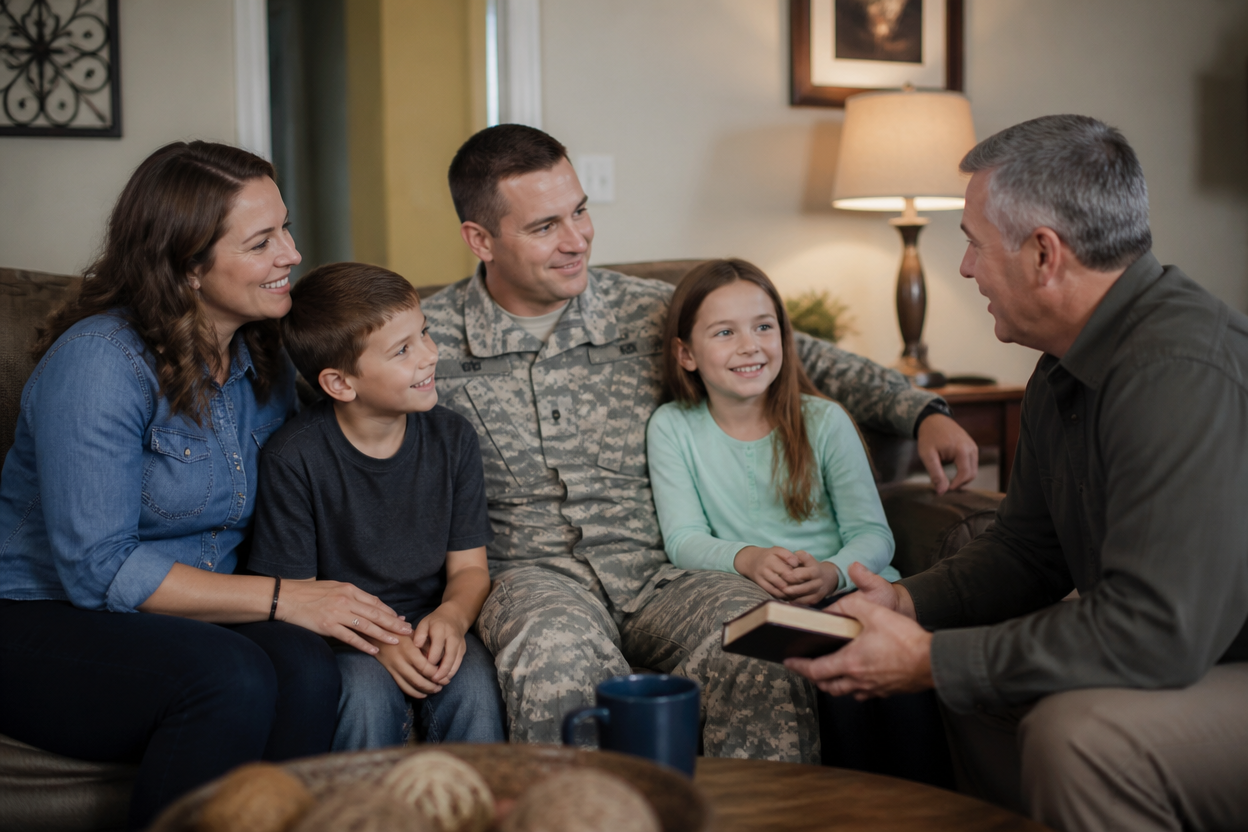
Many giving portfolios unintentionally prioritize the most visible person in the system: the deployed service member. Yet military outreach ministries serve military families well when they regard spouse and children as moral agents with their own burdens, not secondary characters in someone else’s story. That approach produces better outcomes and better theology, because it recognizes the household as a covenant community where discipleship is formed under pressure.
Support for military spouses is often the highest-leverage care
Spouses frequently shoulder solo parenting, financial administration, and the emotional labor of keeping a home stable while life remains unstable. Ministries commonly serve spouses through peer cohorts, mentoring, childcare during programming, and practical assistance during deployment windows. Some organizations offer career coaching or credentialing support, acknowledging that frequent moves disrupt spouse employment and can intensify anxiety around family finances.
For donors, the question is whether the ministry treats spouse care as an auxiliary feature or as a core part of mission. The ministries that are clearest about outcomes tend to define what “support” means: reduced isolation, increased access to pastoral care, strengthened marriage practices, and a clearer pathway into local church membership rather than perpetual dependency on a parachurch program.
Military children need more than recreation
Children in military homes often experience repeated cycles of attachment and loss: new schools, new friends, absent parents, and, at times, a parent returning changed. Ministries can help by providing consistent adult presence, age-appropriate biblical teaching, camps designed for mobility-affected kids, and counseling referrals when needed. Mature programs also coordinate with parents rather than bypassing them, resisting the temptation to treat children’s programming as entertainment rather than formation.
Safeguarding matters acutely here. Donors should look for transparent child protection policies, clear staff-to-child ratios, and documented training. A ministry can do enormous good in a child’s life, but a poorly governed program can do disproportionate harm.
Marriage retreats can be a clinical intervention and a spiritual practice
Marriage programming for military couples is not a luxury add-on. Reintegration after deployment can expose conflicts around trust, parenting roles, intimacy, and spiritual drift. Well-designed retreats and coaching can serve as both a spiritual reset and a structured intervention, especially when they include follow-up rather than treating the retreat weekend as the whole solution. Theologically grounded marriage care refuses two errors at once: excusing sin because life is hard, and treating pressure-cooker dynamics as if mere willpower will heal them.
Recovery after combat requires both pastoral care and clinically informed pathways
“Support the troops” language can obscure the deeper question: what helps a person live faithfully after they have seen or done things that are difficult to reconcile with ordinary life. Post-combat recovery includes trauma exposure, grief, injury, and sometimes moral injury—an erosion of meaning and trust when someone feels they violated, witnessed, or were betrayed by core moral expectations. Christian ministry is not an alternative to clinical care, but it does offer forms of healing that medicine alone does not: confession, forgiveness, lament, and restored communion with God and neighbor.
Chaplaincy and counseling access are not identical, and ministries must name the difference
Many military families first turn to chaplains because chaplains are accessible, culturally competent, and present near the point of need. That role is indispensable. Yet donors should recognize the limits: chaplains may provide pastoral counseling, spiritual care, and referral, but they do not replace licensed mental health treatment for PTSD, severe depression, or addiction. Strong military outreach ministries describe how they coordinate with chaplains, local churches, and clinical providers without confusing categories.
The best practice is a both-and pathway: spiritual care that takes Scripture seriously and clinical referrals that respect evidence-based treatment. This posture is not capitulation to secular psychology; it is an application of Christian wisdom about the complexity of the human person as embodied soul.
Recovery ministries must treat substance use and despair with sober realism
Some donors prefer ministries that only tell uplifting stories of resilience. Military life does include resilience, but it also includes relapses, marital breakdown, and crises that do not resolve on a donor-friendly timeline. Verifiable evidence suggests that veteran suicide remains an ongoing national concern, which should press Christian philanthropy toward patient, accountable support rather than quick programmatic wins (U.S. Department of Veterans Affairs).
Ministries with integrity avoid simplistic testimonies that imply a single altar call settles a complex clinical condition. They can still preach hope without promising what they cannot deliver. Donors should listen for clear language about boundaries, crisis protocols, and referral networks.
Discipleship after war must include lament and moral repair
Some service members carry guilt that is not resolved by reassurance; some carry grief that cannot be rushed into celebration. The Psalms give the church vocabulary for sustained lament without loss of faith. Ministries that understand this do not force triumphal spirituality on people who are still learning to sleep, trust, and pray. They teach Scripture in a way that allows “How long, O Lord?” to be a faithful sentence.
Effective support is logistical as well as spiritual, especially during PCS moves
Permanent Change of Station moves are more than inconvenient. They disrupt jobs, schooling, medical continuity, and church belonging. Practical help during moves—packing support, temporary lodging assistance, local connection to churches near the new duty station, and care packages at the right moment—may appear modest, but it often prevents cascading stress. A ministry can reduce a family’s vulnerability by helping them land well.
What this means in practice is that some of the most faithful programs are operationally disciplined. They maintain updated installation-area networks, coordinate volunteers across regions, and provide predictable assistance without humiliating application processes. Their theology of dignity shows up in their paperwork.
Donors should ask how ministries avoid dependency and preserve agency
The field has had to reckon with a perennial tension in mercy ministry: help can strengthen, or it can unintentionally erode agency. The When Helping Hurts framework, articulated by Corbett and Fikkert, has reshaped many ministries’ approaches by pressing leaders to avoid paternalism and to prioritize relational, empowering help where possible (When Helping Hurts). Military families often have strong competencies; the ministry’s role is frequently to remove friction and isolation, not to replace the family’s own capacity.
Wise donor expectations include clear criteria for assistance, thoughtful limits, and off-ramps into local church community and sustainable support systems. That is not stinginess; it is stewardship shaped by love of neighbor.
Verification matters because military families carry elevated trust and elevated risk
Military contexts can intensify trust quickly: uniforms, chaplain endorsements, and shared hardship create an environment where people assume good faith. That is a gift, but it is also a risk. Families in crisis are vulnerable to manipulation, and donors are vulnerable to emotionally compelling stories that do not correspond to disciplined governance or financial integrity.
Most Trusted exists to help donors give with confidence by evaluating ministries against The Most Trusted Standard, a 15-criteria framework across Faith Foundation, Financial Integrity, Governance and Leadership, and Transparency and Effectiveness. Across our verification work, we observe that ministries serving military families tend to be strongest when their pastoral heart is matched by operational clarity: accountable boards, clean financial statements, written safeguarding policies, and outcomes that are honestly defined and soberly reported.
Donors exploring Military Outreach Ministries should expect more than moving stories. The question is whether a ministry can be trusted to handle trauma, children’s safety, confidential counseling dynamics, and designated gifts with the seriousness the subject requires.
Giving that strengthens military families honors both compassion and accountability
How military outreach ministries serve military families is not primarily a question of novelty, but of faithfulness under strain. The church’s calling is to be a household of God where burdens are shared, truth is spoken with love, and the wounded are not rushed past their healing. Donors serve this mission well when they fund ministries that combine theological seriousness with governance maturity, protecting families from harm while offering durable hope rooted in Christ.



