
How donors can sponsor discipleship ministry training programs is ultimately a question of spiritual formation at scale: how the church equips ordinary believers and emerging leaders to teach sound doctrine, shepherd people, and endure in ministry over decades. Mature donors recognize that training is less visible than a crusade or a building project, but Scripture treats it as strategic. Paul instructs Timothy to entrust what he has heard “to faithful men, who will be able to teach others also” (2 Timothy 2:2). Sponsoring training is a way of funding multiplication rather than mere activity.
The harder question is not whether training matters, but how to sponsor it without financing confusion, celebrity, or dependency. Discipleship is personal, local, and slow; training programs can drift toward generic content, inflated claims, or fragile “pipelines” that produce credentials without character. Donors who want to underwrite discipleship with integrity need categories that are both theological and practical: faithfulness to Scripture, clarity of outcomes, financial honesty, accountable leadership, and a measurable connection to local churches.
Begin with a theology of multiplication and stewardship
Training is not overhead when it strengthens the body
Some donors hesitate to fund training because it feels indirect. Yet the New Testament consistently ties the health of the church to the formation of leaders and teachers. Ephesians 4 describes shepherds and teachers equipping the saints “for the work of ministry” so that the body grows into maturity (Ephesians 4:11–16). When training is tethered to the local church and oriented toward faithful teaching, it functions less like administrative cost and more like mission infrastructure.
This is one reason we encourage donors to read training budgets with discernment rather than suspicion. The broader philanthropic sector has had to correct simplistic assumptions about “low overhead” as a proxy for effectiveness. The well-known “Overhead Myth” letter was signed by Charity Navigator, BBB Wise Giving Alliance, and GuideStar to clarify that overhead ratios alone cannot measure impact and can even incentivize unhealthy underinvestment in leadership and systems (Charity Navigator).
Donor intent should be explicit and durable
Training programs often live at the intersection of church life and nonprofit operations. That makes clear donor intent particularly important: what kind of leaders are being formed, for what communities, with what doctrinal commitments, and under what accountability. Scripture warns that teachers bear weightier responsibility (James 3:1). Donors who sponsor training should be able to articulate what faithfulness looks like in that context and how the ministry will guard it over time.

Choose training models that strengthen local churches
Programs drift when they are detached from pastoral oversight
Many training initiatives begin with sincere zeal and then slowly detach from the oversight structures that preserve theological clarity. Donors can reduce this risk by preferring programs that are explicitly church-anchored: cohorts that require a pastor’s recommendation, supervised ministry assignments, and ongoing evaluation from local elders. Across our verification work at Most Trusted, ministries that meet The Most Trusted Standard tend to make their ecclesial relationships concrete rather than aspirational: they can name who approves curriculum, who disciplines leaders, and how doctrinal disputes are resolved.
Donors can also distinguish between training that adds capacity to churches and training that competes with them. The latter may still produce content or conferences, but it often creates parallel authority structures that are difficult to correct when problems arise.
Context matters as much as content
Discipleship training is not a one-size curriculum. Rural pastors, urban church planters, prison chaplains, bivocational elders, and women leading discipleship ministries in complex family systems face different pressures. Programs that respect context will show it in their design: adaptable assignments, mentoring, and measured expectations for time and travel.
For donors seeking a broader view of how training relates to pastoral formation and governance, our editorial coverage of How Discipleship Ministries Support Church Leadership places these funding decisions within the larger ecosystem of church health.
Underwrite the true costs without subsidizing dysfunction
Scholarships should remove barriers without lowering standards
Sponsorship often takes the form of scholarships for trainees who cannot afford tuition, travel, or study time. This is commendable when it increases access for faithful candidates who are already serving. It becomes complicated when money functions as recruitment pressure: enrolling people who are not called, not vetted, or not accountable simply to meet targets.
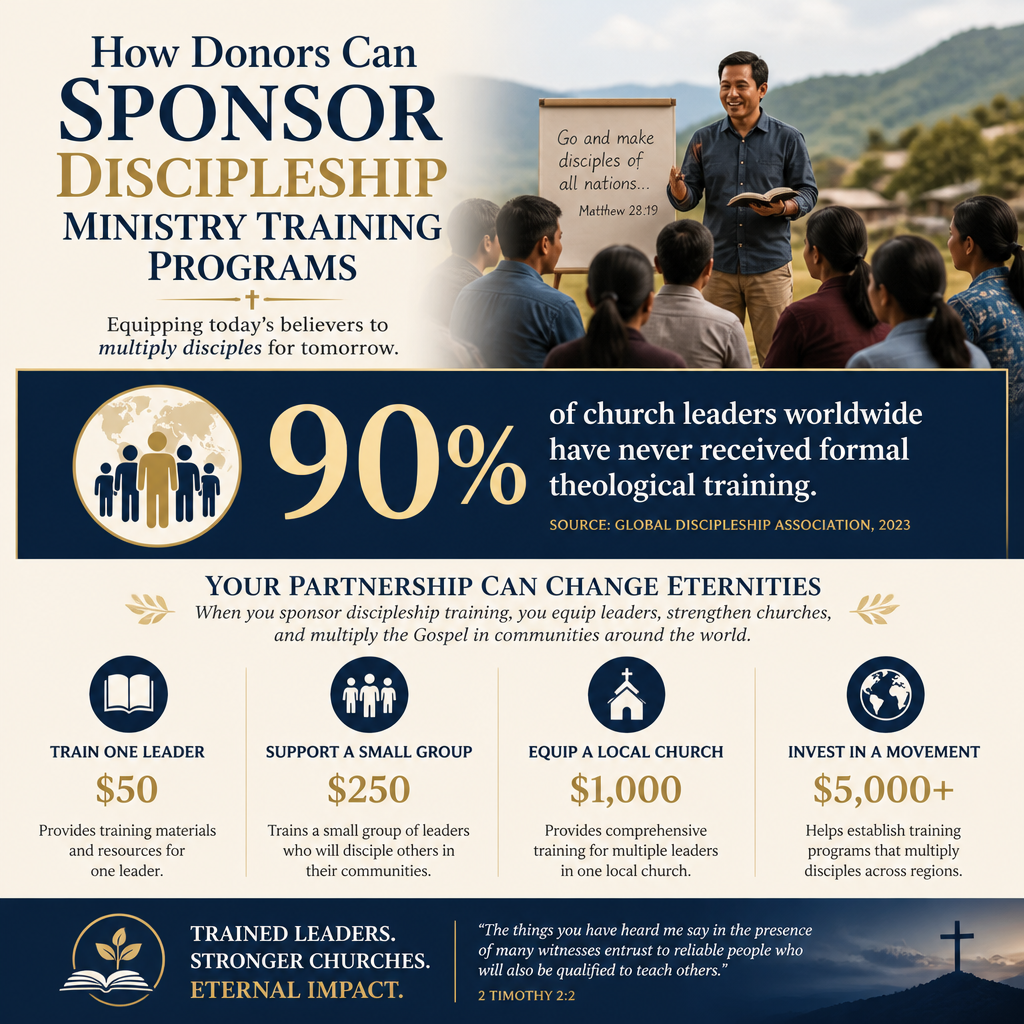
A wise sponsorship design removes financial barriers while keeping formation standards high. Donors can ask for criteria such as: church endorsement, demonstrated ministry service, and a plan for post-training placement. A scholarship that is paired with a supervised ministry role tends to produce more durable fruit than one that funds coursework in isolation.
Sponsor the ecosystem, not only the classroom
Training that produces lasting leaders usually includes more than lectures. It requires mentoring, supervised practice, pastoral care, and evaluation. It also requires responsible operations: background checks where appropriate, safeguarding policies, secure data practices, and a budget that can actually sustain instructors and coaches without constant crisis fundraising.
What this means in practice is that donors may need to sponsor costs that feel unglamorous: learning management systems, trainer development, assessment tools, and administrative staff who keep cohorts organized. These are not inherently suspect. The question is whether the ministry can explain them clearly, govern them well, and demonstrate that they serve formation rather than bureaucracy.
Apply verification-grade questions before you fund
Use The Most Trusted Standard as a due diligence lens
Christian donors often inherit a false choice: either fund based on personal trust and informal relationships, or demand secular metrics that do not fit spiritual formation. A more faithful path is to ask for verifiable evidence that a ministry is doctrinally grounded, financially honest, responsibly governed, and transparent about results and limitations. That is the premise of Most Trusted. We evaluate ministries against The Most Trusted Standard, a 15-criteria framework that addresses faith foundation, financial integrity, governance and leadership, and transparency and effectiveness.
Donors can translate that framework into a short set of pre-sponsorship questions. Strong ministries do not treat these questions as adversarial; they treat them as part of Christian accountability.
- Who owns the curriculum, and what doctrinal statement governs it?
- How are trainers selected, evaluated, and corrected when concerns arise?
- What portion of graduates remain in ministry service after one to three years, and how is that tracked?
- How are scholarship funds restricted, recorded, and audited or reviewed?
- What safeguarding policies govern training environments and mentorship relationships?
Demand clarity about outcomes without forcing simplistic metrics
Christians genuinely disagree about how to measure discipleship. Counting attendance is easy and often misleading. Counting baptisms is meaningful but can become a performance indicator. Tracking “leaders trained” is common but does not guarantee pastoral competence or character. Donors should not abandon measurement; they should insist on measurement that matches the ministry’s theology.
One practical approach is to ask for layered outcomes: completion rates, demonstrated competencies, placement into accountable ministry roles, and feedback from sending churches. The goal is not to quantify the Holy Spirit, but to practice honesty about what the program can and cannot claim.
Structure sponsorship for faithfulness over time
Multi-year commitments can reduce pressure and improve formation
Training is formative work, and formative work is vulnerable to volatility. A one-time gift can help, but it can also create churn: the program expands, recruits aggressively, then contracts when funding drops. When donors can make multi-year commitments with clear milestones, programs can plan cohorts responsibly, retain qualified trainers, and provide consistent mentoring.
Multi-year does not mean unconditional. Mature sponsorship includes agreed checkpoints: financial reporting, curriculum review, safeguarding compliance, and graduate follow-up. When a ministry cannot provide basic reporting, it is usually not a sign of humility. It is a sign of weak systems or weak leadership.
Partner with the church and protect against dependency
Training programs that serve churches well often invite churches to share the cost in proportion to capacity. This builds ownership and reduces dependency on outside donors. It also creates a natural accountability loop: churches who contribute, even modestly, tend to pay attention to quality and fit.
When training occurs cross-culturally, donors should be especially alert to dependency dynamics. The When Helping Hurts framework, articulated by Steve Corbett and Brian Fikkert, has shaped the field by warning that outside resources can unintentionally undermine local agency and leadership when they are not paired with humility and accountability (When Helping Hurts). Sponsorship should aim to strengthen local leaders, not replace local responsibility.
FAQs for How donors can sponsor discipleship ministry training programs
Is sponsoring discipleship training less effective than funding direct evangelism or relief?
It depends on the ministry’s model and accountability. Training is indirect, but Scripture repeatedly frames it as a means of multiplication and endurance in the church (2 Timothy 2:2; Ephesians 4:11–16). Donors can look for verifiable signs that training produces faithful teachers and servants who remain rooted in local churches, rather than merely completing coursework. A well-governed training program often strengthens both evangelism and mercy ministry by forming leaders who can sustain them.
What should donors ask for when sponsoring scholarships for trainees?
Donors should ask for clear eligibility criteria, a process for church endorsement, and reporting that shows how scholarship funds are restricted and tracked. It is also reasonable to ask how the program assesses readiness and character, not only academic performance. Sponsorship should remove financial barriers without creating incentives to enroll unvetted candidates or to graduate people who are not prepared to shepherd others.
A faithful sponsorship is accountable, church-anchored, and transparent
Training leaders for discipleship is one of the most strategic forms of Christian philanthropy because it funds multiplication and long obedience rather than episodic activity. The integrity question is not whether the work is spiritual, but whether it is accountable: rooted in Scripture, governed wisely, financially honest, and clear about what it can verify. Donors who sponsor programs with those commitments serve the church’s future, and they do so with confidence grounded in evidence rather than sentiment.
For donors who are weighing where training fits among other discipleship investments, our coverage of Discipleship Ministries addresses how formation, leadership development, and ministry effectiveness relate across the broader Christian nonprofit landscape.



