

How discipleship ministries train pastors and lay leaders is ultimately a question about formation: whether churches are raising leaders whose doctrine is sound, whose character is credible, and whose ministry practice is faithful under pressure. Donors feel the stakes because leadership failures are rarely private; they wound congregations, discredit witness, and create long-term pastoral vacancy and instability.
The challenge is not merely a shortage of information. The internet can supply endless content. The harder question is whether a ministry can help ordinary Christians and aspiring pastors grow into steady, accountable shepherds who can teach, counsel, manage conflict, and endure suffering without drifting into cynicism or control. That kind of formation takes time, relationships, and governance strong enough to resist celebrity dynamics.
Training begins with the biblical aim of discipleship
Christian leadership training is not primarily skill acquisition. Scripture frames it as the slow shaping of a life under the lordship of Christ. When Jesus commissions the church, he does not begin with leadership pipelines but with disciples: “make disciples of all nations… teaching them to observe all that I have commanded you” (Matthew 28:19–20). Discipleship ministries serve churches best when they keep that aim central: leaders who obey Christ and can teach others to do the same.
Paul’s pastoral letters sharpen the point. The qualifications for elders and deacons in 1 Timothy 3 and Titus 1 are weighted toward character and household faithfulness, not charisma or platform. Competence matters—leaders must be “able to teach”—but competence untethered from holiness becomes a liability.
Doctrine that forms worship rather than factions
Healthy training holds doctrine and devotion together. The church has always needed leaders who can “rightly handle the word of truth” (2 Timothy 2:15) without weaponizing it for tribal conflict. Discipleship ministries often contribute by building structured biblical theology, hermeneutics, and church history into programs for both pastors and lay leaders, so that teaching is anchored in the whole counsel of God rather than in the controversies of the moment.
Character formation that can withstand scrutiny
Donors have watched too many moral failures and financial scandals to be impressed by ministry scale alone. Discipleship ministries that train leaders well build habits of confession, accountability, and submission to local church authority. They treat integrity as a ministry outcome, not as an assumed background condition.

Pastoral training and lay leader training are related but not identical
Churches depend on both ordained pastors and capable lay leaders. Yet the callings differ in responsibility and in the types of authority exercised. Mature discipleship ministries recognize this and avoid a one-size-fits-all pipeline.
Pastors need training for Word and sacrament and for suffering
Formal pastoral training typically emphasizes exegesis, preaching, theology, and shepherding. But the modern pastoral role also includes complex organizational burdens: staff supervision, child safety practices, crisis response, and the pastoral care implications of mental health, addiction, and family fragmentation. Disciplines of prayer and endurance are not optional add-ons; they are central to a vocation that often includes hidden grief.
Evidence suggests many pastors experience significant strain. Barna has reported high levels of burnout among pastors in recent years, reflecting the cumulative pressures of congregational conflict, cultural polarization, and workload expectations (Barna). The point is not to treat ministry as a wellness program, but to acknowledge that training which ignores suffering and limits will eventually produce either brittle leaders or quiet collapses.
Lay leaders need training for spiritual authority exercised under oversight
Lay leaders often carry the relational ministry that makes churches resilient: small group leadership, youth mentoring, hospitality, mercy ministry, prayer teams, financial stewardship, and volunteer coordination. Their authority is real, but it is exercised under pastoral oversight. Discipleship ministries serve the church when they train lay leaders to lead with humility, to handle Scripture responsibly, and to recognize when a situation requires pastoral or professional referral.
For donors, this distinction matters because it affects how program outcomes should be measured. A ministry claiming to “train pastors” should show evidence of doctrinal depth, supervised ministry practice, and a clear relationship to local churches. A ministry focused on lay formation should show pathways for sustained service, not merely event-based inspiration.
Effective training is relational, supervised, and accountable
The church cannot outsource spiritual authority to content distribution. Discipleship ministries train leaders best when they build real relationships, supervised practice, and a governance model that places guardrails around influence.
Apprenticeship models reflect how Scripture assumes leaders are formed
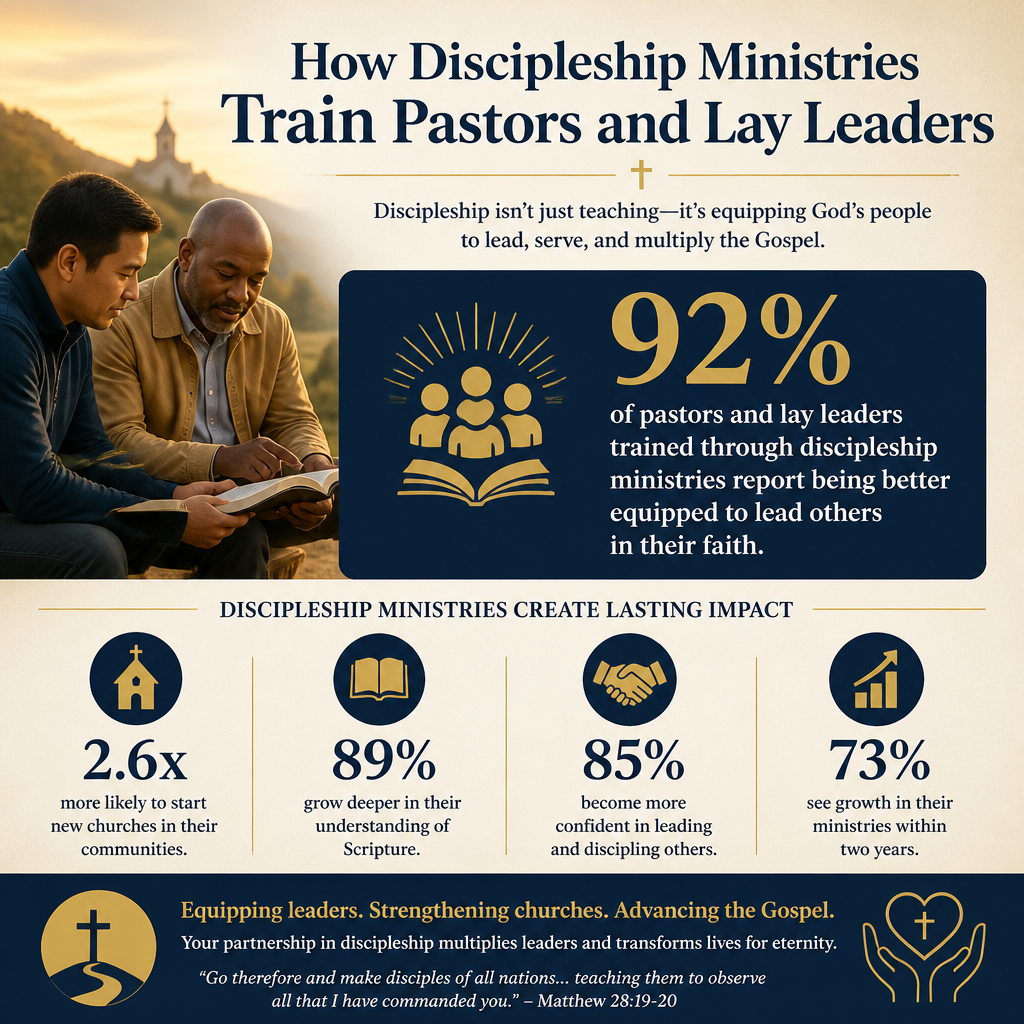
Jesus trained the Twelve by life-on-life apprenticeship: teaching, sending, correcting, and restoring. Paul describes similar patterns with Timothy and Titus. Many contemporary discipleship ministries mirror this through cohorts, mentoring, supervised ministry placements, and peer learning communities that include structured feedback.
These models carry trade-offs. They are expensive, slower to scale, and harder to measure than online courses. Yet formation that can be audited—through documented mentorship, supervised ministry hours, and clear doctrinal standards—often produces leaders whose resilience is visible years later.
Accountability requires more than good intentions
When a ministry trains leaders, it inevitably shapes theology, pastoral instincts, and ethical norms. The ministry therefore needs strong governance, clear conflict-of-interest policies, and transparent financial practices. This is where verification becomes more than administrative hygiene; it becomes a form of neighbor love toward churches and donors.
Across our work at Most Trusted, the ministries that meet The Most Trusted Standard tend to document how leaders are selected, how mentors are vetted, how misconduct allegations are handled, and how finances are reviewed. Donors should not have to infer these safeguards from marketing language. They should be able to read them.
Donors should evaluate training ministries by fruit, not by slogans
Christian donors often want to fund “leadership development” because it feels strategic and multiplicative. That instinct can be wise. But “multiplication” can also become a substitute for evidence. Formation is not a factory process, and Scripture does not treat speed as a moral good.
What outcomes can reasonably be expected
Some outcomes are measurable: completion rates, placements in local churches, retention in ministry after several years, or the number of leaders serving in specific contexts. Other outcomes—humility, prayerfulness, courage—resist easy metrics but can still be assessed through careful qualitative evaluation and third-party references.
Donors may also be tempted to evaluate training by overhead ratios or by how little an organization spends on administration. That approach has been broadly challenged by the “Overhead Myth” statement signed by major charity evaluators, which argues that administrative spending is not a reliable proxy for effectiveness (Candid/GuideStar). For leadership training, appropriate spending on supervision, safeguarding, and evaluation is often part of responsible ministry, not an inefficiency to be minimized.
A practical set of questions that respects the church
Before funding a discipleship ministry that trains pastors and lay leaders, we recommend asking questions that test both theological seriousness and institutional trustworthiness:
- How does the ministry define “a trained leader,” and what evidence supports that definition?
- What doctrinal commitments govern the curriculum, and how are instructors held accountable to them?
- How are mentors selected, trained, and supervised, including background checks where appropriate?
- What is the relationship to local churches for recruitment, placement, and ongoing oversight?
- How does the ministry handle allegations of misconduct, spiritual abuse, or financial impropriety?
These questions are not hostile. They honor the reality that training confers influence, and influence without scrutiny is a consistent recipe for harm.
Verification clarifies trust when donors cannot observe formation directly
Most donors cannot sit in on cohorts, evaluate curriculum quality, or interview graduates. Yet donors are still accountable to give wisely. Verification helps by examining whether a ministry’s public claims are supported by governance, financial integrity, theological clarity, and credible reporting.
What The Most Trusted Standard can and cannot do
The Most Trusted Standard is a 15-criteria framework that assesses ministries across Faith Foundation, Financial Integrity, Governance and Leadership, and Transparency and Effectiveness. This kind of evaluation does not replace local discernment or pastoral counsel. It does, however, provide a disciplined way to see whether a ministry’s operations match its stated mission, especially in areas—board independence, audited financials, conflict-of-interest controls, and disclosure practices—that donors cannot evaluate from a distance.
When donors explore Discipleship Ministries, the goal is not to elevate one model as the only faithful approach. Christians genuinely disagree about pedagogical methods, denominational distinctives, and the right balance between formal theological education and apprenticeship. Verification is not about settling those disputes. It is about clarifying whether a ministry is candid, governed, and financially responsible as it pursues its stated approach.
Why leadership training deserves higher scrutiny, not lower
Some ministry categories involve obvious physical risk—disaster relief, medical missions, child welfare—and donors intuitively demand safeguards. Leadership training can feel safer because it is “only education.” But training shapes spiritual authority, and mishandled authority can cause profound harm. That is why donors should expect clear safeguarding policies, grievance procedures, and reporting that does not hide behind spiritual language.
For donors focused on the church’s long-term health, leadership training is not a niche investment. It is an investment in the teaching ministry that shapes congregations for decades. The category How Discipleship Ministries Support Church Leadership sits close to the center of what makes churches stable, biblically faithful, and able to withstand cultural pressure without surrendering charity.
FAQs for How discipleship ministries train pastors and lay leaders
Should donors prioritize pastor training over lay leader development?
Not necessarily. Churches require both, and the right emphasis depends on context. In regions with severe pastoral shortages, funding credible pastoral training and placement can be urgent. In established congregations where the pastoral office is stable but ministry breadth is constrained, investing in lay leader development can strengthen small groups, mercy ministry, and youth discipleship. Donors serve the church best when they fund according to demonstrated need and verifiable capacity rather than according to prestige categories.
What warning signs suggest a leadership training ministry may be unsafe or ineffective?
Common warning signs include vague doctrinal commitments, charismatic leadership that is insulated from board oversight, reluctance to disclose financial statements, an absence of clear safeguarding policies, and outcome claims that cannot be explained or substantiated. Another concern is training that consistently undermines local church authority by positioning the ministry as the primary source of spiritual covering. Healthy discipleship ministries typically strengthen churches rather than competing with them.
Training leaders is a stewardship responsibility
Discipleship ministries that train pastors and lay leaders are doing work the church cannot afford to treat lightly. Scripture places real weight on teachers and shepherds, precisely because their influence is durable and their failures are costly. Donors can honor that weight by funding ministries that combine theological seriousness with verifiable governance, financial integrity, and transparent evidence of fruit. The church does not need more leadership rhetoric; it needs leaders formed in truth and tested in accountable practice.



