
How clergy coaching works in discipleship ministries is ultimately a question of formation: how a pastor’s inner life, habits of ministry, and patterns of leadership are brought under the lordship of Christ for the sake of the church’s maturity. Donors often encounter the term “coaching” in a marketplace sense—goal-setting, performance, productivity. In a church context, the word can signal something better: a disciplined, accountable practice of shepherding the shepherds so that the means match the message.
The harder question is whether clergy coaching, as practiced by a given ministry, is truly discipleship or simply professional development with Christian vocabulary. Christians genuinely disagree about where the line should be drawn. Yet Scripture does not allow the church to treat pastoral formation as optional. Paul charged Timothy to “keep a close watch on yourself and on the teaching” (1 Timothy 4:16), and Peter warned that shepherds must serve “not domineering over those in your charge, but being examples to the flock” (1 Peter 5:3). Coaching can be one means of putting those apostolic standards into a sustained, measurable practice.
Coaching in discipleship ministries is formation before it is strategy
The biblical logic is shepherding the shepherd
In the New Testament, leadership and discipleship are inseparable. The church is built up as leaders are themselves formed in Christ, then entrusted to teach others (2 Timothy 2:2). When clergy coaching is faithful, it is not a substitute for the Spirit’s work, nor an attempt to mechanize holiness. It is a structured relationship that makes room for confession, recalibration, and wise counsel—especially where the pressures of ministry make self-deception easy.
That need is not theoretical. Pastors routinely serve in contexts of high emotional demand and chronic ambiguity, often with limited peer support. The point is not to sensationalize pastoral stress, but to acknowledge the ordinary strain that accumulates over years of preaching, counseling, and leading through conflict. In surveys of clergy, burnout is repeatedly identified as a significant risk; Barna has documented high levels of stress among pastors in recent years Barna.
Discipleship language can be used to avoid accountability
There is a real tension donors should name plainly: “discipleship” can be used as a halo word that obscures weak practice. Some coaching models focus heavily on encouragement and vision while avoiding hard questions about character, boundaries, fiscal stewardship, or governance. Others treat pastors as isolated entrepreneurs who only need better tools. Either approach can drift from a biblical view of the pastor as an undershepherd accountable to God and to the church.
What this means in practice is that donors should look for coaching that is integrated with spiritual oversight rather than detached from it. That does not require a single denominational model. It does require that the coaching relationship has moral clarity about what faithfulness looks like, and that it is ordered toward the church’s long-term health rather than short-term momentum.
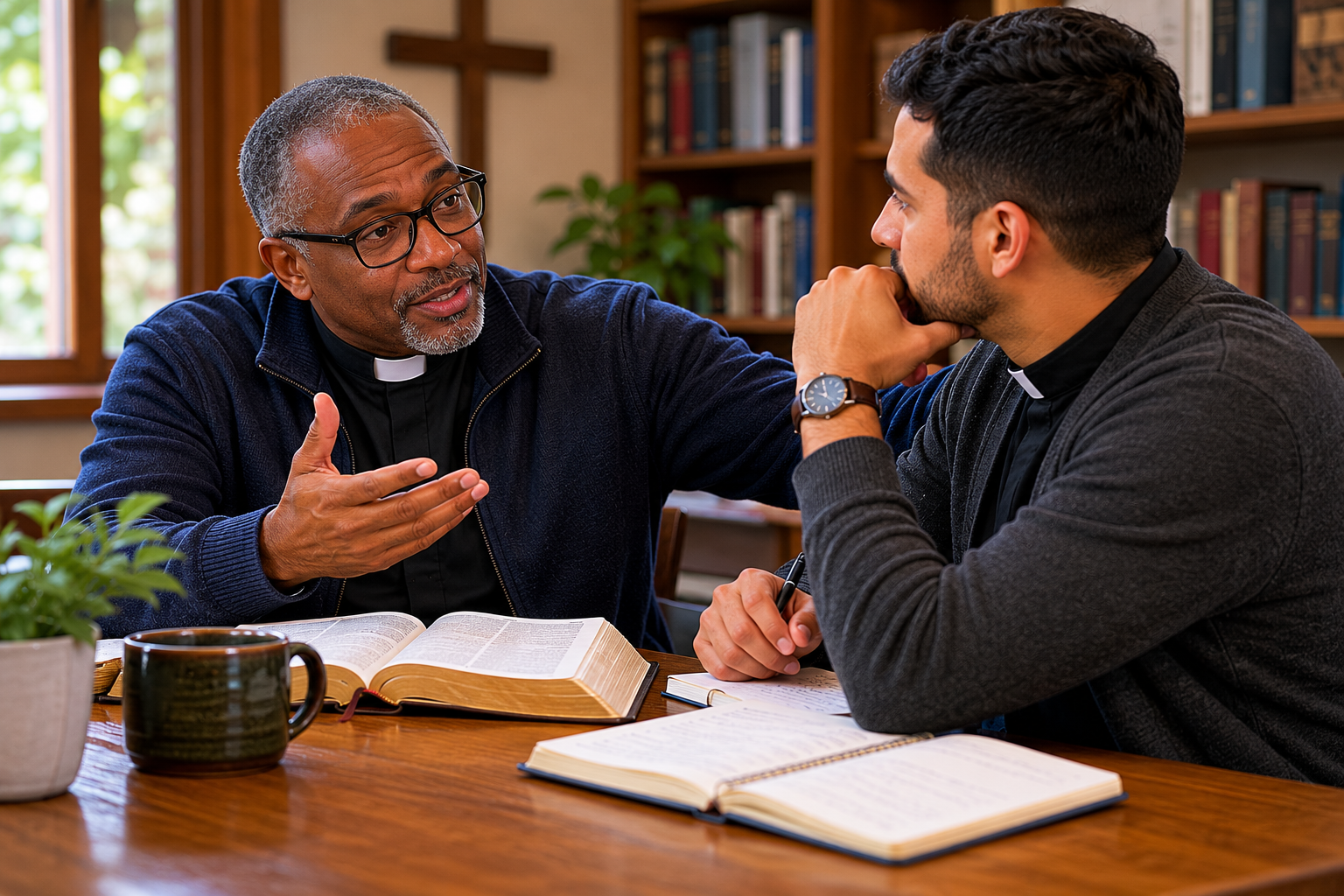
What clergy coaching actually looks like when it is done well
A defined covenant, clear rhythms, and documented learning
In mature discipleship ministries, clergy coaching is usually built on a covenant: confidentiality parameters, expectations for preparation, the cadence of meetings, and the limits of the coach’s role. Coaching is not therapy, not spiritual direction in every case, and not a replacement for a pastor’s accountability structures. A credible ministry will say so directly and set referral pathways when counseling needs exceed coaching competence.
Coaching rhythms vary, but strong programs tend to have predictable practices: monthly or twice-monthly sessions, a shared set of formation aims, and a disciplined review of commitments. The aim is not to create paperwork; it is to resist the common pastoral pattern of living from crisis to crisis with little reflective space. Because discipleship is a long obedience, coaching that never results in concrete commitments is usually not coaching at all.
Common coaching domains in discipleship ministries
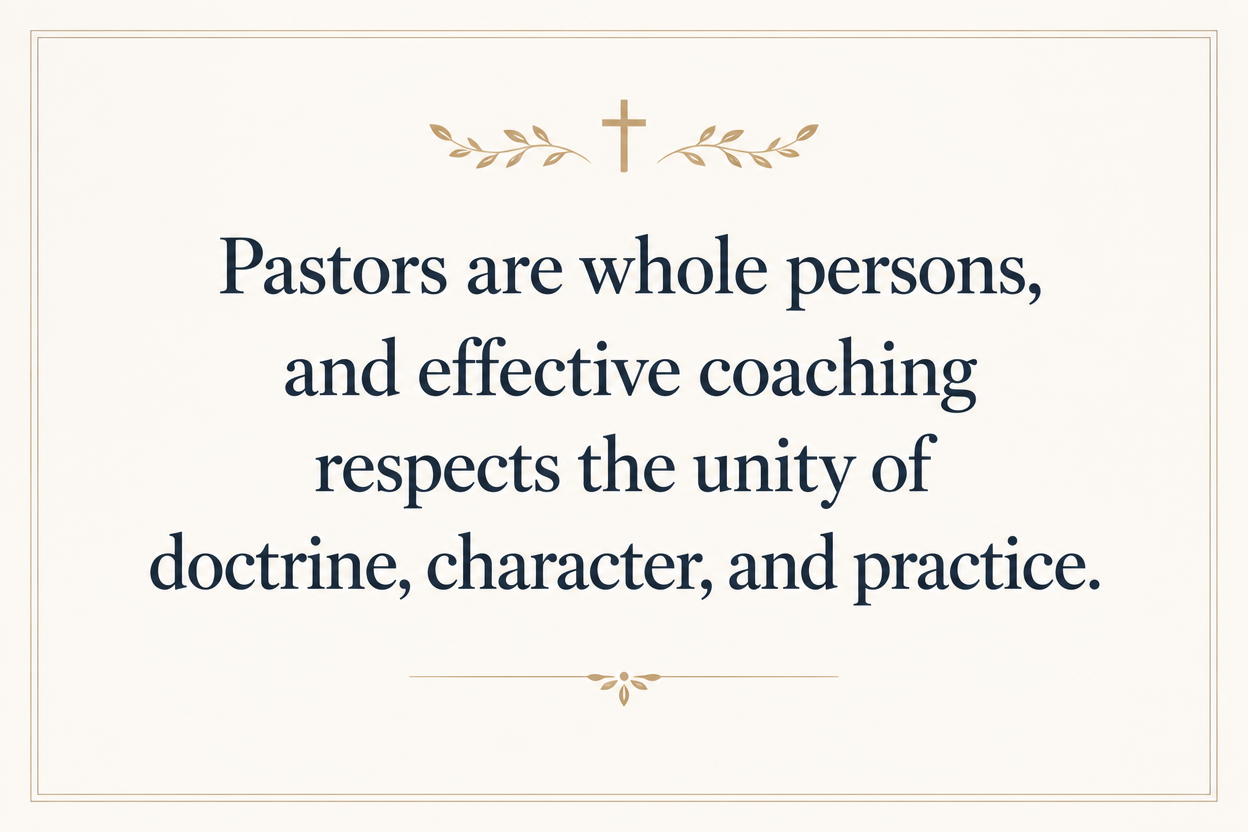
Pastors are whole persons, and effective coaching respects the unity of doctrine, character, and practice. While every ministry uses different language, coaching conversations tend to return to a small set of domains that shape pastoral faithfulness:
- Rule of life and spiritual disciplines that are sustainable in real ministry conditions
- Preaching and teaching integrity, including theological coherence and pastoral application
- Relational health, conflict practices, and appropriate boundaries
- Leadership clarity, delegation, and the formation of other leaders
- Missional focus that resists both drift and frenzy
Donors should notice what is missing. If a program never touches money, power, sexuality, or ambition, it is avoiding the places Scripture treats as spiritually decisive. If it never touches prayer, Scripture, repentance, or sacramental life, it is mistaking leadership technique for discipleship.
The outcomes worth funding are often quieter than donors expect
Faithfulness is measurable without being mechanized
Donors understandably want evidence. Yet in pastoral formation, the most important outcomes are not always the easiest to count. The church has seen enough hype cycles built on attendance spikes, campaign totals, or social media reach. Christian philanthropy has learned, across many fields, that simplistic metrics can incentivize distortion.
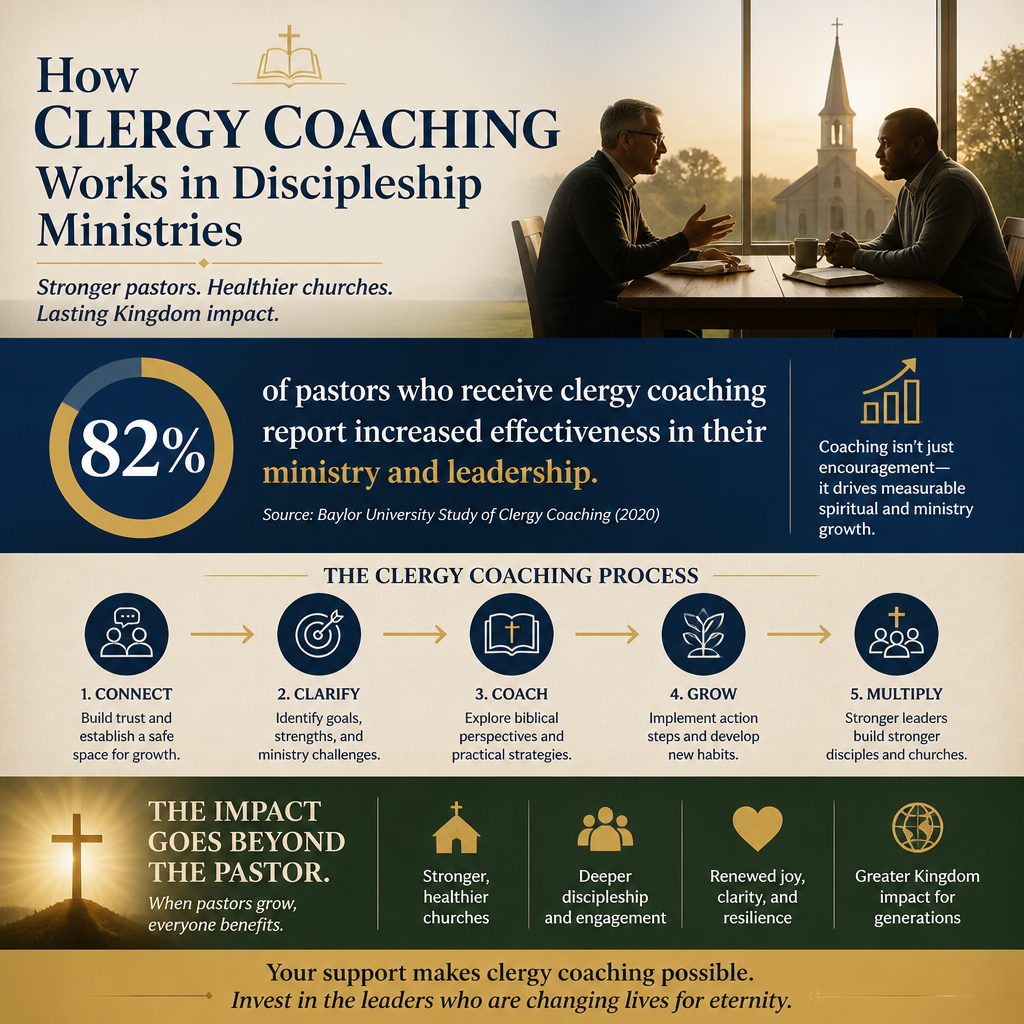
Still, ministries can measure coaching outcomes with integrity. They can document retention in pastoral calling, improvements in boundary practices, reduced isolation, strengthened elder functioning, and the multiplication of trained lay leaders. Some of these indicators are proxy measures, not proofs of holiness. But they can be tracked over time, and they can be triangulated through 360-degree feedback and church health assessments.
Beware the false tradeoff between care and mission
One common objection is that coaching sounds inward-facing when the world’s needs are urgent. Yet Scripture refuses the dichotomy. Jesus formed the Twelve before sending them, and Paul’s letters intertwine mission with leadership integrity. The church’s witness is compromised when leaders burn out, implode morally, or govern poorly. Funding coaching can be mission support precisely because it strengthens the moral and spiritual infrastructure that mission depends on.
Across our verification work, we observe that ministries with credible discipleship outcomes usually resist dramatic claims. They describe their aims with restraint, show their work, and accept that some fruit will not be visible on a donor timeline.
How coaching intersects with governance, finances, and donor trust
When coaching is a ministry program, it needs nonprofit discipline
Clergy coaching can be offered by a local church, a denominational body, or an independent nonprofit. When it is funded by donors through a nonprofit structure, it must meet ordinary standards of stewardship: clear financial reporting, responsible compensation practices, independent board oversight, and truthful communication about impact. The pastoral nature of the work does not exempt it from governance rigor.
This is one place where Most Trusted’s mission matters. We help donors give with confidence by evaluating ministries against The Most Trusted Standard, a 15-criteria framework that examines Faith Foundation, Financial Integrity, Governance and Leadership, and Transparency and Effectiveness. Coaching ministries often do meaningful work, but meaningful work is not the same as verifiable trustworthiness.
Signals donors can verify without becoming cynical
Donors do not need to become amateur investigators, but they should insist on basic clarity. A coaching ministry that is worthy of support will normally provide: audited or review-level financials when scale warrants it, a board with real independence, a conflict-of-interest policy, and program descriptions that align with what participants experience. For donors who want a wider view of the field, our coverage of Discipleship Ministries addresses the broader ecosystem in which coaching sits.
The field has had to reckon with the “overhead” misunderstanding that treats administration and leadership as inherently suspect. The joint “Overhead Myth” letter from major nonprofit evaluators argued that overhead ratios alone are a poor measure of effectiveness Candid GuideStar. Coaching ministries should not hide their costs, but neither should donors demand unrealistically low infrastructure spending that undercuts supervision, training, and safeguarding.
Questions donors should ask before funding clergy coaching
Clarity about theology, competence, and safeguarding
Coaching is an intensely relational intervention. It can bless churches, and it can also cause harm if carried out without competence or accountability. Donors should expect a ministry to articulate its theological convictions about pastoral office, sanctification, and authority. Vague “spiritual leadership” language is rarely sufficient when a program is shaping real decision-making in churches.
Competence matters as well. Coaching is not the same as ordination, and it is not automatically credentialed by sincerity. Ministries should be transparent about how coaches are trained, supervised, and evaluated, and how they handle mandatory reporting, abuse disclosures, and conflicts of interest. Donors should also ask whether the program is integrated with local church oversight rather than operating as a parallel authority structure.
Alignment with church leadership realities
Healthy coaching respects the complexity of pastoral life. It does not treat pastors as CEOs, nor does it treat them as fragile victims who cannot be challenged. It acknowledges denominational constraints, congregational power dynamics, and the spiritual warfare that Scripture assumes is real. It also acknowledges that some pastoral situations require intervention beyond coaching: mediation, clinical care, or denominational discipline.
For donors who are particularly focused on leadership development and its downstream effects on churches, our analysis in How Discipleship Ministries Support Church Leadership addresses the broader question of how leadership formation efforts should be evaluated and funded.
FAQs for How clergy coaching works in discipleship ministries
Is clergy coaching just professional development with religious language?
It can be, and donors should not ignore that risk. Faithful clergy coaching is oriented toward discipleship: the pastor’s life before God, integrity in shepherding, and accountability in leadership. Strong programs integrate spiritual formation with concrete leadership practices, and they name the limits of coaching in relation to therapy, spiritual direction, and ecclesial oversight.
What should donors expect a trustworthy coaching ministry to disclose?
At minimum, donors should expect clear program descriptions, coach training and supervision practices, governance information, and financial reporting proportionate to the organization’s size. Trustworthy ministries also describe outcomes with restraint and provide evidence that participants’ experience matches public claims. Independent verification, such as evaluation against The Most Trusted Standard, can help donors distinguish between compelling narratives and credible stewardship.
Funding coaching is funding the church’s long-term capacity for faithfulness
Clergy coaching works best in discipleship ministries when it is neither romanticized nor dismissed. It is a structured means of pastoral formation that can strengthen churches quietly over time: steadier leaders, healthier decision-making, fewer preventable failures, and deeper capacity to disciple others. Donors who want their giving to endure should ask not only whether a coaching ministry is sincere, but whether it is accountable, transparent, and ordered toward the kind of maturity Scripture commends.



