

When donors ask what results donors can expect from discipleship ministries, they are usually asking two questions at once: what fruit is realistic in human lives, and what evidence a ministry can responsibly offer without reducing spiritual formation to a dashboard. Scripture gives us the category for both. Jesus calls for fruit that remains (John 15), and he also warns against appearances that do not reach the heart (Matthew 23). Mature giving requires holding both truths together.
Discipleship is measurable, but not mechanically so. Some outcomes emerge slowly, with long causal chains and meaningful confounding factors: family systems, church health, trauma history, and the quality of local pastoral leadership. The harder question is how a ministry defines “results” in a way that is biblically faithful, ethically gathered, and transparent enough for donors to trust.
Start with a biblical definition of fruit, not a marketing definition
Results are ultimately about formation into Christ
Christian discipleship is not primarily the transfer of information. It is apprenticeship to Jesus that bears visible fruit over time: obedience, holiness, reconciliation, love of neighbor, and endurance through suffering. When ministries define “success” as attendance alone, content consumption, or emotional peaks, they train donors to expect shallow indicators and they train participants to perform.
That is why the strongest ministries anchor outcomes in a theology of sanctification and the means of grace. Bible engagement matters because “faith comes from hearing” (Romans 10:17). But hearing is meant to lead to repentance, restored relationships, and costly obedience. Donors should expect ministries to articulate a doctrine of change: how the gospel, Scripture, prayer, worship, and community shape a person over months and years.
Discipleship results are personal, but they are not private
The New Testament assumes that spiritual transformation becomes visible in community. Churches recognized elders by observable character (1 Timothy 3). Believers were known for love that could be seen and tested (John 13:35). This does not authorize intrusion into people’s lives, but it does mean a discipleship ministry can responsibly report patterns of change without violating dignity.
Christians genuinely disagree about how much structure discipleship should have, and about the boundary between local church responsibility and parachurch support. In our view, donors should treat this disagreement as a prompt to ask better questions, not a reason to avoid accountability. A ministry may serve the local church directly or indirectly, but it should be able to explain its ecclesiology and how it relates to pastors and congregations.

Expect a credible chain of evidence, not a single headline metric
What a donor can reasonably verify
In healthy discipleship work, no one metric carries the weight of proof. The more a ministry claims, the more donors should expect it to show its work. A credible evidence chain usually includes inputs, outputs, outcomes, and guardrails against self-deception. Outputs matter, but they are not the end: number of groups launched, leaders trained, or curricula completed are not the same as spiritual maturity.
What this means in practice is that donors can ask for a small set of indicators that are difficult to fake and consistent with Scripture. For example, does participation correlate with sustained engagement in the life of the church, reconciliation in broken relationships, or perseverance in prayer and Scripture? The goal is not to pry, but to confirm that the ministry is pursuing more than activity.
Strong reporting distinguishes between attribution and contribution
Discipleship ministries rarely “cause” transformation in isolation. The Spirit gives growth (1 Corinthians 3:6–7), and God often uses parents, pastors, friends, and suffering itself. Responsible ministries speak in terms of contribution: they can describe how their approach supports what churches are already called to do, and how they assess whether their contribution is actually helping rather than distracting.
Donors should be cautious with claims that imply certainty about spiritual outcomes from program participation alone. The best ministries name limits in their measurement, describe the risks of selection bias, and avoid moralizing those who do not show the same visible change on the same timetable.
What results look like across common discipleship models
Small groups, mentoring, and leader multiplication
Many discipleship ministries center on small groups, mentoring relationships, or leader development. In these models, realistic results include trained facilitators who can open Scripture well, a growing culture of mutual care, and leaders who reproduce leaders without burning them out. Donors should expect evidence that leader standards are clear, that safeguarding is in place, and that the ministry monitors leader health and retention.
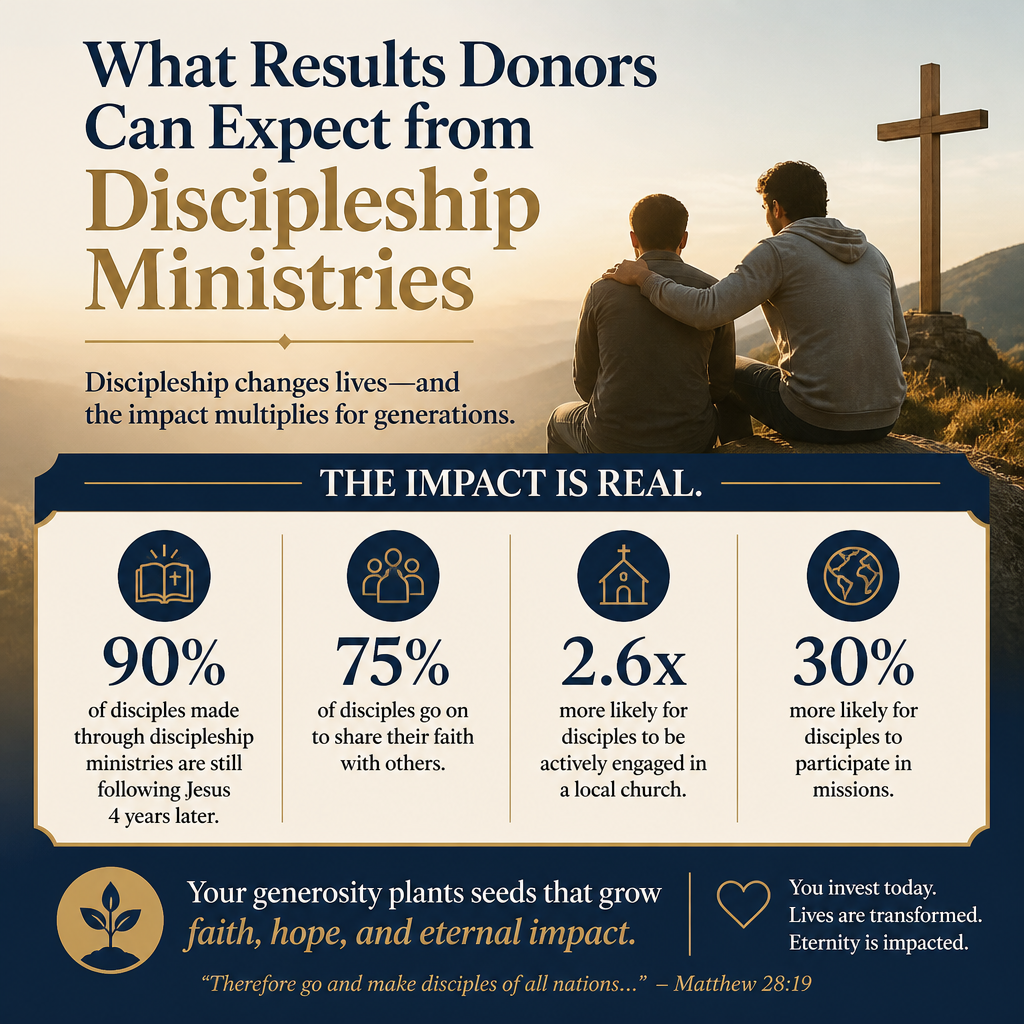
Because multiplication is often a stated goal, donors should ask how a ministry defines faithful multiplication. Rapid growth can mask shallow formation. Conversely, slow growth can reflect careful selection and depth. A ministry should be able to explain why its pace matches its theology and its context.
Curriculum distribution and digital discipleship
Other ministries focus on curriculum, media, and online training. In these cases, raw reach is an unreliable proxy for impact. A million downloads can still mean minimal engagement, while smaller communities can show real transformation. Donors should expect evidence beyond views and clicks: completion rates, discussion participation, follow-on involvement in local churches, and qualitative evaluation that is gathered systematically, not selectively.
When results depend on local implementation, the ministry should report what it can actually control: clarity of materials, training quality, feedback loops, and how they learn from churches using the resources. This is one place where transparency is a theological virtue as much as a governance practice.
Donor expectations should include faithfulness, safety, and integrity
Evidence of spiritual fruit is inseparable from character and governance
Donors sometimes separate “impact” from integrity, as if a powerful teaching ministry can compensate for weak governance or financial opacity. Scripture does not permit that separation. The qualifications for leadership are moral and relational before they are strategic (Titus 1). A discipleship ministry that forms others while tolerating secrecy, manipulation, or financial carelessness undermines its own message.
This is where independent verification can serve the Church. At Most Trusted, we evaluate ministries against The Most Trusted Standard, a 15-criteria framework across Faith Foundation, Financial Integrity, Governance and Leadership, and Transparency and Effectiveness. The point is not to replace prayerful discernment, but to strengthen it with evidence that a donor can check.
Practical markers donors should expect to see
Across our verification work, the ministries that withstand scrutiny tend to share a disciplined approach to both formation and accountability. Donors can reasonably expect clarity on the ministry’s theory of change, transparent finances, and safeguards that treat participants as people, not outcomes.
- Clear doctrinal commitments and an explicit understanding of discipleship that is anchored in Scripture
- Defined processes for leader selection, training, and ongoing supervision
- Safeguarding policies for work with minors and vulnerable adults, including reporting protocols
- Measurement practices that combine quantitative indicators with structured qualitative learning
- Board oversight that is active, documented, and independent enough to correct the organization
These expectations are not cynical. They are consistent with the New Testament’s insistence that leaders be “above reproach,” and with a donor’s responsibility to steward resources entrusted by God.
How to read discipleship metrics without being misled
Beware the metrics that reward the wrong behavior
Some measurements are easy to report and subtly distort the ministry’s incentives. Counting “decisions,” for example, can pressure leaders to manufacture spiritual moments or to treat conversion as a transaction rather than a beginning. Counting attendance can produce a constant churn of events rather than deep community. Donors should not punish ministries for refusing to inflate numbers, especially when the refusal reflects theological seriousness.
Christians also disagree about the best instruments for measuring spiritual maturity. Some prefer competency-based assessments; others emphasize narrative testimony. Both can be misused. The more personal the data, the higher the ethical burden: informed consent, privacy protections, and honest communication about how stories and images will be used.
Prefer transparency over certainty
Discipleship is not a laboratory environment, and donors should not demand a level of causal proof that is unrealistic for most ministry settings. But donors can ask for transparent reporting: what the ministry measures, why it measures it, what it has learned, and what it is changing as a result. A posture of learning is not a lack of conviction; it is often the fruit of wisdom.
For donors who want broader context on how discipleship organizations report and validate outcomes, we maintain editorial coverage on Discipleship Ministries and the specific questions raised in How Discipleship Ministries Measure Impact. These are not substitutes for local church discernment, but they help donors ask the next faithful question.
FAQs for What results donors can expect from discipleship ministries
What is a reasonable time horizon for discipleship results?
Many discipleship outcomes are best assessed over months and years rather than weeks. Donors can reasonably expect near-term indicators such as consistent participation, leader development, and engagement with Scripture and community, while recognizing that deeper fruit such as reconciliation, character change, and perseverance often emerges over longer periods. Ministries that promise rapid transformation should be asked to explain their theology of change and their evidence.
Should donors expect discipleship ministries to report numbers?
Yes, but with proportion and integrity. A disciplined set of quantitative measures can help a ministry remain accountable, especially around participation, leader training, and retention. Numbers alone are not sufficient for spiritual formation, so donors should also expect structured qualitative learning, clear safeguards, and transparency about what cannot be claimed. The aim is truthful reporting, not persuasive storytelling.
A faithful donor posture toward discipleship outcomes
Donors should expect discipleship ministries to pursue fruit that is recognizably Christian, to report evidence with humility, and to operate with integrity that matches the message they teach. When results are framed as formation into Christ, supported by a credible chain of evidence, and protected by strong governance and transparency, donors can give with confidence that their generosity is serving the Church rather than funding a narrative.



