

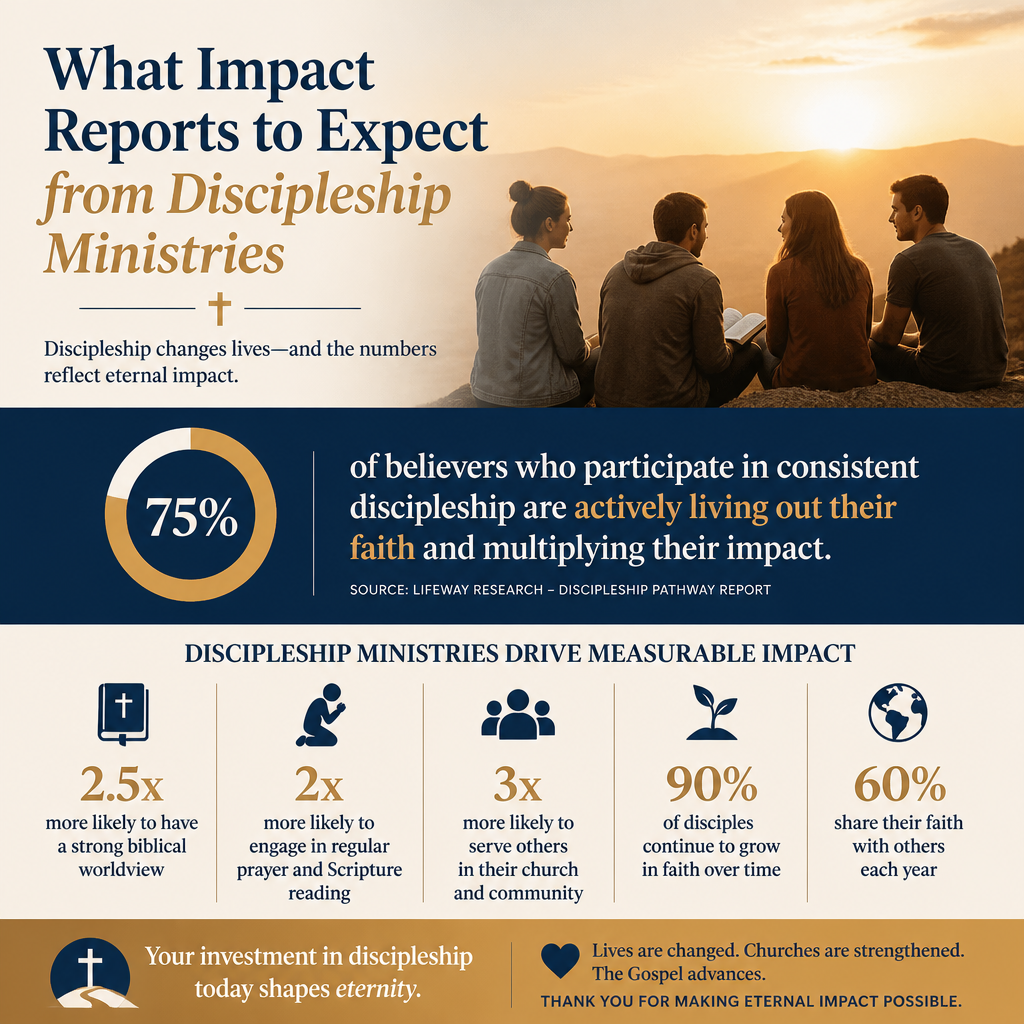
When donors ask what impact reports to expect from discipleship ministries, they are rarely asking for marketing. They are asking for credible evidence that spiritual formation is being pursued with integrity, that resources are stewarded faithfully, and that reported outcomes are not confused with the work of the Holy Spirit.
Discipleship is difficult to measure precisely, and Christians genuinely disagree about what counts as a faithful indicator of growth. Yet Scripture still calls leaders to watch their life and doctrine closely (1 Timothy 4:16), and the New Testament assumes accountable, observable fruit in a community shaped by the gospel. The question is not whether discipleship can be reduced to metrics. It cannot. The question is what kinds of reporting respect the nature of formation while still honoring a donor’s duty to steward resources wisely.
Start with theological clarity and a coherent theory of change
The most reliable impact reports in discipleship ministries begin with an explicit definition of discipleship that is rooted in Scripture and historically orthodox Christianity. If a ministry cannot name what it means by “making disciples,” donors are left to infer outcomes from activity counts. The Great Commission provides the basic frame: disciples are made through going, baptizing, and teaching obedience to all Jesus commanded (Matthew 28:18–20). A ministry does not need to replicate a seminary syllabus, but it should demonstrate that its methods plausibly form people toward Christ, not merely toward Christian subculture.
What donors should expect to see named
Across our verification work at Most Trusted, the ministries that communicate most credibly tend to articulate a simple line from mission to methods to outcomes. They name the people they serve, the spiritual and practical formation practices they employ, and the markers they believe indicate progress. This is not about certainty; it is about honesty and coherence.
How this shows up in an impact report
A strong report will typically include a brief ministry model: for example, how small groups are formed and led, how leaders are trained, what curriculum or Scripture plan is used, how pastoral care and accountability function, and what safeguarding measures exist for vulnerable participants. Vague language about “doing life together” without structure often hides either inconsistency or a lack of meaningful oversight.

Expect balanced reporting across outputs and outcomes
Discipleship ministries can and should report outputs. Attendance, group participation, training completions, and curriculum distribution are legitimate facts. The problem arises when outputs are presented as if they are outcomes. A person can attend a group for months without repentance, reconciliation, or growing obedience; a leader can complete a training module without becoming spiritually qualified to shepherd others.
Outputs that are appropriate when interpreted properly
- Number of participants in consistent discipleship relationships or groups over a defined period
- Leader training cohorts completed and the standards required for completion
- Retention over time, with clear definitions for “active” participation
- Pastoral care touchpoints, mentorship meetings, or follow-up conversations logged
- Resources distributed, paired with evidence of actual use rather than shipment totals
Outcome indicators that should be modest but real
Outcome reporting for discipleship should be presented with theological humility. It should not imply that a ministry can “produce” sanctification on demand. Still, it can responsibly report changes that are observable, consistent with Christian maturity, and gathered through defensible methods: testimonies collected through structured interviews, pre-and-post self-assessments that measure practices and attitudes, reconciliation steps taken, sobriety milestones when relevant, or increased engagement in the ordinary means of grace within a local church.
When ministries use surveys or scales, donors should expect basic transparency: what instrument was used, how questions were framed, how many responded, and how results were interpreted. Without that, the report becomes a set of uncheckable claims.
Look for integrity about what cannot be quantified
Many donors have learned to distrust reports that only tell celebratory stories. Discipleship reporting should include narrative, because formation is personal and relational. But narrative must be governed by truthfulness, privacy, and proportion. A single powerful testimony is not evidence that a program works broadly; it is evidence that God is at work in one life through ordinary faithfulness.
Testimony done with credibility
Credible reports explain how stories are collected and vetted, whether names are changed, and what consent practices are used. They avoid emotional manipulation and do not present trauma narratives as fundraising assets. Donors should also watch for a ministry’s willingness to name setbacks: leaders who were removed, groups that failed, or contexts where fruit has been slow.
Healthy tension in discipleship measurement
Christians genuinely disagree about the best proxies for spiritual growth. Some traditions emphasize catechesis and doctrinal formation; others emphasize obedience, mission, or spiritual disciplines. The stronger reports acknowledge those choices and their limits. They do not claim to measure “heart change” directly, and they do not imply that the Holy Spirit’s work can be captured in a dashboard.
At the same time, donors should not accept “we cannot measure discipleship” as a rationale for reporting nothing. Scripture’s warnings to shepherds assume accountability (James 3:1), and healthy ministries can describe faithful practices and observable fruit without presuming control over outcomes.
Expect transparency about safeguards, governance, and stewardship
Discipleship ministries are often relational by design: mentoring, counseling-like conversations, spiritual authority dynamics, and access to vulnerable people. This creates particular risks: spiritual abuse, boundary violations, and unqualified leaders exerting influence without oversight. An impact report that never addresses safeguarding is incomplete.
Safeguards that belong in the public record
Donors should expect to see basic safeguarding commitments described plainly: screening for mentors and group leaders, codes of conduct, reporting pathways for concerns, supervision structures, and how the ministry handles allegations. When minors are involved, the report should indicate child protection training and policies, even if details remain internal for safety.
For donors considering broad giving in this space, reviewing the wider landscape of Discipleship Ministries can help clarify which models tend to provide the strongest oversight and reporting practices.
Financial stewardship and the Overhead Myth context
Mature donors know that low “overhead” is not the same as high effectiveness. The Overhead Myth statement—signed by GuideStar, Charity Navigator, and the BBB Wise Giving Alliance—argued that donors should look beyond overhead ratios to governance, transparency, and results because overhead alone is a poor proxy for impact https://www.guidestar.org/. Discipleship ministries, in particular, often require investments that are not immediately “program visible”: training systems, supervision, screening, data protection, and careful evaluation.
What this means in practice is that an impact report should connect spending to mission. It should describe why staffing levels exist, how leaders are supported, and what it costs to do relational ministry responsibly. A ministry that claims unusually low administrative expense while scaling mentoring rapidly may be underinvesting in safeguards or accountability.
How Most Trusted evaluates impact reporting under The Most Trusted Standard
Donors frequently ask whether an impact report is “good.” The more precise question is whether it is credible: whether it reflects reality, whether it is governed by clear definitions, and whether it can withstand reasonable scrutiny. At Most Trusted, we assess ministries against The Most Trusted Standard, a 15-criteria framework spanning Faith Foundation, Financial Integrity, Governance and Leadership, and Transparency and Effectiveness. Our aim is not to punish ministries for having imperfect data; it is to identify whether a ministry is structured to be trustworthy.
What stronger reports tend to include
Across our verification work, ministries that meet The Most Trusted Standard tend to publish reports that make it possible for an informed donor to ask and answer responsible questions. They disclose leadership and accountability structures, provide consistent year-over-year reporting, and separate aspiration from evidence. They explain methods and limitations. They show that the organization is not merely active, but attentive to whether its activity is forming people faithfully.
Common weaknesses donors should notice
Some weaknesses are subtle. Reporting may emphasize reach while failing to define what participation means. A ministry may list “decisions” or “commitments” without follow-up data or connection to local church life. Others are more direct: a lack of basic financial disclosure, unclear governance, or impact claims that read like promises. A disciplined donor reads these as signals, not as disqualifications in every case, but as prompts for further questions.
For donors who want to compare reporting norms and evaluation criteria across organizations, How Discipleship Ministries Measure Impact provides a broader frame for what responsible transparency can look like in this field.
FAQs for What impact reports to expect from discipleship ministries
Should a discipleship ministry report numbers at all?
Yes, with appropriate restraint. Participation counts, leader training completions, and retention can clarify whether the ministry is organized and whether it can sustain relationships over time. Numbers should not be treated as proof of sanctification, but they can be honest indicators of reach and consistency when paired with clear definitions and outcome reporting that is modest and transparent about limits.
What are red flags in a discipleship impact report?
Major red flags include unverifiable claims, emotionally charged stories presented without consent safeguards, “decisions” reported without evidence of follow-up, and rapid scale claims paired with little mention of leader screening or supervision. Donors should also be cautious when a ministry reports only successes, never setbacks, and when financial or governance disclosures are thin or inconsistent year to year.
Giving with confidence in a ministry of formation
Discipleship is, by nature, slow, relational, and resistant to simplistic measurement. Donors do not need ministries to quantify the Holy Spirit. They do need ministries to tell the truth, to report what they do with clarity, to name what they can and cannot know, and to demonstrate stewardship and safeguards consistent with the weight of spiritual influence. The most trustworthy impact reports treat discipleship as a sacred trust, not a branding opportunity.



