

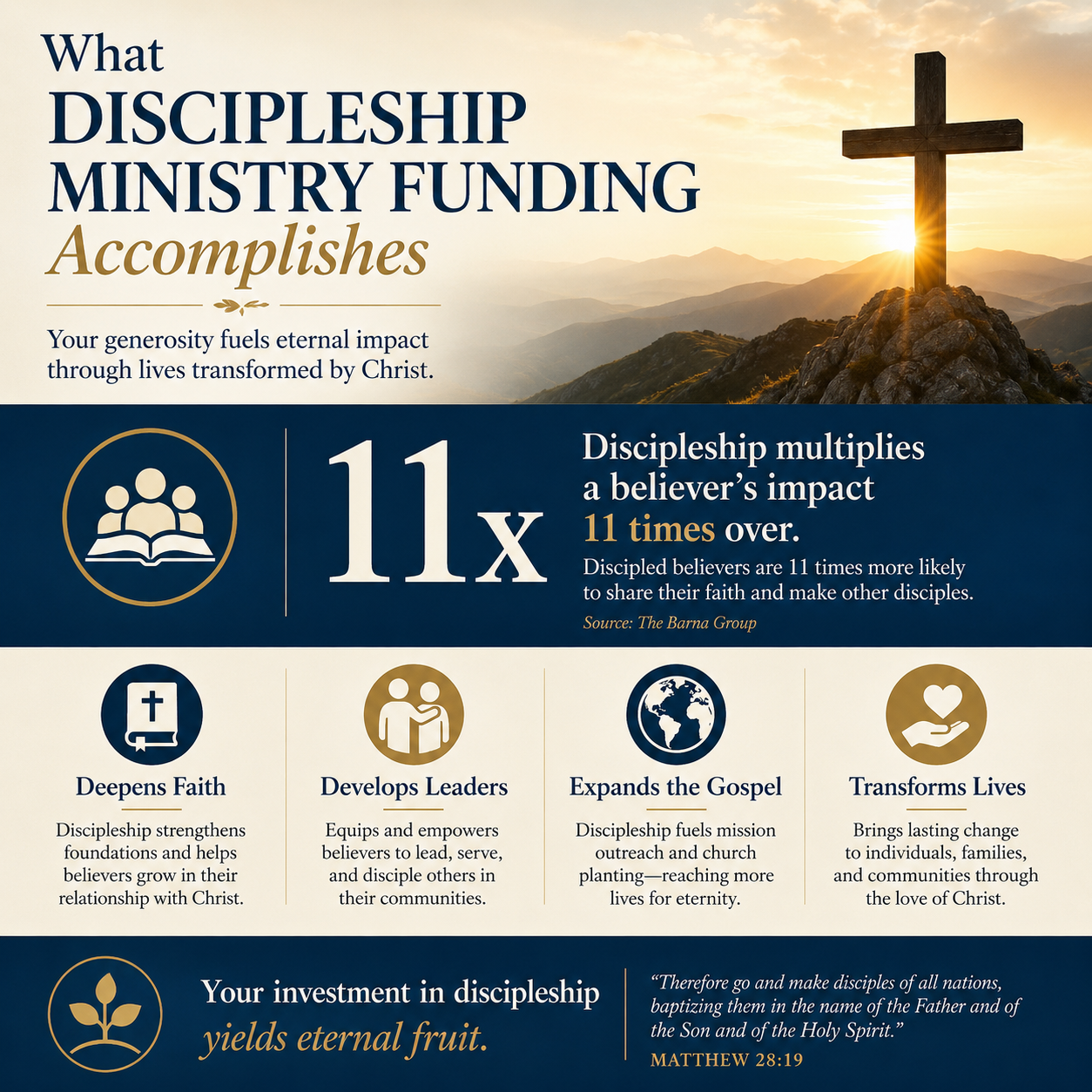
What discipleship ministry funding accomplishes is not primarily a set of religious activities; it is the slow formation of people into the likeness of Christ. Christian donors often feel the strain of giving in a world that can count meals served and beds provided more easily than it can count repentance, perseverance, and love. Yet Scripture does not treat discipleship as optional work. Jesus’ final instruction to the church was not merely to gather converts, but to “make disciples…teaching them to observe all that I have commanded you” (Matthew 28:19–20).
The question for serious givers is not whether discipleship matters, but whether our funding is actually strengthening faithful, accountable ministry rather than paying for religious motion. Discipleship can be sincere and still be poorly governed, financially fragile, or opaque in its claims. That is why Most Trusted exists: to help donors give with confidence by evaluating ministries against The Most Trusted Standard, a 15-criteria framework that tests faith commitments, financial integrity, governance and leadership, and transparency and effectiveness.
Discipleship funding builds durable spiritual formation, not just attendance
Christian formation is more than exposure to teaching. It is the gradual reordering of desires, habits, and loyalties under the lordship of Christ. Well-funded discipleship ministries can sustain coherent pathways for growth: Scripture intake, prayer, accountable relationships, and opportunities for service that move believers from consumption to costly obedience.
It underwrites the ordinary means God uses
In the New Testament, formation happens through Word and community over time: the apostles’ teaching, fellowship, breaking of bread, and prayers (Acts 2:42). Funding that strengthens those ordinary means tends to be less dramatic than emergency relief, but it is often more durable. It pays for trained leaders, curriculum development, safe meeting environments, and systems that make care consistent rather than episodic.
It supports leaders who can teach and shepherd faithfully
Discipleship funding commonly goes toward people: pastors, small-group leaders, mentors, and ministry staff who can handle Scripture accurately and care for souls responsibly. That is not overhead in the pejorative sense; it is the ministry. Donors sometimes inherit a secular suspicion of leadership costs, but the church has always required qualified shepherds (1 Timothy 3). The harder question is whether the ministry is paying for qualified leadership with accountability, or merely expanding payroll without clear formation outcomes.

It strengthens churches and local networks that make growth sustainable
Discipleship is inherently relational and local. Even when a ministry operates nationally or globally, the most credible models respect the primacy of the local church and equip believers in their actual communities. Funding can either reinforce that local embeddedness or unintentionally replace it with centralized programming that produces consumers.
It equips the local church rather than competing with it
Many discipleship nonprofits exist because churches ask for help: training, resources, coaching, and specialized support that a congregation may not have capacity to develop on its own. When done well, these ministries function as servants of the church, not substitutes for it. Donors can situate this work within the broader field by tracking how ministries describe their relationship to churches across Discipleship Ministries.
It builds connective tissue across a fragmented Christian landscape
American Christianity is marked by mobility, institutional distrust, and thinning social ties. Research has documented declining participation in civic and communal life for decades, which affects churches as well as other institutions. Robert Putnam’s work on social capital remains a common reference point for understanding this erosion (Harvard University profile for Robert Putnam). While discipleship is not reducible to sociology, ministries that rebuild durable relationships—through mentoring, small groups, and spiritual friendship—are pushing against a real cultural headwind.
It funds the unglamorous infrastructure of care and accountability
Discipleship ministries are often evaluated by their public content: sermons, studies, conferences, podcasts. Those can be valuable. Yet the ministry’s integrity is more often tested in private: how leaders handle power, money, conflict, and failure. Donor funding can either enable healthy infrastructure or subsidize brittle systems that eventually fracture.
It establishes safeguards that protect people and witness
In many contexts, discipleship involves minors, vulnerable adults, and intense spiritual counsel. Funding that supports background checks, child protection policies, reporting mechanisms, and training is not a distraction from mission; it is part of loving one’s neighbor. A ministry that cannot describe its safeguarding practices is asking donors to accept risk without evidence.
It enables meaningful evaluation without turning formation into metrics theater
Christians genuinely disagree about how much measurement is appropriate for spiritual growth. There is wisdom in resisting simplistic scorecards for sanctification. There is also wisdom in refusing to treat discipleship outcomes as entirely unknowable. Donors should expect ministries to articulate what they are trying to produce, how they know whether it is happening, and what they do when it is not. That is a central concern in How Discipleship Ministries Measure Impact, where donors can compare the field’s most credible approaches.
- Clear discipleship aims stated in biblical and behavioral terms, not only inspirational language
- Defined pathways showing how a participant moves from entry to deeper maturity
- Leader development with training, coaching, and accountability
- Safeguards for vulnerable people and ethical boundaries in counseling and mentoring
- Evidence practices that are honest about limitations and still seek verifiable signals of fruit
It resists the donor temptations that distort spiritual work
Discipleship funding is not neutral. Money can clarify mission, and it can also bend it. Some of the most common distortions come from donor expectations—often well-intentioned—that reward speed, scale, and spectacle more than faithfulness.
It protects ministries from the pressure to manufacture results
Discipleship takes time. The New Testament’s agricultural metaphors are not accidental: sowing, watering, growth that God gives (1 Corinthians 3:6–7). When donors demand short-term proof, ministries may gravitate toward what can be counted rather than what must be cultivated. That can produce an inflationary culture around numbers, spiritual language, and testimonies. Responsible funding creates room for patience and truth-telling.
It takes the formation of the poor seriously, not as a sentimental add-on
Some donors assume discipleship is “spiritual” while poverty ministry is “practical.” Scripture refuses that separation. The gospel addresses the whole person, and the poor are not merely recipients of aid but image-bearers called to maturity in Christ. The When Helping Hurts framework, articulated by Steve Corbett and Brian Fikkert, has shaped many Christian ministries by warning that unexamined aid can harm relationships and agency (When Helping Hurts). Discipleship funding that is integrated with wise mercy ministry can avoid both material reductionism and spiritual neglect.
It enables trustworthy stewardship through governance and transparency
Christian donors are not funding a concept; they are funding organizations. The moral seriousness of discipleship raises the standard rather than lowering it. A ministry that teaches holiness should be marked by financial integrity, truthful communication, and governance that does not concentrate power without accountability.
It insists on financial clarity without the overhead fallacy
Many donors were trained, implicitly or explicitly, to equate low administrative cost with virtue. The nonprofit sector has corrected that misconception repeatedly. Charity Navigator, GuideStar, and the BBB Wise Giving Alliance warned in their “Overhead Myth” letter that fixation on overhead can starve organizations of the capacity needed for effectiveness (Stanford Social Innovation Review). Discipleship ministries need competent finance practices, safe systems, and healthy staffing; a starved infrastructure is a predictable path toward crisis.
It rewards ministries that can be verified, not merely admired
Across our verification work, we observe that the ministries that meet The Most Trusted Standard tend to communicate with restraint. They avoid exaggeration, name risks plainly, and provide documentation that matches their claims. They can describe who makes decisions, how leaders are evaluated, how conflicts of interest are handled, and how donors can access meaningful reporting. That kind of transparency is not cynicism; it is a form of honesty that protects the church’s witness and honors the sacrifices donors make.
FAQs for What discipleship ministry funding accomplishes
How can donors assess discipleship impact without reducing sanctification to numbers?
We recommend looking for ministries that articulate biblically grounded outcomes and then use a mix of evidence: participation over time, leader-to-disciple ratios, retention in community, qualitative assessments with documented methods, and clear narratives tied to verifiable program activity. The goal is not to quantify the Holy Spirit, but to test whether the ministry’s practices plausibly align with the fruit it claims to cultivate.
Is it appropriate for discipleship ministries to spend significantly on staff and leadership development?
Yes, when staff spending reflects the nature of the work and is governed with accountability. Discipleship is mediated through teaching, mentoring, and pastoral care, which are labor-intensive. Donors should expect clarity about roles, qualifications, safeguarding practices, and governance. The concern is not whether a ministry employs capable leaders, but whether it can demonstrate integrity, oversight, and effectiveness consistent with its message.
Discipleship funding is a wager on faithfulness over time
Discipleship ministry funding accomplishes formation that is often difficult to photograph and slow to validate, yet essential to the church’s life. Donors serve the Kingdom best when giving is guided by theological clarity and institutional realism: the patience discipleship requires, the safeguards it demands, and the governance it needs. When ministries can be verified with integrity, donors can give not only generously, but wisely, trusting that their resources are strengthening the long obedience of God’s people.



