

How to evaluate discipleship ministry program effectiveness is ultimately a question about Christian stewardship: whether a donor’s resources are helping real people follow Christ with durable fruit. Discipleship is not a commodity, and the New Testament does not treat formation as a program metric. Yet Scripture does assume that ministry bears discernible results over time, and that leaders can be held accountable for how they shepherd the flock entrusted to them.
Christian donors often feel the tension acutely. The ministries that seem most compelling may be the least measurable, while the ministries that report the most numbers may be counting what is easiest rather than what is faithful. What this means in practice is that “effectiveness” has to be evaluated with theological seriousness, methodological sobriety, and a willingness to ask uncomfortable questions without demanding false precision.
Begin with a biblically serious definition of effectiveness
Discipleship ministry effectiveness cannot be reduced to attendance, content consumption, or short-term enthusiasm. Jesus defined the mission as making disciples who obey his commands (Matthew 28:19–20), and the apostolic witness consistently ties spiritual maturity to persevering faith, growing holiness, and love expressed in concrete practice. Donors are right to ask for evidence, but the evidence should correspond to the actual end Scripture sets.
Clarify the ministry’s discipleship theory before reviewing the data
Before any metrics discussion, we recommend asking a ministry to articulate its discipleship theory: what practices it expects God to use ordinarily to form people in Christ, and why. Some ministries emphasize one-to-one mentoring, others prioritize small groups, catechesis, or leadership pipelines. Christians genuinely disagree about sequencing and emphasis, but credible ministries can explain their choices in light of Scripture, ecclesiology, and context.
A practical test is coherence. Do the program inputs match the stated aim? If a ministry claims to form resilient disciples but offers only large-event inspiration with little pastoral follow-up, the mismatch is not a measurement problem; it is a design problem. Effectiveness begins with fidelity: doing the kind of work that can reasonably lead to the kind of fruit the ministry says it seeks.
Distinguish faithfulness from outcomes without separating them
The New Testament is clear that growth ultimately belongs to God (1 Corinthians 3:6–7). That doctrine guards donors from treating spiritual formation as a mechanical transaction. At the same time, Scripture also expects leaders to labor wisely, to teach sound doctrine, and to correct error—real responsibilities with real consequences. A ministry can be faithful and see limited visible fruit in a season; it can also be busy and unfaithful while producing impressive counts.
Donor evaluation is therefore neither cynical nor naïve. It asks whether a ministry is doing the work Scripture calls good shepherds to do, and whether there is credible evidence that people are actually being formed over time.

Choose indicators that reflect formation rather than activity
Many discipleship programs report what can be counted quickly: sessions held, books distributed, small groups launched, or leaders trained. Those figures can be relevant, but they are weak proxies for the actual question. The harder question is whether participants are becoming the kind of people who can endure, serve, and obey Christ when no one is watching.
Prefer leading and lagging indicators that connect to Scripture
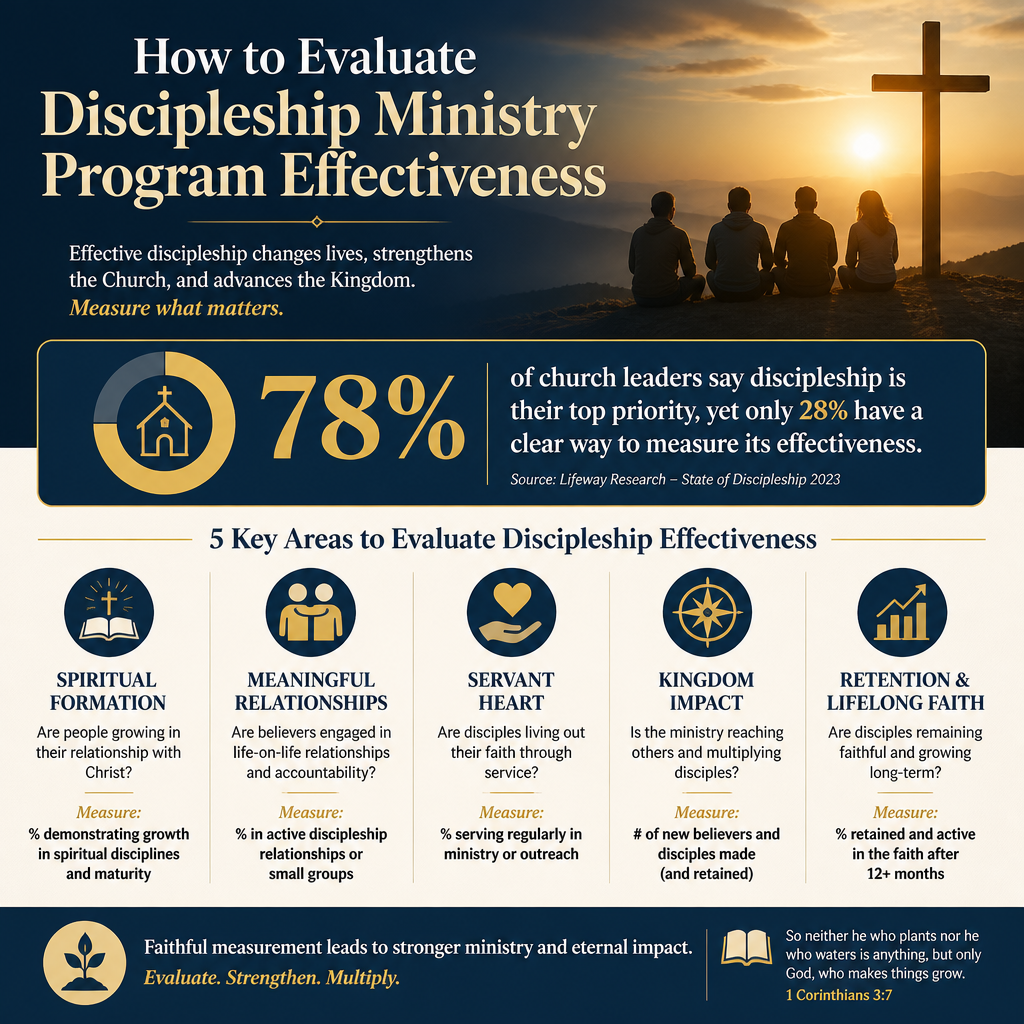
We recommend looking for a small set of indicators that connect plausibly to biblical formation. Leading indicators capture whether formative practices are happening; lagging indicators reflect longer-term change. A mature ministry usually uses both, because lagging outcomes take time and can be affected by factors beyond the program.
- Retention and perseverance: Do participants remain engaged in Word, prayer, and community six or twelve months later?
- Practice adoption: Are participants establishing durable habits like Scripture intake, confession, and service within a local church?
- Relational depth: Are mentoring relationships stable, accountable, and appropriately supervised?
- Leadership multiplication: Are participants prepared and affirmed to disciple others with clear safeguards?
- Holiness and reconciliation: Are there documented stories of repentance, repaired relationships, and ethical change that are pastorally credible?
Even here, donors should be cautious about turning the fruit of the Spirit into a scorecard. The question is not whether a ministry can produce a perfect report; it is whether it is measuring what it claims to be doing, and whether those measures are treated as tools for shepherding rather than marketing.
Watch for the difference between testimony and evidence
Testimonies are a biblical category, and they matter. But for donor discernment, testimony should be accompanied by evidence of process: how participants are selected, what the curriculum entails, how mentors are trained, and what follow-up looks like when someone struggles or drops out. A handful of compelling stories can be true and still unrepresentative. Evidence helps donors evaluate whether the ministry’s claimed fruit is typical, not merely possible.

When ministries can describe both the ordinary pathway and the hard cases—participants who relapse, disengage, or require pastoral care—they tend to be more trustworthy. Serious discipleship work is never only a sequence of wins.
Assess measurement integrity, not just measurement volume
Some discipleship organizations drown donors in dashboards; others offer almost nothing. Neither posture is automatically virtuous. What donors need is measurement integrity: definitions that are stable, data that is gathered consistently, and reporting that does not hide weaknesses or inflate results.
Interrogate definitions and denominators
“Leaders trained” can mean a person attended a single workshop, or it can mean a supervised apprenticeship with observed competency. “Small group launched” can mean a group met once, or it can mean it met weekly for a year with trained facilitation. Donors should ask ministries to define their terms in writing, and to clarify denominators: trained out of how many approached, completed out of how many enrolled, persevered out of how many started.
In our verification work at Most Trusted, we consistently find that strong ministries do not fear these questions. They may not have perfect answers, but they can explain how they count, why they count that way, and what they are doing to improve.
Seek appropriate third-party signals without outsourcing discernment
External evaluation can help when it is fitted to the ministry’s scale and claims. A local church discipleship initiative may not need a university-led impact study. A national discipleship network, however, should be able to demonstrate a more formal learning agenda, including audits of data quality and periodic program reviews.
Donors should also resist simplistic rules of thumb about overhead. The philanthropic sector has repeatedly warned against treating administrative and fundraising ratios as a proxy for effectiveness, including in the joint statement commonly referred to as the “Overhead Myth” from major charity evaluation organizations such as BBB Wise Giving Alliance, Charity Navigator, and Candid (GuideStar) https://www.charitynavigator.org/. Discipleship ministry evaluation often requires real investment in training, supervision, and safeguarding—costs that should not be penalized simply because they are not front-stage.
Evaluate discipleship in its ecclesial and community context
Discipleship is ordinarily embedded in the local church. When a ministry operates alongside churches—supporting pastors, equipping lay leaders, or providing resources—its effectiveness should be evaluated partly by the strength of those partnerships. When a ministry functions as a substitute for the church, donors should ask harder questions about ecclesiology, authority, and long-term pastoral care.
Ask whether the ministry strengthens churches or competes with them
A healthy relationship with local churches can be observed, not merely asserted. The ministry should be able to identify what churches contribute that the ministry cannot: sacraments, discipline, long-term shepherding, and covenant membership. It should also be able to describe what it contributes that churches in its context may lack: specialized training, structured materials, or support for hard-to-reach populations.
Donors evaluating programs within Discipleship Ministries should look for explicit pathways that move participants toward rooted participation in a church, not permanent dependence on the program’s platform. Mature ministries treat “sending” as success, even when it reduces their own retained audience.
Consider cultural and demographic fit without reducing the gospel to sociology
Program effectiveness can vary sharply by context. A curriculum that forms mature believers in a suburban professional setting may fail among first-generation believers, recent immigrants, or those navigating addiction recovery. The field has had to reckon with the limits of one-size-fits-all models. Donors should ask whether the ministry has done contextual listening, whether it trains leaders from within the community, and whether its measurement approach accounts for barriers like transportation, work schedules, and trauma history.
These considerations are not an excuse for low standards. They are a reminder that true effectiveness often includes patient work that does not look efficient on paper.
Use a verification lens that connects theology, governance, and outcomes
For donors, the most common failure mode is evaluating discipleship effectiveness in isolation. A program may have sound curriculum but weak safeguarding. It may show impressive participation but operate with opaque finances. It may claim theological orthodoxy while lacking accountable leadership. These are not separate concerns; they are intertwined forms of stewardship.
Evaluate the ministry as a moral community, not only as a service provider
Discipleship programs form people through teaching and through the example of leaders. When governance is weak, misconduct is more likely to be hidden; when finances are opaque, donors cannot know whether resources are used for their intended purposes. For that reason, the strongest ministries treat transparency as part of discipleship rather than as a compliance burden.
The Most Trusted Standard is designed to hold these realities together. Across our verification work, we observe that ministries meeting The Most Trusted Standard tend to report outcomes with more restraint, document safeguards more carefully, and address limitations more directly. This posture is not pessimism; it is a form of truth-telling appropriate to Christian ministry.
Ask for the discipline of learning, not the illusion of certainty
Discipleship measurement will always have limits. Spiritual formation includes interior realities that surveys cannot fully capture. At the same time, a ministry can learn concretely: which cohorts persist, which leaders multiply fruitfully, which practices correlate with sustained engagement, and which participants are being missed. Donors should look for evidence that the ministry is using data to improve, not to reassure.
Programs in the category of How Discipleship Ministries Measure Impact are at their best when they treat evaluation as pastoral stewardship: a disciplined attempt to love people well, tell the truth about results, and change course when the evidence warrants it.
FAQs for How to evaluate discipleship ministry program effectiveness
Should donors prioritize ministries with the most measurable discipleship outcomes?
Not automatically. Measurability is not the same as faithfulness, and some formative work is difficult to quantify responsibly. Donors should prioritize ministries whose measures correspond to their stated discipleship aims, whose definitions are clear, and whose reporting includes limitations rather than only highlights.
What is a reasonable time horizon for discipleship effectiveness?
Meaningful outcomes often require at least six to twelve months to observe, and some of the most important fruit shows over years. Donors can ask for interim indicators such as consistent participation, adoption of spiritual practices, and integration into a local church, while also expecting ministries to track longer-term perseverance where it is feasible and ethical.
A donor’s responsibility is discernment ordered by love
Evaluating discipleship ministry program effectiveness requires more than checking for inspiring stories or impressive counts. It calls for a biblically grounded definition of fruit, indicators that match that definition, and an insistence on integrity in how outcomes are reported. Donors who apply these disciplines give ministries a gift: resources accompanied by clear-eyed accountability, offered for the sake of Christ’s people and the credibility of his name.



