

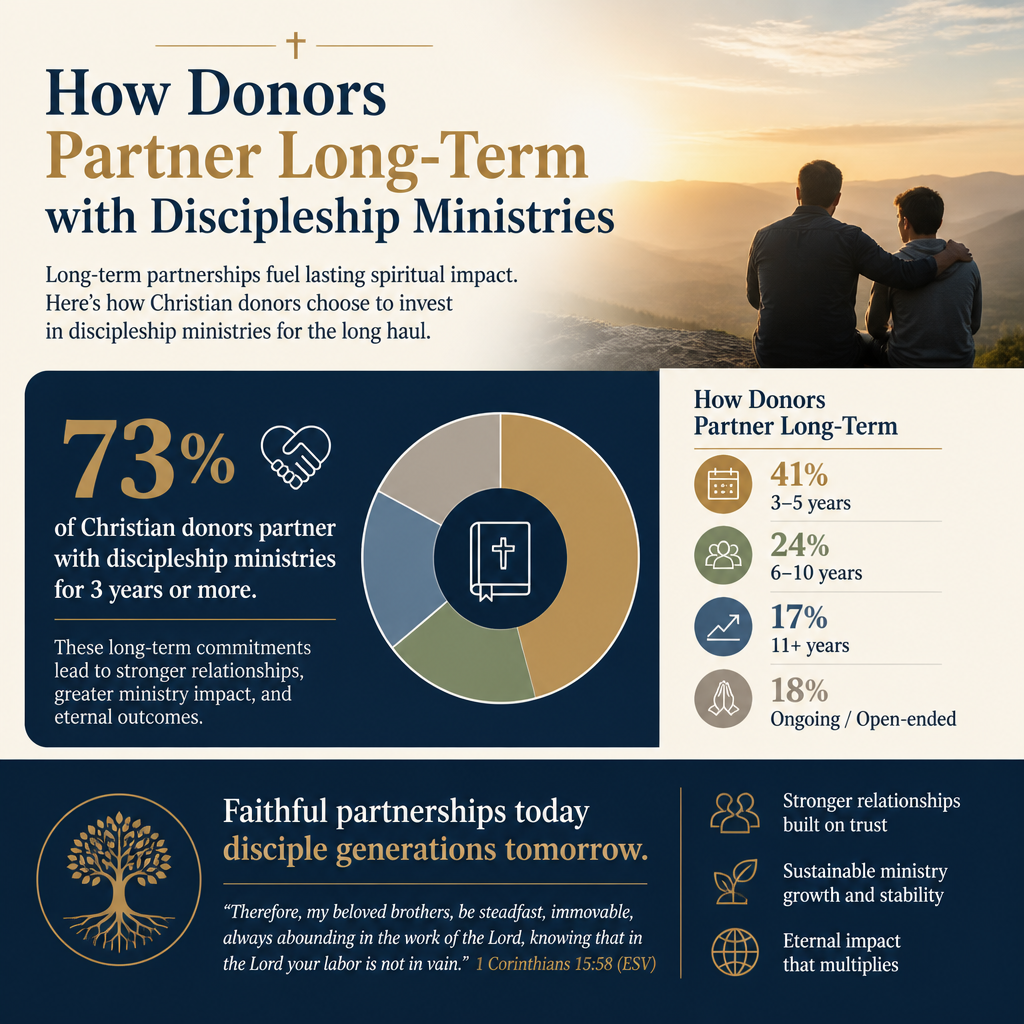
How donors partner long-term with discipleship ministries is not primarily a question of funding mechanics. It is a question of spiritual formation: what kind of fruit a donor expects, what kind of time horizon a donor will honor, and what kind of accountability a donor will require without drifting into control.
Discipleship is slow by design. Jesus formed people through presence, instruction, correction, and repetition, and he entrusted the work to ordinary disciples who needed formation themselves. Donors who desire enduring impact often discover that the most faithful kind of partnership is less like underwriting an event and more like committing to a multi-year labor of prayer, trust, and verifiable stewardship.
Why discipleship requires a different kind of donor patience
Christian maturity is measurable, but it is rarely immediate
Many ministries can report outputs quickly: meals served, wells drilled, Bibles distributed. Discipleship ministries can and should report concrete activity, but their central aim is transformation that persists when the program ends. Scripture frames this transformation in long horizons: “We proclaim him… that we may present everyone mature in Christ” (Colossians 1:28). Maturity is the point, and maturity takes time.
What this means in practice is that a wise donor asks for evidence that a ministry is pursuing fruit that looks like the New Testament: steady adherence to sound teaching, repentance, reconciliation, sacrificial love, endurance in suffering, and multiplication into others. Those are observable realities, but they often show up in trajectories rather than dramatic before-and-after stories.
The ministry donor relationship can unintentionally distort discipleship
Christians genuinely disagree about the best models for discipleship: formal curricula versus informal mentoring, church-based versus parachurch approaches, centralized programs versus decentralized movements. That diversity can be a strength. The risk is that donors, without meaning to, can pressure ministries toward whatever “success” looks most fundable: large numbers, rapid expansion, and simplified reporting.
The field has had to reckon with how incentives shape behavior. Growth is not automatically a problem, but growth that outruns governance, pastoral care, and financial controls has ended in public failure often enough that donors should approach scale with sober gratitude rather than automatic applause.

What long-term partnership means in practice
Fund the disciple-making system, not only the visible moments
Discipleship ministries often have “front door” moments that donors can easily picture: retreats, conferences, camps, worship nights, mission trips. Those moments can be spiritually significant, but they are seldom the whole system. The harder work is the weekly mentoring meeting, the small-group leader training, the pastoral oversight, the counseling referral, the child-safety policy, and the follow-up after a crisis.
Donors who partner long-term ask ministries to articulate the whole pathway: how a person enters, how leaders are trained, how doctrine is safeguarded, how vulnerable people are protected, how outcomes are assessed, and how graduates are connected to local church life. Partnership becomes more than paying for an experience; it becomes sustaining an ecosystem of formation.
Give in a way that strengthens accountability without creating dependency
Long-term giving can stabilize a ministry. It can also create dependency if it is not paired with healthy diversification and realistic budgeting. The “Starvation Cycle,” described by Ann Goggins Gregory and Don Howard, explains how funders’ pressure to minimize overhead can push nonprofits into underinvesting in systems, talent, and evaluation, which then weakens performance and erodes trust over time Stanford Social Innovation Review.
Discipleship work particularly needs strong “infrastructure” that donors sometimes hesitate to fund: training systems, background checks, data security for sensitive stories, financial controls, and leader development. These are not distractions from ministry. They are part of faithful stewardship when the work involves spiritual authority, vulnerable people, and donor trust.
How to evaluate discipleship ministries without reducing the work to numbers
Ask for outcomes that match the theology
The temptation is to demand metrics that are easy to count rather than metrics that are faithful to the ministry’s calling. Discipleship ministries should still be able to demonstrate effectiveness, but the indicators should match the stated theory of change. A campus discipleship ministry may track retention in Christian community after graduation. A prison discipleship ministry may track sustained church connection after release. A men’s or women’s ministry may track participation in mentoring relationships and referrals to counseling or recovery resources.
Here donors can borrow a helpful discipline from program evaluation without becoming technocrats: distinguish outputs from outcomes, and outcomes from long-term fruit. A ministry that reports only enthusiasm at events is underreporting. A ministry that claims spiritual transformation with no evidence is overclaiming. The goal is honest reporting that aligns with theology and acknowledges limits.
Use independent verification as a form of neighbor-love
Scripture’s concern for honesty in weights and measures is not an administrative footnote; it is a moral demand. “A false balance is an abomination to the Lord, but a just weight is his delight” (Proverbs 11:1). Donors who take this seriously seek verifiable evidence that a ministry is financially sound, well-governed, and transparent about results and setbacks.
Most Trusted exists to help donors give with confidence by evaluating Christian nonprofits against The Most Trusted Standard, a 15-criteria framework spanning Faith Foundation, Financial Integrity, Governance and Leadership, and Transparency and Effectiveness. Our role is not to replace discernment, pastoral counsel, or prayer. It is to strengthen decision-making with documented evidence and clear expectations for integrity.
- Clarity of doctrinal commitments and consistency between public teaching and internal training
- Board governance that is active, independent where appropriate, and able to exercise real oversight
- Financial controls proportionate to size and risk, including audit practices when warranted
- Safeguarding policies for children and vulnerable adults, with training and reporting procedures
- Transparent reporting that includes both outcomes and meaningful limitations
Building a partnership that is spiritually grounded and operationally sound
Set expectations that honor the ministry and protect the donor
Long-term partnership works best when expectations are explicit. A donor can ask for an annual conversation with leadership, a written update that includes both progress and challenges, and financial reporting that matches the scale of the gift. Ministries should be able to articulate what they will do with restricted funds and what they cannot promise.
Donors should also name the spiritual posture of the relationship. Discipleship ministries are not vendors. They are servants of Christ accountable first to God, then to their boards, and in many cases to local church authorities. A mature partnership respects that accountability chain rather than inserting the donor into it.
Prioritize the local church connection
One persistent tension in discipleship work is the relationship between parachurch programs and the local church. Many parachurch ministries have served the church with extraordinary faithfulness, especially in contexts where churches lack capacity for specialized outreach. Yet discipleship that never roots people into a worshiping, accountable local body is at risk of becoming personality-driven or program-dependent.
Donors can ask simple, clarifying questions: How does this ministry partner with churches? What does it expect of participants regarding church membership and regular worship? How are leaders supervised spiritually, not only operationally? Strong answers here are often a leading indicator of long-term health.
Common pitfalls in long-term giving to discipleship ministries
Confusing loyalty with discernment
Long-term partnership is not a vow of unconditional endorsement. Ministries change: leadership transitions, financial pressures, theological drift, and organizational fatigue are real. Donors who stay engaged ask whether the ministry remains aligned with its mission, whether governance remains strong, and whether transparency is increasing rather than shrinking.
Many Christian donors have watched a beloved ministry stumble publicly. The painful lesson is not cynicism; it is the need for ongoing diligence. Continuing to ask for documentation and third-party verification is not a lack of trust. It is an application of prudence in a world where reputations can outpace reality.
Funding growth without funding the disciplines that make growth safe
Discipleship ministries can be particularly vulnerable to “charismatic bottlenecks,” where a founder or lead teacher carries the entire spiritual and operational weight. Growth can magnify that vulnerability. Donors can help by funding leadership development, strengthening boards, and supporting the operational systems that make accountability real.
When donors insist that every dollar go “directly to ministry,” they can unintentionally weaken the very conditions that keep ministry faithful. The joint statement sometimes referred to as the Overhead Myth, issued by Charity Navigator, Candid, and the BBB Wise Giving Alliance, argued that simplistic overhead ratios are a poor measure of nonprofit performance Candid. For discipleship ministries, the stakes include not only efficiency but spiritual authority and safeguarding.
FAQs for How donors partner long-term with discipleship ministries
Should donors restrict gifts to specific discipleship programs?
Restricted gifts can be appropriate when a donor and ministry share clear goals and the ministry has the accounting capacity to track restrictions responsibly. Unrestricted support is often healthier for discipleship ministries because formation work requires stable staffing, training, and follow-up that do not fit neatly into a single event or program line item. We recommend asking the ministry how restricted funds will be managed, what reporting will be provided, and what risks the restriction creates for sustainability.
What should donors ask a discipleship ministry for each year?
At minimum, donors can request a ministry update that includes both progress and setbacks, current financial statements or an annual report, and a clear description of governance and safeguarding practices. For larger partnerships, it is reasonable to request audited financials when appropriate, board-level accountability, and an explanation of how outcomes are assessed. Many donors also benefit from comparing the ministry’s claims with independent verification; that is precisely where Most Trusted’s evaluation against The Most Trusted Standard can clarify whether a ministry’s public narrative is matched by documented integrity.
A long obedience with transparent stewardship
Long-term partnership with discipleship ministries is one of the most strategic forms of Christian giving because it invests in people who will carry the gospel into families, churches, workplaces, and communities for decades. Yet the very nature of discipleship makes it vulnerable to shallow metrics, distorted incentives, and unexamined trust.
Donors serve the church best when they combine spiritual seriousness with operational clarity: prayer with verification, generosity with accountability, and patience with truthful reporting. Readers considering this work across the broader landscape of Discipleship Ministries can deepen that discernment within the particular context of Donor Partnership with Discipleship Ministries.



