

Why donors fund discipleship-driven community transformation is ultimately a question of what kind of change Christian giving is meant to seek. Many donors can fund visible relief, buildings, or short-term programs, yet still sense that a community’s deepest needs are spiritual, relational, and moral as well as material. Discipleship is not a rival to compassion; it is the formative process that makes mercy durable and keeps mission aligned with the Kingdom of God.
That conviction does not eliminate complexity. Christians genuinely disagree about how explicit spiritual programming should be when poverty, trauma, or injustice are acute. Some ministries over-spiritualize structural problems; others, under pressure from funders or regulators, reduce Christian mission to generalized social service. Donors who fund discipleship-driven work are usually trying to hold together what Scripture holds together: proclamation and compassion, word and deed, conversion and costly love.
Discipleship treats spiritual formation as a community variable, not a private preference
Scripture frames transformation as formation
The New Testament does not describe salvation as a transaction that leaves people unchanged. Jesus’ call is to follow, learn, obey, and be conformed to his likeness. The Great Commission is to “make disciples… teaching them to obey everything I have commanded you” (Matthew 28:19–20). Communities change when people change, and people change as they are formed by worship, teaching, repentance, and accountable relationships.
Donors who have supported projects that never quite “stick” often recognize the difference between activity and formation. A program can distribute resources without shaping how power is used, how families handle conflict, how employers treat workers, or how leaders resist corruption. Discipleship addresses the heart-level drivers that sit beneath recurring crisis: fear, shame, addiction, despair, rivalry, and the misuse of money and authority.
Material inputs are necessary but rarely sufficient
This is not a denial of economic reality. Food, clean water, healthcare, shelter, and education are goods Christians should gladly support. The harder question is why similar interventions produce different long-term outcomes in different places. Discipleship-driven ministries argue that spiritual formation, reconciled relationships, and local moral leadership help determine whether resources become a bridge to stability or a temporary interruption of decline.
In practice, the donor appeal of discipleship is not that it ignores poverty, but that it names the whole person and the whole community. It insists that what is unseen—integrity, marital faithfulness, sobriety, forgiveness, truth-telling, courage—eventually becomes visible in household economics and civic life.

Discipleship-driven models tend to build local ownership rather than donor dependency
Outside funding can unintentionally displace local agency
Most mature donors have seen the risk: external money can create incentives that weaken local responsibility. The When Helping Hurts framework, articulated by Steve Corbett and Brian Fikkert, sharpened the church’s understanding of how aid can drift into paternalism, distort local markets, and undermine dignity when it is not paired with genuine partnership and accountability. A discipleship-driven approach is often attractive because it aims to form people who can lead, serve, and solve problems from within their own community.
That includes forming local churches and indigenous leaders who can withstand the volatility of outside funding. Donors are increasingly wary of models that require indefinite foreign subsidy. They are more willing to fund ministries that can articulate a credible path toward local leadership, diversified funding, and community participation.
What donors fund is the cultivation of capable, accountable leaders
When donors speak carefully about “transformation,” they often mean leadership formation: pastors who preach Scripture without manipulation, elders who govern with accountability, women and men who can mediate conflict, resist graft, and steward resources for the common good. Discipleship is where these capacities are taught and practiced, especially when it includes mentoring, peer accountability, and biblically grounded ethics.
Across our verification work at Most Trusted, we observe that ministries committed to discipleship-driven change tend to describe outcomes in terms of both spiritual formation and local capacity: strengthened churches, trained leaders, reconciled relationships, and sustainable community initiatives. This does not guarantee health, but it provides a more credible theory of change than activity metrics alone.
Measured outcomes matter, but the right outcomes must be measured
Donors have learned to be cautious with claims
Many ministries can tell compelling stories. Fewer can show credible evidence that their work is producing durable fruit. In the broader nonprofit sector, the “Overhead Myth” debate clarified that simplistic ratios do not tell donors what they most need to know: whether an organization is effective and trustworthy. The original open letter—signed by Charity Navigator, GuideStar, and the BBB Wise Giving Alliance—warned donors against using overhead percentages as a proxy for impact and encouraged evaluation of results, transparency, and governance BBB Wise Giving Alliance.
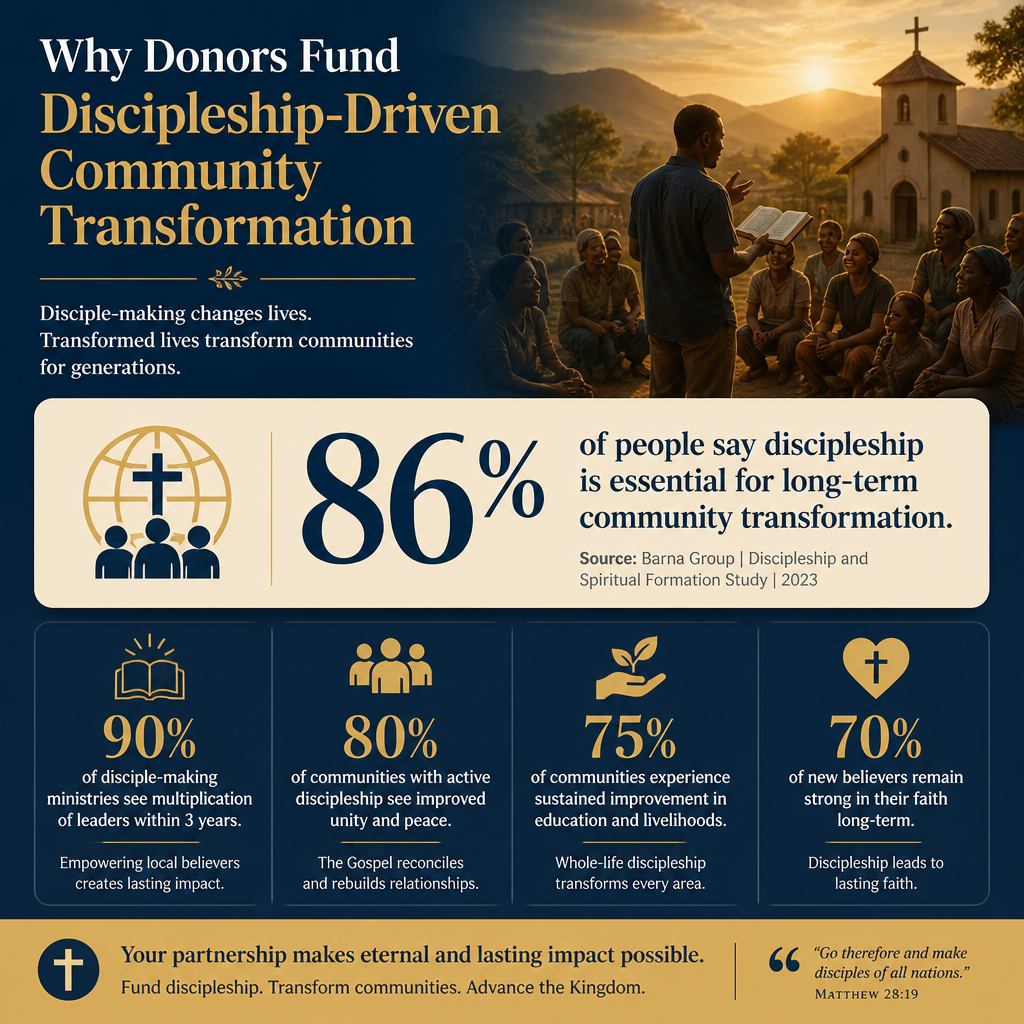
For discipleship-driven community transformation, the challenge is even sharper because spiritual formation is real but not always easily quantified. Christians should not accept manipulation in the name of “Kingdom results,” yet we should also resist forcing discipleship into metrics that miss the substance. The right approach is disciplined humility: clear goals, honest reporting, and evidence that is appropriate to what is being claimed.
What credible evaluation can look like in discipleship work
Measured outcomes can include both spiritual and social indicators, provided they are defined carefully and gathered ethically. Strong ministries explain how they track progress, protect vulnerable people, and avoid pressuring participants to produce “good testimonies” for donor communications. They also distinguish between outputs (classes delivered, leaders trained) and outcomes (behavior change, restored families, reduced violence, stable livelihoods) and can articulate plausible causal links.
Donors can reasonably ask for a small set of concrete indicators and a transparent method. A disciplined, faith-honoring approach often includes:
- Clear participant selection and safeguarding practices for vulnerable adults and children
- Defined discipleship pathways with accountable leadership and documented curriculum
- Outcome tracking that includes retention, follow-through, and pastoral care, not just attendance
- Third-party financial review practices appropriate to organizational size and complexity
- Public reporting that names setbacks and limitations, not only success stories
Within Discipleship Ministries, donors often find that the most trustworthy organizations are those willing to be specific: specific about what they do, what they do not do, and what evidence would count as meaningful progress.
Trustworthy discipleship ministries show theological clarity and organizational integrity
Donors are not only funding programs, they are funding spiritual authority
Discipleship-driven community work necessarily involves spiritual influence. That makes governance, accountability, and doctrinal clarity central to donor due diligence. Donors are right to ask how leaders are selected and supervised, what safeguards exist against financial misconduct and spiritual abuse, and how the ministry handles power when growth accelerates.
Scripture’s warnings about leadership are direct. The pastoral epistles assume that character and household integrity are not private matters when one teaches the church. James cautions that teachers will be judged with greater strictness. These are not abstract concerns for donors; they are risk categories with real victims when ignored.
The Most Trusted Standard brings structure to donor discernment
Most Trusted exists because many donors want to give confidently without reducing discernment to instinct or reputation. The Most Trusted Standard is a 15-criteria framework across four areas: Faith Foundation, Financial Integrity, Governance and Leadership, and Transparency and Effectiveness. In our work, the ministries that meet The Most Trusted Standard tend to present a coherent theology of discipleship and a disciplined organizational posture: documented policies, appropriate financial controls, clear reporting, and leadership accountability that is more than aspirational.
That posture matters for discipleship work because the ministry is shaping hearts and lives. If a ministry cannot be trusted with money, children’s safety, or honest reporting, it should not be trusted with spiritual authority. Donors who fund discipleship-driven community transformation are often funding what is hardest to rebuild after scandal: credibility.
Discipleship integrates mercy and justice without collapsing either into the other
Christians debate emphasis because the needs are real
The field has had to reckon with polarizing instincts. Some donors and ministries emphasize evangelism and worry that “social gospel” approaches dilute the message of salvation. Others emphasize justice and fear that discipleship language becomes a way to avoid difficult structural realities. Serious Christian giving resists both evasions. Jesus proclaimed the Kingdom and healed the sick. The early church preached Christ crucified and fed widows. Scripture does not give permission to use theology as an excuse for indifference, nor does it allow compassion to become untethered from repentance and faith.
Many donors fund discipleship-driven transformation precisely because it provides a framework to hold these tensions honestly. It is possible to preach conversion and also address exploitation. It is possible to teach forgiveness and also confront abuse. It is possible to disciple believers in stewardship and also advocate for fair economic practices.
Community transformation requires moral ecology, not only services
Over time, communities develop a moral ecology—shared norms about truth, work, family, sexuality, generosity, and responsibility. Discipleship shapes that ecology by forming consciences and strengthening institutions that transmit virtue: families, churches, and local associations. Services remain important, but donors who think long-term often prioritize the renewal of moral leadership because it is a root system for other change.
Within Discipleship Ministries in Missions and Community, the strongest models are typically those that can explain how discipleship connects to concrete community outcomes without making inflated promises. They speak with confidence about the gospel’s power and with sobriety about timelines, setbacks, and spiritual opposition.
FAQs for Why donors fund discipleship-driven community transformation
Is funding discipleship-driven community work less “practical” than funding direct aid?
Not necessarily. Direct aid addresses immediate suffering, which Christians should take seriously. Discipleship-driven work addresses the formation of people and institutions that determine whether a community can sustain progress. Many donors fund both, but they look for ministries that can explain how relief, development, and discipleship fit together without confusing emergency response with long-term formation.
How can donors evaluate discipleship outcomes without turning faith into a metric?
Donors can ask for clear definitions, ethical data practices, and evidence appropriate to the ministry’s claims. Credible ministries distinguish outputs from outcomes, report limitations, and avoid manipulative storytelling. Donors can also evaluate organizational integrity through governance, financial controls, and transparency. Most Trusted’s verification work applies The Most Trusted Standard to help donors assess whether a ministry’s theology and operations support the kind of discipleship it claims to produce.
What donors are really seeking when they fund discipleship-driven transformation
Donors fund discipleship-driven community transformation because they want to participate in change that is not merely external, temporary, or dependent on outsiders. They are aiming for the kind of renewal Scripture describes: people reconciled to God, households strengthened, leaders formed in integrity, and communities shaped by truth and mercy. That kind of change is slower, harder to measure, and more vulnerable to counterfeit claims. It is also closer to the heart of Christian mission.
The wisest giving pairs conviction with verification. Discipleship deserves serious support, and it also deserves serious scrutiny—so that donors can fund ministries whose theology is clear, whose leadership is accountable, and whose work is as trustworthy as the message they proclaim.



