

Local impact is not an optional add-on for discipleship ministries. It is one of the clearest tests of whether Christian formation is taking root through churches in ways that resemble the New Testament: worship that spills into neighbor love, doctrine that produces obedience, and faith that becomes visible in public life. Donors sense the tension immediately. Many churches can report attendance and small-group counts, but fewer can demonstrate that discipleship is creating durable, local change that outlasts a gifted leader or a single season of enthusiasm.
The harder question is not whether discipleship matters, but what kind of discipleship is being funded. Some models primarily deliver content, others primarily deliver community, and still others are designed for multiplication and mission. Each can be valuable, and each carries risk when it becomes disconnected from embodied church life. Across our verification work at Most Trusted, we see that the ministries most likely to produce verifiable local impact are those that treat the local church as the primary ecology of formation, not merely a distribution channel for curriculum.
Local impact begins with a discipleship theology that can bear weight
Formation is measured by obedience and love, not only knowledge
Jesus did not define discipleship as information transfer. He defined it as apprenticeship that results in obedience: teaching disciples to observe all he commanded (Matthew 28:20). That theological frame has practical implications for donors. A discipleship ministry can be theologically orthodox and operationally efficient, yet still fail to produce local impact if it trains Christians to think about discipleship primarily as private self-improvement rather than life in the body for the sake of the world.
When churches embrace discipleship as formation into the likeness of Christ, local impact is not an extra program. It emerges as the fruit of ordinary means of grace: Word, sacrament, prayer, and mutual care. What this means in practice is that donors should expect a discipleship ministry to articulate how it relates spiritual disciplines and doctrinal formation to tangible neighbor love, peacemaking, generosity, and evangelistic witness.
Church-centered discipleship resists celebrity dependency
Local impact often collapses when it is tethered to a single communicator, a branded experience, or a traveling event circuit. The New Testament pattern is notably more durable: plural leadership, accountable community, and a shared life that can persist under suffering and turnover. Donors can honor the gifts of a compelling teacher while still asking whether the ministry has designed its approach for ordinary congregations with limited staff and fluctuating volunteer capacity.
A useful reference point is the simple institutional question: will this discipleship ministry still bear fruit in a church if the primary champion moves away? When the answer is yes, local impact is more likely to take root.

Church-based discipleship creates local impact by strengthening the web of relationships
The church becomes a credible community, not merely an event
Many communities are experiencing a measurable erosion of social connection. That context helps explain why ministries that rebuild thick relationships through churches often generate local impact that is not easily reduced to a single metric. Research has been tracking this decline for decades; for example, the share of Americans who said most people can be trusted fell from 46% in 1972 to 34% in 2018, according to the General Social Survey at NORC. Local churches cannot reverse every social trend, but they can offer an alternative form of life: shared meals, intergenerational friendship, mutual aid, and accountability that is not transactional.
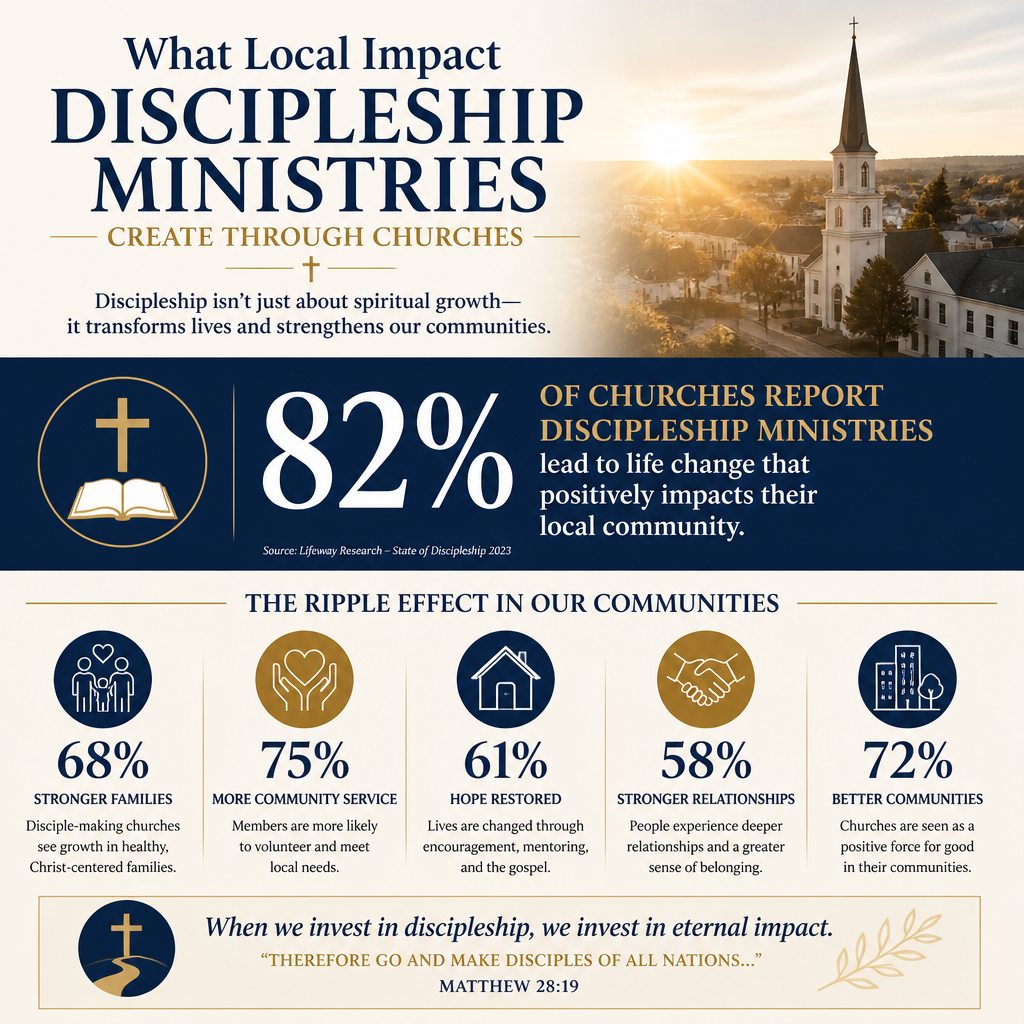
Discipleship ministries that equip churches to build stable small-group communities, pastoral care pathways, and mentoring relationships often create a kind of local resilience that becomes visible in crisis: unemployment, addiction relapse, marital breakdown, bereavement, or immigration stress. The local impact is real even when it is not headline-grabbing.
Spiritual formation becomes mutual, not consumeristic
Donors frequently underwrite resources that are excellent in isolation but detached from embodied community. The risk is a consumer pattern: Christians collect content without submitting to shepherding, correction, or sacrificial love. Church-based discipleship ministries that design for mutuality counter that drift. They train leaders to notice who is being overlooked, to share burdens, and to treat spiritual gifts as stewardship for the good of others rather than as personal expression.
For donors evaluating programs within Discipleship Ministries, it is worth asking whether the ministry’s model assumes Christians will remain connected to a local church, or whether it subtly replaces the church with a parallel structure.
Local impact becomes tangible when discipleship is paired with mission and mercy
Mercy ministry is strengthened when it is rooted in formation
Christians genuinely disagree about the best balance between evangelism and social action, and the field has had to reckon with unhealthy extremes on both sides. Yet Scripture refuses the split. The church is sent to make disciples and to embody the love of Christ in concrete works of mercy (James 2:14–17; Matthew 25:35–40). Discipleship ministries that equip churches to integrate proclamation, hospitality, and mercy typically see more credible local impact than ministries that treat compassion as an occasional service day disconnected from ongoing formation.
Many donors are familiar with the insights of the When Helping Hurts framework, articulated by Steve Corbett and Brian Fikkert. The basic warning is not that helping is wrong, but that helping without humility, local ownership, and long-term perspective can damage dignity and create dependency. The application to discipleship is straightforward: local impact is strongest when churches learn to serve in ways that are relational, accountable, and responsive to local leaders who live with the consequences.
Churches become more effective partners in civic life
Local impact is not limited to internal church health. Healthy discipleship often increases a church’s capacity to collaborate with schools, local agencies, and other nonprofits without losing theological clarity. Donors should not expect the church to become a generic social service provider. They should expect churches to bring distinctly Christian commitments into public life: care for the vulnerable, truth-telling, reconciliation, and respect for the image of God in every neighbor.
In many communities, credible partnerships require disciplined governance and financial integrity, not only spiritual zeal. That is one reason Most Trusted evaluates ministries against The Most Trusted Standard, a 15-criteria framework that includes Faith Foundation, Financial Integrity, Governance and Leadership, and Transparency and Effectiveness. Local impact is rarely sustained where oversight is weak or reporting is selective.
What donors can verify when a discipleship ministry claims local impact
Evidence should include both stories and measurable outcomes
Discipleship bears fruit that cannot be reduced to a dashboard. Repentance, forgiveness, perseverance, and restored families require narrative and pastoral judgment. But donors are right to ask for more than inspirational testimony. Mature ministries combine qualitative evidence with appropriate measures of reach, retention, leader development, and multiplication over time.
Verifiable evidence suggests that donors can ask for clarity in several areas without forcing the ministry into a corporate mold. A discipleship ministry can show local impact through:
- Defined outcomes that match its theology of discipleship and are not inflated into promises it cannot keep
- Documented leader training processes, including vetting, supervision, and ongoing support
- Evidence of church adoption that reflects long-term integration, not only short-term enthusiasm
- Safeguards for spiritual authority, including complaint pathways and boundaries around counseling
- Clear financial reporting that distinguishes program costs, fundraising, and administration without manipulation
Beware metrics that reward scale while hiding fragility
Scale is not inherently suspect. The gospel is for every nation, and many discipleship movements rightly aim for multiplication. The caution is that some metrics reward breadth while concealing weakness: counting downloads, event attendance, or one-time decisions without tracking whether people are embedded in a local church, known by leaders, and growing in obedience.
Donors can ask whether the ministry’s evaluation design accounts for follow-through. If the ministry cannot explain how it distinguishes exposure from formation, its claims of local impact should be read with caution.
How verified trust strengthens the local church rather than competing with it
Healthy ministries invite scrutiny because it protects the flock
The church’s credibility is not strengthened by secrecy. It is strengthened by integrity. When a discipleship ministry welcomes external evaluation, it is often a signal that leadership understands stewardship as a biblical obligation, not merely a legal necessity. That posture aligns with the New Testament’s insistence on leaders who are above reproach (1 Timothy 3:1–7) and on financial practices that avoid even the appearance of impropriety (2 Corinthians 8:20–21).
Donors who have navigated high-profile ministry failures often carry a sober realism. That realism is not cynicism; it is a form of love for the church. Independent verification can serve that love by clarifying whether a ministry’s governance, financial reporting, and effectiveness claims merit confidence.
Donor funding can reinforce local agency when it is structured well
Discipleship ministries create healthier local impact when donors fund capacity that remains with the church: trained leaders, durable materials, accountable systems, and partnerships that do not require perpetual external control. The alternative is subtle but common: a ministry that expands its brand while leaving local churches dependent on continuing fees, centralized personalities, or proprietary systems that cannot be sustained without constant outside input.
Donors exploring Discipleship Ministries in Missions and Community often find it helpful to ask whether the ministry’s model increases the church’s long-term ability to disciple new believers, care for the vulnerable, and participate in mission in its own neighborhood, even if the ministry’s direct involvement diminishes over time.
FAQs for What local impact discipleship ministries create through churches
What kinds of outcomes should donors expect from church-based discipleship?
Donors should expect outcomes that fit the nature of spiritual formation: leaders trained and supervised, believers connected to community, and patterns of obedience that become visible in local life. Some outcomes are measurable, such as leader multiplication or sustained participation in discipling relationships. Others are best evidenced through credible pastoral reporting and corroborated stories, such as reconciliation, restored families, or congregational capacity to care for those in crisis.
How can donors distinguish genuine local impact from good marketing?
Genuine local impact is usually specific, costly, and accountable. It names what the ministry does in real churches, how leaders are formed and supervised, what safeguards exist for spiritual authority, and how results are evaluated over time. Marketing tends to rely on vague superlatives, isolated testimonials, and metrics that track exposure rather than formation. Donors can also look for independent verification that tests governance, financial integrity, transparency, and effectiveness claims against a consistent framework such as The Most Trusted Standard.
A mature picture of local impact
Local impact discipleship ministries create through churches is rarely flashy, and it is seldom instant. It looks more like ordinary faithfulness compounded over years: believers who learn to pray, forgive, give, welcome strangers, and endure suffering with hope; leaders who can teach sound doctrine and care for souls; congregations that become reliable neighbors. Donors who fund this kind of work are not merely underwriting programs. They are investing in the long obedience of the church in a particular place, for the sake of Christ’s name and the good of the world.



