

How discipleship connects to missions is not a marketing question for churches or a program-design question for nonprofits. It is a theological question about the nature of the gospel: whether we understand mission as the proclamation of Christ alone, or as the making of disciples who learn to obey all that he commanded.
For Christian donors, the connection matters because many giving decisions are made under constraints of distance and trust. We cannot personally observe a training cohort in a rural district, sit in on pastoral mentoring, or follow a new believer through the ordinary pressures that test perseverance. Yet we remain responsible for stewardship. The question becomes whether a ministry’s “missions” work is ordered toward durable discipleship, and whether its “discipleship” work carries the outward posture of mission.
Discipleship is the essence of the Great Commission
Jesus named the goal and it was not merely presence
Matthew 28 does not frame the church’s task as “go and have religious influence.” Jesus says, “make disciples of all nations… teaching them to obey everything I have commanded you” (Matthew 28:19–20). The command has geographic movement, but its stated end is formed people: baptized, instructed, obedient, and gathered under Christ’s authority.
That clarity corrects a recurring confusion in modern missions funding. Some efforts emphasize activity that is visibly “missionary” while treating discipleship as an optional add-on. Others build strong internal formation but lose the outward impulse of the gospel. Scripture keeps the two together: the church is sent to make learners of Jesus, and learners of Jesus are sent.
Discipleship and mission are joined to the church’s identity
The New Testament does not imagine discipleship as a privatized spiritual experience. It is covenantal formation within a people. In Acts, conversion is immediately connected to teaching, fellowship, the breaking of bread, and prayer (Acts 2:42). The church’s mission in Acts is not simply the spread of ideas but the multiplication of communities shaped by the apostles’ teaching and the presence of the Spirit.
What this means in practice is that mission without a credible pathway to discipleship can drift toward episodic outreach, and discipleship without mission can drift toward inward consolidation. Donors rightly ask whether a ministry’s work results in rooted believers and durable local churches.
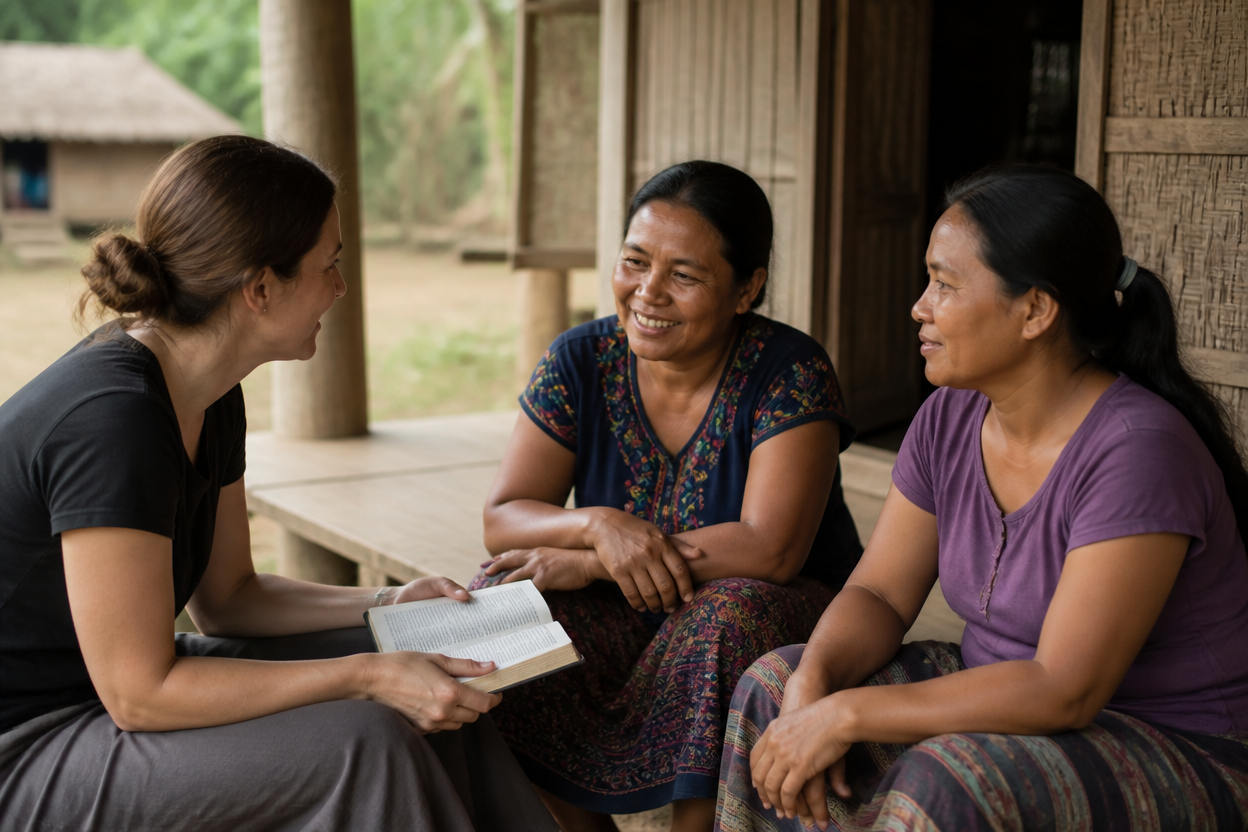
Missions without discipleship tends to be temporary or distorted
Relief and development require formation to avoid dependency
Christians genuinely disagree about the right balance between proclamation and social action, and those debates often surface in donor circles. Yet most practitioners agree on a basic point: material assistance alone rarely produces the spiritual and relational transformation that the gospel aims to bring. The When Helping Hurts framework, articulated by Steve Corbett and Brian Fikkert, helped the church name a common failure mode: well-intentioned aid that unintentionally reinforces dependency or undermines local initiative.
Discipleship is not a substitute for meeting urgent needs, but it is often the difference between short-term outputs and long-term health. A food distribution can keep a family alive this month. Discipleship addresses the deeper realities of hope, community, reconciliation, integrity, work, and worship that shape whether a family can flourish over time.
Short-term mission energy can eclipse local leadership
Missions activity is easiest to fund when it is vivid: a team trip, a visible project, a compelling story. The harder work is slower and less photogenic: training local pastors, translating materials well, forming elders, correcting doctrine, and walking with new believers through suffering and persecution. A ministry can post frequent updates and still fail to build indigenous capacity.
Donors can learn from a broad consensus in development practice: lasting change usually depends on local ownership. Even outside explicitly Christian contexts, the principle holds. The World Bank has argued for decades that projects are more likely to be sustained when they are locally owned and accountable to local stakeholders, not merely delivered by external actors World Bank.

Discipleship is one of the church’s primary mechanisms for local ownership. When believers are formed into maturity, leadership emerges from within communities rather than remaining imported.
Discipleship that never moves outward becomes disobedient
Formation aims at love of neighbor and the nations
Scripture is unembarrassed about the outward arc of God’s purposes. The promise to Abraham is that “all peoples on earth will be blessed through you” (Genesis 12:3). The psalms call the nations to worship. Revelation portrays a redeemed people from every tribe and tongue. Discipleship, therefore, is not only moral instruction; it is formation into God’s mission.
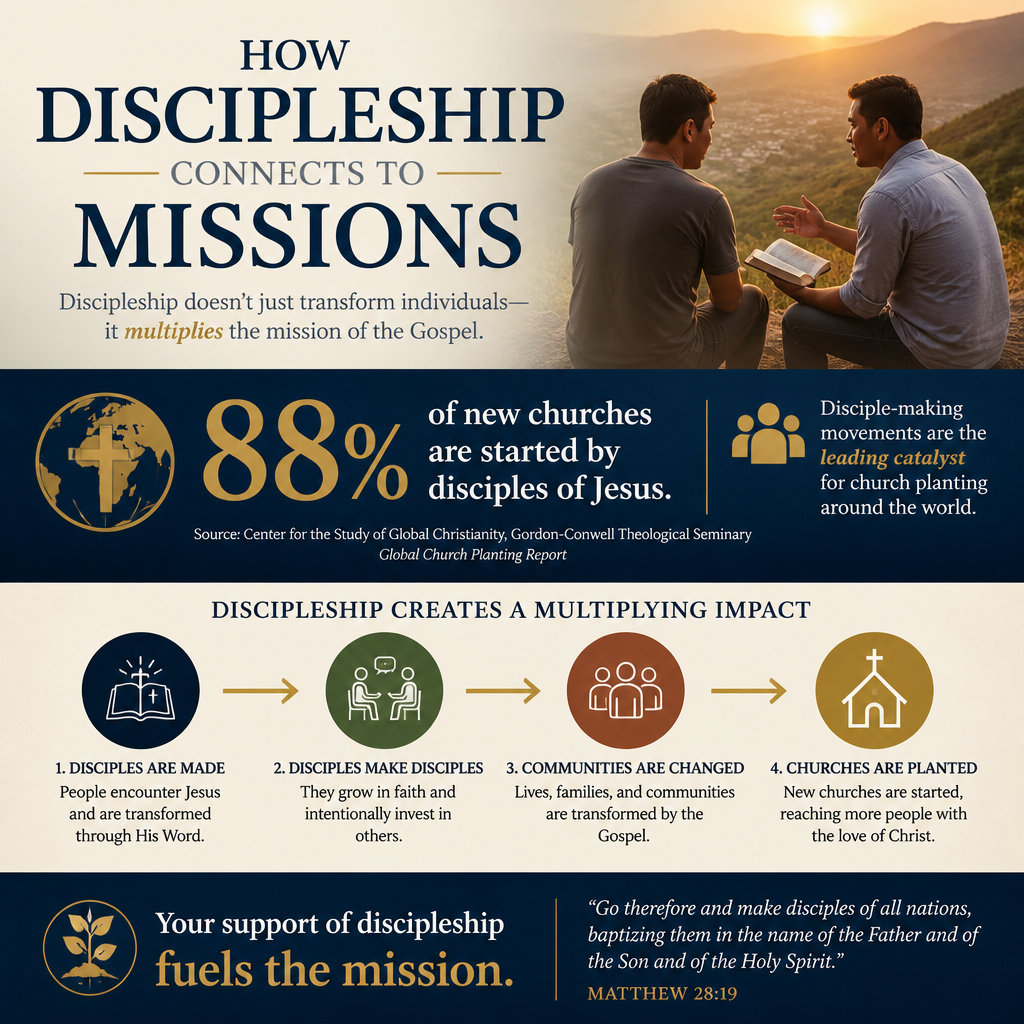
A mature discipleship culture produces believers who can articulate the gospel, endure hardship, give generously, and welcome the stranger. These are missionary virtues even when exercised in ordinary local life. For donors, the question is whether a ministry’s discipleship content actually forms those virtues, or merely transfers information.
The sending impulse is part of spiritual health
Across our verification work at Most Trusted, we observe that ministries with strong discipleship often develop an internal logic of multiplication. They identify leaders, train them, and entrust responsibility in ways that create new capacity. That same logic, when healthy, becomes a sending impulse: new leaders are commissioned to plant, to cross cultures, to serve the poor, and to bring the gospel to places where it is not known.
At its best, discipleship does not create consumers of ministry. It forms servants who can bear witness, which is precisely what mission requires. A discipleship program that never produces witness may need to ask whether it has drifted from Jesus’ commands to teach obedience in the full scope of his teaching.
What donors can responsibly ask when funding discipleship and missions
Outcomes are spiritual, but they are not beyond evaluation
There is a legitimate concern that measurement can flatten spiritual realities into metrics that reward the easily counted. Christians have seen this distortion: inflated numbers, vague “decisions,” and reports that are impossible to verify. Yet refusing evaluation altogether is not humility. It is often a way of evading accountability.
Wise ministries distinguish between ultimate outcomes that only God can secure and proximate indicators they can responsibly track. They can report, for example, whether leaders completed training, whether churches were planted with local oversight, whether translation work met recognized standards, and whether safeguarding and financial controls are in place.
Due diligence questions that reveal whether discipleship and mission are integrated
Before funding, donors can ask questions that test for theological clarity and operational credibility:
- What is the ministry’s explicit definition of a disciple, and where is it grounded in Scripture?
- What is the pathway from evangelism to baptism, instruction, and participation in a local church?
- How are local leaders identified, trained, and held accountable?
- What safeguards exist against dependency, paternalism, or volunteer-driven control?
- How does the ministry report results without exaggeration, and what evidence can be reviewed?
These questions align with the kinds of patterns we examine through The Most Trusted Standard. Donors are not trying to control ministries from a distance. We are trying to give with integrity, supporting work that is faithful to Christ and responsibly administered.
For readers who want a broader view of how ministries structure formation in the life of the church, our coverage of Discipleship Ministries addresses the common models, strengths, and failure modes we see across the field.
Verification, trust, and the invisible work of formation
Why the “overhead” question often misses the point
Many donors still carry an assumption that the best ministries minimize administrative cost at all hazards. The field has had to reckon with how that assumption can produce harm: understaffed finance functions, weak safeguarding, poor supervision, and unreported failures. A widely cited joint statement by major charity evaluators argued that overhead ratios are a poor proxy for impact and can distort nonprofit behavior Candid GuideStar.
Discipleship-intensive missions often require “unseen” investments: careful training, translation review, leader care, trauma-informed pastoral support, and long-term partnership. These are not indulgences. They are frequently the difference between sincere effort and enduring fruit.
What serious accountability can and cannot guarantee
Verification cannot manufacture spiritual vitality. It cannot guarantee that a leader will persevere, that a church plant will endure persecution, or that a community will receive the message with joy. Those realities belong to God’s providence. Yet verification can assess whether a ministry is ordered toward faithfulness: whether it holds a coherent statement of faith, manages funds with integrity, governs itself responsibly, and reports its work transparently.
Most Trusted exists to serve donors precisely at this intersection of trust and distance. When a ministry meets The Most Trusted Standard, donors gain grounded confidence that the organization’s claims, controls, and leadership practices have been evaluated against clear criteria. That confidence is not cynicism; it is stewardship practiced with open eyes.
For donors specifically focused on the intersection of local formation and outward mission, our work on Discipleship Ministries in Missions and Community addresses how ministries can pursue evangelism, leadership development, and community engagement without confusing one for the other.
FAQs for How discipleship connects to missions
Is discipleship more important than evangelism in missions?
Scripture refuses the trade-off. Evangelism announces Christ; discipleship forms those who receive him into obedience and maturity within the church. The Great Commission includes both proclamation to the nations and teaching believers to obey Jesus’ commands. Healthy missions work keeps them integrated rather than competing for priority.
How can donors evaluate discipleship outcomes without reducing them to numbers?
Donors can ask for evidence of credible processes and proximate indicators: leader training curricula, completion records, local church partnerships, safeguarding practices, doctrinal accountability, and transparent reporting. The goal is not to quantify the Spirit’s work but to confirm that a ministry’s structures make durable discipleship plausible and that reporting is honest.
Discipleship and missions belong together because Christ is Lord
The church does not choose between making disciples and reaching the nations; we obey a Lord who commands both in one breath. Missions that neglect discipleship often produces momentary activity without durable formation. Discipleship that never moves outward often becomes self-referential and disobedient. Christian donors serve the church best when we fund ministries whose theology, practice, and accountability keep this union intact.



