

How discipleship ministries measure impact is not a secondary question for Christian donors. It is a test of whether a ministry understands the nature of Christian formation and whether it is willing to be accountable for the stewardship of the resources entrusted to it. Discipleship is spiritual work, shaped by the Holy Spirit and often hidden from public view; donors still have a legitimate obligation to ask what a ministry is doing, what it is learning, and whether its claims are commensurate with evidence.
Scripture itself gives donors both urgency and restraint. Jesus’ command is to “make disciples” (Matthew 28:19–20), yet Paul reminds the Church that “neither he who plants nor he who waters is anything, but only God who gives the growth” (1 Corinthians 3:7). Healthy impact measurement in discipleship ministries keeps both truths in view: real actions, real outputs, and real observable fruit, without pretending that spiritual transformation is a controllable product.
Discipleship impact starts with theological clarity about what counts as fruit
Many donor frustrations with impact reporting come down to category confusion. A ministry may report what it can count (attendance, curriculum distribution, small group launches) while donors are asking about what Scripture commends (maturity, perseverance, obedience, love). A serious measurement approach begins by defining discipleship in a way that can be tested over time, anchored in the Bible and articulated with enough precision that leaders can be held accountable.
Clarifying outcomes without reducing discipleship to metrics
Discipleship ministries that measure well typically distinguish between outputs (what the ministry does), intermediate outcomes (what participants learn and practice), and longer-term outcomes (what patterns of life persist). For donors, this distinction matters because a crowded calendar is not the same thing as spiritual formation. Outputs can be necessary, but they are not sufficient evidence that disciples are being made.
We also encourage donors to watch for ministries that can name discipleship outcomes in biblical terms and then translate them into observable indicators. For example: growth in prayer and Scripture engagement, increased participation in the life of a local church, reconciliation and peacemaking, sacrificial generosity, vocational faithfulness, or sustained patterns of repentance. None of these can be captured perfectly, but they can be assessed credibly through repeated observation, validated testimonies, and structured pastoral discernment.
Why Christian donors should expect both humility and candor
Christians genuinely disagree about how directly spiritual maturity can be attributed to a particular program. The field has had to reckon with the dangers of triumphal reporting that implies a ministry “produced” holiness, as well as the opposite error of vague spirituality that never faces evaluation. A mature posture is comfortable naming what can be known, what cannot be known, and what must be inferred carefully.
This is one reason Most Trusted evaluates ministries against The Most Trusted Standard, which requires theological coherence alongside governance, financial integrity, and credible evidence of effectiveness. When a discipleship ministry’s theology of sanctification is confused, its reporting typically becomes confused as well—either inflating claims or retreating into untestable language.

Better measurement distinguishes faithfulness from effectiveness and holds both together
Donors often sense a tension: discipleship ministries must be faithful to Scripture even when results are slow, yet donors also want evidence that resources are being stewarded responsibly. The most trustworthy ministries refuse the false choice. They define faithfulness in concrete terms (teaching sound doctrine, forming leaders, protecting the vulnerable, practicing integrity) and they pursue effectiveness by learning from data, listening to communities, and adjusting methods that are not bearing fruit.
What donors can reasonably expect to see measured
Across our verification work, the ministries that report impact with integrity tend to measure several categories consistently:
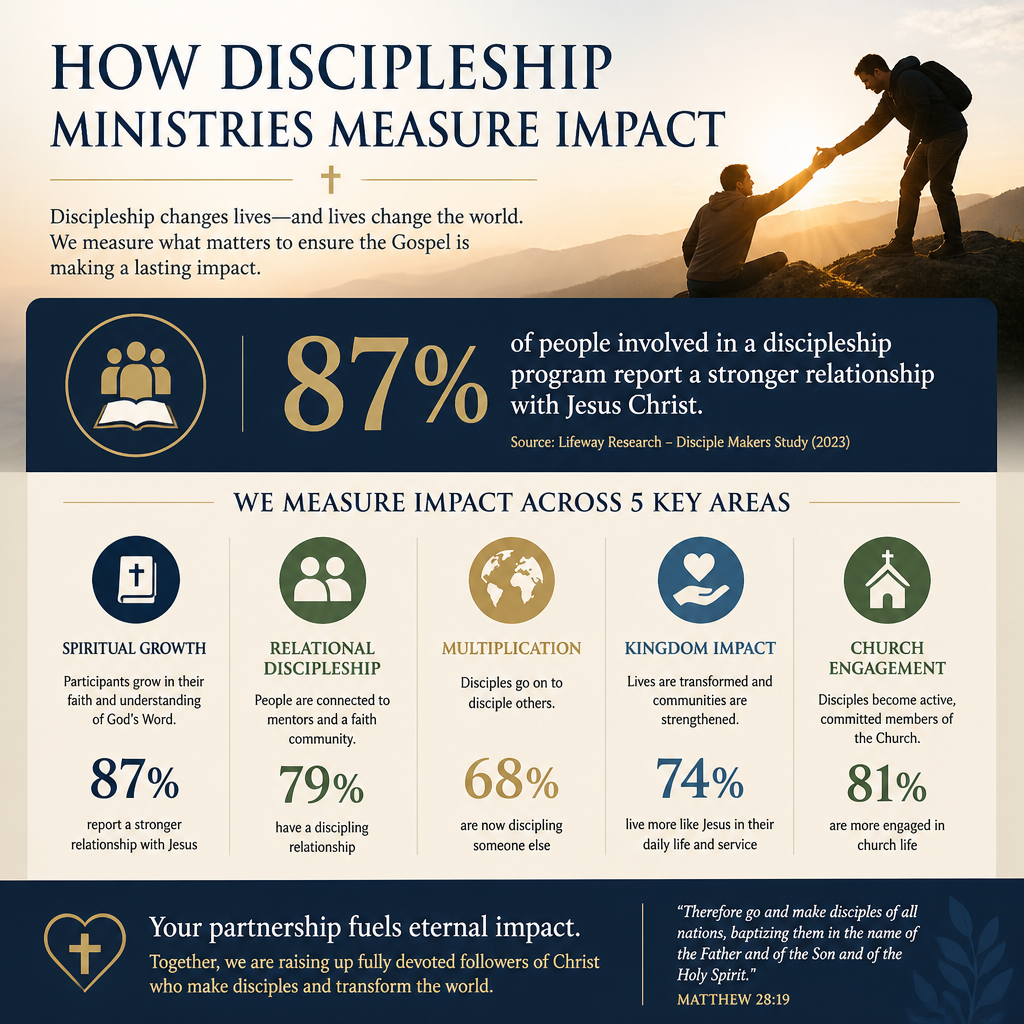
- Participation and reach: Who is being served, at what intensity, and with what retention? This includes attendance, small group continuity, leader-to-participant ratios, and completion of cohorts or training tracks.
- Learning and practice: Whether participants are actually engaging core practices (Scripture study, prayer, confession, service, evangelism) and whether knowledge is increasing in ways consistent with orthodox Christian teaching.
- Leadership development: The multiplication of competent, accountable leaders—especially evidence of ongoing coaching, doctrinal examination, and character assessment.
- Church connection: Discipleship separated from the local church becomes unstable. Many ministries track involvement in congregational life, pastoral oversight, and long-term integration rather than “graduates” who drift away.
These categories do not guarantee maturity, but they do indicate whether a ministry is operating with intentionality, whether it understands formation as a sustained process, and whether it is honest about the difference between a moment and a pattern.
Evidence that should make donors cautious
Some reporting patterns deserve scrutiny. Ministries should not treat raw numbers as proof of transformation. Large attendance figures can coexist with shallow formation, especially when programming is designed around event growth rather than relational discipleship. Donors should also be wary of ministries that cannot articulate any indicators beyond enthusiasm, social media engagement, or anecdotal highlight reels.
A further caution is the “overhead” fixation that pushes ministries to underinvest in evaluation, safeguarding, and leadership development. The charitable sector has repeatedly warned that simplistic overhead ratios distort donor expectations and can undermine effectiveness; major charity evaluators have publicly challenged this dynamic in the Overhead Myth statement led by GuideStar (now Candid), Charity Navigator, and the BBB Wise Giving Alliance Candid.
Credible impact reporting combines quantitative measures with disciplined qualitative evidence
Discipleship is personal; it is also communal. It involves doctrine, affection, behavior, and endurance. Because of this, the strongest discipleship ministries do not pretend that one kind of evidence is enough. They count what is countable and they document what must be discerned, using methods that can be inspected by leaders, boards, and informed donors.
Quantitative signals that can be meaningful in discipleship work
Numbers can tell the truth when they are tethered to a coherent model of formation. Useful quantitative measures often include: retention across seasons (not just single-event attendance), frequency of participation in small groups, leader training completion rates, and follow-up engagement six to twelve months after a cohort ends. Ministries may also track giving, volunteering, or membership transitions when those data are available and ethically collected, especially in partnership with local churches.
Donors should not expect discipleship measurement to look like clinical trials. Even in broader nonprofit work, the ability to prove causality is frequently limited by ethical and practical constraints. What donors can expect is competent evaluation practice: clear definitions, consistent data collection, and honest interpretation that recognizes confounding factors.
Qualitative evidence that is more than storytelling
Christian donors often value testimonies, and Scripture honors the telling of God’s works. Yet “stories” can become a substitute for accountability if they are curated only for emotional effect. Mature ministries treat qualitative evidence as disciplined documentation: verified participant narratives, pastor or mentor observations recorded over time, and case studies that include struggle, relapse, and perseverance rather than only tidy outcomes.
Stronger reports will also show how leaders guard against selective reporting. That can include sampling methods for interviews, third-party feedback, anonymous participant surveys, and documentation of negative feedback and how it was addressed. A ministry that can name what it is learning—including what is not working—usually has the internal culture required for long-term fruitfulness.
Safeguarding and spiritual authority as part of impact
Discipleship ministries exercise spiritual influence. That influence can build up or it can wound. For donors, a credible impact picture includes evidence that the ministry has policies and accountability structures that protect participants: background checks where appropriate, clear reporting lines, doctrinal oversight, and processes for responding to misconduct. A ministry may have impressive program activity, but if it lacks governance strength or transparent handling of failures, donors should assume the long-term impact will be compromised.
What discerning donors should ask for in an impact report
Donors do not need to be professional evaluators to ask responsible questions. The goal is not to pressure ministries into marketing claims; it is to understand whether leaders are stewarding people, Scripture, and resources with sobriety. The most helpful questions press toward clarity, verification, and learning.
Questions that reveal whether a ministry understands its own theory of formation
- What is your definition of a disciple, and how does it shape your program design and staffing?
- What do you consider “success” at three months, one year, and three years?
- How do you avoid confusing busyness with maturity?
- How do you work with and under local church leadership rather than competing with it?
Discipleship ministries that are prepared to answer these questions typically have done the internal work to align theology, strategy, and reporting. Ministries that evade them often rely on charisma, momentum, or vague aspiration.
Questions that test data integrity and transparency
- What data do you collect consistently, and what do you not collect? Why?
- How do you verify outcomes beyond self-reporting?
- What have you changed in the last 12–24 months based on what you learned from measurement?
- Do you report retention and follow-up, or only initial participation?
It is reasonable to expect a mature ministry to acknowledge limitations. The presence of limitations is not disqualifying; the absence of candor is.
How verification supports donor confidence
Discernment is a Christian duty, and it is also a practical burden for donors with limited time. Most Trusted exists to reduce that burden by evaluating Christian nonprofits against The Most Trusted Standard—examining faith commitments, financial integrity, governance and leadership, and transparency and effectiveness. This kind of independent review does not replace spiritual wisdom, but it does help donors avoid preventable mistakes and direct generosity toward ministries that have earned trust through observable practices.
For donors seeking broader context on the category, our coverage of Discipleship Ministries situates impact reporting alongside the financial and governance realities that often determine whether a ministry’s discipleship work endures.
Measured impact should strengthen, not replace, spiritual discernment
Christian donors should expect discipleship ministries to measure impact with rigor that fits the nature of the work: clear definitions, honest reporting, and evidence that leaders learn over time. The aim is not to mechanize sanctification, but to honor stewardship, protect people, and encourage ministries to pursue what is faithful and fruitful. When reporting holds together theological seriousness, transparency, and humility before God’s agency, donors can give with clearer conscience and steadier confidence.



