
Why disability ministries need child protection policies is not a bureaucratic question; it is a test of whether our compassion is disciplined by truth. When a church or nonprofit welcomes children and teens with disabilities—often with communication limitations, dependence on adults, and a history of being dismissed—good intentions without safeguards can become a predictable context for harm.
Christian donors routinely invest in disability ministries because they recognize something Scripture refuses to let the church forget: every person bears the image of God, and the “weaker” members are due greater honor (1 Corinthians 12:22–23). Yet honoring vulnerable children requires more than funding programs. It requires insisting that ministries adopt clear child protection policies that govern who may serve, how ministry is conducted, and what happens when something goes wrong.
Child protection is part of a biblical doctrine of the person
The church is commanded to protect, not merely to include
The New Testament’s concern for the vulnerable is not sentimental. Jesus’s warning about causing “little ones” to stumble is severe (Matthew 18:6). The point is not only moral outrage; it is moral obligation. A disability ministry that welcomes children without documented safeguards is asking volunteers to carry responsibilities Scripture treats as weighty, while leaving children and families to absorb the consequences when something breaks.
This becomes especially acute in disability contexts because “inclusion” can be misconstrued as access without accountability. Inclusion is good, but inclusion without protection is not Christian care. A sound policy framework is one way a ministry demonstrates that it understands the moral asymmetry of adult-child relationships and the heightened duty owed when a child requires assistance with toileting, mobility, feeding, or communication devices.
Disability can increase vulnerability in specific, predictable ways
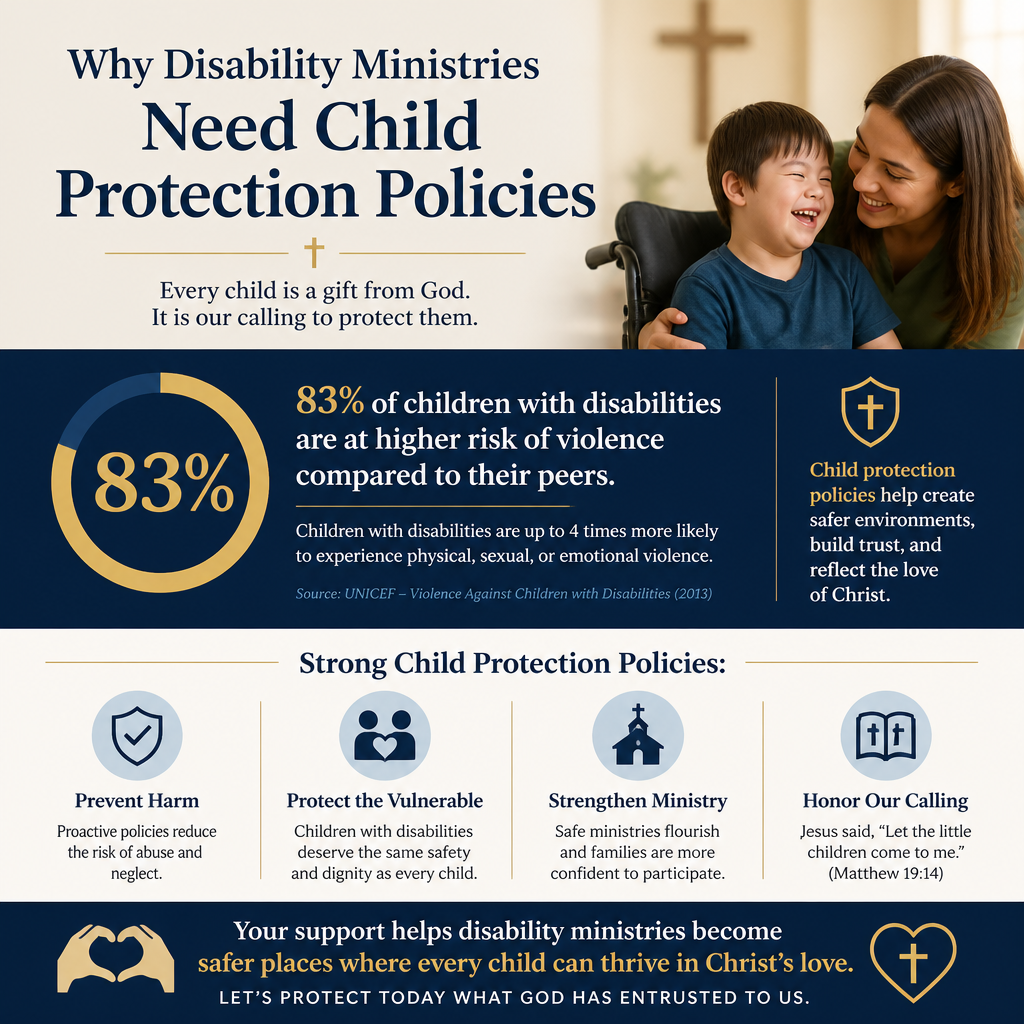
The field has had to reckon with the fact that children with disabilities experience elevated risk of maltreatment compared with their peers. A widely cited meta-analysis in The Lancet reported that children with disabilities were at significantly higher risk of violence than children without disabilities, underscoring that vulnerability is not theoretical in these settings (The Lancet). Ministries serving these children should treat child protection policies as core program design, not an optional administrative layer.
What this means in practice is that policies must address the realities of disability ministry work: one-to-one assistance, sensory regulation spaces, transportation, toileting support, and the use of physical prompts. Each of these can be conducted with dignity or with harm, and the difference is often not intent but structure.

Good intentions do not prevent abuse, and they can enable it
Volunteer warmth can unintentionally normalize boundary violations
Disability ministries are often staffed by unusually compassionate volunteers. That is a gift to the church. It can also create an environment where boundary crossings are reinterpreted as “love,” especially when a child is nonverbal, eager for affection, or socially isolated. Child protection policies do not assume volunteers are predators; they assume that human beings are fallible, power dynamics are real, and confusion flourishes when expectations are informal.
Donors sometimes resist policy conversations because they fear the ministry will feel clinical or distrustful. The harder question is whether we can fund ministries that implicitly ask families to trust private judgment rather than a documented, enforceable system. Mature disability ministry does not force parents to choose between belonging and safety.
Complex needs require more than informal common sense
Even well-meaning volunteers can mishandle situations where a child becomes dysregulated, attempts to run, or resists toileting. Without training and clear rules, “helping” can slide into restraint, isolation, or humiliation. Policies establish non-negotiables: when to call a supervisor, what de-escalation methods are permitted, and what documentation is required after incidents.
Across our verification work at Most Trusted, we observe that ministries that can articulate their boundaries in writing tend to make better decisions in moments of pressure. It is not because they are less relational; it is because they have done the moral work ahead of time.
What credible child protection policies include in disability ministry settings
Policies that anticipate disability-specific ministry scenarios
A child protection policy for a typical children’s program is not automatically sufficient for a disability ministry. The operational realities differ. A credible policy set should explicitly address one-to-one care, intimate personal care, and the management of behavior and sensory needs. It should also name decision rights: who may approve exceptions, and how those exceptions are documented.
The following elements are not exhaustive, but they represent the kinds of controls sophisticated donors should expect when funding disability ministries:
- Screening and suitability: background checks appropriate to role, reference checks, and role-specific placement rather than blanket approval for all volunteer roles.
- Two-adult and visibility rules: clear standards for line-of-sight supervision, including how these rules apply to sensory rooms, restrooms, and transport.
- Personal care protocols: explicit guidance for toileting, diapering, and changing, including documentation and caregiver communication.
- Touch and physical prompting standards: what types of touch are permitted, what requires parental consent, and what is prohibited.
- Incident reporting and escalation: definitions of reportable events, timelines, and who receives reports inside and outside the ministry.
Reporting pathways that do not depend on a single leader
One of the consistent failure points in abuse prevention is concentrating reporting power in one trusted figure. Healthy governance disperses authority and creates independent pathways. Donors should look for policies that allow volunteers, parents, and youth to report concerns in more than one way, including to a designated safeguarding lead and to an external authority when required.
The U.S. Department of Health and Human Services maintains a consolidated overview of mandatory reporting and state-specific resources, which ministries can use to align policies with legal obligations (Child Welfare Information Gateway). Legal compliance does not replace moral duty, but it does establish a baseline that ministries should meet without hesitation.
For donors, child protection is a governance and transparency issue
Funding risk increases when safety practices are informal or hidden
Donors are not merely funding activities; they are funding an organization’s ability to keep promises to families. When safety practices are informal, the ministry’s risk profile shifts. A single failure can harm a child, devastate families, fracture a church, and create legal and financial consequences that impair the mission for years.
This is one reason our team evaluates ministries against The Most Trusted Standard, a 15-criteria framework that examines faith foundation, financial integrity, governance and leadership, and transparency and effectiveness. Child protection touches each of those areas. It reflects theological seriousness about the vulnerable, leadership’s willingness to be accountable, and the ministry’s discipline in documenting and enforcing what it claims to value.
What to ask before making a significant gift
Christian donors are sometimes told that safety policies are “internal,” and therefore not a donor concern. That assumption should be challenged. A donor does not need confidential case details, but a donor can reasonably ask for evidence that policies exist, are current, and are practiced. In many contexts, redacting personal information and sharing policy documents is both feasible and prudent.
For donors supporting Disability Ministries, several questions sharpen discernment without drifting into micromanagement:
Do you have a written child protection policy specific to disability programming? Generic children’s ministry policies often leave critical scenarios unaddressed.
How are volunteers trained and refreshed? One-time onboarding is rarely sufficient when the ministry includes intimate care or de-escalation situations.
How do parents access reporting channels? A ministry should be able to describe this plainly.
How are incidents documented and reviewed? Documentation protects children first, and it also protects faithful volunteers from suspicion and rumor.
Strong policies protect children and volunteers, and strengthen ministry credibility
Policies reduce moral injury and volunteer burnout
Disability ministry volunteers regularly face emotionally complex situations: children with trauma histories, families under strain, and behaviors that can be difficult to interpret. When volunteers are left to improvise, the burden is not only risk; it is moral injury. Volunteers may carry lingering doubt about whether they responded rightly, or fear that they will be blamed if a situation escalates.
Clear policies and training do not eliminate complexity, but they distribute responsibility appropriately. They also make it more likely that a volunteer will speak up early—before a problem becomes a crisis—because the ministry has already defined what “early concern” looks like.
Policies help ministries earn trust without spectacle
Some ministries react to abuse scandals in the broader church by offering dramatic reassurances. Serious organizations do not rely on reassurance; they rely on controls. For donors who support Volunteer Training and Safety in Disability Ministries, policy strength is one of the clearest signals that a ministry’s compassion is governed by wisdom.
Christians genuinely disagree about how public child protection documentation should be. Some leaders fear that publishing details will create a false sense of security or expose the ministry to misuse. Those concerns deserve consideration. Yet secrecy is rarely a sustainable posture. At minimum, ministries should be able to describe their safeguards, their training cadence, their reporting pathways, and their accountability structure in a way that invites scrutiny rather than avoiding it.
FAQs for Why disability ministries need child protection policies
Do child protection policies make disability ministry feel distrustful or impersonal?
They can, if they are communicated as suspicion rather than stewardship. Well-designed policies are better understood as an extension of Christian love: they protect children from harm, protect volunteers from false accusation, and protect families from being asked to trust informal judgment. In disability settings, where personal care and one-to-one support are common, written boundaries often make ministry more humane, not less.
What should donors do if a ministry refuses to share anything about its child protection practices?
A donor can begin by asking for a high-level description: whether the ministry conducts background checks, how volunteers are trained, what supervision rules are used, and how concerns are reported. If the ministry still declines to provide basic transparency, it is reasonable to pause or redirect funding. Donors can also choose to support organizations that submit to independent evaluation, including verification against The Most Trusted Standard, because external scrutiny reduces the likelihood that safety is treated as a private preference rather than an enforceable obligation.
Protection is part of faithful care
Disability ministries exist because the church is called to honor those the world overlooks and to bear one another’s burdens. That calling is not fulfilled by access alone. It is fulfilled when access is paired with protection: clear policies, practiced training, accountable leadership, and transparency commensurate with the trust families are asked to place in the ministry. Donors serve the church best when they fund that kind of disciplined compassion.



