
Disability ministries honor dignity and the image of God when they treat disability not as a problem to be managed but as a human reality carried by image-bearers whom Christ receives. Donors often sense the stakes intuitively: ministries can either reinforce pity and dependency or cultivate belonging, agency, and spiritual formation. The difference is not cosmetic. It is theological, and it shapes how programs are designed, how stories are told, and how funds are deployed.
Christian donors also recognize a second pressure. Disability ministry can be emotionally compelling, which makes it vulnerable to shortcuts: fundraising narratives that flatten complex lives, programs that substitute activity for relationship, and leadership structures that marginalize the very people the ministry serves. Serious compassion requires more than goodwill. It requires practices of truthfulness, accountability, and evidence of impact that are consistent with a Christian understanding of persons.
The image of God establishes dignity before ability
Genesis grounds dignity in personhood, not productivity
Scripture begins with a claim that relativizes every social hierarchy: “God created man in his own image” (Genesis 1:27). The text does not tie dignity to cognitive capacity, economic contribution, or physical independence. It anchors dignity in God’s creative act and covenantal regard. Disability ministry that truly honors the image of God therefore resists the modern habit of measuring lives by output.
That theological starting point has practical implications for donors. A ministry can have a kind tone and still operate with an unspoken metric of “normalcy” as the standard of full participation. Programs built around fixing, correcting, or “graduating” people into acceptability can unintentionally communicate that a person is less fully welcome until they approximate an able-bodied ideal.
The church’s witness is tested where dignity is most contested
Christians genuinely disagree about some of the boundaries of healing, suffering, and divine providence. But the baseline is not disputed: the church is called to honor the weak, the dependent, and the overlooked as indispensable. Paul’s argument in 1 Corinthians 12 is not sentiment. It is ecclesiology: “the members of the body that seem to be weaker are indispensable” (1 Corinthians 12:22). Where a local church or nonprofit treats disabled people primarily as recipients rather than members, it is not merely a program weakness. It is a distorted picture of the body of Christ.

Jesus’s ministry reframes weakness and belonging
Healing stories are not permission slips for pity
The Gospels include many healings, and donors understandably love them. Yet Jesus’s healings are never performances of spiritual superiority. They are signs of the Kingdom and restorations into community. In several accounts, the deeper issue is not only impairment but exclusion: being pushed to the margins of worship, work, and public honor. When a disability ministry tells stories that center the helper’s compassion rather than the person’s agency and faith, it can unintentionally train supporters to see disabled people as props for inspiration.
There is a difference between testimony and exploitation. The harder question is whether a ministry can communicate need without reducing a person to the most painful parts of their story. This is where donors can rightly demand disciplined editorial standards: informed consent, accurate representation, and a refusal to trade dignity for clicks or gifts.
Honor is a Christian practice, not a brand value
Jesus consistently grants dignity through attention, touch, and direct address. He asks, “What do you want me to do for you?” (Mark 10:51). That question assumes personhood and desire, not passive reception. Disability ministries that honor the image of God tend to formalize this posture: individualized planning, meaningful choice, and leadership pathways for disabled adults, not only volunteer roles framed as “helping.”
For donors, this also reframes “impact.” The most faithful outcomes are not always the most photogenic. Faithful outcomes include sustained belonging, pastoral care for families under chronic strain, and spiritual formation that is honest about suffering without romanticizing it.
Dignity requires more than access: it requires agency
Participation without voice is a subtle form of exclusion
Many churches have learned to think in terms of ramps, sensory rooms, and inclusive programming. Those matter. But a ministry can offer access and still withhold agency. When disabled people are present but not consulted, served but not heard, accommodated but not trusted, the ministry may be inclusive in form while remaining paternalistic in substance.
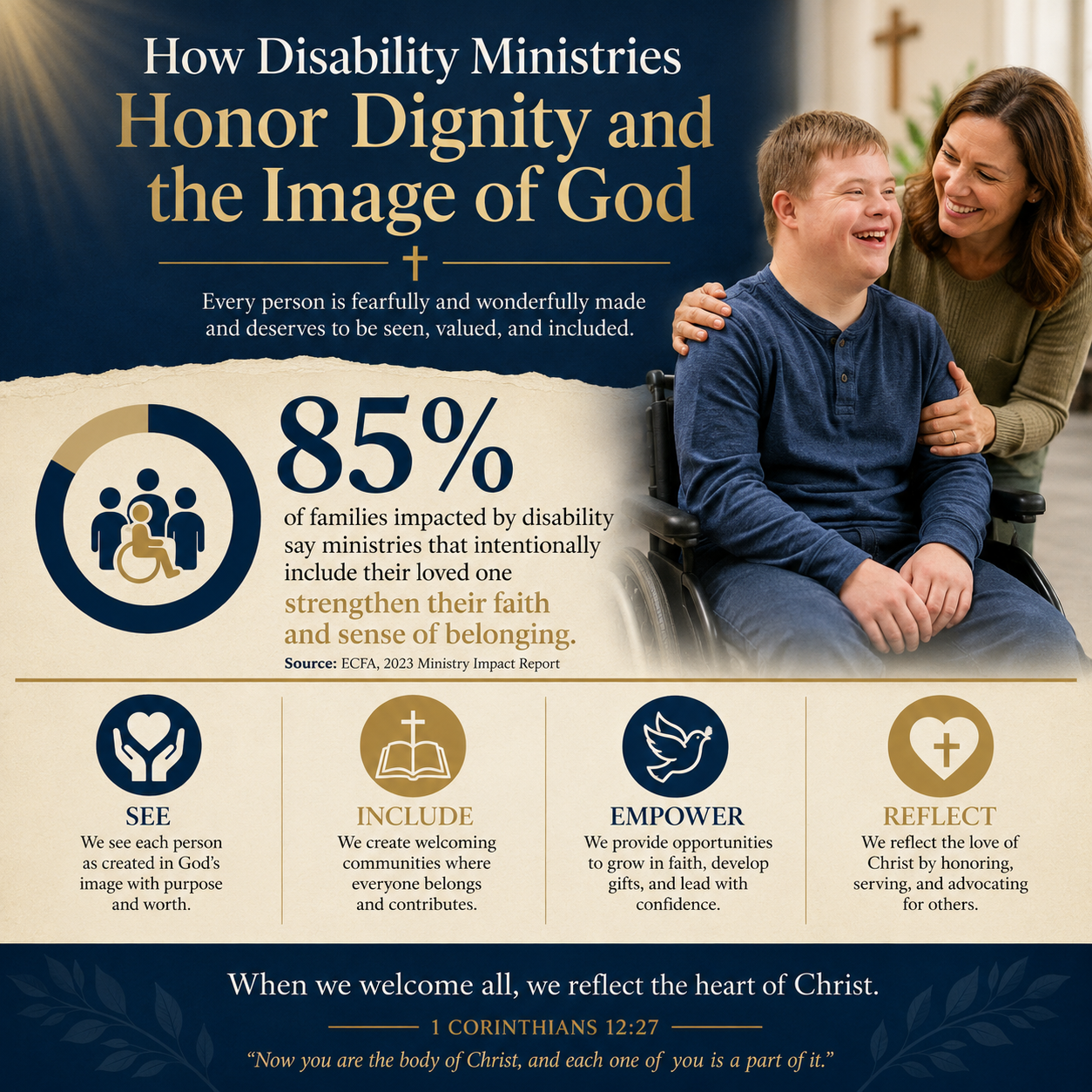
Across our verification work at Most Trusted, we observe that ministries best positioned for long-term credibility tend to embed the voices of those served into program design and governance. That does not mean every board seat must be filled by a program participant, and in some settings it would be inappropriate or burdensome. It does mean there should be clear, recurring mechanisms for informed feedback and shared decision-making that are not filtered entirely through caregivers or staff.
Families need ministries that see the whole household
Disability often changes a family’s economic, emotional, and spiritual rhythms. Caregivers can become isolated, siblings can carry quiet burdens, and marriages can be strained. A ministry that honors dignity will not treat the disabled family member as the only “client” while ignoring the household context. At the same time, it must avoid the opposite error of speaking about the disabled person chiefly as a “burden” on others. Both distort the image of God.
Donors who support Disability Ministries should expect ministries to articulate how they care for caregivers without erasing the disabled person’s identity or agency. Done well, support to families is not a concession. It is a form of discipleship and mutual care within Christ’s body. For a wider view of the landscape donors are funding, see Disability Ministries.
What faithful donors should evaluate in disability ministries
Theological clarity and ethical storytelling are inseparable
Many donors have learned to ask whether a ministry is doctrinally sound. Fewer have learned to ask whether a ministry’s fundraising is ethically sound. But the two belong together. A ministry that confesses the imago Dei while publishing demeaning narratives, infantilizing photos, or private medical details is speaking out of both sides of its mouth.
What this means in practice is that responsible disability ministries should have written policies for consent, privacy, and communications. They should also train staff and volunteers to recognize how “inspiration” tropes can demean—especially when a person’s life is presented as inspiring chiefly because it includes disability. Donors can ask to see these policies and to understand who has final editorial accountability.
Verification questions that honor both compassion and accountability
Because disability ministry often operates in close proximity to vulnerable people, strong governance is not optional. It is a moral requirement. The Most Trusted Standard is designed to help donors evaluate Christian nonprofits across faith foundation, financial integrity, governance and leadership, and transparency and effectiveness without reducing the work to a single metric. For disability ministries, the framework helps donors ask disciplined questions that protect dignity.
- Who holds power in program decisions, and how are participant voices incorporated?
- How are staff and volunteers screened and trained for safety, boundaries, and disability competence?
- What outcomes are measured beyond attendance, and how is spiritual care defined without coercion?
- How are stories gathered and approved to ensure consent, accuracy, and respect?
- What financial disclosures are public so donors can verify stewardship and avoid conflicts of interest?
The field has had to reckon with the fact that good intentions do not reliably produce good outcomes. In broader poverty-alleviation conversations, the When Helping Hurts framework, articulated by Steve Corbett and Brian Fikkert, has sharpened the church’s awareness that help can harm when it undermines local agency or confuses relief with development. Disability ministries are not identical to international aid, but the warning transfers: interventions that bypass voice and agency can quietly erode dignity.
Measuring impact without reducing people to metrics
Transparency is a form of neighbor-love
Donors sometimes hear that “ministry outcomes can’t be measured.” That statement can be partly true and still serve as an excuse for vagueness. Some dimensions of faithfulness are not quantifiable. But many are observable and reportable: retention, safeguarding incidents, training completion, family support utilization, and independent evaluations of program quality. Transparency is not a secular import. It is a practical expression of truth-telling.
In disability spaces, transparency also includes clarity about what the ministry can and cannot do. Overpromising cures, independence, or “normal” functioning not only misleads donors; it can injure the people served. Honoring dignity includes honest boundaries and appropriate referrals.
Effectiveness should include belonging and formation
The church’s aim is not merely services delivered but people loved into communion with God and neighbor. Disability ministries that honor the image of God often track indicators of belonging: participation in worship, friendships sustained beyond program hours, opportunities to serve, and pastoral care offered with consent and respect. These are not vanity metrics. They are signs of ecclesial health.
Donors can also ask whether the ministry’s practices align with what we know about disability prevalence and the likely scope of need. In the United States, the Centers for Disease Control and Prevention reports that “more than 1 in 4” adults have some type of disability, underscoring how ordinary disability is within every community and church network (CDC). A ministry that treats disability as rare will often design programs as occasional charity rather than as long-term belonging.
At the same time, donors should be wary of simplistic comparisons between ministries based on overhead ratios or single-number ratings. A widely endorsed corrective in the nonprofit sector—the “Overhead Myth” letter signed by GuideStar, BBB Wise Giving Alliance, and Charity Navigator—argues that overhead alone is a poor proxy for performance and can pressure organizations into underinvesting in governance and systems (GuideStar). Disability ministries in particular require sustained investment in trained staff, safety protocols, and accessible environments, none of which should be apologized for.
For donors who want to evaluate these questions with theological seriousness and verifiable evidence, our analysis within The Theology Behind Christian Disability Ministry helps situate program decisions inside Christian anthropology rather than sentiment.
FAQs for How disability ministries honor dignity and the image of God
Should donors prioritize ministries that focus on healing and cures?
Christians may pray for healing with confidence in God’s power and without presuming his timing. Donors can support ministries that pray for healing while also asking whether the ministry honors those who are not healed. A faithful disability ministry does not treat continued disability as spiritual failure, nor does it withhold belonging until “progress” is visible.
What are responsible ways for ministries to share stories of people with disabilities?
Responsible storytelling requires informed consent, privacy protections, and truthful representation that preserves agency. Donors can ask whether participants review their stories before publication, whether medical details are minimized, and whether the ministry avoids “inspiration” framing that centers the audience’s feelings rather than the person’s God-given dignity.
Why dignity is the donor’s first question
Disability ministry tests whether Christian compassion is rooted in the imago Dei or in a subtler desire to feel helpful. The ministries that most credibly honor dignity tend to pair warm presence with accountable structures: ethical communications, participant agency, trained staff, transparent reporting, and governance that treats vulnerability as a reason for greater care, not looser standards. When donors fund that kind of ministry, they are not merely underwriting services. They are strengthening a witness that the church can receive every member as indispensable, because Christ does.



