
Learning how to read a disability ministry annual report is an act of stewardship, not a bureaucratic exercise. These reports are one of the few places a donor can test whether a ministry’s stated theology of human dignity is matched by disciplined leadership, honest financial practice, and measurable service to people with disabilities and their families.
Disability ministry sits close to the heart of the gospel. Jesus’ healings were never mere displays of power; they were signs of the Kingdom and restorations to community. Yet Christian donors also know the tensions: stories can be curated, numbers can be chosen selectively, and good intentions can drift into paternalism. Annual reports, read carefully, can clarify whether a ministry is honoring image-bearers or simply showcasing them.
Begin where Scripture begins: dignity, belonging, and the ministry’s theory of care
Look for a theological frame that resists sentimentality
A strong annual report does more than affirm that every person is made in the image of God. It shows what that confession demands in practice: safety, consent, accessibility, and belonging in the local church and community. Reports that rely mainly on emotional imagery may still represent faithful work, but they leave donors unable to evaluate whether programs are shaped by a coherent Christian ethic.
As you read, watch for language that treats people with disabilities as full participants in the life of the church rather than as objects of ministry. In 1 Corinthians 12, Paul insists that the members of the body that seem weaker are indispensable and worthy of greater honor. That theological claim has organizational implications: leadership development, mutuality, and an expectation that people with disabilities contribute, not merely receive.
Test the clarity of the ministry’s purpose and scope
Disability ministry is a broad field: respite care, inclusive worship, special education, employment support, adaptive camps, accessible church training, pastoral care, and global disability outreach all operate with different goals and risk profiles. A reliable annual report names the ministry’s specific calling and boundaries. Vagueness can function as a shield against accountability.
Where possible, the report should distinguish direct service from training and technical assistance. It should also name what the ministry does not do. Across our verification work at Most Trusted, unclear scope often correlates with unclear measurement and governance, even when the work itself is earnest.
Follow the money with care: revenue, restrictions, and true program costs
Read the revenue mix and ask what it pressures the ministry to do
Annual reports commonly highlight total revenue and year-over-year growth. Mature donors read one layer deeper: where does the money come from, and what does that funding model incentivize? A ministry funded primarily by a few large donors carries concentration risk. A ministry heavily dependent on special events may face volatility. A ministry supported by government contracts may face compliance burdens and shifting policy expectations.
Pay attention to whether the report explains restricted versus unrestricted funding. Restricted gifts can be a blessing, but they can also constrain leadership when costs rise in areas donors do not like to fund: staff training, background checks, insurance, accessibility retrofits, and data systems for safeguarding and outcomes.
Resist simplistic overhead conclusions and look for stewardship signals
Many annual reports still attempt to reassure donors with a single program-percentage figure. Wise stewardship requires more context. The nonprofit sector has publicly rejected the idea that low overhead is the primary indicator of effectiveness. In an open letter co-signed by GuideStar, Charity Navigator, and the BBB Wise Giving Alliance, these watchdogs argued that overhead ratios can mislead donors and can even harm nonprofits by discouraging necessary infrastructure spending GuideStar.
What this means in practice is that donors should look for evidence of disciplined spending rather than artificially minimized administration. A disability ministry may need specialized staff, training in trauma-informed care, accessible transportation, adaptive equipment, and safeguards that are expensive but essential. When a report treats those costs as embarrassing, it can indicate weak leadership maturity.
Still, stewardship questions remain legitimate. A trustworthy report will disclose audited financials or at least provide clear summaries, explain major variances, and avoid presenting fundraising as costless. If the report includes a Form 990 link, use it, but interpret it with knowledge: classification differences and timing issues can distort comparisons across organizations.
Examine governance and safeguarding: who holds power and how harm is prevented
Board composition and accountability should be visible, not implied
Disability ministry often serves vulnerable people, including children and adults who may rely on caregivers for communication or decision-making. That reality raises the stakes for governance. Annual reports should name board members and senior leaders, describe their relevant experience, and indicate how the board provides real oversight rather than ceremonial endorsement.
A report that never mentions oversight practices leaves donors guessing. We recommend looking for signals such as board meeting frequency, committee structures, conflict-of-interest expectations, and independent financial review. Ministries that meet The Most Trusted Standard tend to treat governance as part of discipleship: truthfulness, restraint, and accountability before God and neighbor.
Safeguarding is not optional, and it should be described plainly
Many donors focus on services provided, but safeguarding practices often determine whether those services are genuinely loving. Read for background check policies, child protection training, incident reporting procedures, mandatory reporter training where applicable, and clear boundaries for volunteers. If a ministry operates residential programs, camps, or one-on-one care, the safeguarding section should be substantial.
Also note how the report handles difficult realities. Does it acknowledge incidents, near-misses, or lessons learned without sensationalizing them? Christians genuinely disagree about how much disclosure is prudent in a public document, especially when privacy is at stake. But complete silence on risk management is rarely a mark of maturity.
Evaluate transparency and effectiveness: outcomes, not only stories
Stories should honor agency and consent
Annual reports often lead with testimonies. In disability ministry, stories must be handled with particular care. Watch for whether the ministry explains consent practices, uses dignifying language, and avoids portraying people with disabilities as props for donor motivation. The goal is not clinical distance; it is truthful love.
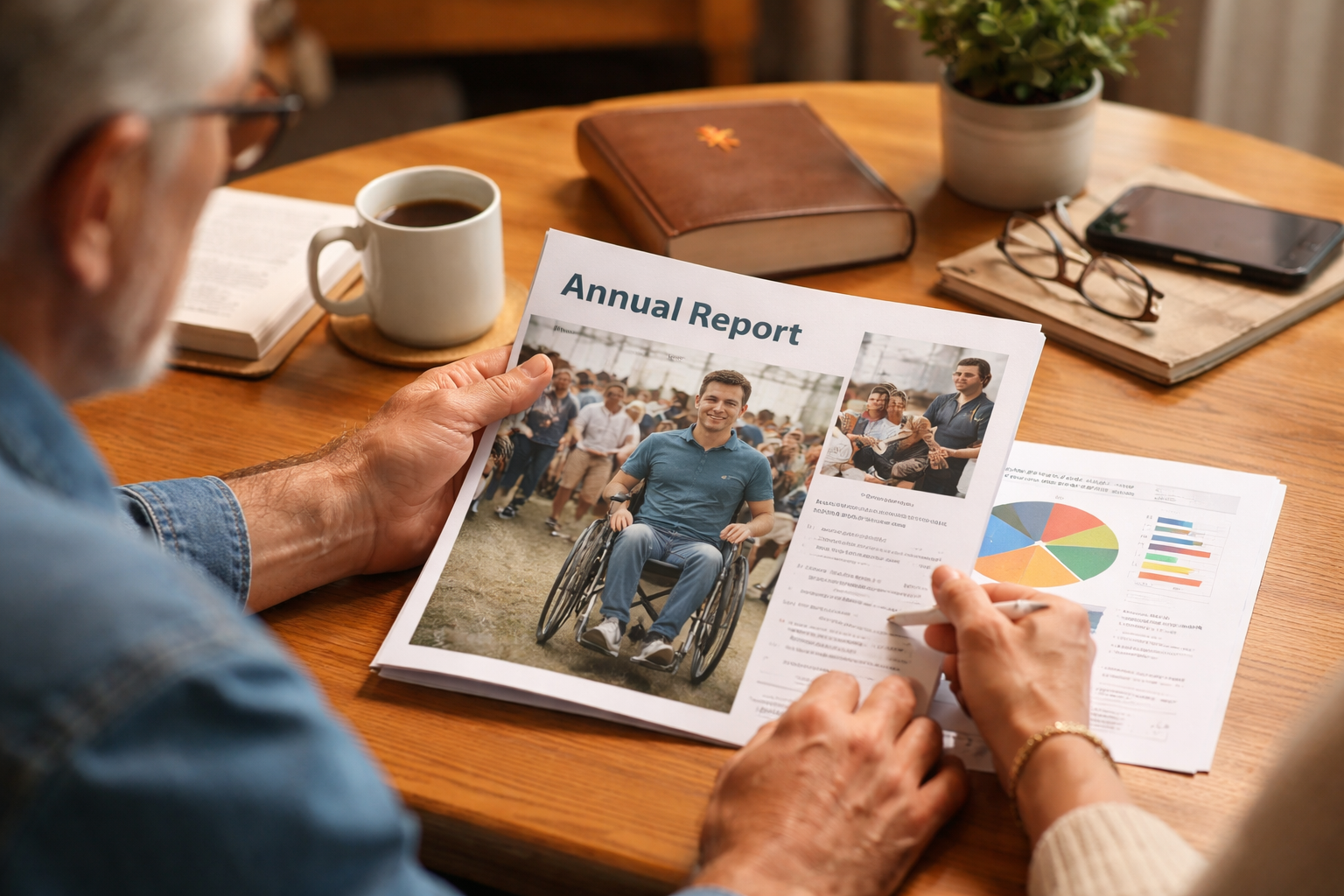
When a report includes photos, consider what is being communicated about personhood. Are people shown as active participants, friends, leaders, employees, worshipers, and learners? Or only as recipients? The narrative posture matters because it shapes organizational culture.
Outcomes should match the ministry’s actual mission
Many ministries report outputs: number of respite nights, camp attendees, trained churches, accessible resources distributed. Outputs are not meaningless, but they do not answer the donor’s most serious question: did this ministry help people flourish in Christ and in community in ways that can be responsibly described?
Look for outcomes appropriate to the model. For example, a church-training ministry might report the number of congregations that implemented accessibility plans, trained volunteers, or added inclusive discipleship pathways. A respite ministry might track caregiver stress reduction through validated surveys. An employment program might report job placements and retention. Not every ministry can run academic-grade studies, but a credible report shows a disciplined attempt to measure what it claims to deliver.
If the report cites research, it should be specific and relevant. For example, many ministries speak about caregiver burden; a donor can request clarity about how the ministry defines and measures that burden, given the extensive caregiver research literature maintained by federal health agencies National Institutes of Health.
Read for strategic maturity: long-term sustainability, partnerships, and honest limits
Capacity planning reveals whether the ministry is built to endure
Annual reports frequently describe expansion: more sites, more campers, more churches trained. Growth may be faithful, but it can also be destabilizing. Disability ministry is staff-intensive, and quality can collapse under scale if training, supervision, and safeguarding do not keep pace.
We recommend scanning for sober capacity signals: staff retention, leadership development, succession planning, and reserves. Many nonprofits aim to keep operating reserves, and donors often ask what is appropriate. There is no single biblical ratio, but a ministry should be able to explain how it plans for disruptions and how it avoids both fear-driven hoarding and fragile hand-to-mouth operations.
Partnerships can signal humility or can dilute accountability
Disability work is rarely done well in isolation. Partnerships with local churches, schools, healthcare providers, or other ministries can increase impact and reduce duplication. A strong annual report names key partners and explains how responsibilities and safeguarding standards are handled across organizational boundaries.
At the same time, partnerships can become a way to outsource accountability. If outcomes depend heavily on partners, the report should clarify what the ministry controls and what it does not. Donors can then give with eyes open, rather than funding a promise that no one truly owns.
For donors seeking a broader view of this field, our ongoing coverage of Disability Ministries tracks common models, recurring risks, and patterns of effective practice.
Practical questions to bring to the report and to the ministry
Annual reports are public documents; they should invite conversation rather than replace it. When a report raises questions, a responsive ministry will welcome them, especially from donors who are committed to long-term partnership.
- What part of this ministry’s work is most difficult to measure, and how are you addressing that limitation?
- How do you ensure people with disabilities and their families have meaningful voice in program design?
- What safeguarding policies govern volunteers, one-on-one interactions, and digital communications?
- How much of your revenue is restricted, and what important costs are hard to fund?
- What would have to be true for you to slow down growth in order to protect quality?
Donors who want to understand how ministries describe the use of funds across different disability programs may also find it helpful to read How Disability Ministries Use Donations, where we examine common spending categories and the integrity questions they raise.
FAQs for How to read a disability ministry annual report
What should a disability ministry annual report include if it is truly transparent?
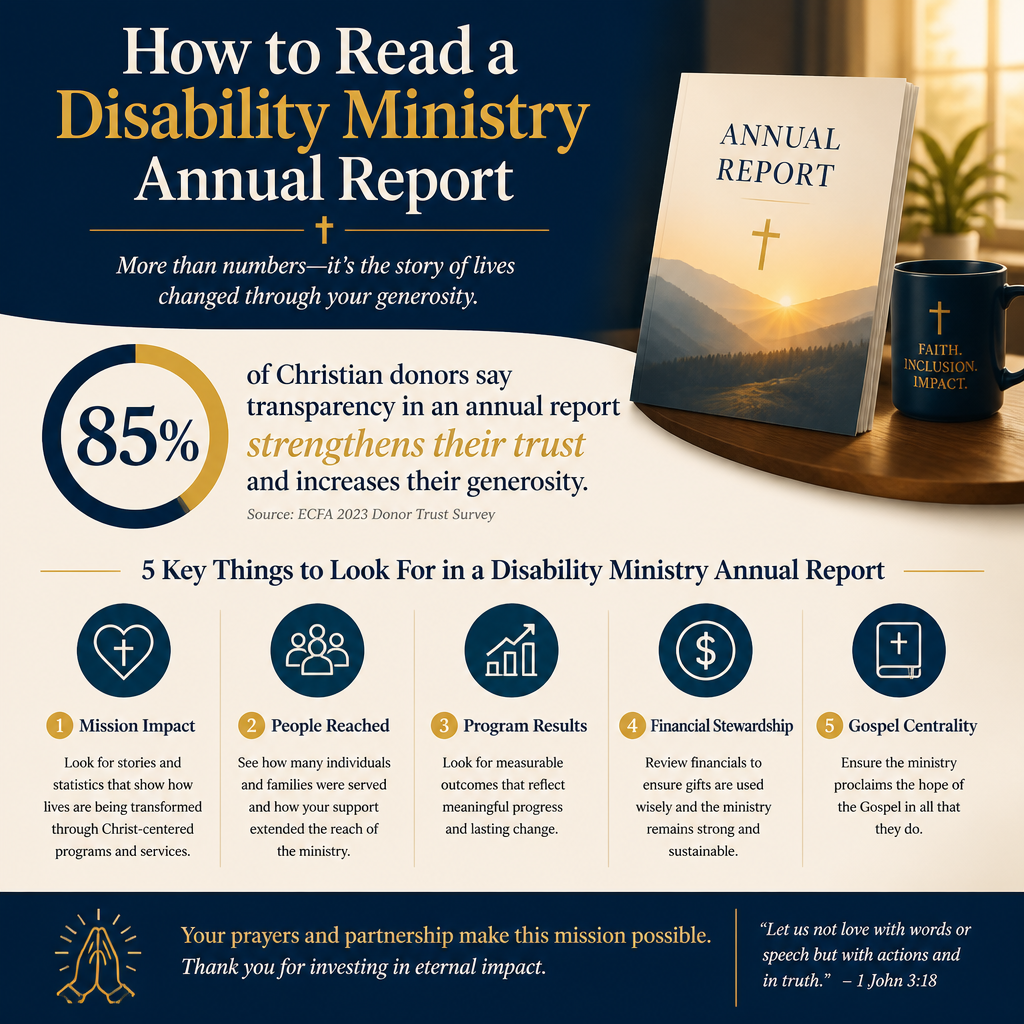
At minimum, it should clearly state mission and scope, present understandable financial reporting, name governing leadership, describe safeguarding practices, and provide outcomes that correspond to the ministry’s stated aims. Transparency also includes acknowledging limits: what the ministry cannot claim, what it is still learning, and what risks it actively manages.
Should we avoid disability ministries that spend “too much” on administration?
Not automatically. Administrative costs can include necessary elements of faithful service: supervision, training, compliance, insurance, financial controls, and systems that protect vulnerable people. Sector leaders have warned donors against using overhead ratios as the primary indicator of a nonprofit’s quality Charity Navigator. The better question is whether the ministry explains its cost structure honestly and demonstrates disciplined stewardship and measurable effectiveness.
A disability ministry annual report is a window into formation and faithfulness
When donors read annual reports carefully, we honor both the people served and the leaders entrusted with care. The goal is not suspicion; it is truthful partnership. A mature report will show a ministry that treats people with disabilities as indispensable members of Christ’s body, governs itself with accountability, handles money with clarity, and reports results with humility. That is the kind of work Christian donors can support with confidence and endurance.



