

What disability ministries spend donations on is not a question of mere accounting. It is a question of stewardship, the kind Jesus assumes when he teaches that servants will give an account for what was entrusted to them (Luke 16:10–12). For Christian donors, the aim is not simply efficiency, but faithfulness: whether resources are being directed toward love of neighbor that is both compassionate and truthful.
Disability ministry carries distinctive costs and distinctive temptations. The costs are often invisible to donors who have not tried to make a program accessible, safe, and sustainable. The temptations include sentimental storytelling, paternalism, and projects that substitute appearances for genuine inclusion. Mature giving asks where funds actually go, and whether those expenditures create durable, dignifying access to life in the church and community.
Direct ministry programs and the cost of meaningful inclusion
Programming that serves people rather than platforms
Most disability ministries devote a significant share of donations to direct program delivery: respite care for families, adaptive discipleship classes, sensory-friendly gatherings, supported employment initiatives, accessible camps, counseling and pastoral support, and mentoring relationships. These are not “extra” services; for many families they are the difference between isolation and participation in the body of Christ.
Meaningful inclusion also carries a discipline of listening. Well-run ministries spend funds on needs assessments, family feedback loops, and partnerships with local churches and clinicians. Some donors prefer money to go only to “frontline” events, but the ministries that endure tend to invest in the unglamorous work of understanding what actually helps.
Accessibility spending is often essential, not optional
Physical and communication accessibility routinely require cash outlay: ramps and lifts, accessible transportation, assistive listening systems, captioning, visual schedules, sensory kits, adaptive curriculum, and training for volunteers who support people with complex needs. When these supports are absent, the message heard by families is not simply that a ministry lacks capacity; it is that they were not expected to come.
In the United States, disability is also common enough that ministries planning for accessibility are not addressing a niche. The CDC reports that 1 in 4 U.S. adults live with a disability, which means most churches and Christian communities already include people whose participation depends on practical accommodations CDC.

Staff and training because volunteer ministry still requires professional competence
Why staffing is frequently a ministry expense, not a bureaucratic one
Disability ministry is often volunteer-rich and still staff-dependent. Donations fund coordinators who recruit and screen volunteers, plan curricula, schedule respite rotations, communicate with families, and maintain safety protocols. In ministries serving children or adults with higher support needs, donors should expect spending on staff who can assess risk, respond to behavioral crises appropriately, and coordinate with caregivers.
Some donors hesitate at salaries because they have been taught that “overhead” is suspect. The better question is whether staffing levels match program responsibilities, and whether compensation aligns with competence and accountability. Understaffing can create predictable breakdowns: volunteer burnout, inconsistent care, and avoidable safety incidents that harm the very people the ministry is trying to serve.
Training and safeguarding are part of love of neighbor
Disability ministries also spend on training: disability awareness, trauma-informed care, de-escalation practices, mandatory reporting, and boundaries in caregiving relationships. These are not secular distractions from spiritual work. They are ordinary means of protecting the vulnerable, which Scripture consistently treats as a test of righteousness (Proverbs 31:8–9).
Where ministries serve minors or adults who may be at higher risk of exploitation, donors should expect expenditures related to safeguarding: background checks, child protection policies, incident reporting systems, and insurance. When donors pressure ministries to minimize these costs, they can unintentionally reward negligence.
Facilities, equipment, and the hidden infrastructure that makes ministry possible
Adaptive equipment and the long tail of maintenance
Many disability ministries require specialized equipment that is expensive to purchase and costly to maintain: wheelchair-accessible vans, adaptive sports gear, lifts and transfer systems, medical-grade supplies, and accessible lodging for retreats or camps. Donations may also pay for maintenance schedules, replacement cycles, and compliance requirements that do not appear “spiritual” on a brochure but are foundational to dignified care.
A sophisticated donor will also ask whether equipment purchases match the ministry’s ongoing capacity. Buying a vehicle without budgeting for insurance, drivers, and maintenance is not generosity; it is a liability deferred.
Digital accessibility and communications that broaden participation
Disability ministry increasingly includes digital and communication expenses: websites that work with screen readers, captioned video content, plain-language materials, translated resources, and secure communication tools for coordinating volunteers and caregivers. These are often framed as marketing line items, but they can be core accessibility expenses when they expand who can participate and who can understand.
Donors evaluating communications spending should distinguish between promotion that inflates the organization’s brand and communication that serves families, equips churches, and documents outcomes with restraint and truthfulness.
Administration and compliance, and why simplistic overhead ratios mislead
Accountability systems are morally consequential
Disability ministries operate in environments where mistakes can be costly to people. Donations commonly support accounting, donor receipting, internal controls, cybersecurity, legal review, HR, and governance processes that protect against fraud, harassment, and mission drift. These expenses rarely inspire donors, but they are part of what it means to handle entrusted resources with integrity.
This is one reason serious evaluators warn against judging a ministry by overhead ratios alone. The “overhead myth” critique has been articulated by major charity evaluators and standard-setters who argue that administrative costs can be necessary for effectiveness and accountability Charity Navigator.
What to look for in administrative spending
Christians genuinely disagree about what counts as “too much” administration. The more constructive approach is to look for signals of stewardship: clear budgeting, audited or reviewed financial statements when appropriate, independent board oversight, conflict-of-interest policies, and transparent reporting that treats donors as partners rather than targets. Across our verification work at Most Trusted, ministries that meet The Most Trusted Standard tend to document these fundamentals clearly and without defensiveness.
For donors who want a broader view of the field beyond any single organization, our coverage of Disability Ministries addresses common program models and the accountability questions that repeatedly surface.
Measuring effectiveness without reducing people to metrics
Outcomes that respect dignity and spiritual reality
Some disability ministries spend donations on measurement: program evaluation, participant feedback, and longitudinal follow-up. Donors should welcome serious efforts to understand impact, but they should also resist measurement frameworks that treat people as a means to a fundraising end. The goal is not to “prove” a person’s worth through statistics; the goal is to test whether a ministry’s practices are actually serving people well.
In Christian disability ministry, some outcomes will be qualitative by nature: reduced caregiver isolation, increased participation in worship, deeper friendships, a church community that learns patience and honor. These are not easily reduced to charts, yet they are central to the New Testament vision of the body, where members that seem weaker are treated with greater honor (1 Corinthians 12:22–26).
Common spending categories donors should expect to see
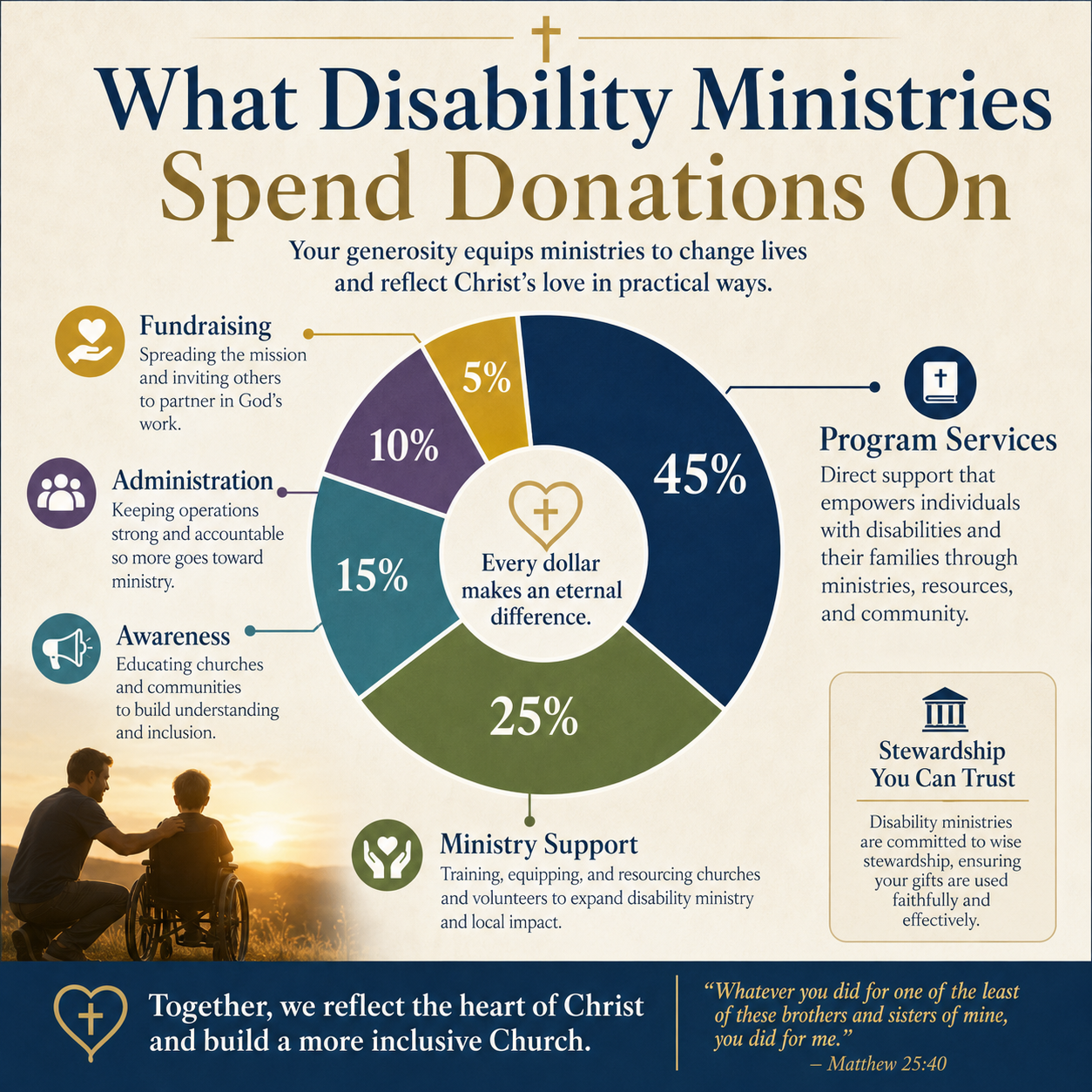
Most budgets in this space include a blend of program, people, and infrastructure costs. Donors should not be surprised to see donations allocated across several lines at once, including:
- Program delivery such as respite nights, camps, small groups, and supported employment
- Accessibility supports including adaptive curriculum, sensory resources, and captioning
- Staff and volunteer training, background checks, and safeguarding systems
- Facilities and equipment purchases, maintenance, and insurance
- Administration such as accounting, compliance, data security, and governance
The harder question is whether these categories are proportionate to the ministry’s claims and scale. A small ministry with national-level communications costs deserves scrutiny. A large, multi-site program with minimal training and safeguarding deserves more.
Donors who want a tighter lens on how giving is handled in practice will find additional analysis in How Disability Ministries Use Donations, where we address typical expense patterns and the questions that separate responsible spending from appealing but fragile models.
FAQs for What disability ministries spend donations on
Should donors avoid disability ministries with higher administrative costs?
Not automatically. Administrative spending can reflect necessary governance, safeguarding, financial controls, and compliance—especially in ministries working with vulnerable people. The more reliable approach is to examine what those costs fund, whether the ministry reports them transparently, and whether there is credible oversight (an independent board, clear conflict-of-interest practices, and appropriate financial review).
What are responsible signs that a disability ministry is spending donations well?
Responsible signs include clear descriptions of programs and who they serve; evidence of accessibility investments that remove real barriers; training and safeguarding that match the risk profile of the ministry; financial reporting that is intelligible to donors; and outcomes reporting that is honest about limits. The healthiest ministries typically show both compassion and restraint: they tell the truth about need, name what donations actually cover, and invite questions without treating scrutiny as disloyalty.
Giving that strengthens the body rather than merely funding activity
Donations to disability ministries often pay for precisely the things that make inclusion real: trained people, safe systems, accessible spaces, and patient, consistent presence. Christian donors are not called to fund an image of mercy; we are called to practice it with wisdom. When spending choices protect dignity, strengthen families, and draw people into worship and community without manipulation, giving becomes one more way the church learns to honor the members who have too often been overlooked.



