
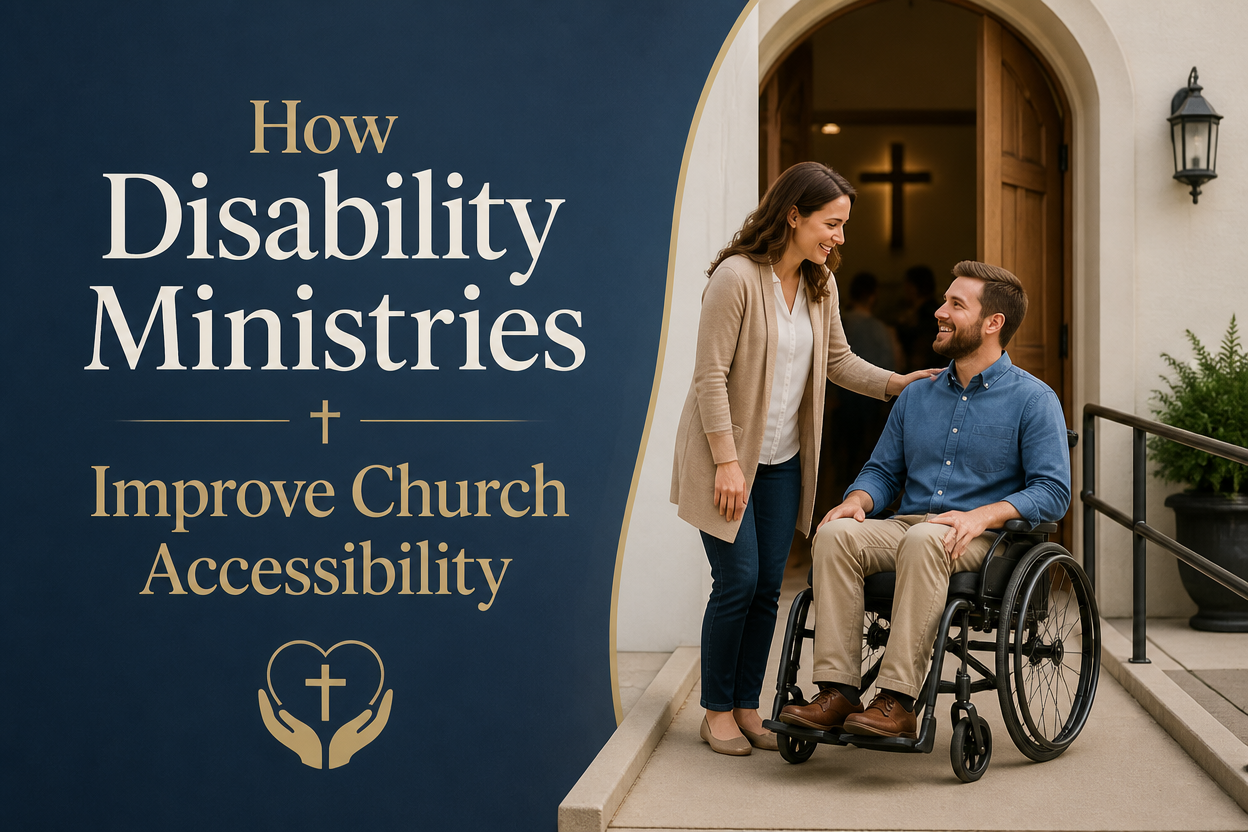
How disability ministries improve church accessibility is ultimately a question about whether the church will embody its confession. If the gospel announces that Christ has broken down dividing walls, then a congregation’s built environment, communication practices, and culture must not quietly rebuild them for worshipers with disabilities.
Christian donors who care about the local church often sense a tension here. Accessibility can feel technical, expensive, and easy to postpone, especially when a congregation already carries competing capital needs. Disability ministry, at its best, reframes the conversation: not as a compliance project, but as discipleship that yields measurable, durable access for image-bearers whom Christ welcomes.
Accessibility begins as ecclesiology, not architecture
Disability is not a marginal pastoral concern
The New Testament’s vision of the church is not a gathering of the strong who occasionally tolerate weakness. Paul’s language in 1 Corinthians 12 is direct: the parts of the body that seem weaker are indispensable, and the church is commanded to give greater honor where the world withholds it. Accessibility, then, is not first a facilities decision. It is an ecclesiological commitment that should govern facilities decisions.
Disability ministry formalizes that commitment into practices a church can sustain. Without that ministry focus, accessibility is often reduced to a ramp, a few reserved parking spaces, and a general assumption that families will “make do.” The result is predictable: the burden of access is transferred onto families already carrying an outsized load.
A significant portion of the community is affected
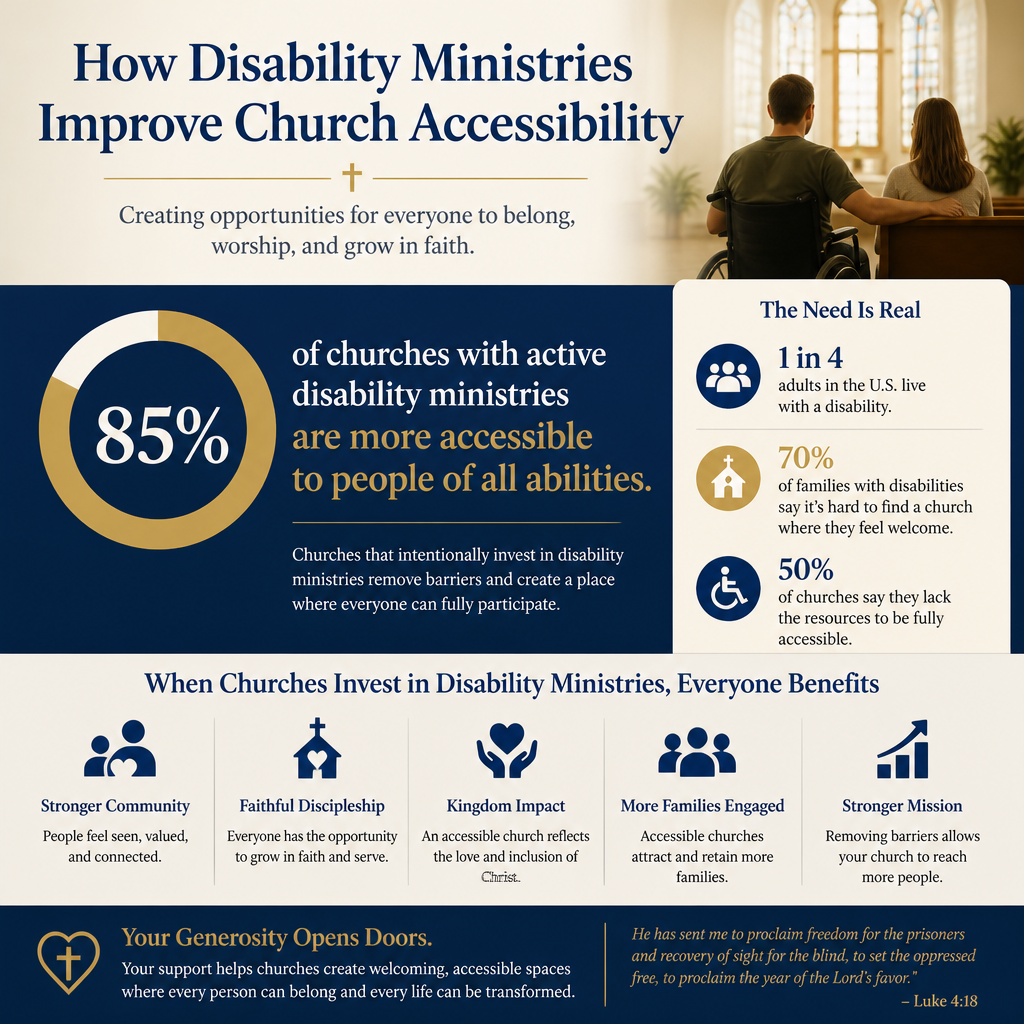
Disability is also not rare. The U.S. Census Bureau reports that a substantial share of Americans live with a disability, which means most churches already include people with disabilities and caregivers in their orbit, whether or not those members are visible on Sunday morning (U.S. Census Bureau).
What this means in practice is that accessibility work is not primarily about attracting “new” people. It is often about finally serving the people already present: the older saint whose hearing is fading, the child with sensory processing differences, the spouse managing mobility limitations after an injury, and the caregiver who has learned to avoid places that require constant negotiation.
Disability ministries convert good intentions into accountable systems
From informal kindness to repeatable practice
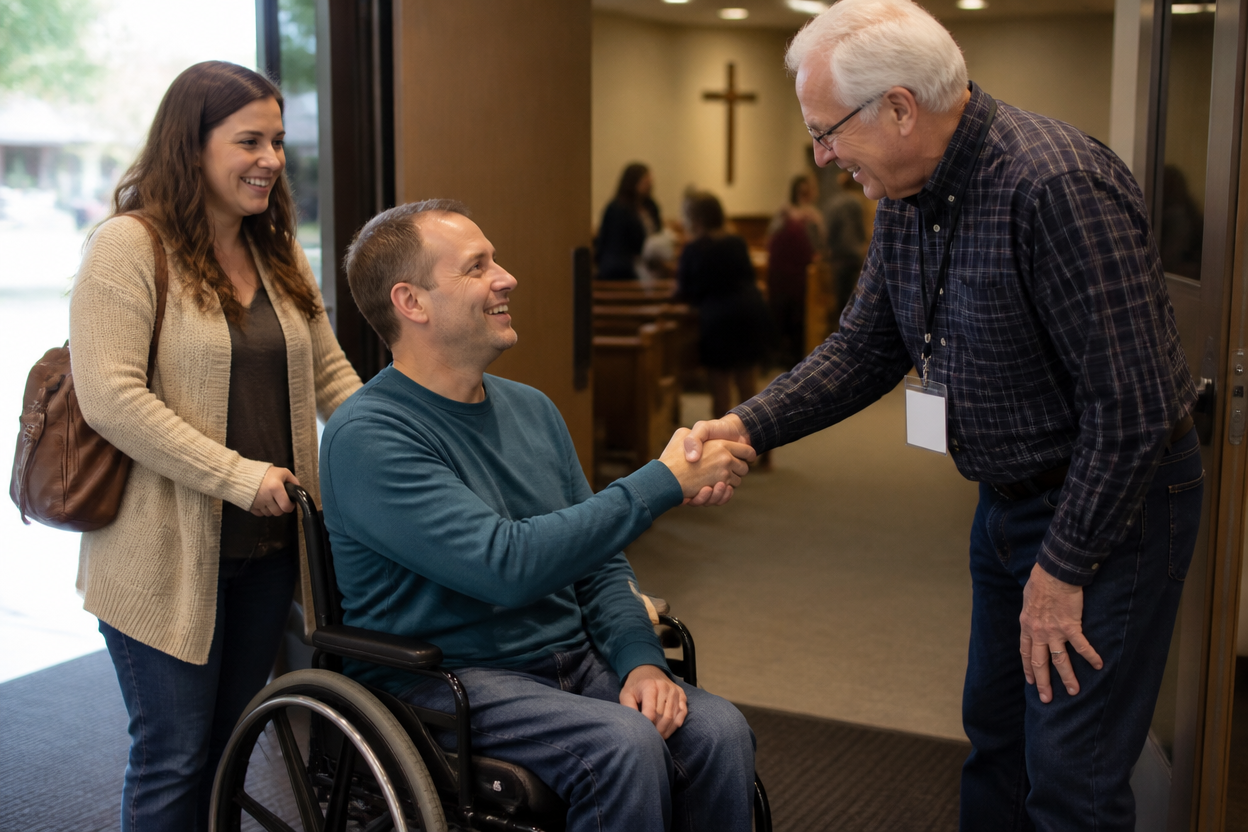
Many congregations can describe acts of kindness toward families affected by disability: a volunteer who sits with a child, a greeter who helps someone into the building, a staff member who “makes an exception.” These gestures matter. They are also fragile. When they depend on individual heroics, access disappears when the right person is absent.
Disability ministries improve church accessibility by creating accountable systems: defined roles, documented procedures, training cadences, and clear escalation paths for safety and pastoral care. In donor terms, this is the difference between sporadic outputs and durable capacity.
Safety, dignity, and consent are not optional
The harder question is how a church provides care without infantilizing people with disabilities or violating privacy. Mature disability ministries build consent into their routines and treat dignity as a non-negotiable. That includes volunteer screening, appropriate ratios for children’s ministry, and clear guidelines on physical assistance.
Many churches rely on background checks for children’s volunteers; disability ministry extends that safeguarding posture to the realities of respite care, one-to-one support, and transportation assistance. Guidance on prevention and screening practices is widely available, including through child safety training resources used across the church and nonprofit sector (Darkness to Light).
Accessibility is physical, digital, and liturgical
The building matters, but it is not the whole story
Donors often associate accessibility with construction: ramps, elevators, automatic doors, and accessible restrooms. Those may be necessary, and the Americans with Disabilities Act has shaped baseline expectations for public accommodation in the United States (ADA.gov). Yet churches frequently miss other high-impact barriers that cost less and serve more people.
Disability ministries tend to start with an audit mindset: how a newcomer moves from parking lot to pew, from nursery check-in to classroom, from communion line to fellowship hall. They notice bottlenecks and silent exclusions that long-time members no longer see.
Communication access is often the fastest win
Accessibility also includes hearing, vision, and cognitive access. Assistive listening systems, captioned videos, readable signage, large-print and digital sermon notes, and predictable service cues can dramatically lower the cost of participation for worshipers who otherwise expend their energy simply trying to keep up.
Digital accessibility belongs in this conversation as well. If a church posts event registration forms or sermon media that a screen reader cannot parse, people with visual impairments are functionally excluded from full membership. Disability ministries keep these concerns on the agenda, not as niche preferences, but as ordinary hospitality.
Disability ministry changes the culture of belonging
Hospitality becomes shared responsibility
There is a cultural dimension that architecture cannot solve. Families affected by disability often describe the exhaustion of being perpetually “on,” anticipating misunderstandings, and managing the social cost of behaviors that others interpret as disruption. A disability ministry can train the broader congregation in patient, informed welcome, reducing stigma and preventing well-intentioned harm.
For donors, this is a critical point: culture change is not easily purchased with a single grant, but it can be cultivated through sustained leadership and clear expectations. Churches that treat accessibility as a shared discipleship obligation, rather than a specialized department’s task, typically retain volunteers and serve families longer.
Integration and specialized support must be held together
Christians genuinely disagree about how to balance inclusion with specialized programming. Some argue that full integration into age-level classes should be the goal wherever possible. Others emphasize that certain disabilities require environments designed for safety, sensory regulation, or individualized instruction.
Mature disability ministries hold these in constructive tension. They resist segregation as a default, but they also resist a sentimental “everyone in the same room” approach that ignores real needs. The question is not ideological purity. The question is whether each person is being equipped to worship, learn, and belong.
Donor due diligence for disability ministries requires more than compassion
What to look for in a ministry’s practices
Donors frequently encounter appeals that speak movingly about welcoming people with disabilities. Compassion is a good start, but it is not an evaluation method. The programs that most reliably improve accessibility tend to show evidence of disciplined planning, governance oversight, and transparent reporting.
Across our verification work at Most Trusted, we observe that ministries most aligned with The Most Trusted Standard tend to make their commitments legible: policies that can be reviewed, financials that can be understood, leadership that can be held accountable, and outcomes that can be assessed without inflating claims.
- Clear scope of who is served and what “access” means for that context
- Safeguarding protocols for one-to-one support and children’s environments
- Volunteer training that is documented and repeated, not assumed
- Facility and communication audits with a prioritized plan and timeline
- Financial transparency that distinguishes program costs from general operations
Support the local church without romanticizing its capacity
Many accessibility gains happen at the congregational level, but donors should not romanticize what volunteer-driven churches can carry indefinitely. Some churches need outside expertise: occupational therapists who can advise on sensory spaces, professionals who can design accessible websites, or partner ministries that can supply training and ongoing coaching.
This is where donors can give strategically. Funding that underwrites training, assessment, and scalable tools often produces broader impact than a single piece of equipment. It can also help congregations move from reactive crisis management to proactive pastoral care.
Those seeking a wider view of programs and issues within Disability Ministries will find that accessibility is seldom solved by one intervention. It is built through consistent attention to the embodied realities of worship and community.
Similarly, donors evaluating how disability ministry intersects with broader church practice should expect to weigh both theology and execution. The category of Church Accessibility and Disability Inclusion is where many of the most consequential trade-offs show up: capital constraints, volunteer capacity, safeguarding requirements, and the challenge of measuring outcomes without reducing people to metrics.
FAQs for How disability ministries improve church accessibility
Is church accessibility mainly about ADA compliance?
ADA compliance can provide a helpful baseline for physical access, but disability ministries typically address a wider set of barriers: communication access, volunteer training, sensory needs, safety protocols, and the culture of belonging. Churches may not always be legally required to meet every ADA standard in the same way as commercial entities, but Christian stewardship presses beyond minimums toward hospitality that reflects the character of Christ (ADA.gov).
What kinds of giving most effectively improve accessibility?
Effective giving often supports capacity rather than isolated fixes: training systems for volunteers, safeguarding practices, accessibility audits with prioritized plans, and communication tools such as captioning or assistive listening. Capital projects can be necessary, but donors should ask whether a church or partner ministry has the governance and transparency to implement changes well and sustain them over time.
Accessibility is a witness to the kingdom
Disability ministries improve church accessibility when they translate biblical conviction into repeatable practice: safer environments, clearer communication, and communities that do not treat disability as interruption. For donors, the goal is not merely to fund compassionate intentions, but to strengthen ministries and churches whose work can be verified, governed, and sustained—so that the welcome of Christ is not aspirational language, but a lived reality in the gathered church.



