
How to give to disability ministries is not only a question of compassion; it is a question of Christian stewardship. Disability is not an edge case in the life of the church. Scripture places honor on those the world is tempted to overlook, and the church’s giving should reflect that moral clarity.
The harder question is how to give in ways that strengthen dignity, protect the vulnerable, and build lasting capacity rather than short-lived sentiment. Disability ministry is diverse: some programs provide direct services, others train churches for belonging, and others advocate for access and justice. Wise donors learn to distinguish between faithful intention and verifiable practice.
Begin with a theology of disability that resists pity and denial
Christian donors often approach disability ministry with a mixture of genuine mercy and quiet uncertainty. Some have walked disability personally, others have little direct contact, and many have absorbed cultural assumptions that treat disability primarily as tragedy. The church has an opportunity to tell the truth more carefully: disability is a real form of human vulnerability, yet it is not outside God’s purposes, nor is it incompatible with full belonging in the people of God.
The New Testament’s language of the body in 1 Corinthians 12 does not romanticize weakness, but it does insist that parts that seem weaker are indispensable. That framework changes donor posture. We are not “rescuing” people into participation; we are recognizing members of Christ’s body and supporting ministries that remove barriers to fellowship, discipleship, and service.
Distinguish healing narratives from faithfulness narratives
Christians genuinely disagree about how to talk about healing, prayer, and disability. Scripture contains both miraculous healings and faithful endurance. Disability ministries can drift into two opposite errors: implying that faith should make disability disappear, or treating disability as a purely social construct with no place for lament. Mature ministries usually make room for both prayer and honesty, offering pastoral care without coercion.
Honor agency, not only need
Strong disability ministries refuse to define people by deficits. They build programs that include choice, consent, and leadership pathways for people with disabilities and their families. Donors can ask a direct question that reveals a ministry’s instincts: “How do people with disabilities shape your decisions—on staff, on boards, or in advisory roles?” The answer is often more illuminating than mission statements.
Expect complexity in family systems
Many disability ministries serve not only individuals but entire households. Caregivers face financial strain, loneliness, and chronic decision fatigue. Donor support that helps a ministry offer respite care, family training, transportation assistance, or accessible discipleship can have multigenerational impact. When ministries describe outcomes, we recommend looking for evidence that they understand family dynamics rather than treating families as passive beneficiaries.
Evaluate disability ministries with verifiable indicators, not slogans
Disability ministry is emotionally compelling, which makes it a common target for shallow storytelling. Donors should insist on accountability without cynicism. The point is not suspicion; it is stewardship. What this means in practice is using consistent criteria to assess whether a ministry is both faithful and trustworthy.
At Most Trusted, we verify Christian nonprofits against The Most Trusted Standard, a 15-criteria framework across Faith Foundation, Financial Integrity, Governance and Leadership, and Transparency and Effectiveness. In disability ministry, those categories translate into specific questions: Is the ministry theologically clear without being exploitative? Are finances handled with discipline and transparency? Are safeguarding practices credible? Does the ministry measure what it claims to accomplish?
Financial integrity is more than low overhead
Many donors were trained to focus on overhead ratios. The charitable sector itself has warned against treating overhead as the primary marker of effectiveness. Charity Navigator, Candid (formerly GuideStar), and the BBB Wise Giving Alliance jointly argued that overhead ratios can mislead donors and discourage necessary investment in staff, systems, and evaluation Charity Navigator.
For disability ministries, “overhead” may include background checks, training for volunteers, safety adaptations, translation for families, or professional supervision for high-needs programming. Underfunding these costs can create hidden risk. We recommend asking for audited financials when available, clear explanations of restricted funds, and evidence that leadership understands the difference between frugality and fragility.
Governance and safeguarding must be explicit
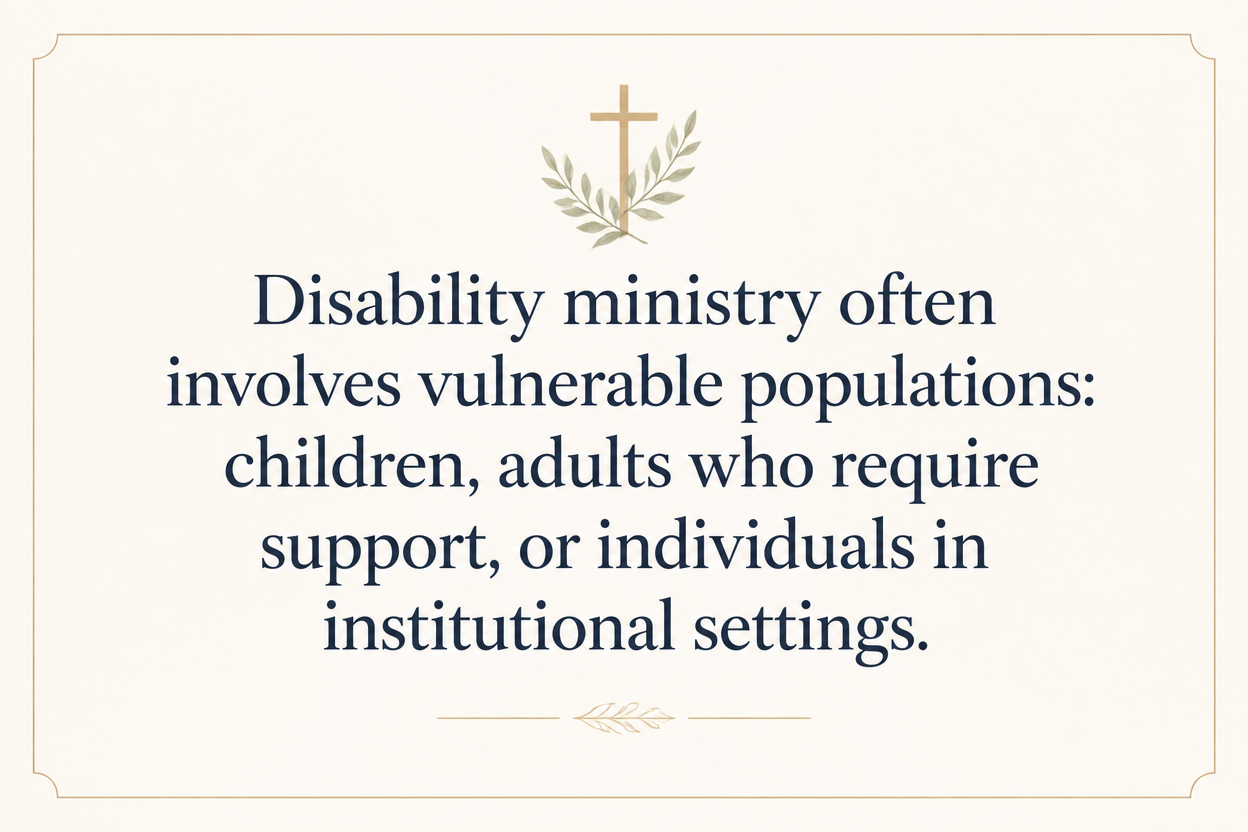
Disability ministry often involves vulnerable populations: children, adults who require support, or individuals in institutional settings. Donors should treat safeguarding as non-negotiable. Ministries should be able to describe screening, supervision ratios, incident reporting procedures, and how they handle mandated reporting requirements. Vague assurances are not sufficient; credible organizations have written policies, training records, and a governance structure that takes oversight seriously.
We also recommend looking for board independence, conflict-of-interest policies, and clear lines of authority. Where a founder remains central, the ministry should still show strong accountability and succession planning. Disability ministries can be relational and founder-driven while still being well-governed; the presence of trust does not remove the need for structure.
Transparency and effectiveness require more than testimonials
Stories matter, but they do not replace evidence. Donors can ask what a ministry measures and why. A church inclusion initiative might track how many congregations adopt accessibility plans, train volunteers, and retain families over time. A respite program might track caregiver stress, attendance consistency, and safety outcomes. Job training programs should be able to describe job placement, retention, and supports offered after placement.
When data are limited—as they sometimes are in pastoral care contexts—ministries can still demonstrate seriousness through clear goals, third-party evaluation when feasible, and honest reporting of challenges. Sophisticated donors should not penalize a ministry for acknowledging complexity; candor is often a sign of maturity.
Choose giving strategies that match the ministry’s actual needs
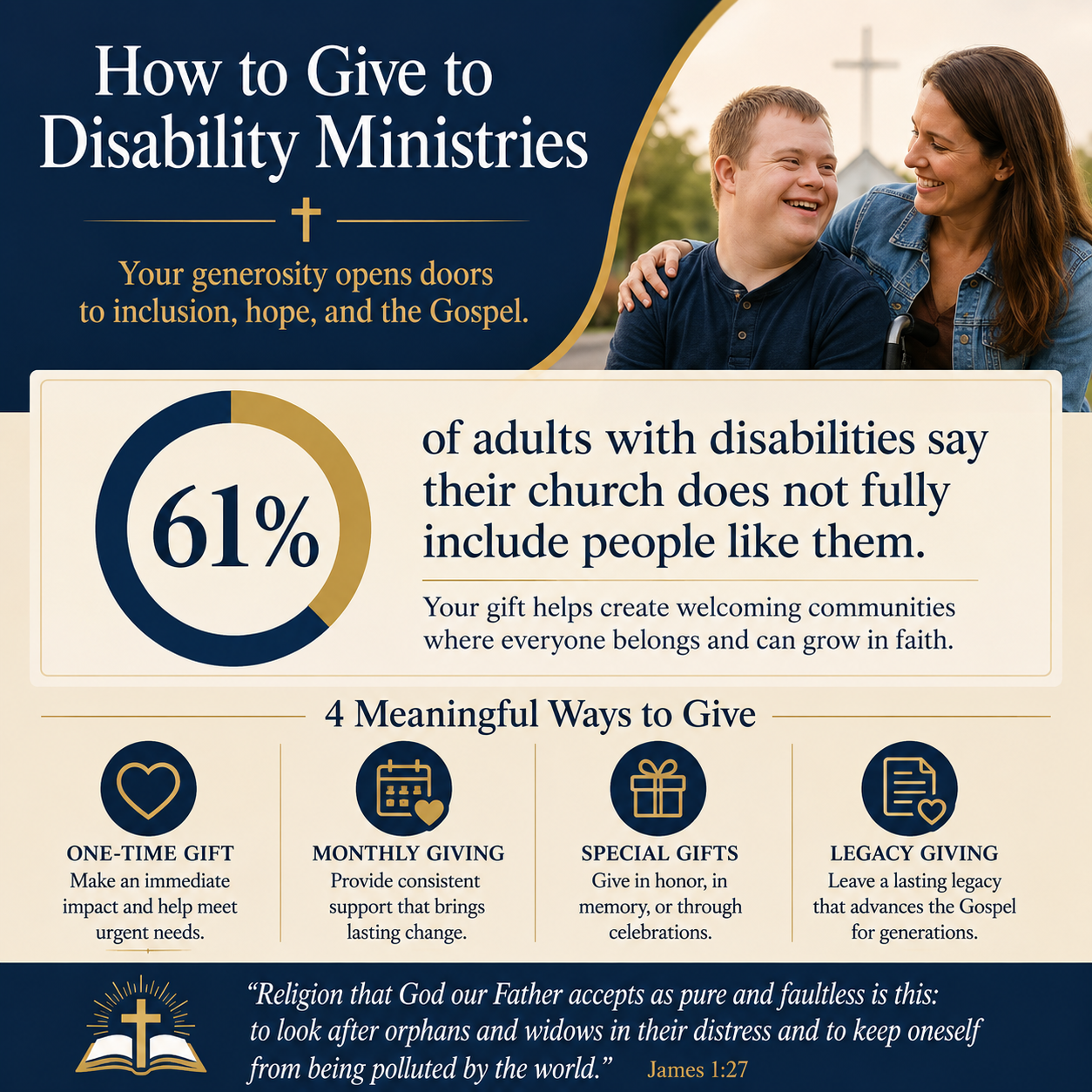
Once a ministry has earned trust, the next question is how to fund it well. Different disability ministries require different forms of capital. Donors often default to one-time gifts because they are simple, but predictable funding is frequently what allows ministries to serve families consistently, retain trained staff, and maintain safe programming.
Monthly giving stabilizes high-touch ministry
Programs serving people with significant support needs can be expensive to run responsibly. Staff training, adaptive materials, transportation coordination, and appropriate supervision ratios do not scale cheaply. Monthly giving helps leaders plan services and avoid the “feast or famine” cycle that produces burnout and turnover.
Donors should expect a ministry to articulate what monthly gifts underwrite: volunteer coordination, caregiver support groups, accessible curriculum, or the staffing required to maintain safe environments. Predictability is not glamorous, but it is often the difference between a ministry that endures and one that repeatedly restarts.
Matching gifts can accelerate growth, but they can also distort priorities
Matching campaigns can be effective when they are structured honestly and aligned with real needs. Donors should ask who the matcher is, whether the match is truly incremental, and what the campaign funds. A match that pushes a ministry into rapid expansion without the staff, training, and governance to support growth can create long-term fragility.
When matching gifts are tied to new recurring donors or to specific capacity investments—such as staff training, evaluation systems, or facility accessibility—they tend to strengthen ministries rather than merely spike short-term revenue.
Capital projects require rigorous planning and sober expectations
Accessibility improvements, sensory-friendly spaces, ramps, lifts, adaptive bathrooms, vans, and purpose-built respite facilities can open doors for families. Capital giving, however, is one of the easiest places for donors to be moved by vision without adequate diligence. Donors should ask for detailed budgets, contractor bids when appropriate, realistic timelines, and a plan for long-term maintenance.
We also recommend clarifying the operating model after the build. A facility can become a financial burden if the ministry cannot staff it, insure it, and maintain safe programming within it. Capital campaigns that include reserves and operating support reflect prudence, not lack of faith.
Practice due diligence that respects dignity and strengthens the church
Disability ministry sits at the intersection of pastoral care, social services, and church formation. Donors therefore need a diligence process that is both spiritually serious and operationally clear. The goal is to support ministries that expand belonging and uphold the image of God, without funding practices that unintentionally marginalize the very people they claim to serve.
Ask questions that reveal culture
Donors can learn much from a small set of disciplined questions:
- Whose voices shape the ministry? Look for leadership input from people with disabilities and caregivers.
- What does discipleship look like? Mature ministries can describe spiritual formation, not only programming.
- How is safeguarding implemented? Ask for policies, training expectations, and oversight structures.
- How does the ministry handle limits? Responsible leaders can describe what they do not do and why.
These questions do more than gather information. They signal that donors will not reward vague ambition, and they protect families from being turned into inspirational content.
Be cautious with imagery and storytelling incentives
Disability ministries often rely on donor communications that feature children or adults with visible needs. The ethical question is whether stories preserve dignity and consent. Donors should be wary of marketing that treats people as props for fundraising. Responsible ministries can explain consent practices, privacy protections, and how they avoid portraying disability as spiritual failure or emotional spectacle.
We recommend supporting organizations that can celebrate real joy without flattening suffering, and that can describe people as full persons—neighbors, members, friends, disciples—rather than as fundraising categories.
Use independent verification when it is available
Donors are rarely positioned to conduct full governance and financial reviews on their own. Independent verification can narrow uncertainty, especially when it applies consistent criteria across organizations. Most Trusted exists to help donors give with confidence by evaluating ministries against The Most Trusted Standard, emphasizing evidence, clarity, and accountable Christian leadership.
Many donors also want to situate disability giving within their broader priorities—local church support, global missions, poverty alleviation, and crisis response. A disciplined approach helps prevent reactive giving and supports ministries that serve faithfully over decades.
For donors seeking a wider view of the landscape, we maintain resources on Disability Ministries that reflect both theological seriousness and operational accountability.
Give in ways that build faithful presence over time
Disability ministry is a long obedience in the same direction. The church’s credibility is not measured by whether we notice disability during a campaign season, but by whether we sustain belonging, safety, and discipleship when needs are ongoing and progress can be slow. Donors can serve that end by funding what is durable: trained leadership, safeguarding, accessible spaces, caregiver support, and programs shaped by the voices of those most affected.
Giving well is not only about selecting the right organization; it is about aligning money with the kind of church we claim to be. When disability ministries are faithful and verifiably trustworthy, they do not merely provide services. They bear witness to the God who honors the vulnerable and draws his people into mutual dependence within the body of Christ.



