
How disability ministries use donations is a stewardship question before it is a budget question. Christian donors are not only asking whether a ministry is efficient; they are asking whether it is faithful—whether giving is translating into dignified care, wise inclusion, and durable witness in the lives of people made in God’s image.
That question carries special weight in disability ministry because the work often happens in quiet places: respite nights, communication supports, adapted classrooms, caregiver counseling, accessible worship, and long-term relationships that do not yield easy metrics. Scripture refuses to treat those lives as peripheral. The body imagery of 1 Corinthians 12 names those members who seem weaker as “indispensable,” and Jesus’ ministry repeatedly centered people whose communities had pushed them to the margins. Donations should therefore be evaluated not only for program activity, but for whether they strengthen belonging, protect the vulnerable, and honor the church’s calling.
Donations fund presence, not projects
Many Christian donors were formed by funding models that assume a clear “unit” of impact: a meal served, a Bible distributed, a bed provided. Disability ministry can include tangible goods, but the heart of the work is often relational and long-range: cultivating trust with families, building consistent volunteer teams, training churches to welcome, and sustaining staff who can walk with people through complex needs. What this means in practice is that the most faithful spending sometimes looks ordinary—staff hours, training, coordination, transportation—because it is underwriting the conditions for persevering love.
This is also why simplistic overhead rules are a poor fit. The widely cited “Overhead Myth” statement from major charity evaluators argued that overhead ratios are not a proxy for performance and can mislead donors away from what actually builds capacity and outcomes.BBB Wise Giving Alliance A disability ministry that refuses to invest in training, safeguarding systems, case documentation, or family follow-up may appear lean while quietly eroding quality and safety.
Direct care and caregiver support are often the largest cost drivers
Where disability ministries provide direct services—day programs, tutoring, adaptive activities, supported employment, or caregiver respite—donations frequently fund staff who deliver consistent care and volunteers who need training and supervision. Even when a ministry relies on volunteers, the ministry still pays for what makes volunteer service safe and fruitful: screening, scheduling, coaching, and crisis response. For donors, the question is not whether a ministry uses volunteers, but whether it treats people with disabilities and their families as worthy of competent, accountable care.
Accessible church life requires practical investment
In church-based disability ministry, donations may fund adaptive curriculum, sensory supports, assistive technology, transportation, and environmental accessibility. Some of this spending is episodic—ramps, signage, audio systems—and some is ongoing—trained buddies, inclusion coordinators, family liaisons. Theologically, those line items are not add-ons. They are part of loving our neighbor in ways that are concrete rather than sentimental.
Long-term relationships require stable teams
Disability ministry is exposed to volunteer churn and staff turnover. Donations used for staff stability—competitive pay for key roles, benefits, supervision, and ongoing formation—often protect the continuity that families depend on. Donors sometimes worry that “staffing” is administrative; the deeper question is whether staffing is proportionate to the ministry’s promises and responsibilities. If a ministry is entrusted with vulnerable people, under-resourcing staffing is not frugality; it is risk.

Healthy ministries spend on training, safeguards, and governance
When donors ask what disability ministries spend donations on, they should pay close attention to the unglamorous categories that reduce harm. The field has had to reckon with hard truths: vulnerable adults and children face elevated risk of abuse, and ministries can unintentionally create conditions where harm goes unreported. Faithful ministries therefore spend money on prevention: policies, training, background checks, and independent oversight.
Research consistently indicates elevated vulnerability. A U.S. Department of Justice analysis reported that persons with disabilities experienced violent victimization at higher rates than persons without disabilities in the years studied, underscoring why prevention and reporting pathways matter for ministries serving this population.Bureau of Justice Statistics Donors should expect ministries to respond with seriousness—clear safeguarding standards, incident response procedures, and leadership that welcomes scrutiny.
Training is a program expense, not a luxury
Volunteer and staff training is where theology becomes practice. It includes disability theology and language, behavior support, communication approaches, trauma awareness, de-escalation, and family partnership. For some ministries, training also includes medical-adjacent competencies such as seizure response or safe mobility assistance—always within appropriate scope and professional boundaries. Donors should not penalize spending that equips people to serve wisely; they should question ministries that avoid it.
Safeguarding and reporting systems protect the ministry and the people it serves
Background checks, two-adult policies, controlled access procedures, transportation rules, and mandatory reporting training have real costs. So do data systems that document participation, incidents, accommodations, and family communication. These are not bureaucratic preferences; they are part of honoring the dignity of people whose vulnerability can be exploited. Donors should ask whether safeguarding is embedded in operations or treated as a periodic compliance task.
Governance and leadership should be visible to donors
Strong boards and accountable leadership are not abstractions. They determine whether a ministry can say “no” to unsafe growth, respond to conflict, and course-correct when programs do not serve families well. Across our verification work at Most Trusted, the ministries that meet The Most Trusted Standard generally treat governance as a spiritual and fiduciary trust: documented decision-making, clear role boundaries, conflict-of-interest discipline, and oversight of safeguarding. Donors should view these investments as part of faithful stewardship, not as a distraction from mission.
Financial integrity includes hard trade-offs about unrestricted giving
Christians genuinely disagree about how much restriction is appropriate in donor giving. Some donors want every dollar tied to a named program. Others prioritize flexibility, trusting leadership to allocate where need is greatest. The harder question is that disability ministry frequently requires shared infrastructure—training, scheduling, facilities, insurance, data, pastoral care—that cannot be neatly assigned to one line item without distorting reality.
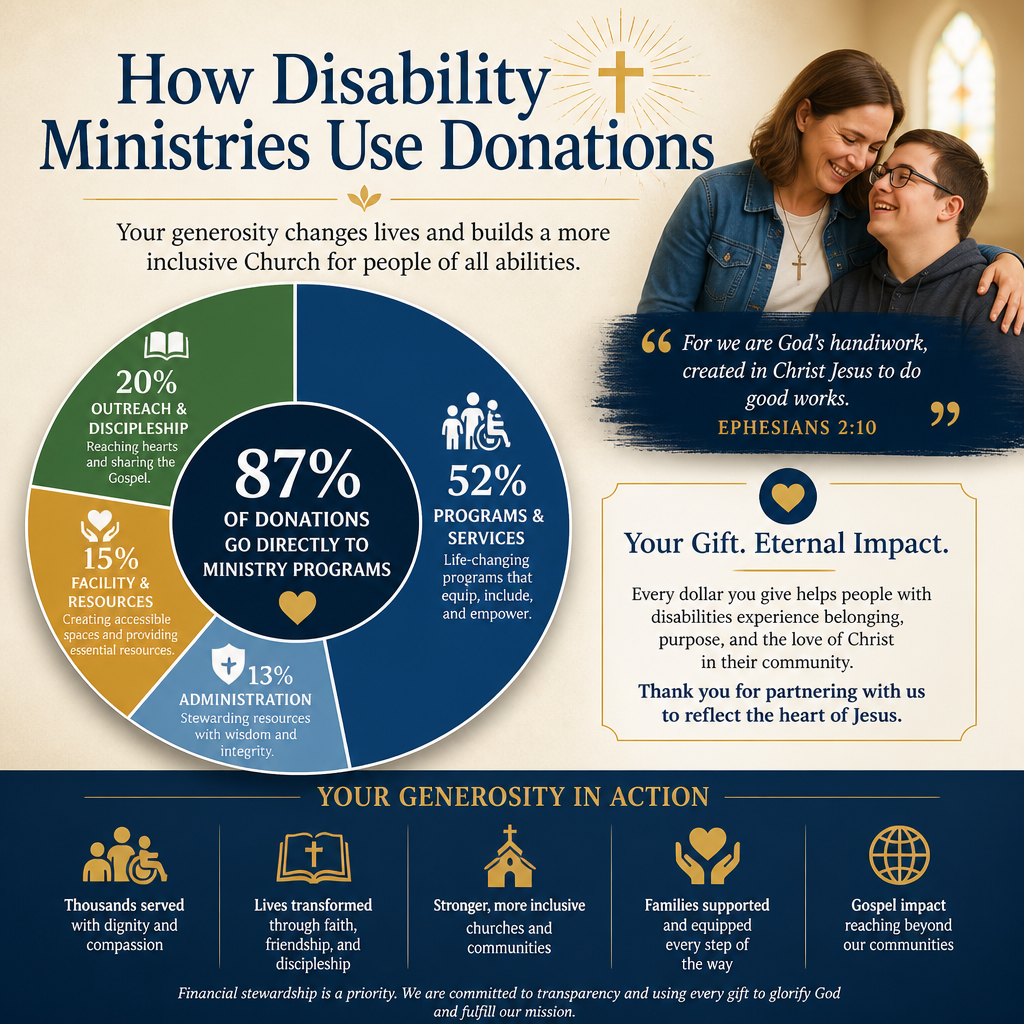
Unrestricted giving is often what keeps promises to families when costs rise or emergencies emerge. A respite night does not become more “spiritual” because it is underwritten by designated dollars; it becomes more reliable when the ministry can pay trained staff, replace a broken lift, or add support for a child with escalating needs. Donors should not assume that restrictions increase faithfulness. They can also increase fragility, pushing ministries to chase fundable activities rather than deliver the care their community actually needs.
Facilities, insurance, and compliance are part of serving responsibly
Some disability ministries operate in accessible facilities with specialized equipment. Others partner with churches or community spaces but still face costs: liability insurance, ADA-related upgrades, transportation coverage, and professional services. These expenses can feel distant from front-line ministry, but they are what make front-line ministry possible. Donors should be cautious about any narrative that implies faithful work can be done without the mundane responsibilities of operating safely.
Staff care and spiritual formation affect service quality
Burnout in caregiving roles is not theoretical. When ministries push staff to carry heavy needs without support, families experience turnover, inconsistency, and diminished trust. Donations used for supervision, counseling support, manageable caseloads, and spiritual formation can protect the long-term health of a ministry’s people. That is not self-indulgence; it is a recognition that we serve from within creaturely limits.
Transparency should match complexity
Disability ministries should not hide behind complexity, but donors should also resist demanding a false simplicity. A faithful annual report will describe major expense categories in a way that connects spending to real services and real outcomes, while acknowledging what is difficult to measure. It will also make governing documents, leadership information, and financial statements accessible without defensiveness. Ministries worthy of trust tend to treat questions as part of discipleship in stewardship rather than as an adversarial audit.
What discerning donors should look for in spending and impact
Most donors cannot visit every program or evaluate clinical quality. They can, however, ask questions that reveal whether donations are being used in ways consistent with Scripture’s call to justice, mercy, and truthfulness. The goal is not to interrogate ministries into anxiety; it is to direct generosity toward work that is credible, accountable, and spiritually aligned.
Connect dollars to outcomes without reducing people to numbers
Disability ministry outcomes may include caregiver endurance, sustained church participation, friendships, improved communication, spiritual formation, reduced isolation, or successful job placement. Some of these can be counted; others require qualitative evidence: family testimonies gathered with consent, retention patterns, and documented follow-up. Donors should expect a ministry to define what fruitfulness looks like, show how it learns, and admit where progress is uneven.
Ask how the ministry includes people with disabilities in leadership and feedback
Spending patterns often reflect who has voice. Ministries that budget for advisory councils, accessible feedback mechanisms, and leadership development for people with disabilities are signaling that inclusion is not merely a service provided to “them,” but a shared life in the body of Christ. Donors should ask how the ministry receives critique, how complaints are handled, and whether families can raise concerns without fear of retaliation.
Use independent verification as a guardrail
Discernment is strengthened when it is not built on marketing or sentiment. Most Trusted exists to help donors give with confidence by evaluating ministries against The Most Trusted Standard, a 15-criteria framework spanning faith foundation, financial integrity, governance and leadership, and transparency and effectiveness. When donors pair relational awareness with verifiable documentation, generosity becomes both warm-hearted and clear-eyed.
For donors who are comparing organizations or seeking a broader view of the space, our Disability Ministries coverage provides context for how different models operate and what credible accountability tends to look like across the field.
Faithful giving strengthens dignity, safety, and belonging
How disability ministries use donations is ultimately a question about what kind of church we are becoming. The strongest ministries spend in ways that honor dignity, protect the vulnerable, and sustain long obedience in the same direction—often through costs that are not dramatic but are essential. Donors can press for clarity, support the unglamorous work of capacity and safeguarding, and give in ways that strengthen the ministry’s ability to keep faith with the people it serves.



