
When should Christian donors start legacy conversations? Earlier than most families expect, and with more spiritual clarity than most legal processes encourage. A legacy plan is not primarily a document; it is a discipleship decision about what our lives will mean when we are no longer here to explain them.
Scripture treats death as certain and stewardship as accountable. “Teach us to number our days that we may gain a heart of wisdom” (Psalm 90:12). Numbering our days is not morbid; it is clarifying. For Christian donors, legacy conversations belong wherever mature stewardship belongs: in the ordinary years, before crisis and before the family dynamics of grief narrow what can be said well.
Begin when you can still speak calmly and clearly
Legacy conversations are hardest when time is short
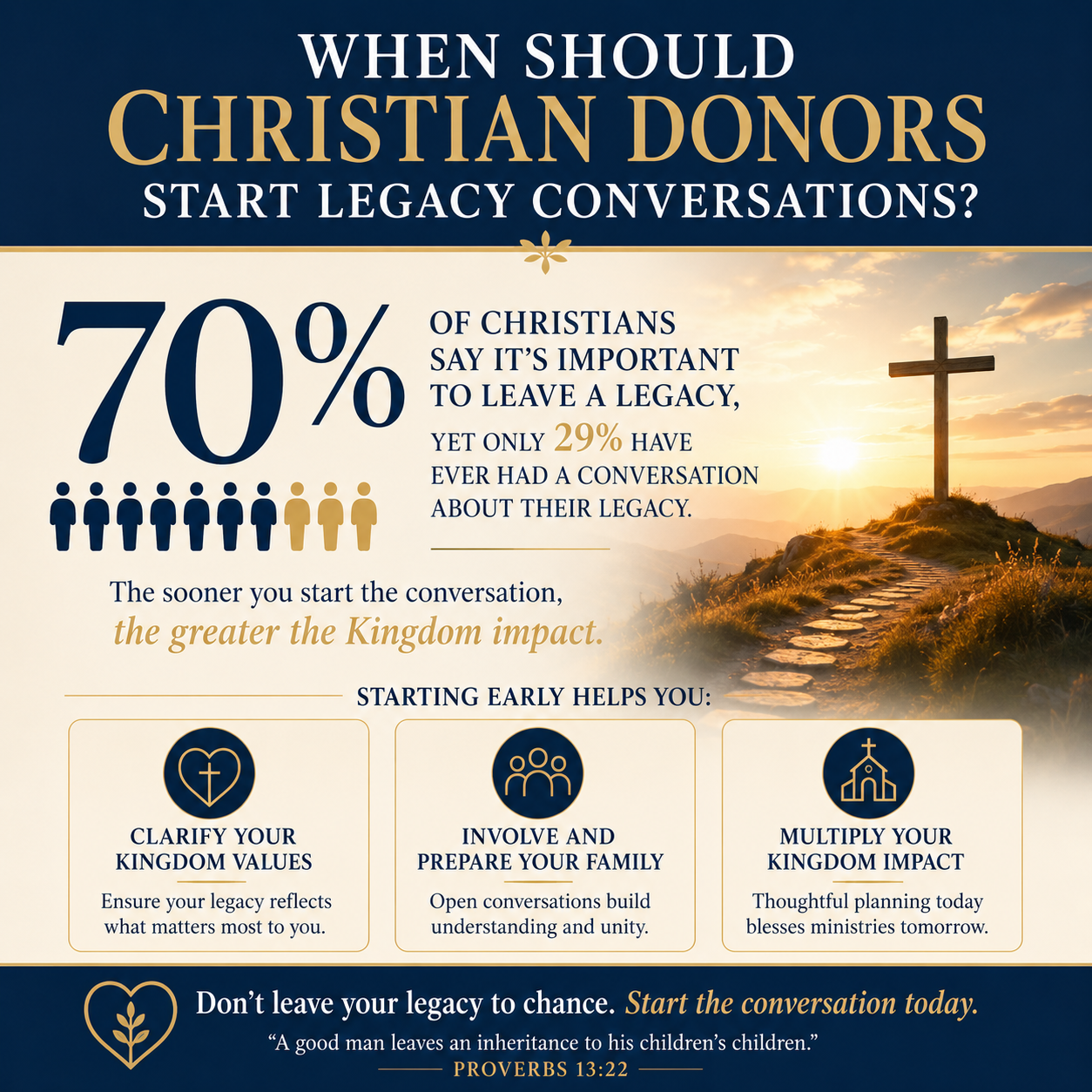
We recommend beginning legacy conversations when health is stable and decision-making is unhurried. The practical reason is obvious: end-of-life stress compresses complex choices into reactive ones. The spiritual reason is more important. A legacy conversation is one of the few settings where we can explicitly connect money, family, and mission without competing urgencies.
Christians sometimes delay because legacy planning feels like tempting providence. Scripture gives a different frame. Proverbs commends prudent preparation, while repeatedly warning against presumption. Planning is not mastery; it is responsible attention to the stewardship God has already placed in our hands.
Earlier does not mean complicated
Starting early does not require drafting every instrument immediately. It often begins with a simple conversation: what we want our children and heirs to understand about God’s provision, the purpose of wealth, and the ministries we believe we are called to strengthen. Many families can begin with a values statement and a shortlist of priorities, then proceed to counsel from attorneys and financial advisors.
Across our verification work at Most Trusted, we observe that donors who begin early tend to give more thoughtfully later. They develop a pattern of asking not only “Is this ministry compelling?” but “Is this ministry faithful, well governed, financially sound, and candid about outcomes?” That posture is the same posture that makes legacy giving trustworthy.

Start before wealth transfers force the issue
Generational transfer is already reshaping giving
Legacy conversations become urgent not because donors suddenly become older, but because assets and authority begin moving. Many families experience this through retirement, the sale of a business, a move, or the death of a parent. Once those transitions begin, unresolved expectations can harden into conflict.
It is also worth naming what the philanthropy field has tracked for years: large-scale wealth transfer is underway in the United States. The conversation is often framed in purely financial terms, but for Christian donors it is also a question of spiritual continuity and missional responsibility. For a broad overview of the dynamics, see the Dorothy A. Johnson Center for Philanthropy’s work on the “Great Wealth Transfer” (Johnson Center homepage).
Legacy conversations reduce the hidden costs of uncertainty
Ambiguity is not neutral. When heirs do not know what mattered to their parents, they often fill the silence with assumptions. Some assume “faith mattered, but money is private.” Others assume “generosity was optional.” Still others interpret a late-stage gift as a reaction to fear rather than a settled conviction.
What this means in practice is that donors who want their generosity to disciple the next generation should speak while they can be understood without suspicion. That may be in one’s forties; it may be in one’s sixties. The principle is not age but capacity: when we can communicate motives, commitments, and boundaries without defensiveness.
Make legacy planning explicitly theological, not merely legal
Scripture frames the purpose of wealth
Christian legacy giving should be governed by more than tax efficiency. The New Testament repeatedly warns that money can master us, while also commanding generosity as a mark of genuine faith. Paul instructs the wealthy “to do good, to be rich in good deeds, and to be generous and willing to share” (1 Timothy 6:18). A legacy plan is one way to carry that obedience beyond our lifespan.
Christians genuinely disagree about how much should go to heirs versus ministry, and we should not pretend there is a single faithful ratio. The deeper question is whether our plan reflects the logic of the Kingdom: that all we possess is received, that we will give an account, and that the needs of neighbor and the advance of the gospel are not peripheral concerns.
A practical set of decisions most families can make
We recommend that legacy conversations address a small set of concrete decisions before they become emotionally charged. A family does not need to resolve every detail at once, but clarity in these areas prevents misunderstanding:
- What purposes do we want our assets to serve: family stability, generosity, gospel work, community good?
- What ministries do we want to strengthen, and why are they aligned with our convictions?
- What do we want our heirs to learn about stewardship from our decisions?
- Who will carry fiduciary responsibility, and what qualifications matter for that trust?
- What level of privacy or transparency do we want within the family about amounts and recipients?
These questions naturally connect to broader Christian stewardship commitments. Many donors find it helpful to situate the legacy conversation within their larger giving philosophy and accountability practices, including research and verification. For donors who want a wider stewardship context, our coverage of Christian Stewardship Services situates legacy giving alongside faithful practices of discernment, accountability, and generosity.
Choose ministries with governance and integrity worthy of a permanent gift
Legacy gifts magnify both impact and risk
A bequest or beneficiary designation can become one of the largest gifts a donor ever makes. That magnifies impact when the recipient ministry is healthy. It also magnifies risk when the ministry lacks doctrinal stability, financial integrity, accountable governance, or transparent reporting. The longer the time horizon, the more donors should care about institutional strength, not only program appeal.
Some donors assume that because a ministry is Christian, it is automatically safe. Scripture is more realistic about human leadership and institutional temptation. The New Testament warns churches about false teaching and disordered leadership. The Old Testament repeatedly chronicles what happens when spiritual authority is not accountable. Christian donors honor Christ when they apply careful discernment to Christian institutions.
Verification helps donors give with confidence
Most Trusted exists because donors deserve verifiable clarity. We evaluate ministries against The Most Trusted Standard, a 15-criteria framework across four domains: Faith Foundation, Financial Integrity, Governance and Leadership, and Transparency and Effectiveness. For legacy planning, these categories matter because a bequest is not a one-time transaction. It is a long-term entrustment of capital and reputation.
The ministries that meet The Most Trusted Standard tend to share a few characteristics that are particularly relevant to legacy giving: clear doctrinal commitments; boards that exercise real oversight; financial reporting that is timely and intelligible; and public communications that do not exaggerate outcomes. These are not marketing preferences. They are indicators that a ministry can bear the weight of a gift intended to outlast the donor.
Legacy giving often intersects with complicated family concerns: blended families, adult children with differing convictions, and the fear that giving to ministry will be interpreted as withholding love from heirs. Clear verification does not solve those tensions, but it does remove one avoidable problem: uncertainty about whether the recipient is trustworthy.
Invite your heirs into the meaning, not only the mechanics
Silence can become a form of burden
Many Christian parents hope their children will “figure it out” spiritually and financially. Yet a significant body of research suggests religious transmission is shaped by parental clarity and practice over time. Pew Research Center’s work on religion and family life repeatedly finds that parents’ religious commitment and practices are associated with outcomes in children’s religious affiliation and practice (Pew Research Center homepage). That is not a promise, but it is a sober reminder: formation rarely happens by accident.
Legacy conversations are one place where parents can explain the “why” behind giving: gratitude for Christ’s grace, responsibility toward neighbors, and confidence that the gospel is worth the investment of a lifetime. When heirs understand the meaning, they are less likely to interpret a bequest as a sentimental gesture or a last-minute anxiety.
What healthy heir involvement can look like
Not every family should involve children in every detail. Some children are not ready, and some parents have legitimate privacy concerns. But many families can involve heirs in age-appropriate ways that reinforce unity rather than provoke competition. For example: inviting adult children to recommend ministries they respect, then discussing them against shared theological and integrity criteria; setting aside a portion of annual giving for collaborative decisions; or explaining in writing the convictions behind a bequest.
For donors focusing specifically on multi-generational generosity, planned giving, and family decision-making, our work on Legacy and Family Giving Through Christian Stewardship Services addresses the distinct pressures families face when money, love, and spiritual identity intersect.
FAQs for When should Christian donors start legacy conversations
Is there a biblically ideal age to begin legacy conversations?
Scripture does not prescribe an age. It does prescribe a posture: wisdom that remembers our finitude and stewardship that expects accountability. We recommend beginning when the conversation can be calm, deliberate, and spiritually clear, typically before major health decline or complex wealth transitions. For many donors that is in midlife, not late life.
Should Christian donors tell their children exactly what ministries will receive a bequest?
There is no single faithful rule. Transparency can reduce confusion and help heirs understand the spiritual intent of the gift. Privacy can be wise when family dynamics are volatile or when amounts could distort relationships. A prudent middle path is often to explain purposes and priorities plainly, name categories of ministry support, and share specific recipients when doing so will build unity rather than resentment.
Legacy conversations belong to Christian stewardship, not to crisis management
Christian donors should start legacy conversations when the goal can still be formation rather than damage control. A legacy plan is one expression of a deeper conviction: that everything we have is entrusted by God, that our family relationships are sacred, and that the work of the Kingdom deserves more than leftover attention. When donors unite theological clarity with careful verification of recipient ministries, they honor both the gospel they profess and the people they love.



