
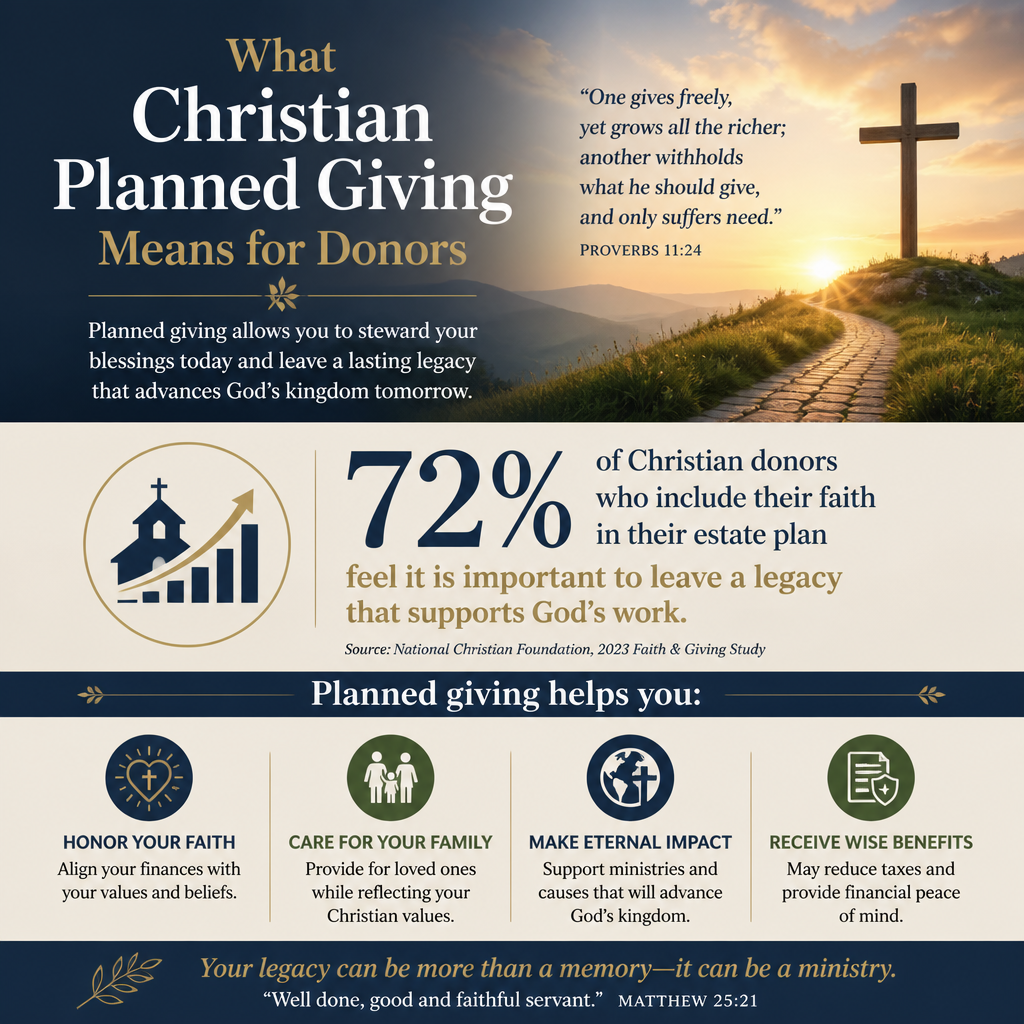
What Christian planned giving means for donors is not primarily a set of tax tactics. It is the long obedience of stewardship: arranging our assets so that love of God and neighbor persists beyond our own lifespan, and so that our final acts of generosity are coherent with the gospel we profess.
Planned giving raises questions mature donors already feel: How do we provide responsibly for family without treating provision as ultimate? How do we give in ways that strengthen the church’s witness rather than create dependency, scandal, or drift? And how do we ensure that a legacy gift goes to a ministry that will still be faithful and financially sound when our estate is settled?
Christian planned giving begins with worship, not wealth transfer
Scripture does not treat possessions as morally neutral. Jesus speaks of treasure because treasure reveals devotion (Matthew 6:19–21). Paul frames generosity as worship that overflows in thanksgiving to God (2 Corinthians 9:11–12). Planned giving belongs in that theological register. It asks what our wealth is for, and it disciplines the imagination against the quiet assumption that our assets are finally ours to control.
For many Christian donors, the deeper work is not legal but spiritual: bringing long-term plans under the lordship of Christ. When estates are handled only as technical puzzles, they tend to mirror the same habits that shaped our finances in life—anxious accumulation, family idolatry, or reactive giving driven by sentiment.
Stewardship includes time horizons we will not live to see
Planned giving is one way Christians acknowledge that our discipleship has consequences after death. The church has always known that believers can fund translation work, theological education, mercy ministries, and local congregational stability for decades through endowments, beneficiary designations, and bequests. The point is not to secure a name on a building, but to place resources in service of the Kingdom when we can no longer manage them ourselves.
Planned giving does not replace generosity in the present
Estate intentions can become a substitute for actual sacrifice now. A will that promises generosity “someday” can coexist with a present life of careful self-protection. Christian planned giving is healthiest when it is an extension of existing generosity, not a moral offset for its absence.

The donor’s first responsibility is clarity: what we are trying to accomplish
Planned gifts are often discussed in terms of vehicles—charitable remainder trusts, donor-advised funds, life insurance, retirement accounts, and so forth. The more foundational question is the purpose of the gift. Mature stewardship defines outcomes before instruments.
Common Christian purposes for planned gifts
Across our verification work at Most Trusted, we observe that legacy gifts tend to be most durable when donors are specific about the ministry work they want to advance and realistic about the constraints nonprofits face over time. Purposes that donors commonly name include:
- Stabilizing a faithful local church’s long-term ministry, especially during pastoral transitions
- Strengthening theological education and leadership development that will shape future generations
- Supporting mercy ministries with measurable local impact and careful safeguards
- Funding Bible translation and global disciple-making with accountable partnerships
- Providing flexible capacity for a ministry’s core operations when designated funds are already abundant
Designation is powerful, but it can also create future constraints
Christians genuinely disagree about how tightly donors should restrict planned gifts. Some argue that restrictions protect doctrinal fidelity and prevent drift. Others note that restrictions can unintentionally hamper faithful leaders who must respond to future needs donors cannot anticipate. A wise approach often distinguishes between mission-level clarity and program-level rigidity. Naming the type of work you want to fund is prudent; trying to script operational details decades in advance is often fragile.
Planned giving forces the harder conversation about trust and governance
Legacy giving is an act of trust at a distance. You may never meet the CEO who receives your bequest. You may not know what cultural, theological, or regulatory pressures the ministry will face in twenty years. That is why planned giving, more than most forms of giving, depends on governance quality and institutional integrity.
Why donor confidence has become harder, not easier
The American philanthropic environment has been strained by high-profile failures—misuse of funds, moral collapse, and boards that functioned as rubber stamps. Christian ministries are not exempt. The result is not cynicism so much as the sober recognition that good intentions do not substitute for accountable structures.
Even when a ministry is sincere, complexity introduces risk. Rapid growth can outpace financial controls. International work can complicate compliance. Founder-led organizations can struggle to transition into mature governance. Donors who plan gifts should assume that every ministry they love will face some version of these pressures over time.
What to look for before you write a ministry into your estate
Planned giving due diligence is often treated as a quick reputational check. It should be more rigorous than that. We recommend grounding decisions in verifiable signals of long-term health: financial integrity, independent oversight, clear theological commitments, transparent reporting, and evidence that programs are accomplishing what is claimed.
That is the purpose of Most Trusted’s independent verification. We evaluate Christian nonprofits against The Most Trusted Standard, a 15-criteria framework across Faith Foundation, Financial Integrity, Governance and Leadership, and Transparency and Effectiveness. When a planned gift will outlive the donor, verification is not a luxury; it is a form of stewardship.
Tax efficiency matters, but it is not the moral center
Some donors hesitate to engage planned giving because they suspect it is code for “avoid taxes.” Others treat tax savings as the entire purpose. Both impulses miss the Christian frame. Scripture recognizes civil obligations, but it also insists that God owns all things and that our giving is accountable to him (Psalm 24:1).
Tax considerations can remove friction from obedience
Prudent planning can allow more resources to reach ministry work rather than being lost unnecessarily. For many households, the largest assets are not in checking accounts but in retirement plans and appreciated securities. Beneficiary designations and gifts of appreciated assets can be materially significant, especially when structured with competent legal and tax counsel.
Giving patterns in the United States also show that generosity is often shaped by tax and policy environments, even when donors’ motivations are spiritual. The Internal Revenue Service reports aggregate charitable deduction amounts each year, a useful reminder that tax policy influences giving behaviors at scale Internal Revenue Service.
The Overhead Myth is relevant to planned gifts
Planned donors sometimes want to restrict every dollar to “programs,” assuming that administration is a sign of waste. The nonprofit field has had to correct this assumption. In 2013, Charity Navigator, GuideStar, and the BBB Wise Giving Alliance published the “Overhead Myth” letter, arguing that simplistic overhead ratios can mislead donors and harm nonprofits by discouraging necessary investments in staff, systems, and evaluation Charity Navigator. For planned giving, this matters because legacy gifts are often most helpful when they strengthen long-term capacity: financial controls, safeguarding practices, leadership development, and transparency.
Practical steps donors can take without losing spiritual seriousness
Christian donors often want to act without turning a spiritual decision into an endless project. Planned giving can be approached with disciplined simplicity: clarify aims, choose trustworthy recipients, document clearly, and review periodically.
Begin with a short inventory and a short list
Most estates are not complicated, but they do require clarity. We recommend starting with three questions: What assets will likely remain at death? Who must be provided for? Which ministries are central to our Christian commitments and have earned our trust over time? A small list is usually stronger than a scattered one.
Use vehicles that fit your situation and the ministry’s realities
Some ministries are equipped to receive complex gifts; others are not. Some donors need income streams or estate-tax planning; others mainly need to name beneficiaries on retirement accounts. The right choice depends on counsel from qualified professionals and frank conversations with ministries about their capacity to receive and manage gifts responsibly.
For donors who want a broader view of how stewardship services and planned giving fit together, we address related considerations within Christian Stewardship Services, including how donors can pair generosity with discernment over time.
For those comparing types of ministries and the particular questions planned gifts raise within each, Christian Stewardship Services and Planned Giving gathers further context that can help donors think clearly about long-range faithfulness.
FAQs for What Christian planned giving means for donors
Is Christian planned giving only for wealthy families?
No. Many planned gifts come through simple beneficiary designations or modest bequests, not complex trusts. The Christian question is not whether the amount is large, but whether it is offered faithfully and directed toward trustworthy, accountable ministry work.
Should we name one ministry or spread a planned gift across several?
Either can be wise. A single recipient can simplify execution and increase impact, especially if the ministry is well governed and closely aligned with your convictions. Multiple recipients can reflect a broader set of commitments and reduce dependence on one organization’s future leadership. The decision should be guided by clarity of purpose and confidence in each ministry’s integrity and accountability.
A legacy that deserves the gospel we proclaim
Christian planned giving is a final opportunity to state, in legal form, what we have claimed in worship: that Christ is Lord over our lives and our assets. Done well, it is not sentimental and not transactional. It is disciplined generosity shaped by Scripture, attentive to family responsibilities, and anchored in verifiable confidence that the ministries we name will remain faithful, transparent, and accountable when we are no longer here to ask questions.



