

How Christian trusts support ministry giving is ultimately a question about stewardship with endurance. Many donors can name a calling—supporting church planting, Bible translation, crisis relief, or local mercy ministries—yet also feel the pressure of competing obligations, tax complexity, and the uncertainty of what tomorrow will require. A well-structured trust can serve the Church by converting a donor’s intent into a durable plan that protects both generosity and family responsibilities.
Scripture treats this kind of foresight as morally serious. Jesus commends wise stewardship that bears fruit over time (Luke 19:11–27), and Paul’s collection for the saints models ordered, planned generosity rather than impulsive sentiment (1 Corinthians 16:1–2). Trusts are not a substitute for cheerful giving; they are a tool that can help faithful giving continue when circumstances change.
Why Christian trusts matter for faithful stewardship over a lifetime
Stewardship is not only about amount but about endurance
Most donors do not struggle with whether ministry is worthy. They struggle with how to give faithfully across decades: while caring for aging parents, funding a child’s education, navigating a business sale, or living through market volatility. A trust can create a disciplined structure for generosity when the donor’s attention, capacity, or health inevitably fluctuates.
In practical terms, trusts can coordinate assets that are not naturally “liquid giving” assets—real estate, closely held business interests, or appreciated securities—and convert them into an ongoing stream of support for ministry. This is particularly important because many households’ wealth is concentrated outside cash accounts. For example, in the United States, real estate makes up roughly a quarter of household assets, and financial assets roughly another quarter, with significant variation by age and income (Federal Reserve). When wealth is illiquid, donors often give less simply because the giving mechanism does not match the asset.
Trusts can reconcile generosity and legitimate duties
Christians rightly resist any framework that treats family obligations as spiritual distractions. Scripture binds believers to concrete responsibilities: providing for one’s household is treated as a serious moral duty (1 Timothy 5:8). Some planned giving tools, including certain trusts, are designed to hold together these obligations—providing income for a spouse, for example—while still committing an eventual gift to ministry.
Christians genuinely disagree about how to weight inherited wealth, intergenerational assistance, and sacrificial giving. Those disagreements are not solved by a legal instrument. But a trust can clarify intent and reduce later conflicts by setting expectations while the donor can speak plainly and pastorally to heirs and ministry partners.

What Christian trusts are and how they function in ministry giving
The basic structure donors should understand
A trust is a legal arrangement in which a grantor transfers assets to a trustee to manage for the benefit of designated beneficiaries under stated terms. Some trusts are revocable (changeable during the grantor’s lifetime), and others are irrevocable (more fixed, often with stronger tax and estate implications). In the ministry context, the beneficiary can include a church or Christian nonprofit, either immediately or at a future date.
Trusts are frequently discussed alongside other planned giving tools—bequests in a will, donor-advised funds, charitable gift annuities, and charitable remainder trusts. Each tool serves a different purpose. The donor’s question should not be, “Which tool is best?” but, “What responsibility am we trying to meet, what asset are we trying to give, and what risks should we reduce?” For a broader view of stewardship decisions that often sit adjacent to planned giving, see Christian Stewardship Services.
How trusts translate intent into accountable action
Many donors have experienced the unease of “good intentions” that never become dependable support. Trust terms can formalize timing, amounts, conditions, and oversight. That formality can serve ministries as well: predictable funding reduces the temptation to chase restricted gifts or expand into programs without long-term support.
The field has also had to reckon with distortions that can accompany large gifts. Money can create unhealthy dependence, weaken local ownership, or encourage a ministry to report the kind of stories donors want to hear rather than the truth. The When Helping Hurts framework, articulated by Steve Corbett and Brian Fikkert, has pushed Christian donors to ask whether our giving strengthens agency and local stewardship or unintentionally undercuts it (When Helping Hurts). A trust cannot guarantee wisdom, but it can create a forcing function for governance, review, and clear expectations.
How trusts can increase both generosity and clarity for ministries
Supporting ministries with durable funding rather than reactive fundraising
Trust-based giving can be structured to provide annual distributions, fund a specific long-term initiative, or create an endowment-like stream for operations. For ministries, stability matters. It reduces the “feast or famine” cycle that leads to short-term staffing decisions, underinvestment in evaluation, and donor communication that prioritizes urgency over accuracy.
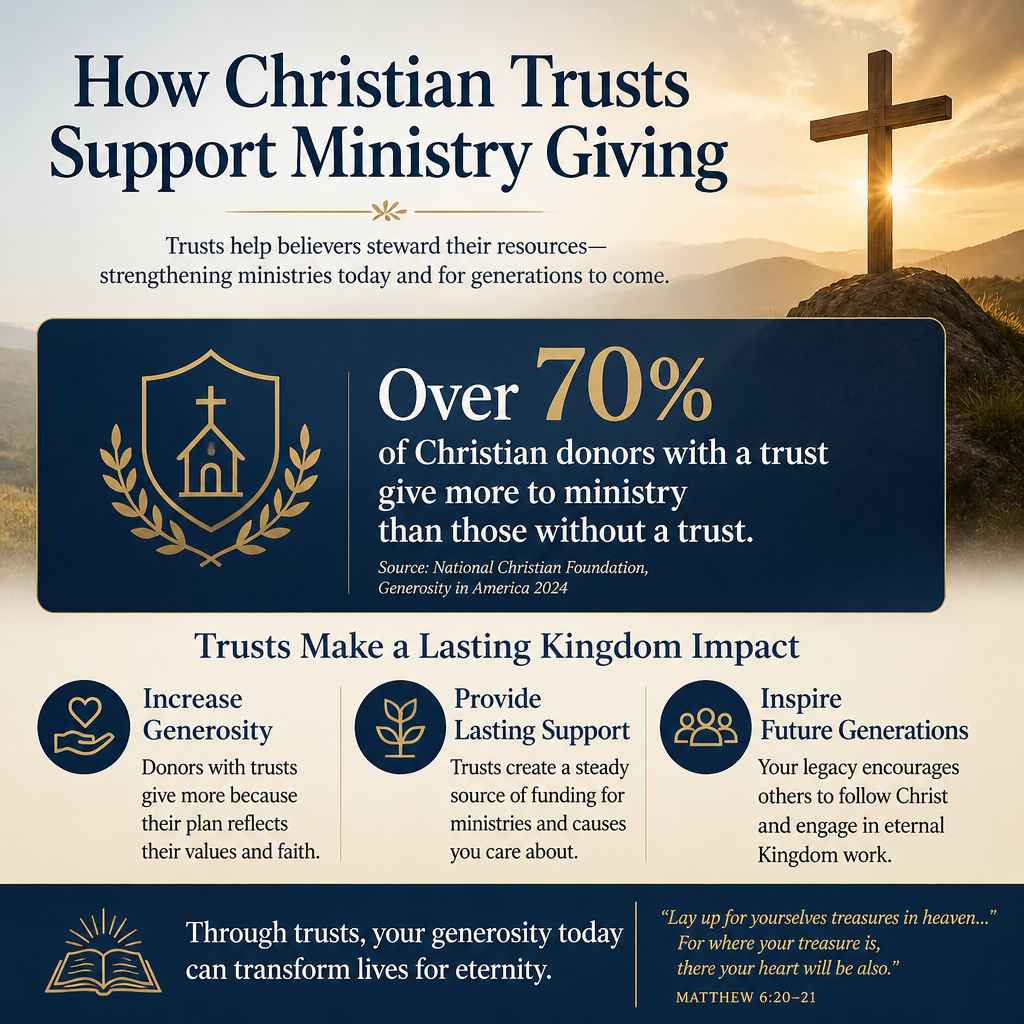
At the same time, donors should resist the assumption that a perpetual funding stream is always the most faithful form of support. Some ministries need catalytic capital for a time-limited expansion; others need dependable unrestricted support. Christians genuinely disagree about how much to emphasize restricted giving, and the disagreement often turns on a ministry’s maturity and track record rather than donor preference alone.
Making complex assets serve the Kingdom
Trusts can be particularly suited for gifts of appreciated assets. Donors often hesitate to liquidate assets because of capital gains exposure or because liquidation disrupts family plans. Some charitable trust structures can address these concerns while still directing value to ministry. These arrangements require counsel; they are not do-it-yourself decisions.
For donors who want ministry giving to remain coherent across multiple organizations, trust terms can also specify governance expectations, reporting cadence, and successor decision-making. This is not distrust. It is stewardship: “Moreover, it is required of stewards that they be found faithful” (1 Corinthians 4:2).
- Clarity of purpose: the trust can name the ministry priorities the donor intends to serve.
- Timing and discipline: distributions can be scheduled rather than left to annual whim.
- Protection for dependents: income provisions can reduce fear-driven hoarding.
- Accountability expectations: reporting and audit requirements can be made explicit.
- Succession planning: successor trustees or advisory committees can keep the plan coherent.
Key risks and due diligence for donors considering Christian trusts
Complexity, cost, and the risk of outsourcing discernment
Trusts can be expensive to establish and administer, and poorly drafted terms can create rigidity that harms both family and ministry. Some donors also overestimate what documents can accomplish. A trust can specify rules, but it cannot supply spiritual discernment, wisdom about a ministry’s health, or a living relationship with the Church. Christians should be candid about the temptation to replace ongoing discipleship with a legal mechanism that “handles” generosity for us.
There is also reputational and theological risk for ministries that receive trust-based gifts without adequate governance. Donors should ask whether the organization has the controls and leadership maturity to steward a large, potentially long-term commitment. This is not merely an efficiency question; it is a witness question.
Evaluating ministries with verifiable evidence
Across our verification work at Most Trusted, we observe that donors are often forced to make decisions under conditions of limited information. Many ministries communicate compelling outcomes but do not provide the governance and financial transparency that serious stewardship requires. Donors can reduce risk by selecting organizations that demonstrate consistent accountability across the areas assessed in The Most Trusted Standard: faith foundation, financial integrity, governance and leadership, and transparency and effectiveness.
Donors should be wary of two opposite errors. The first is the cynical assumption that most ministries are untrustworthy. The second is the sentimental assumption that a Christian mission statement guarantees faithful practice. Discernment is better served by ordinary, verifiable signals: audited financial statements when appropriate, clear board oversight, conflict-of-interest policies, and honest outcome reporting that includes limitations. For donors who are specifically weighing planned giving questions, the broader context in Christian Stewardship Services and Planned Giving can help frame the conversation with counsel and clarity.
How to align a trust with biblical priorities and wise governance
Start with theology, then choose the instrument
Before selecting a structure, donors should define the spiritual and practical aims: What ministries are we responsible to support? What does faithfulness require when we cannot foresee future needs? What provisions should be made for dependents, and what level of sacrifice is appropriate? These are not merely financial questions. They are discipleship questions, because Scripture consistently treats money as a rival for the heart (Matthew 6:19–24).
From there, the donor can work with qualified legal and tax counsel to match the instrument to the intent. A trust should be comprehensible to the people who will administer it, and it should include enough flexibility to handle foreseeable change—health events, regulatory shifts, or ministry landscape changes—without becoming a burden.
Build in review, accountability, and ministry realism
The strongest trust arrangements anticipate that ministries and contexts change. Boards turn over, mission drift can occur, and what was once a healthy organization can become unstable. Donors can address this by empowering trustees to redirect distributions if an organization ceases to operate faithfully or effectively, or by defining objective criteria that trigger review.
Responsible planned giving also refuses the donor fantasy of control. Donors can and should set guardrails, but Christian giving ultimately entrusts resources to God’s purposes in the Church. Humility here is not passivity. It is the recognition that our plans are partial, and that accountability mechanisms exist to support faithfulness, not to enshrine preference.
FAQs for How Christian trusts support ministry giving
Are Christian trusts only for wealthy donors?
No. Trusts are most common among donors with significant assets or complex holdings, but the deeper issue is not wealth level; it is whether the donor’s assets and goals require a legal structure. Many donors will be better served by simpler planned giving tools, such as a straightforward bequest or beneficiary designation, unless there is a clear need for trust-based administration and oversight.
How do we choose ministries to name in a trust?
We recommend beginning with theological and mission clarity, then evaluating organizations using verifiable evidence of governance, financial integrity, and truthful reporting. Because a trust can create long-term commitments, it is prudent to choose ministries that demonstrate durability and accountability over time, and to include language that allows review or redirection if an organization changes materially in doctrine, leadership integrity, or stewardship practice.
A trust can serve generosity when it serves faithfulness
Christian trusts support ministry giving when they protect a donor’s intent, provide for legitimate responsibilities, and channel resources toward ministries that can steward them with integrity. The goal is not sophistication for its own sake. The goal is the kind of ordered, accountable generosity that honors God, strengthens the Church, and endures when circumstances make ordinary giving difficult.



