

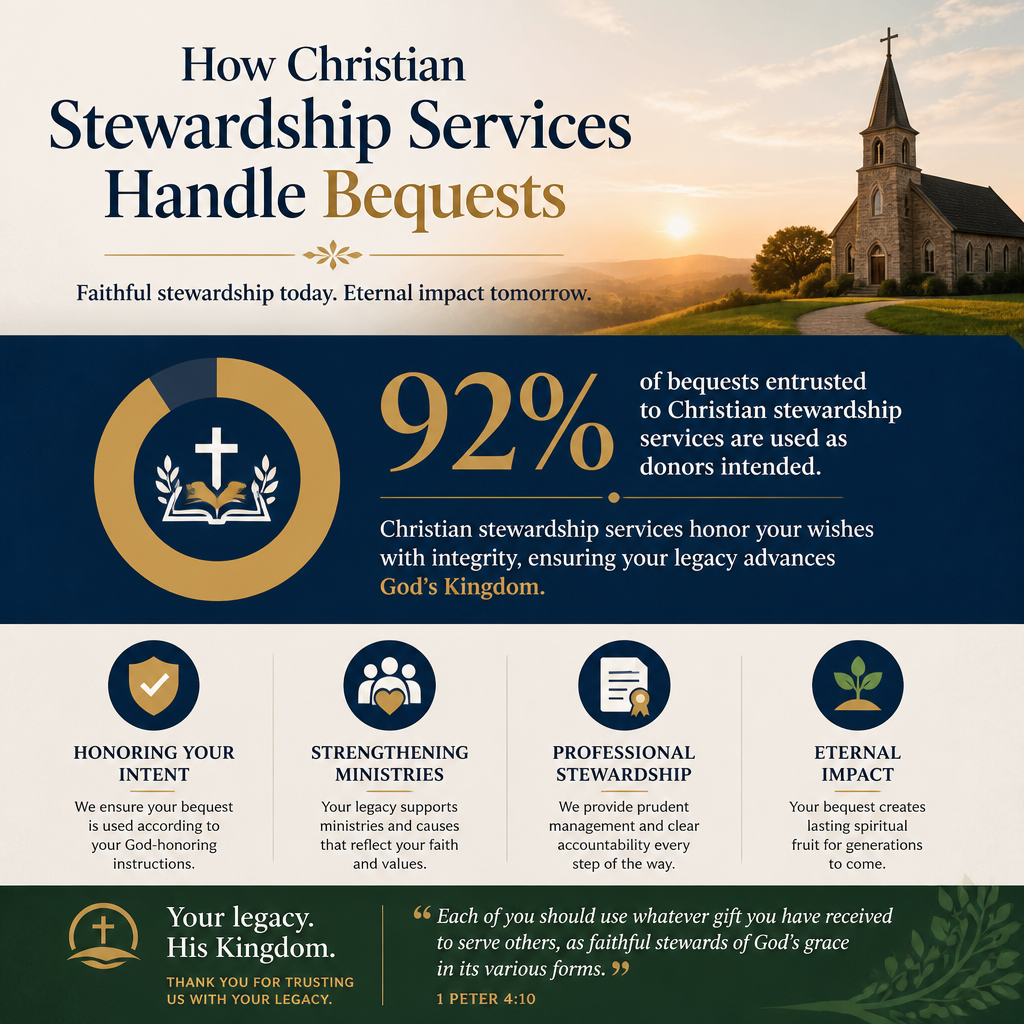
How Christian stewardship services handle bequests is ultimately a question of discipleship under pressure: pressure from grief, family complexity, tax law, and the very human temptation to treat legacy giving as a final transaction rather than a final act of worship. For Christian donors, a bequest is not merely an estate-planning device. It is a stewardship decision that will continue to bear moral and spiritual fruit after our voices are no longer in the conversation.
Most stewardship services are at their best when they keep two commitments in view at the same time: honoring the donor’s intent with clarity, and honoring the ministry’s integrity with restraint. That restraint matters because planned giving can become a subtle place of coercion, opacity, or misplaced confidence if it is not governed carefully.
Bequests are spiritual commitments with legal consequences
A bequest sits at the intersection of theology and law. Scripture frames wealth as entrusted, not possessed: “Moreover, it is required of stewards that they be found faithful” (1 Corinthians 4:2). Estate documents, by contrast, are enforced by courts according to technical language. Christian stewardship services exist to help donors speak faithfully in a legal dialect they may not naturally understand.
What stewardship services typically do
Most Christian stewardship services begin with listening: the donor’s story, convictions, family obligations, and specific ministry goals. They then translate those goals into practical options—specific bequests, contingent bequests, residuary clauses, beneficiary designations, and sometimes charitable trusts—while urging donors to work with their own attorney. When done well, this is not an attempt to “close” a gift; it is an attempt to prevent avoidable confusion that can wound heirs and burden ministries.
Why clarity matters more than sentiment
Donors often intend to “leave something to the ministry,” but vague intent can create conflict. A properly drafted bequest clause can prevent probate delays, contested interpretations, and administrative costs. The most responsible stewardship services do not offer legal advice; they provide sample language, encourage independent counsel, and insist on documentation that can withstand scrutiny.

How responsible ministries invite bequests without manipulating donors
Christians genuinely disagree about how direct a ministry should be in inviting planned gifts. Some donors welcome frank conversations about legacy; others rightly recoil when spiritual language is used to create urgency. Stewardship services that deserve trust build their approach around informed consent rather than emotional leverage.
Healthy invitation is pastoral, not pressurized
When stewardship is taught biblically, it does not depend on guilt. Jesus commended costly generosity, but he also condemned religious leaders who “devour widows’ houses” (Mark 12:40). The boundary is clear: ministries must never treat a donor’s vulnerability, loneliness, or grief as an opening for extraction.
Common ethical safeguards we look for
Across our verification work at Most Trusted, the organizations that meet The Most Trusted Standard tend to formalize boundaries around planned giving conversations. In practice, that often includes:
- Written policies that prohibit staff from drafting donor documents or providing legal advice
- Clear statements that donors should consult independent counsel and family advisors
- Documentation practices that protect donor intent and reduce future ambiguity
- Internal review for unusually complex gifts or gifts that raise conflict-of-interest concerns
- Respectful procedures for donors who revise or revoke plans
These safeguards do not diminish generosity. They dignify it.
The operational mechanics of bequests and what can go wrong
A bequest typically becomes known to a ministry in one of two ways: the donor notifies the organization during life, or the executor/attorney contacts the organization after death. Many ministries prefer to know during life for relational reasons, but the more important reason is administrative readiness—having correct legal name, address, and tax identification details so the gift can be processed without avoidable friction.
Notification, documentation, and recordkeeping
When a donor notifies a ministry, stewardship services commonly offer a confirmation letter that records the donor’s stated intent in broad terms. This is not legally binding, but it can reduce confusion later. Responsible services also keep the donor’s information confidential, limit internal access, and avoid public recognition unless the donor requests it.
Administration after a donor’s death
After death, the ministry typically receives documentation from the estate representative. The organization then issues receipts and acknowledgments appropriate to the asset type. If the gift is non-cash (real estate, closely held stock, business interests), responsible ministries involve qualified professionals, evaluate carrying costs and liabilities, and sometimes decline the gift if it would compromise the mission or expose the organization to disproportionate risk.
One area donors often underestimate is the complexity of estate settlement itself. The probate process varies by state, and timelines can be longer than families expect. The U.S. Courts describe probate as a court-supervised process for authenticating a will and distributing assets, with procedures that differ across jurisdictions; donors who want to reduce friction often coordinate beneficiary designations and titling decisions well in advance. U.S. Courts
Discernment questions Christian donors should ask before naming a ministry
The most difficult planned giving questions are not about tax efficiency. They are about trustworthiness over time. A bequest may mature decades after it is drafted. The ministry’s theology, governance, and financial integrity must be durable enough to deserve a donor’s long-range confidence.
Alignment with doctrine and mission drift risk
Donors routinely ask whether a ministry will “stay faithful.” No external reviewer can guarantee the future. But donors can reasonably assess whether an organization has guardrails that reduce the likelihood of drift: clear doctrinal commitments, accountable leadership, and transparent reporting. That is one reason we evaluate organizations against The Most Trusted Standard across faith foundation, financial integrity, governance and leadership, and transparency and effectiveness.
Donors also serve their heirs by writing bequests that are specific enough to honor intent but flexible enough to remain useful if a program changes. A narrowly restricted bequest can become impossible to execute; an unrestricted bequest requires higher trust in governance and leadership. The choice is not merely technical—it reflects a donor’s judgment about accountability.
Governance, conflicts of interest, and the handling of restricted funds
Planned gifts can expose governance weaknesses. When a donor’s gift comes with restrictions, the ministry must track and honor those restrictions over time. Donors should be cautious of organizations that do not publish meaningful financial statements, refuse to name board leadership, or cannot explain how they monitor restricted funds and designated gifts. For donors who want a broader view of how stewardship services fit within planned giving practices, Christian Stewardship Services and Planned Giving provides context for evaluating the ministry side of the relationship, not only the donor side.
We also encourage donors to treat “overhead” narratives with discernment. The field has had to reckon with simplistic pressure to minimize administrative costs, even when strong controls and competent staff are essential to integrity. Charity Navigator has published the “Overhead Myth” statement in partnership with sector leaders, arguing that financial ratios alone are poor proxies for effectiveness and that underfunding infrastructure can weaken accountability. Charity Navigator
How verification strengthens confidence in legacy giving
Because bequests often mature long after the donor’s death, the question “Will this ministry still be worthy of trust?” becomes unavoidable. Verification cannot remove every risk, but it can reduce blind spots by requiring evidence rather than relying on reputation or charisma.
What we evaluate that directly affects bequest integrity
Across our verification work at Most Trusted, the themes that most often affect planned giving outcomes are not exotic. They are the basics done consistently: independent board governance, clear financial reporting, conflict-of-interest discipline, and truthful communications about results. When those are present, ministries tend to handle bequests with steadiness—receipting correctly, honoring intent, communicating respectfully with executors, and resisting the temptation to treat a legacy gift as a trophy.
How donors can integrate verification into estate planning
For many donors, the simplest approach is to make verification part of the decision process before naming a beneficiary. Others build in a “review” discipline: revisiting beneficiary designations and charitable bequests every few years, especially after major life changes. For donors engaged in ongoing discernment about ministry trustworthiness, Christian Stewardship Services is a practical starting point for understanding how Christian organizations structure stewardship support and where prudent boundaries should be expected.
Some donors also choose to communicate their intent to heirs while they are living. That conversation can reduce suspicion, prevent surprises, and frame the bequest as a coherent extension of a life of generosity rather than a posthumous correction of family relationships.
FAQs for How Christian stewardship services handle bequests
Should we tell a ministry that we have included it in our will?
It depends on your goals, but notification is often beneficial when done carefully. It allows the ministry to confirm its correct legal name and address, offer suggested bequest language for your attorney, and prepare to administer a future gift responsibly. If you prefer privacy, you can notify the ministry without public recognition and without disclosing the amount. Responsible stewardship services will respect those boundaries and document your intent without pressuring you for details.
Are bequests always unrestricted, or can we restrict them to a program?
Bequests can be unrestricted or restricted, and each choice carries trade-offs. Unrestricted bequests require higher trust in governance because leaders will decide where the funds are most needed. Restricted bequests can express clear intent but can also become impracticable if programs change or if the restriction is too narrow to administer. Many donors choose language that reflects a priority while permitting redirection if necessary, so the gift remains faithful to intent without immobilizing the ministry.
A legacy gift should be as truthful as the life that precedes it
Christian stewardship services handle bequests well when they treat legacy giving as a sober act of worship: clear in language, restrained in solicitation, and accountable in administration. Donors honor Christ not only by giving, but by giving in a way that protects heirs, guards the church’s witness, and directs resources toward ministries that can bear the weight of trust over time.



