
Legacy and family giving through Christian stewardship services is ultimately a question of formation: what story about God, money, and neighbor will shape a family when one generation is no longer in the room to explain itself. Many Christian donors feel the tension acutely. They want heirs to inherit more than assets, yet they also know that pressure, guilt, or performative “family philanthropy” can provoke quiet resistance rather than lasting discipleship.
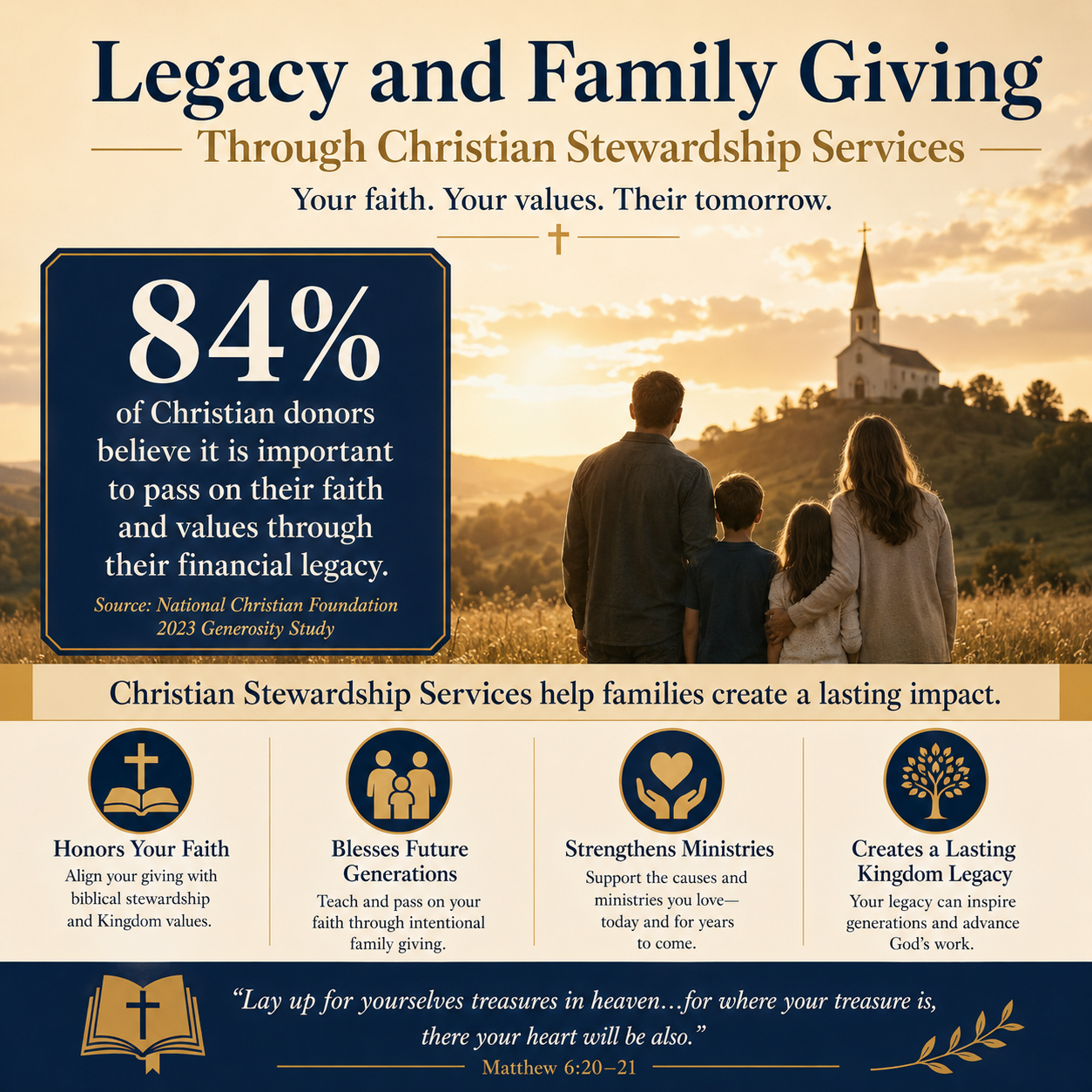
Scripture is not sentimental about wealth. It is frank about money’s power to disciple a household in one direction or another. Jesus warns that “where your treasure is, there your heart will be also” (Matthew 6:21). Paul cautions that “the love of money is a root of all kinds of evils” (1 Timothy 6:10). A faithful legacy is not the same as a large legacy, and Christian family giving is not measured by how much is transferred, but by whether it trains a family to seek first the Kingdom and to love the least of these without self-deception.
Legacy planning is spiritual formation before it is a financial plan
Christian donors often approach legacy conversations as a technical exercise: beneficiary designations, wills, trusts, donor-advised funds, and tax consequences. Those tools matter, but they do not set the spiritual direction of a household. The deeper question is what kind of people the family is being formed to become through the decisions being made.
Proverbs assumes that inheritance is significant, but it also warns that wealth can be misdirected and quickly dissipate. “A good man leaves an inheritance to his children’s children” (Proverbs 13:22) is not a blanket endorsement of unexamined accumulation. It is wisdom literature speaking into a moral economy: a household ordered toward God’s purposes can pass on stability, restraint, and blessing across generations. A household ordered toward self can pass on entitlement and fragmentation just as efficiently.
What Christian donors are often trying to protect
Across our verification work at Most Trusted, we observe that thoughtful donors are not merely concerned about fraud or waste. Many are trying to protect something more fragile: their family’s trust in the Church’s witness. When a ministry collapses in scandal, or when stories emerge of manipulative fundraising, the damage often extends beyond the donor’s portfolio. It can harden children and grandchildren toward Christian giving altogether.
This is one reason sophisticated families insist on verifiable accountability. Good intentions do not exempt a ministry from governance failures, financial opacity, or leadership cultures that cannot sustain power responsibly. Discernment is part of stewardship, not a rival to generosity.
When the heart work is ignored, plans become brittle
Families sometimes adopt giving structures that look impressive on paper but collapse at the first real disagreement. One generation prioritizes local church and evangelism; another is drawn to international relief or policy advocacy. Christians genuinely disagree about emphasis, strategy, and even how to interpret certain biblical obligations in complex modern systems. A plan that cannot name these disagreements honestly will not endure.
Christian stewardship services are most helpful when they treat these tensions as formative. The aim is not forced unanimity, but a shared posture: humility before Scripture, careful attention to the poor, and a refusal to let money become the household’s unspoken god.

Family giving succeeds when it is governed with clarity and shared authority
Multi-generational giving often fails for predictable reasons: unclear decision rights, mismatched expectations, and unspoken assumptions about control. A Christian family can avoid many of these failures by treating the family’s giving as a form of governance. That language may sound clinical, but it is biblical in spirit. Scripture consistently links stewardship with accountability and order, not with impulse.
Define a giving mission statement that can withstand succession
A well-crafted giving mission statement does not try to cover every cause. It establishes theological and practical boundaries that a future generation can honor without having to guess the founders’ intent. In plain terms, it answers questions such as:
- What do we believe God calls our household to prioritize: local church strength, global missions, mercy ministry, theological education, crisis relief, justice work, or a defined combination?
- What doctrines are non-negotiable for grantees, and what differences can be respected within orthodox Christianity?
- What outcomes matter enough to measure, and what ministry fruit must be received as harder to quantify?
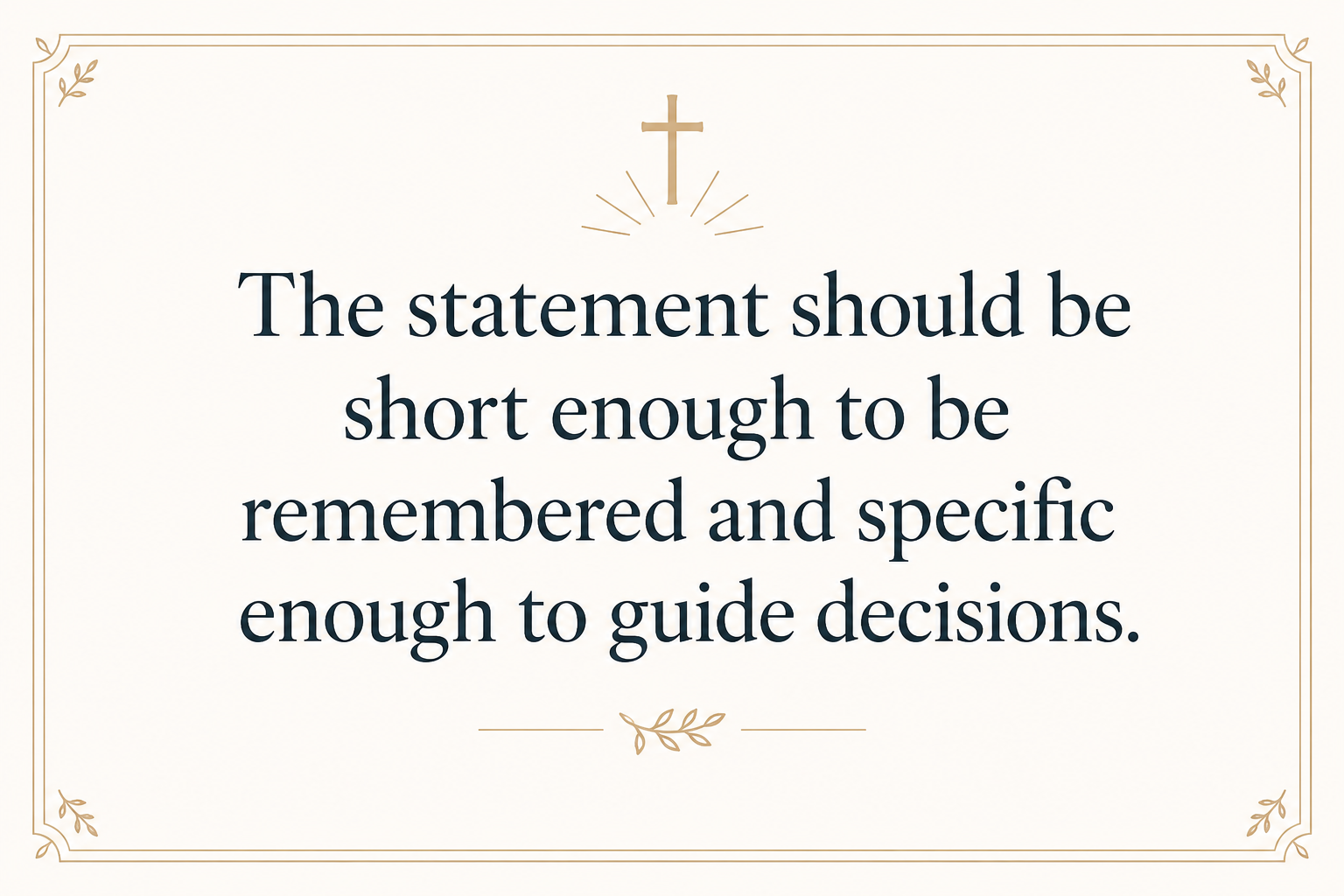
The statement should be short enough to be remembered and specific enough to guide decisions. Many families discover that the drafting process is the real work; the document simply records the consensus earned through prayerful, sometimes strenuous conversation.
Build a decision process that honors both parents and adult children
Christian donors sometimes assume that involving children means giving them equal vote immediately. That approach can be unfair to both generations: it can burden young adults with responsibility they have not requested, and it can sideline parents who carry spiritual and financial accountability. A more durable pattern is staged authority—an intentional progression from observation, to participation, to co-decision, to leadership.
What this means in practice is that a family might begin by inviting children to listen to ministry leaders, read annual reports, and accompany parents to site visits when appropriate. Then, as maturity grows, children can be entrusted with a defined portion of the annual giving budget, along with the responsibility to justify decisions in writing and in conversation. The aim is formation: learning to ask better questions, to weigh trade-offs, and to practice generosity that is not performative.
Establish guardrails for emotional giving and crisis-driven decisions
Many Christian families are compassionate, and compassion is not a weakness. Yet crisis appeals can produce reactive giving that crowds out long-term commitments. The field has had to reckon with how emergency narratives can be used, sometimes unintentionally, to bypass due diligence and exploit donor urgency.
A mature family policy often includes a small “rapid response” allocation for disasters or urgent needs, while keeping the majority of giving aligned to pre-decided priorities and trusted partners. This approach honors biblical responsiveness without letting the loudest need displace the most faithful plan.
Legacy conversations should begin earlier than most families think
Legacy giving is frequently postponed until a health crisis or a major liquidity event forces decisions. But Christian formation rarely flourishes under time pressure. Earlier conversations allow a family to integrate generosity into ordinary life: budgeting, work, hospitality, and the steady habit of supporting faithful ministry over decades.
Research consistently shows that wealth transfer is a relational and cultural moment, not merely a technical one. Fidelity’s long-running philanthropy research has reported that the most commonly cited reason donors give is “because they want to make a difference” Fidelity Charitable. Christian donors may express the same impulse in theological language: love of neighbor, obedience to Christ, gratitude for grace. But the underlying point stands: the motive structure matters, and it is best shaped over years rather than weeks.
Start with family practices before complex vehicles
Many families assume they need sophisticated structures to bring children into giving. Often the opposite is true. Regular practices tend to form convictions more deeply than one-time initiatives. Families might begin with rhythms such as:
- Annual conversations about what God is teaching the household about money and contentment
- Choosing a limited number of ministries to support consistently, rather than scattering small gifts widely
- Serving together in a local mercy ministry where the needs are proximate and personal
These practices create the moral vocabulary that will later make wills, trusts, and beneficiary designations meaningful rather than merely transactional.
Anticipate the hardest conversation: fairness versus faithfulness
One of the most contested questions in Christian legacy planning is how to weigh “equal inheritance” against other goals: generosity, gratitude, and the specific needs of adult children who may be thriving or struggling. Scripture does not offer a simplistic formula. It offers principles—justice, impartiality, provision, and warnings about favoritism—alongside examples of complex family dynamics where outcomes are not tidy.
Wise stewardship services do not rush families past this tension. They help donors clarify what they are trying to accomplish: prevent dependence, protect vulnerable heirs, honor the labor of a family business, provide for special needs, or free children from expectations that money can never satisfy. A faithful plan can still feel emotionally costly, and that cost should not be hidden from the family.
Verification is a form of neighbor-love in multi-generational giving
As legacy and family giving grows, the consequences of poor due diligence compound. A single unvetted ministry can absorb years of giving, erode family trust, and in some cases harm the very people a donor intended to serve. Christian donors are right to insist that ministries be both doctrinally faithful and operationally trustworthy.
Most Trusted exists to help donors give with confidence by evaluating ministries against The Most Trusted Standard, a 15-criteria framework spanning Faith Foundation, Financial Integrity, Governance and Leadership, and Transparency and Effectiveness. Verification is not cynicism. It is the recognition that ministries are run by fallen human beings, and that faithful organizations welcome accountability because they fear God more than they fear questions.
What careful donors should examine before committing a family legacy
Before a family ties its name and long-term resources to an organization, several categories deserve sustained attention:
- Doctrinal clarity and ecclesial alignment: Is the ministry’s statement of faith clear? Is it accountable to a real board and, where appropriate, to church authority rather than personal charisma?
- Financial integrity: Are audited statements available when appropriate? Are related-party transactions disclosed? Does the ministry communicate honestly about costs without manipulating donors?
- Governance and leadership culture: Does the board function as an actual governing body? Is there meaningful oversight of executive authority? Are conflicts of interest disclosed and managed?
- Transparency and effectiveness: Does the ministry report outcomes with candor, acknowledging limits and setbacks? Does it avoid overstating impact?
These questions protect more than money. They protect the spiritual credibility of a family’s giving story.
Resist the false comfort of simplistic metrics
Sophisticated donors already know that “low overhead” is not a reliable measure of effectiveness, and the charitable sector has publicly warned against treating overhead as a proxy for impact Charity Navigator. For Christian donors, the danger is not merely bad measurement. It is a moral confusion that rewards ministries for appearing inexpensive rather than for being truthful, well-governed, and actually fruitful over time.
At the same time, families should not swing to the opposite error and treat impact assessment as worldly or unspiritual. Scripture commends honest weights and measures. Faithful reporting is part of faithful ministry.
When donors want a more disciplined approach to ministry selection while remaining rooted in Christian convictions, we point them to Christian Stewardship Services as a natural place to consider the broader practices that make generosity sustainable: due diligence, governance questions, and a theology of money that can carry a family through transition.
A legacy worth leaving is a pattern of faithful stewardship
The strongest legacy and family giving plans are neither flashy nor anxious. They are coherent: a family knows why it gives, how it decides, and what it will not fund even when pressured by trends or emotion. Those commitments are sustained by practices that form character, not merely by documents that allocate assets.
Christian donors cannot guarantee what a future generation will believe. But we can refuse to leave them a spiritual vacuum filled only with money and ambiguity. A legacy shaped by Scripture, governed with clarity, and directed toward verified, faithful ministry is not merely a transfer of resources. It is an act of love ordered toward the Kingdom of God.



