
Why giving to senior care is Christian stewardship is not primarily a question of sentiment or demographic change. It is a question of whether we will honor God’s explicit concern for older people, and whether our giving will strengthen the kinds of communities where aging is met with dignity rather than neglect.
For many Christian donors, senior care can feel less straightforward than other causes. Needs are real, but outcomes can be harder to summarize. Costs are high. The line between “medical,” “social,” and “spiritual” support is often blurred. Christian stewardship does not avoid those complexities; it brings them under the lordship of Christ, with clear theological priorities and careful attention to how ministries actually operate.
Stewardship begins with the worth of the person, not the efficiency of the program
Scripture treats old age as a moral test for God’s people
In biblical ethics, the vulnerable are not an optional concern. The command to “honor your father and your mother” is not limited to childhood obedience; it assumes a lifetime of reverence expressed in practical care. Paul makes that practical: “If a widow has children or grandchildren, these should learn first of all to put their religion into practice by caring for their own family” (1 Timothy 5:4). And Proverbs frames the posture of Christian speech and action toward the elderly: “Do not cast me off in the time of old age; forsake me not when my strength is spent” (Psalm 71:9).
This matters because the modern West has developed an efficient way to hide aging. Older adults can become invisible to congregations as mobility declines, driving ends, and friends pass away. Senior care giving is a refusal of that invisibility. It insists that a life remains precious when productivity fades and dependence rises.
Christian stewardship resists a market logic that discards the dependent
Some donors hesitate to fund senior care because it can look like “maintenance.” Yet Scripture does not measure worth by novelty or scale. Jesus’ ministry consistently dignified people whose needs were chronic: the sick, the blind, the outcast, and those whose restoration required patient attention. A mature doctrine of stewardship recognizes that sustaining life faithfully is not a lesser form of ministry. It is one of the clearest forms of neighbor-love when the neighbor’s need is persistent.
What this means in practice is that giving to senior care is often less about “solving” and more about “keeping faith”: ensuring daily meals, safe housing, meaningful companionship, appropriate clinical support, and spiritual care that does not abandon a person at the end of life.

Older adults face measurable isolation and health risk that the church cannot ignore
Isolation is common and spiritually consequential
Loneliness is not only a psychological burden; it can become a spiritual crisis, especially when grief accumulates and the ordinary supports of community thin out. In a national survey, about one-third of adults ages 50–80 reported feeling lonely at least some of the time (University of Michigan). The same report has also associated loneliness with health and wellbeing concerns, which means isolation is not simply a pastoral concern but a practical one for ministries designing care.
Christian senior care ministries often occupy a space where church life and social support must be intentionally rebuilt: facilitating transportation to worship, pastoral visitation, small-group connection, grief support, and daily relational presence for those who can no longer “show up” without help.
Families are willing but frequently overextended
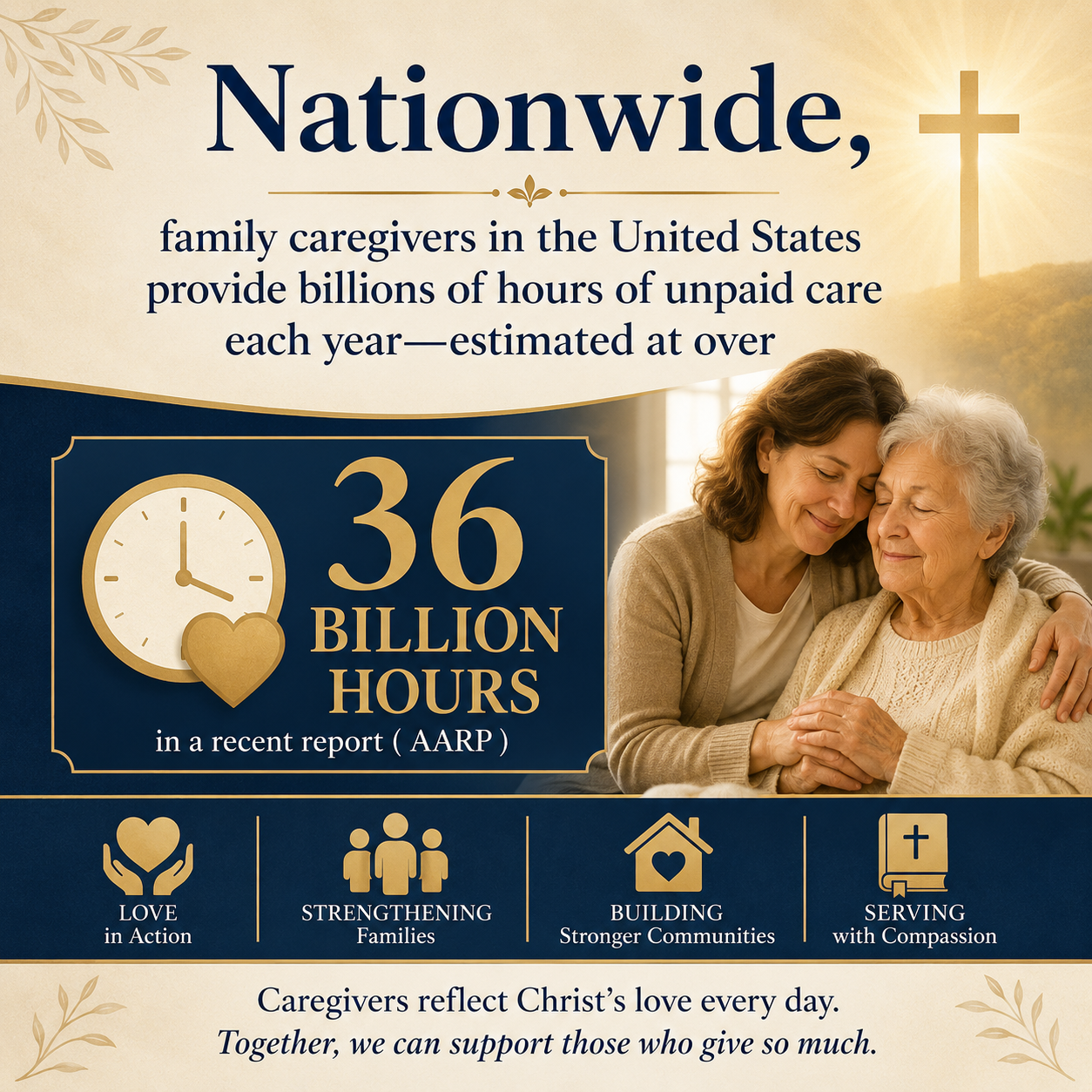
Many donors understand this tension personally: adult children want to care well, but work demands, geographic distance, and complex medical needs exceed what most households can carry alone. Nationwide, family caregivers in the United States provide billions of hours of unpaid care each year—estimated at over 36 billion hours in a recent report (AARP). That figure is not a fundraising talking point; it is an indicator of the load already being carried by ordinary families, including faithful Christians trying to honor parents and grandparents.
Giving to senior care can be a form of burden-sharing with those families. When a ministry provides respite care, trained dementia support, safe housing, and pastoral care, it can stabilize an entire family system—not by replacing family responsibility, but by making it sustainable.
Christian senior care is not identical to general elder services
Spiritual care and embodied mercy belong together
Christians genuinely disagree about the right boundaries between evangelism, discipleship, and social service. Yet historic Christian practice has insisted that works of mercy are not a distraction from the gospel; they are among the fruits of a gospel-shaped life. In Matthew 25, Jesus names visiting the sick among the concrete marks of those who recognized him. Senior care ministries live in that same moral terrain: showing up, returning, staying, and refusing to treat frailty as a reason to withdraw.
Christian organizations are also positioned to address spiritual realities that are often acute in late life: fear of dying, unresolved guilt, estranged relationships, and the need for hope that is more than reassurance. A ministry can offer clinical competence and still be spiritually thin. Christian senior care, at its best, insists on both.
Dementia care raises distinctive ethical and pastoral questions
As cognitive decline progresses, the needs of an older adult become more complex and the potential for mistreatment rises. Ministries may face decisions about memory care staffing ratios, informed consent, family dynamics, and end-of-life medical choices. A Christian approach should be theologically clear about personhood: the image of God is not diminished by dementia. That conviction should shape training, care plans, and institutional culture.
Donors looking into Christian Senior Care Ministries should expect to see this theological seriousness reflected in practice: not simply prayer in a brochure, but policies and staffing that protect dignity when a resident cannot advocate for themselves.
Good intentions are not enough in a high-cost, high-trust field
Senior care is vulnerable to both mission drift and financial pressure
The economics of senior care can push organizations toward difficult compromises: staffing shortages, rising insurance costs, regulatory compliance burdens, and the temptation to fill beds or grow revenue in ways that dilute spiritual distinctives. Even the best-intentioned Christian organizations can drift under that pressure if governance is weak or financial reporting is thin.
Donors also face a legitimate concern: senior care is a space where abuse and neglect can happen behind closed doors, especially when residents are isolated or cognitively impaired. Stewardship requires that we do not confuse a Christian name with Christian accountability.
The Most Trusted Standard is built for exactly these risks
At Most Trusted, we evaluate Christian nonprofits against The Most Trusted Standard, a 15-criteria framework across four areas: Faith Foundation, Financial Integrity, Governance and Leadership, and Transparency and Effectiveness. In senior care, those criteria are not abstract. They are practical safeguards.
When ministries meet The Most Trusted Standard, we generally see several patterns that matter for donor confidence:
- Clear theological commitments that shape care policies and resident experience, not only messaging
- Financial statements and fundraising practices that do not obscure restricted funds or resident-related costs
- Governance structures that reduce conflicts of interest and create meaningful oversight
- Documented safeguarding practices, reporting channels, and staff training appropriate to vulnerable adults
- Transparent outcomes that match the ministry’s actual scope, especially where “spiritual impact” is claimed
Some donors have absorbed the idea that overhead should always be minimized. The nonprofit field has had to reckon with the fact that this assumption can be harmful. The Overhead Myth statement, endorsed by leading evaluators, argued that judging nonprofits primarily by overhead ratios can incentivize underinvestment in the very systems that protect beneficiaries (Charity Navigator). In senior care, underinvestment in staffing, training, and oversight is not merely inefficient; it can become dangerous.
Practical discernment for donors who want stewardship, not sentiment
What faithful funding tends to prioritize
Senior care giving often becomes more effective when donors fund what is hardest to “sell” but most necessary: staff formation, consistent pastoral presence, and structures that prevent harm. That can feel less inspiring than a capital campaign or a new facility wing, yet it is frequently closer to the daily realities that determine whether an older adult is safe, known, and spiritually supported.
We recommend donors ask questions that map to real operational integrity rather than relying on marketing language:
- How does the organization define its Christian distinctives in the daily care environment?
- What safeguards exist for residents with dementia or limited ability to report concerns?
- What is the staffing approach, and how does leadership address turnover and training?
- Are financial statements available and understandable, with clear treatment of restricted gifts?
- How does the board exercise oversight, and how are conflicts of interest handled?
Stewardship also includes the humility to fund the unglamorous
Many Christian donors are drawn to visible outcomes. Senior care often yields quieter fruit: fewer falls, consistent medication management, a resident who is no longer alone at meals, a grieving spouse who is met with prayer and presence, a person approaching death who is not spiritually abandoned. These are not lesser outcomes. They are acts of mercy, rendered in ordinary time.
Within Faith and Stewardship in Christian Senior Care, we often see the strongest donors hold two convictions at once: that older adults deserve tangible care because they bear God’s image, and that ministries serving them must be evaluated with rigor because the trust placed in them is profound.
FAQs for Why giving to senior care is Christian stewardship
Should Christian donors prioritize senior care over other causes?
Scripture does not provide a single ranked list of causes, and Christians will weigh callings differently. Senior care deserves serious consideration because honoring older people and caring for the frail are recurrent biblical themes, and because isolation and vulnerability in late life are widespread. Many donors find a faithful balance by maintaining commitments to local church and global mission while designating a meaningful portion of giving to ministries that protect dignity in aging.
How can donors avoid funding ineffective or unsafe senior care ministries?
Donors should look for verifiable evidence of governance, financial transparency, and safeguarding practices rather than relying on branding or emotional narratives. Ask for audited financials or clear financial reporting, review board oversight and conflict-of-interest practices, and examine how the ministry trains staff and handles complaints. Most Trusted exists to help donors give with confidence by evaluating Christian nonprofits against The Most Trusted Standard, which is designed to surface these operational realities.
Stewardship that honors aging as a Christian responsibility
Giving to senior care is Christian stewardship when it treats older adults as neighbors to be honored, not problems to be managed, and when it funds ministries capable of sustaining that honor in daily practice. The call is not merely to feel compassion, but to support structures of care that are theologically faithful, financially honest, well-governed, and transparent about what they can truly provide. That is the kind of stewardship mature Christian donors have always sought, especially where the vulnerable stand to lose the most.



