
How Christian senior care aligns with biblical mercy becomes clearest when we stop treating elder care as a private family problem and start recognizing it as a moral test of the church’s love. Scripture consistently ties mercy to the treatment of the vulnerable, and aging often brings a layered vulnerability: declining health, reduced income, isolation, and the slow loss of agency.
For Christian donors, the question is not whether older adults “deserve” care. The question is what it means to fund care that is both compassionate and truthful: protecting dignity, guarding against harm, and sustaining faithfulness over years rather than weeks. Mercy is not sentiment; it is covenantal love expressed through durable, accountable action.
Mercy in Scripture is costly, concrete, and ordered toward dignity
Mercy is not optional in the biblical moral imagination
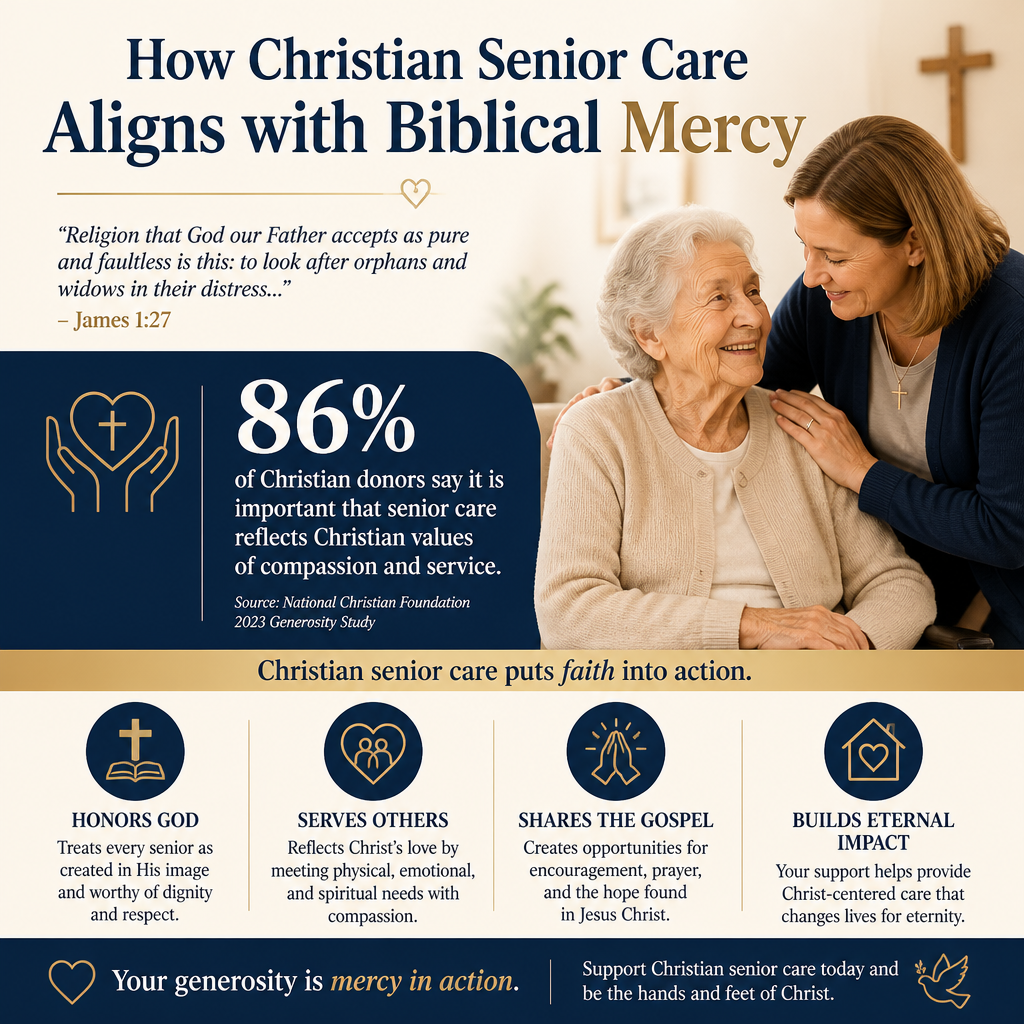
In the Old Testament, God identifies himself with the cause of the vulnerable: “Father of the fatherless and protector of widows is God in his holy habitation” (Psalm 68:5). In the New Testament, James refuses to spiritualize the obligation: “Religion that is pure and undefiled before God, the Father, is this: to visit orphans and widows in their affliction” (James 1:27). “Widows” in Scripture are not only a demographic category; they represent those whose economic and social protections have collapsed.
Older adulthood frequently mirrors that condition. Even when family remains present, the modern care economy can be punishing: complex insurance rules, understaffed facilities, costly medications, and the emotional toll of long decline. The biblical mandate does not erase complexity; it insists that the people of God do not outsource compassion to impersonal systems and call it discipleship.
The church has always treated embodied care as spiritual work
Christian tradition has long recognized that caring for bodies is not a distraction from spiritual ministry but a manifestation of it. Jesus’ own pattern joins teaching with healing and attentive presence. The parable of the Good Samaritan emphasizes proximity and persistence: he interrupts his schedule, bears cost, and arranges follow-through (Luke 10:25–37). Biblical mercy is measured by what happens after the first moment of concern.
In senior care, that “after” can be years of faithful attention. Compassion must be organized: care plans, staffing, medication management, pastoral presence, safety protocols, and financial models sturdy enough to avoid desperation decisions. Mercy that cannot endure becomes another form of abandonment.

Christian senior care addresses a real and growing vulnerability
Aging is not merely a medical problem
The Christian donor’s instinct is often to fund “ministry” and assume that health care belongs elsewhere. Yet elder care is one of the most direct contexts where spiritual, emotional, and physical needs converge. Loneliness, grief, fear, and cognitive decline raise questions of meaning that can be difficult to voice in ordinary church settings. A faithful Christian senior care ministry treats those questions as central, not ancillary.
The need is also expanding. The U.S. population is aging; the share of adults 65 and older has been rising for decades, reshaping the demands on families, congregations, and care systems U.S. Census Bureau. Donors should treat this as a long-term stewardship field, not a temporary trend.
Families carry a burden they were not designed to bear alone
Scripture honors family responsibility, and the New Testament addresses it directly: “If anyone does not provide for his relatives… he has denied the faith” (1 Timothy 5:8). Yet that same chapter also assumes an ecclesial role in sustaining widows (1 Timothy 5:3–16). The Bible refuses the modern either-or: “family only” or “institution only.” It calls for ordered care in which households are supported, not crushed.
In practice, many adult children are balancing employment, parenting, and the complexities of elder needs. Across our verification work, we observe that the strongest Christian senior care ministries do not compete with families; they equip them with respite care, counseling, practical planning help, and pastoral oversight—especially when hard decisions about memory care, safety, or end-of-life treatment arrive.
Mercy requires truth telling about risk, harm, and incentives
Vulnerability invites exploitation without safeguards
When seniors lose capacity, the risk of neglect, fraud, and spiritual manipulation rises. A ministry can speak often about compassion and still fail to protect the people it claims to serve. Mature mercy names uncomfortable realities: poor staff training, caregiver burnout, insufficient clinical oversight, weak financial controls, and opaque grievance processes. Christian donors should not mistake a warm mission statement for a safe program.
The field of adult protective services exists for a reason, and public agencies document the seriousness of elder abuse and neglect concerns Administration for Community Living. Christian ministries working in this space should demonstrate not only tenderness but competence: reporting protocols, background checks, clear supervision lines, and a culture where concerns can be raised without retaliation.
Financial pressure can distort care unless governance is strong
Senior care is expensive. That reality does not justify low standards; it explains why incentives matter. A facility under financial strain may reduce staffing, delay maintenance, or avoid admitting residents with higher needs. A ministry with weak governance may rely on charismatic leadership rather than documented accountability. And donors, if they reward only visible expansion, can unintentionally encourage growth that outpaces capacity.
Christians genuinely disagree about the right blend of professionalization and simplicity in mercy ministries. Some fear that clinical rigor diminishes spiritual warmth; others fear that spiritual language can mask incompetence. The best ministries show that this is a false trade-off: tenderness without skill is not love, and skill without tenderness is not Christian mercy.
What faithful donor support looks like in Christian senior care
Fund whole-person care, not only the most visible deliverables
Older adults often need more than housing or medical oversight. They need belonging, spiritual care, and patient companionship. These are difficult to quantify, which makes them tempting to underfund. Yet Scripture measures mercy by neighbor-love, not by what photographs well.
For donors assessing Christian senior care ministries, the most telling questions are often mundane:
- Are staffing levels and training practices clearly documented and realistic?
- Is pastoral care integrated into care plans rather than treated as an add-on?
- Are family members treated as partners, with clear communication rhythms?
- Is there a transparent process for complaints, incident reporting, and corrective action?
- Does the ministry show financial clarity about how restricted and unrestricted gifts function?
Support ministries that can demonstrate accountable compassion
Most donors cannot personally audit clinical practices, governance records, and financial systems. That is one reason independent verification matters. At Most Trusted, we evaluate ministries against The Most Trusted Standard, a 15-criteria framework spanning faith commitments, financial integrity, leadership and governance, and transparency and effectiveness. In senior care, these criteria are not bureaucratic hurdles; they are guardrails that help mercy remain mercy.
The ministries that meet The Most Trusted Standard tend to show a consistent pattern: a clear theological rationale for elder dignity; policies that protect vulnerable adults; financial reporting that withstands scrutiny; and leadership structures that reduce the likelihood of concealed harm. Donors should see those features as spiritual assets, not merely administrative qualities.
Mercy is a long obedience for the church and its donors
End-of-life discipleship is part of Christian witness
Christian senior care is not only about prolonging life; it is about honoring life to the end, including the spiritual tasks of aging: reconciliation, remembrance, worship under weakness, and the hope of resurrection. A faithful ministry does not treat residents as “bed spaces” or “units of care.” It treats them as image-bearers whose lives still matter to the community of faith.
This theological vision affects practical decisions: whether a facility makes room for communion and prayer; whether chaplains are trained for grief and dementia; whether staff are formed to speak truthfully and gently about death. The church’s historic confession that death is an enemy—and that Christ has conquered it—should produce both honesty and tenderness.
Donors can strengthen the moral ecosystem around aging
Donor support can underwrite what fee-for-service models struggle to sustain: charity care for low-income seniors, respite care for exhausted family caregivers, specialized dementia programming, and pastoral staff who can remain present without needing to “bill” their hours. It can also fund systems that prevent harm: staff formation, compliance work, and transparent reporting.
For donors seeking context on this wider field, we track patterns and programs across Christian Senior Care Ministries, including models that blend congregational support, residential care, and community-based services. For those thinking more broadly about how faith shapes funding decisions, the category of Faith and Stewardship in Christian Senior Care is where many of the most consequential trade-offs become visible.
FAQs for How Christian senior care aligns with biblical mercy
Is funding senior care a biblical priority, or should donors focus on evangelism?
Scripture does not permit a clean separation between proclaiming the gospel and practicing mercy. James treats care for the vulnerable as “pure and undefiled” religion, and Jesus’ teaching repeatedly joins love of God with love of neighbor. Christian senior care becomes distinctly Christian when it serves whole persons—body and soul—with truthful compassion, clear accountability, and a hope shaped by the resurrection.
What should donors ask before supporting a Christian senior care ministry?
Donors should ask how the ministry protects vulnerable adults, how it reports finances, and how it responds when something goes wrong. Practical indicators include documented safeguarding policies, credible governance, transparent financial statements, and clear descriptions of pastoral care and family communication. Independent verification, including assessment against The Most Trusted Standard, can help donors distinguish between sincere intentions and demonstrated trustworthiness.
Mercy that endures is mercy that is accountable
Christian senior care aligns with biblical mercy when it treats elder dignity as a theological commitment and builds the practical structures needed to sustain that commitment under pressure. Donors honor God not only by giving generously, but by giving wisely—supporting ministries whose compassion is patient, whose governance is strong, and whose truth telling protects the people entrusted to their care.



