
How to volunteer with local Christian senior care ministries is not primarily a scheduling question. It is a discipleship question about presence, honor, and the kind of mercy Scripture commends when it commands us to “show honor” to those who are older (Leviticus 19:32) and to remember that “pure and undefiled religion” includes faithful care for the vulnerable (James 1:27).
Many Christian donors already give generously to senior care efforts. Volunteering adds something money cannot purchase: consistency, attention, and the dignifying recognition that an elderly neighbor is not a project. The harder truth is that volunteering can also do harm when it is episodic, poorly supervised, or disconnected from the realities of aging, dementia, and family strain. Serious love is patient love, and it is willing to be formed by the constraints that protect seniors.
Begin with the ministry model and the senior population it serves
Local senior care is not one thing
Christian senior care ministries operate across several distinct settings, each with different needs and safeguards. Some serve independent seniors through meals, transportation, home repair, and friendly visiting. Others partner with assisted living, memory care, or skilled nursing facilities. Some are church-based visitation teams; others are licensed providers with chaplaincy programs and volunteer departments.
What this means in practice is that “volunteer opportunities” can range from low-contact tasks (assembling care packages, writing cards) to intimate, high-trust roles (companionship for a resident with dementia, respite for a caregiver, hospice presence). Wise volunteers ask early what kind of population is being served and what training is required.
Clarify who holds responsibility for care decisions
A common donor instinct is to move quickly from compassion to action. In senior care, that can create pressure on families and staff who are already managing medical, legal, and ethical responsibilities. Volunteers should understand the chain of responsibility: who is the resident’s decision-maker, what the facility’s policies require, and what the ministry’s scope does and does not include.
Volunteer service is most fruitful when it strengthens legitimate authority rather than bypassing it. The goal is not to become a parallel care system; it is to become a faithful presence within an accountable one.

Choose roles that prioritize dignity, safety, and long-term presence
Honor often looks ordinary
Much of the best volunteer service in elder care is quiet. It looks like sitting with someone who repeats the same story, reading Scripture aloud to a resident whose eyesight is failing, or showing up on the same afternoon each week so a caregiver can rest. These acts rarely produce dramatic reports, but they align with the Christian conviction that people bear God’s image even when their independence is gone (Genesis 1:27).
When ministries speak candidly, they will acknowledge that seniors are frequently lonely even in full buildings. The U.S. Surgeon General has warned that social isolation and loneliness are associated with increased risk of premature mortality, alongside other adverse health outcomes U.S. Department of Health and Human Services. Volunteers cannot solve aging, but faithful relationships can mitigate its most corrosive relational losses.
Match your capacity to the ministry’s actual needs
Some of the most damaging patterns in volunteerism are not malicious; they are unrealistic. A ministry needs to know whether a volunteer will come twice a week for six months, or once a month as availability allows. Neither is inherently wrong, but the ministry’s assignments should reflect the level of reliability.
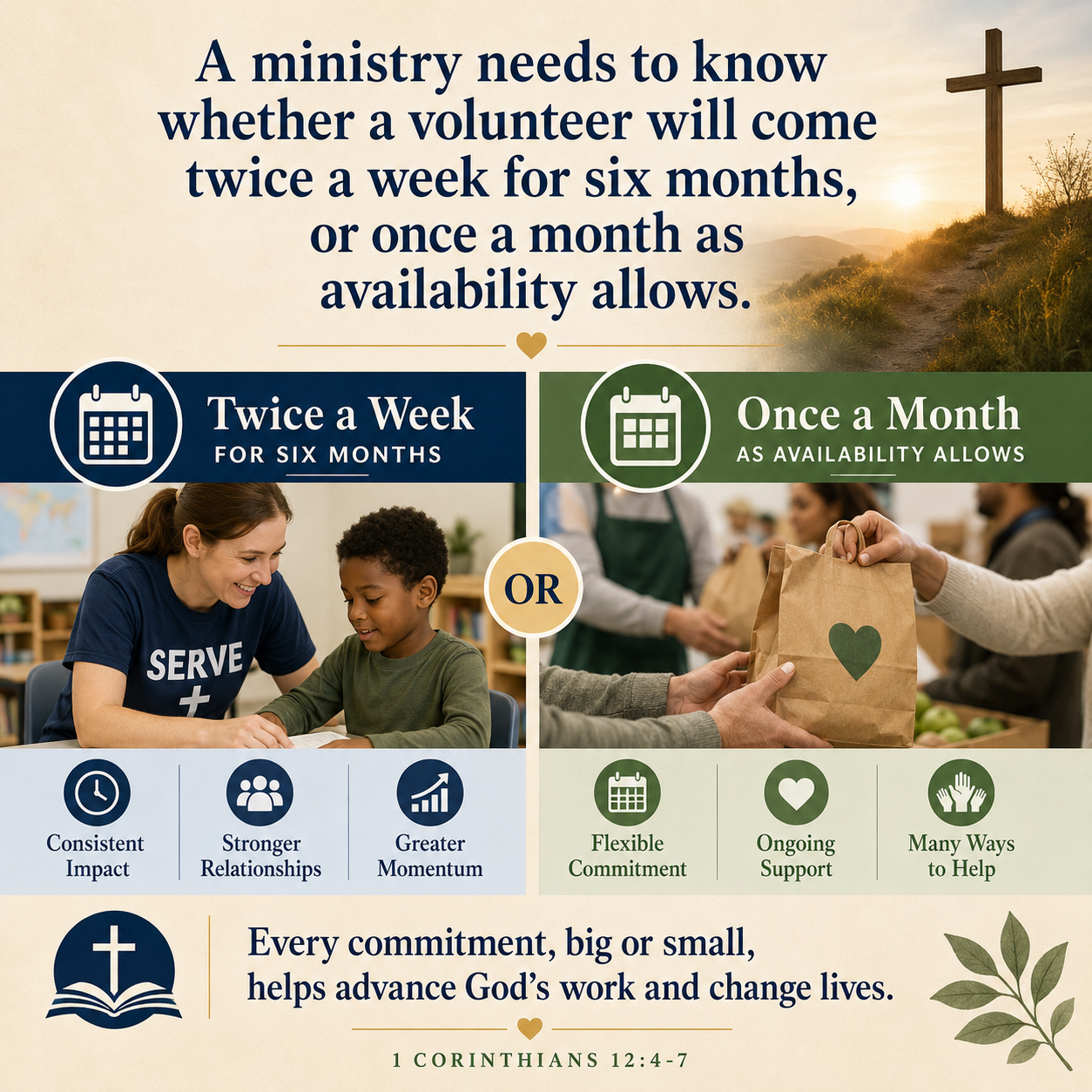
We recommend choosing a role with clear expectations, appropriate boundaries, and a pathway to consistency. The senior and the caregiver should not have to wonder whether affection will be followed by disappearance.
- Companionship and conversation under staff oversight and facility policies
- Caregiver respite through structured, approved programs
- Transportation and errands with documented procedures and insurance clarity
- Meal delivery and friendly visiting with safety check protocols
- Administrative support that frees staff for direct care
Ask the hard questions ministries should welcome
Volunteer screening is a form of love
Some Christians worry that background checks and training requirements signal distrust. In senior care, they are an expression of moral seriousness. Older adults are frequently dependent, sometimes cognitively impaired, and often hesitant to report mistreatment. Ministries that serve them should be able to explain their screening processes, supervision, incident reporting, and policies for financial interactions.
Many ministries that meet The Most Trusted Standard can articulate these safeguards without defensiveness, because their leadership understands that trust is earned through verifiable practices rather than assumed through shared faith language. Donors should not reward a lack of structure as if it were spiritual authenticity.
Care for seniors touches contested questions
Christians genuinely disagree about certain end-of-life decisions, the moral status of specific medical interventions, and how to discuss hospice or palliative care in a way that honors both hope and realism. Volunteers should not presume that every family shares the same theological instincts or medical judgments. The ministry should offer guidance on how volunteers handle conversations about suffering, fear, death, and pastoral counsel.
It is also worth asking how the ministry relates to local churches. When a senior can no longer drive, the church’s ordinary means of grace can become inaccessible. A well-ordered ministry often sees itself as a bridge back to congregational life, not a replacement for it.
Volunteer as a donor with integrity and appropriate influence
Giving does not entitle us to access
Donors sometimes assume that financial support creates relational access to residents or influence over programming. In senior care, that posture can pressure staff and compromise privacy. Residents are not beneficiaries of a donor’s generosity; they are neighbors whom Christ commands us to honor. Volunteer roles should be assigned based on fit, training, and resident well-being, not on gift size.
When donors volunteer under the same standards as other volunteers, it strengthens the culture. It signals that accountability is not for “other people,” and it reduces the temptation to treat vulnerable adults as a fundraising narrative.
Evaluate ministries the way you would want your own family evaluated
Senior care ministries make claims that can be tested: the clarity of their theological commitments, the integrity of their financial practices, the seriousness of their governance, and the transparency of their outcomes and policies. Most Trusted exists because donors deserve to give and serve with confidence, and because faithful ministries should not be disadvantaged by a sector where trust is often based on charisma rather than evidence.
Across our verification work, we observe that strong ministries tend to be consistently clear on who they serve, what outcomes they pursue, and how they protect the people in their care. They also tend to welcome scrutiny, because their leaders understand that Christian witness includes institutional integrity, not only personal sincerity.
For donors wanting to connect their volunteering to informed giving, our broader coverage of Christian Senior Care Ministries names the categories of work, common risk areas, and the kinds of evidence responsible ministries can provide.
Build a sustainable volunteer practice that does not collapse under real life
Consistency requires a rule of life, not a burst of enthusiasm
Many volunteering commitments fail for predictable reasons: travel schedules, family responsibilities, church demands, and the emotional weight of suffering. Senior care is a long obedience, and a realistic plan is part of loving well. A sustainable commitment might be two hours every other week for a year, rather than a season of intense involvement followed by silence.
Volunteers should also prepare for grief. Serving seniors means relationships will end, sometimes abruptly. Ministries should provide pastoral care and debriefing for volunteers, especially those who serve in hospice-adjacent contexts.
Coordinate with your church and family system
Local senior care work is often most resilient when it is shared. A spouse, small group, or church team can rotate visits, cover absences, and keep promises. It also reduces the risk of isolation for the volunteer, which can lead to blurred boundaries or burnout.
Donors who want to align volunteering with broader stewardship often find it helpful to engage through Donor Engagement with Christian Senior Care Ministries, where we address governance-aware questions about serving, giving, and advocacy without confusing them.
FAQs for How to volunteer with local Christian senior care ministries
What is the best first step if we want to volunteer but do not know any ministries nearby?
Begin with your own church’s pastoral staff and deacons, who often know homebound members and local partner ministries. Then contact nearby Christian senior living communities, hospice organizations with chaplaincy partnerships, and community-based senior support nonprofits to ask about volunteer onboarding, screening, and supervision. A credible ministry will be able to describe its policies clearly and place you in a role that matches both your gifts and the seniors’ needs.
How do we know whether a ministry is safe and well-run before we volunteer?
Ask for written volunteer policies, including background checks, training requirements, supervision, and incident reporting. Ask how the ministry handles privacy, financial interactions with residents, and mandatory reporting obligations. Also review public-facing indicators: a current Form 990 if applicable, an independent board, and transparency about leadership and program outcomes. Ministries worthy of trust generally welcome these questions because they share the conviction that care for the vulnerable requires accountable structures.
A faithful volunteer posture in senior care
Christian service to seniors is one of the clearest places where theology becomes tangible. The elderly are not a peripheral concern but a test of whether we will honor those whose cultural “usefulness” has diminished. Volunteering well means submitting compassion to structure, choosing consistency over intensity, and serving within ministries that can demonstrate integrity. For donors, that posture joins mercy to stewardship, and love to truth.



