

How to start a fundraiser for a Christian senior care ministry is not primarily a question of tactics. It is a question of moral clarity: what, exactly, are we asking donors to do, and why does this particular work belong to the church’s faithful obedience rather than to sentiment or nostalgia.
Scripture gives senior care a weighty place in the economy of Christian love. Honoring father and mother is commanded, not suggested. The New Testament’s insistence on practical care for vulnerable people is equally direct: “If anyone does not provide for his relatives, and especially for members of his household, he has denied the faith” (1 Timothy 5:8). Many Christian senior care ministries exist precisely because families, churches, and public systems often cannot carry the full burden alone. A fundraiser, at its best, is a disciplined invitation into shared responsibility.
Begin with a theologically honest case for care
Fundraising language for senior care can drift into two errors. One is mere nostalgia: elevating an earlier generation in a way that bypasses the actual complexities of aging. The other is crisis-only storytelling: reducing older adults to emergencies and deficits. Christian donors tend to sense when a ministry is asking them to buy emotion rather than to practice faithful stewardship.
Anchor the mission in honor and presence
Senior care is not only about safety. It is about dignity, spiritual companionship, and presence in weakness. That is why a fundraiser should explicitly name outcomes that are distinctively Christian: pastoral care, prayer, sacramental life where applicable, and the steady presence of the body of Christ when independence declines.
At the same time, a theologically honest case acknowledges that aging can include dementia, depression, family strain, and financial stress. Mature donors do not require a sanitized narrative. They require assurance that a ministry sees the full person and has the humility to work within real limits.
State the moral claim without coercion
Christian fundraising often falters when it confuses moral urgency with manipulation. Scripture does not need to be weaponized to motivate giving. It is enough to make a clear claim: caring for elders is part of the church’s public witness, and it is a worthy object of sacrificial generosity. Donors respond to ministries that respect conscience, avoid shame, and still speak with conviction.

Choose a funding purpose that donors can evaluate
A fundraiser fails when its purpose is too vague to judge. “Support our seniors” can mean anything and therefore proves very little. Donors—especially those with experience in business, governance, or nonprofit leadership—need a defined use of funds and a plausible plan to execute it.
Fund one clear program or one clear capacity gap
Effective senior care ministries often have multiple moving parts: care staff, chaplaincy, facilities, transportation, respite for caregivers, and benevolence support. The fundraiser should not try to finance everything at once. We recommend selecting a purpose with (1) a defined scope, (2) a credible budget, and (3) a measurable sign of completion.
- Underwrite a set number of subsidized care days for low-income residents
- Fund a chaplaincy initiative with defined pastoral coverage and reporting
- Purchase safety equipment tied to specific risks and standards
- Establish a caregiver respite fund administered with clear eligibility criteria
- Build a staff training program focused on dementia care and spiritual support
This kind of specificity does not reduce ministry to metrics. It honors the donor’s responsibility to give wisely and the ministry’s responsibility to be accountable.
Build the budget with hard costs and honest overhead
Christian donors can be suspicious of “administration,” sometimes for understandable reasons. Yet the nonprofit field has repeatedly emphasized that overhead is not inherently waste. The widely cited “Overhead Myth” letter, signed by Charity Navigator, GuideStar, and the BBB Wise Giving Alliance, warned that an obsessive focus on overhead can distort good governance and harm effectiveness Charity Navigator.

For senior care, overhead is often where safety and integrity live: background checks, compliance, training, financial controls, and supervision. A fundraiser should name these elements plainly and price them accurately. Underfunding them may raise more money in the short term, but it weakens the ministry’s ability to protect elders and steward donor trust.
Establish trust signals before you ask for money
Donors give most freely when they can see the difference between “urgent” and “credible.” Senior care is a high-trust environment because it involves vulnerable adults, family decision-making, and significant costs. A fundraiser should therefore be preceded by demonstrable transparency, not followed by it.
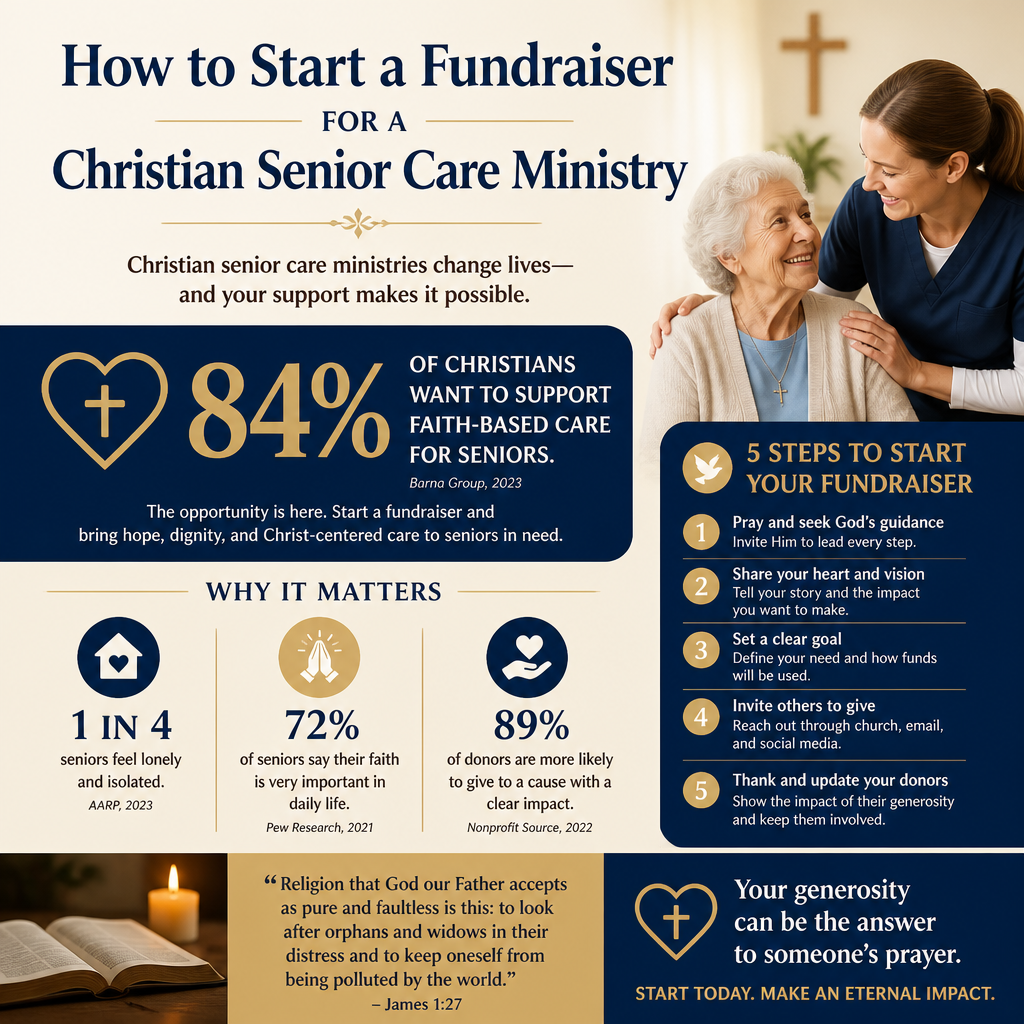
Show governance and safeguards appropriate to vulnerable adults
Many donors are now aware—sometimes through painful public failures—that good intentions are not enough. A Christian senior care ministry should be prepared to describe, in accessible language, how it protects residents and clients: screening, mandatory reporting, incident response, privacy practices, and complaint pathways. Where licensure or accreditation applies, it should be stated accurately and without exaggeration.
Across our verification work at Most Trusted, we observe that ministries that meet The Most Trusted Standard tend to treat governance as a spiritual discipline. They can identify who is accountable for decisions, how conflicts are handled, and what financial controls prevent misuse. That is not public relations. It is neighbor-love expressed through institutional integrity.
Invite donors into verification, not mere reassurance
Trust is strengthened when ministries welcome scrutiny. If the ministry has recent audited financials, a Form 990 where applicable, board lists, and clear program reporting, those should be easy to find. If they are not available, a fundraiser should not attempt to substitute testimonies for documentation.
For donors who are evaluating multiple options in this space, it can help to consult a verification framework designed for Christian nonprofits. Most Trusted evaluates ministries against The Most Trusted Standard, a 15-criteria framework across Faith Foundation, Financial Integrity, Governance and Leadership, and Transparency and Effectiveness. The point is not to create suspicion; it is to support confidence so that generosity can be wholehearted rather than hesitant.
Build the campaign around relationships, not spectacle
Christian fundraising is often tempted by spectacle: the dramatic video, the countdown, the manufactured urgency. Senior care ministries should be particularly cautious. Many older adults value privacy. Many families carry complicated histories. And many donors have their own experiences of caregiving that are tender or unresolved.
Center the voice and dignity of seniors and families
When stories are used, they should be consented to, dignified, and representative rather than exceptional. If a story involves cognitive impairment, consent becomes more complex and should be handled with clinical and pastoral care. The goal is not to maximize clicks; it is to represent a person made in God’s image.
What this means in practice is that ministries often do better with a small number of carefully stewarded narratives and a larger body of non-identifying evidence: program descriptions, staff qualifications, and clear reporting on how funds were used.
Choose channels that fit mature donors and church life
Senior care donors are often deeply connected to local congregations, and many prefer to give through trusted, relational pathways. A fundraiser can be built around pastoral endorsement, informational gatherings, and targeted communications that respect the donor’s attention.
For donors who want to understand the broader field, it is worth engaging the wider context of Christian Senior Care Ministries—not as a marketing category, but as an ecosystem with varied models, regulatory realities, and theological emphases. Fundraising improves when donors know what kind of ministry they are actually supporting.
Report back with the same seriousness as the ask
A Christian fundraiser is not complete when the goal is met. It is complete when donors can see that the ministry did what it said it would do, learned what it needed to learn, and remained faithful in both success and constraint.
Offer timely, verifiable reporting
We recommend reporting that includes both narrative and numbers, without pretending that spiritual fruit is fully quantifiable. For example: number of residents receiving subsidized care, number of pastoral visits or spiritual care touchpoints, staff training completed, and safety improvements made. Where outcomes are harder to measure—loneliness, spiritual resilience, family reconciliation—reporting should be careful, modest, and grounded in concrete observations rather than inflated claims.
Many donors are also alert to how nonprofits talk about efficiency. The nonprofit sector has long debated the limits of single-number performance measures, and sophisticated donors know that low overhead can hide underinvestment in accountability. Reporting should therefore explain how administrative spending protected quality and safety, not merely how small it was.
Link reporting to ongoing donor formation
Senior care giving often becomes personal. Donors may be facing their own parents’ decline, or their own aging, or the memory of loss. A responsible ministry does not exploit that tenderness, but it can serve donors by offering thoughtful resources: theology of aging, guidance for Christian caregiving, and clear explanations of how the ministry partners with families and churches.
For readers who want to develop a longer-term approach to giving in this area, Donor Engagement with Christian Senior Care Ministries is a constructive place to consider how ongoing communication, verification, and transparent reporting create durable trust.
FAQs for How to start a fundraiser for a Christian senior care ministry
Should a Christian senior care fundraiser focus on emergency needs or ongoing operations?
Emergency needs can be legitimate, especially when safety or continuity of care is at stake. Yet many senior care ministries are healthiest when fundraising also strengthens ongoing operations: staffing stability, training, pastoral care, and benevolence policies. Donors typically respond well to a defined purpose that can be evaluated, paired with transparent reporting that shows how the ministry sustains faithful care over time.
What should donors ask before giving to a Christian senior care ministry fundraiser?
Wise questions include: What is the specific use of funds and the full budget? What safeguards protect vulnerable adults? Who governs the ministry, and how are conflicts of interest handled? Are financial statements, key policies, and program reporting available? Donors do not ask these questions to be suspicious, but to practice stewardship that honors both the giver and the older adults being served.
A fundraiser worthy of elders and of the gospel
Christian senior care fundraising should reflect the character of the ministry itself: patient, truthful, and dignifying. When the case is theologically grounded, the purpose is specific, and accountability is treated as a form of love, donors can give with a clear conscience and a steady heart. That is not merely effective fundraising. It is Christian stewardship ordered toward faithfulness to Christ and honor toward those who have borne long years.



